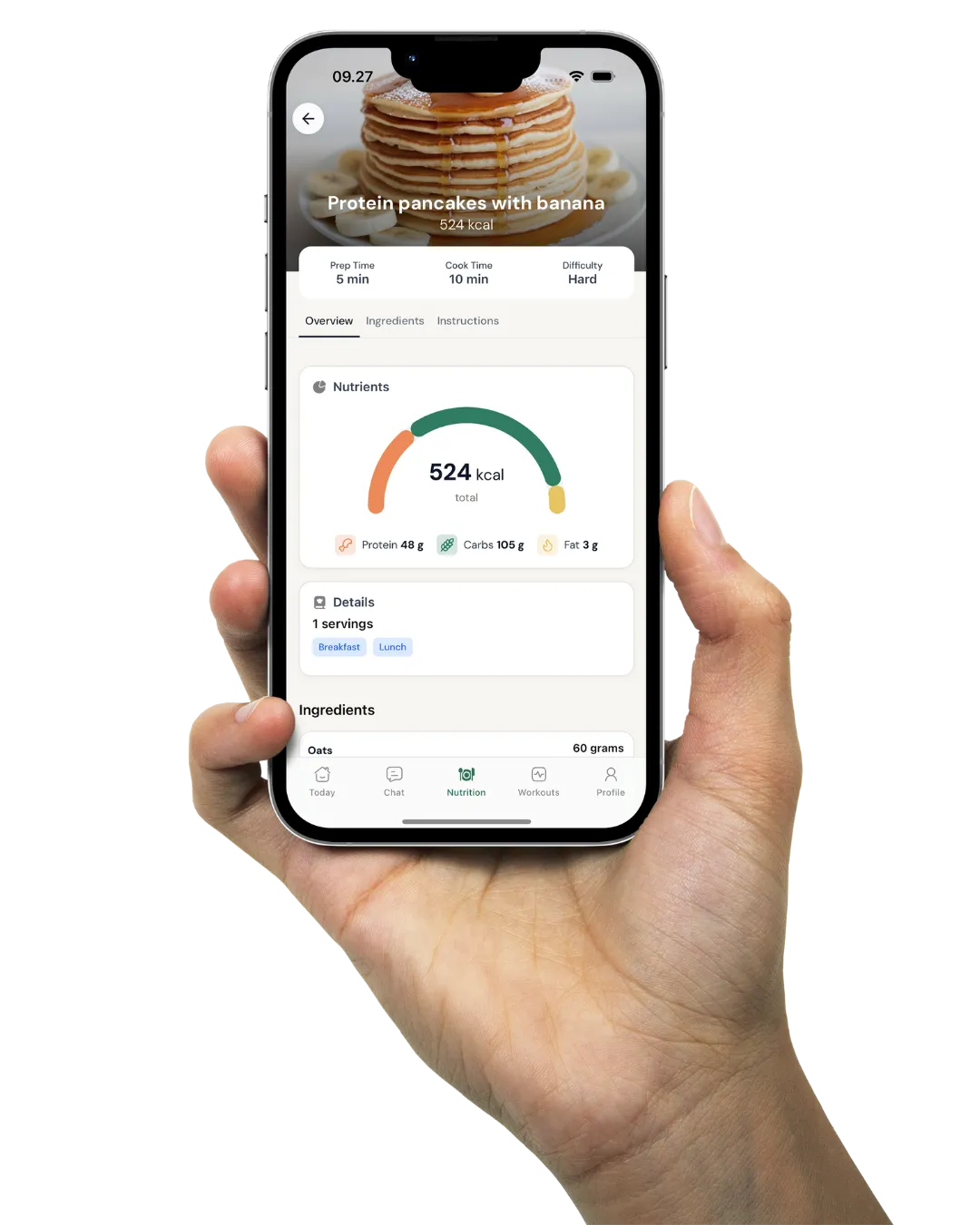
Online fitness coaching statistics 2026. Four original Coachway studies, plus the sourced market numbers.
This page reports four studies Coachway ran itself. The Coachway Nordic Coaching Benchmark (August 2026) is an aggregated, anonymized snapshot of 201 Nordic coach accounts and 5,666 clients on the Coachway platform: how many clients a coach account has, what a client pays per month, how long clients stay and what share are still active at 12 months. The Coachway AI Shortlist Study (November 2026) counts which coaching software three AI engines name. The Coachway Coaching Software Price Index (November 2026) reads the list prices of 12 coaching software platforms. The Coachway AI Meal Plan Accuracy Test (21 November 2026) checks 30 one-day meal plans from three AI engines against their own arithmetic, their targets and USDA reference values; the test and its limits are in how to use AI for meal planning as a coach. Every study figure carries its definition and sample size. The market-size, headcount and earnings figures are third-party, with the source name, the year and a link. If you came for online coaching statistics or online personal training statistics, start with the key statistics list and the personal trainer section. For the business behind these numbers, read our online fitness coaching guide.
By Markus Evers · Published August 2026 · Updated 21 November 2026
the short version
The Coachway Nordic Coaching Benchmark found that the median Nordic coach account with active clients has 5 active clients (average 17.2) and that the median price is EUR 181 per client per month, based on 201 Nordic coach accounts and 1,563 pricing records from 79 coaches in August 2026. Its retention curve shows 45% of clients still active at month 12 (clients with a recorded start date; the number old enough to reach month 12 is not published).
The Coachway AI Shortlist Study found that 60 of 63 AI answers (95%) to coaching-software questions on 17 November 2026 named at least one of Everfit, Trainerize or TrueCoach. The Coachway Coaching Software Price Index found a median list price of USD 72 a month for coaching 25 clients, based on 12 platforms read on 21 November 2026.
These are counts from Coachway's own database and from our own runs, not survey estimates. Figures marked as derived are arithmetic on those counts. Each study figure carries its definition and sample size, and the methodology is spelled out below.
Online fitness coaching statistics at a glance.
29 figures: 19 from the four Coachway studies, then 10 from named third-party sources. Each is written to stand on its own, with the study or source name, the year and the sample size inside the sentence. Quote any of them with attribution.
- 01
The Coachway Nordic Coaching Benchmark found that the median Nordic coach account with active clients has 5 active clients (average 17.2), based on 201 Nordic coach accounts in August 2026.
- 02
The Coachway Nordic Coaching Benchmark found that 81% of the 201 Nordic coach accounts have fewer than 20 active clients and 4% have 100 or more, August 2026.
- 03
The Coachway Nordic Coaching Benchmark found a median price of EUR 181 per client per month (interquartile range EUR 134 to EUR 255), based on 1,563 pricing records from 79 Nordic coaches in August 2026.
- 04
The Coachway Nordic Coaching Benchmark found that 37% of 79 Nordic coaches with pricing configured have charged at least one client a one-time startup fee, August 2026.
- 05
Derived from the Coachway Nordic Coaching Benchmark medians (201 Nordic coach accounts, 1,563 pricing records from 79 coaches, August 2026), a Nordic coach account with the median 5 clients at the median price has gross client revenue of about EUR 905 per month, and 20 clients at the median price is EUR 3,620; this is arithmetic on two medians from different samples, not revenue measured for any coach.
- 06
The Coachway Nordic Coaching Benchmark found that observed client tenure averages 4.3 months (upper quartile 5.6), based on 5,666 Nordic clients in August 2026, with still-active clients cut off at the snapshot date.
- 07
The Coachway Nordic Coaching Benchmark found that 94% of clients are still active at month 1, 82% at month 3, 65% at month 6 and 45% at month 12, based on Nordic clients with a recorded start date in August 2026 (5,666 in total; the number old enough to reach month 12 is not published), so treat the curve as an upper bound.
- 08
Derived from the retention curve of the Coachway Nordic Coaching Benchmark (Nordic clients with a recorded start date, August 2026, curve treated as an upper bound), average monthly client attrition is about 6.4% in year one, steepest in months 3 to 6.
- 09
The Coachway AI Shortlist Study found that 60 of 63 answers (95%) to coaching-software questions named at least one of Everfit, Trainerize or TrueCoach, based on 21 questions put once to each of three AI engines on 17 November 2026.
- 10
In the Coachway AI Shortlist Study, Everfit was named in 64 of 72 answers (89%), Trainerize in 58 of 66 (88%) and TrueCoach in 48 of 69 (70%) on 17 November 2026.
- 11
In the Coachway AI Shortlist Study, the same engine matched its first-named product a week apart in 37 of 63 cases (59%), between 10 and 17 November 2026.
- 12
In the Coachway AI Shortlist Study, at least 290 of the 435 sources (67%) listed in 72 answers on 17 November 2026 were vendor-owned pages.
- 13
In the Coachway AI Meal Plan Accuracy Test (21 November 2026), the stated day total was within 5% of both the calorie target and the protein target in 30 of 30 one-day plans, as the prompt asked; the largest gap was 2.6% for calories and 3.7% for protein.
- 14
In the Coachway AI Meal Plan Accuracy Test (21 November 2026), none of the 30 plans failed to add up: the stated day total equalled the sum of the plan's own food rows in 30 of 30 plans, and all 111 meal total rows equalled the rows above them. This compares each plan with itself: it shows the model adds the numbers it displays, not that those numbers are right.
- 15
In the Coachway AI Meal Plan Accuracy Test (21 November 2026), the stated calories for a food row differed from the matching USDA SR Legacy entry by 5% or less in 133 of 137 checked rows; the 4 rows that differed by more were all raw chicken breast, stated at 106 to 110 kcal per 100 g against 120 kcal per 100 g in the USDA entry.
- 16
The Coachway Coaching Software Price Index found a median list price of USD 72 a month for coaching 25 clients, based on 12 coaching software platforms read on 21 November 2026 (range USD 39 to USD 200).
- 17
Derived from the Coachway Coaching Software Price Index (12 platforms, 21 November 2026), the median list price per client falls from about USD 5.70 at 5 clients to USD 1.50 at 100 clients; flat plans and the change in platform count contribute to the fall.
- 18
The Coachway Coaching Software Price Index found that 14 of the 16 coaching software platforms Coachway checked show a list price on their English pricing page, 21 November 2026.
- 19
The Coachway Coaching Software Price Index found that at least 13 of the 16 platforms Coachway checked state a free plan or a free trial on their own pages, as read on 21 November 2026.
- 20
The 2025 ICF Global Coaching Study, run by the International Coaching Federation and PwC, counted a record 122,974 coach practitioners worldwide, up 15% since 2023, and estimated global coaching revenue at USD 5.34 billion, across all coaching disciplines, not only fitness. source
- 21
The US Bureau of Labor Statistics counted 388,400 fitness trainer and instructor jobs in 2025 (group fitness instructors included) and projects 7% growth from 2025 to 2035. source
- 22
IBISWorld puts the US personal trainers industry at USD 12.1 billion in 2026, down 0.2% on 2025. source
- 23
IBISWorld counts 325,671 personal trainer businesses in the US in 2026, down 1.7% from 2025. source
- 24
In a 2020 thePTDC survey, the share of trainers doing some kind of online fitness business rose from 39% just before COVID to 83% by August 2020. source
- 25
In thePTDC's 2021 personal trainer salary survey of 837 respondents, trainers and nutrition coaches who train clients virtually earned an average of USD 52,518 a year, against USD 34,585 for those offering in-person services only. source
- 26
In thePTDC's 2021 salary survey, 86% of the trainers and nutrition coaches earning six-figure incomes trained their clients online. source
- 27
Future Market Insights valued the global personal fitness trainer market at USD 45.6 billion in 2025 and forecasts USD 80.5 billion by 2036, a 5.3% CAGR. source
- 28
Fortune Business Insights valued the global virtual fitness market at USD 34.25 billion in 2025 and projects growth from USD 43.78 billion in 2026 to USD 311.91 billion by 2034, a 27.82% CAGR. source
- 29
Market.us estimates the global coaching platform market at USD 3.7 billion in 2024 and forecasts about USD 10.4 billion by 2034, a 10.9% CAGR. source
Six first-party benchmarks for an online fitness coach.
One headline figure per question from the Coachway Nordic Coaching Benchmark (August 2026), shown as a median, an average or a share as labelled, with the full distribution and the sample size in the sections below.
5
active clients
median per coach account (average 17.2), 201 accounts
EUR 181
per client / month
median per-client price, 1,563 records from 79 coaches
99%
default weekly check-in
of coach accounts keep the platform default; a setting, not behaviour
4.3 mo
observed client tenure
average, start date to end date, 5,666 clients
45%
active at month 12
Nordic clients with a recorded start date; count per milestone not published
37%
charge a startup fee
at least one client, one time, 79 coaches
How many clients does an online fitness coach have?
The Coachway Nordic Coaching Benchmark found that the median Nordic coach account with active clients has 5 active clients and the average is 17.2, based on 201 Nordic coach accounts with at least one active client on the Coachway platform in August 2026. A long tail of large client lists, topped by a single account at 295 active clients, pulls the average far above the middle. The same benchmark found that 81% of those 201 coach accounts have fewer than 20 active clients.
| Active clients | Share of coach accounts |
|---|---|
| Under 20 | 81% |
| 20 to 49 | 11% |
| 50 to 99 | 4% |
| 100 or more | 4% |
Read the shape, not just the median. The sample spans accounts at every stage, from a first client to 295, so the median of 5 describes accounts with at least one active client. What the data shows cleanly is the shape: a small number of large client lists and a broad base of accounts under 20 clients.
Where the ceiling actually comes from, workflow rather than hours, is covered in our guide to how many clients an online coach can handle, and you can pressure-test your own number with the client capacity calculator.
How much do online fitness coaches charge per client per month?
The Coachway Nordic Coaching Benchmark found a median price of EUR 181 per client per month (DKK 1,350), based on 1,563 active per-client pricing records from 79 Nordic coaches on the Coachway platform in August 2026. The lower quartile is EUR 134 and the upper quartile is EUR 255, so half of all prices sit between EUR 134 and EUR 255.
| Where a price sits | Per client / month | Meaning |
|---|---|---|
| Lower quartile (P25) | EUR 134 | A quarter of prices sit at or below this. |
| Median | EUR 181 | The middle price (DKK 1,350). Half above, half below. |
| Upper quartile (P75) | EUR 255 | A quarter of prices sit at or above this. |
A related question is the one-time joining fee. The Coachway Nordic Coaching Benchmark found that 37% of 79 Nordic coaches with pricing configured have charged at least one client a one-time startup fee and 63% have not. The 1,563 pricing records come from those same 79 coaches, so this is a small sample: treat the split as directional rather than precise. It tells you a startup fee is common but far from universal, not that the exact figure is nailed down.
For context, the platform these numbers come from costs USD 39 per month for up to 5 clients plus USD 4.99 per additional client, with every feature included and a 14-day free trial (card required). To set your own rate, work through our guide to how much an online fitness coach costs, price a package with the coaching rate calculator, and read how to price online coaching packages.
How much revenue does an online fitness coach make per month?
Derived from the Coachway Nordic Coaching Benchmark medians (201 Nordic coach accounts, 1,563 pricing records from 79 coaches, August 2026), a Nordic coach account with the median 5 clients at the median price of EUR 181 has gross client revenue of about EUR 905 per month, and an account at the average of 17.2 clients about EUR 3,100 per month. These figures are derived by multiplying the client-count and price medians, and they are gross client revenue before software, payment fees and tax. This is arithmetic on two numbers from different samples (201 accounts; 1,563 pricing records from 79 coaches, so the price median leans toward coaches with long client lists), not revenue measured for any coach. The table shows what each client count produces at the lower-quartile, median and upper-quartile price.
| Active clients | At P25 price (EUR 134) | At median price (EUR 181) | At P75 price (EUR 255) |
|---|---|---|---|
| 5 (median coach) | EUR 670 / month | EUR 905 / month | EUR 1,275 / month |
| 10 | EUR 1,340 / month | EUR 1,810 / month | EUR 2,550 / month |
| 20 | EUR 2,680 / month | EUR 3,620 / month | EUR 5,100 / month |
| 50 | EUR 6,700 / month | EUR 9,050 / month | EUR 12,750 / month |
| 100 | EUR 13,400 / month | EUR 18,100 / month | EUR 25,500 / month |
How to read this. The 20-client row at the median price is EUR 3,620 per month. The 5-client row describes the median account with at least one active client, not a career income, and no row is the revenue of an identifiable coach.
Model your own numbers with the personal trainer income calculator and the coaching revenue projector, then see what that means for take-home in how much online fitness coaches make.
How often do online coaches check in with clients?
The Coachway Nordic Coaching Benchmark found that 99% of Nordic coach accounts on the Coachway platform keep the platform's default weekly check-in schedule (August 2026); 0.4% are set to biweekly and 0.4% to monthly. The number of accounts behind these shares is not published. This is the schedule configured on each account, not a count of check-ins that were sent or answered.
| Default schedule | Share of coach accounts |
|---|---|
| Weekly (the platform default) | 99% |
| Biweekly | 0.4% |
| Monthly | 0.4% |
What this figure is, and is not. Weekly is the platform default, and nearly every account keeps it. So this is a statement about how the tool is configured: almost no coach here has deliberately set check-ins further apart. It is not a measure of what coaches do, and it says nothing about how often clients actually check in or how often coaches outside the platform do.
The workflow behind a good weekly check-in is in our guide to how to run client check-ins as an online coach, with ready-made client check-in questions. Coachway coaching automations can send scheduled check-in reminders to clients.
Benchmarks tell you what is normal. Your own clients' check-ins tell you who needs you this week.
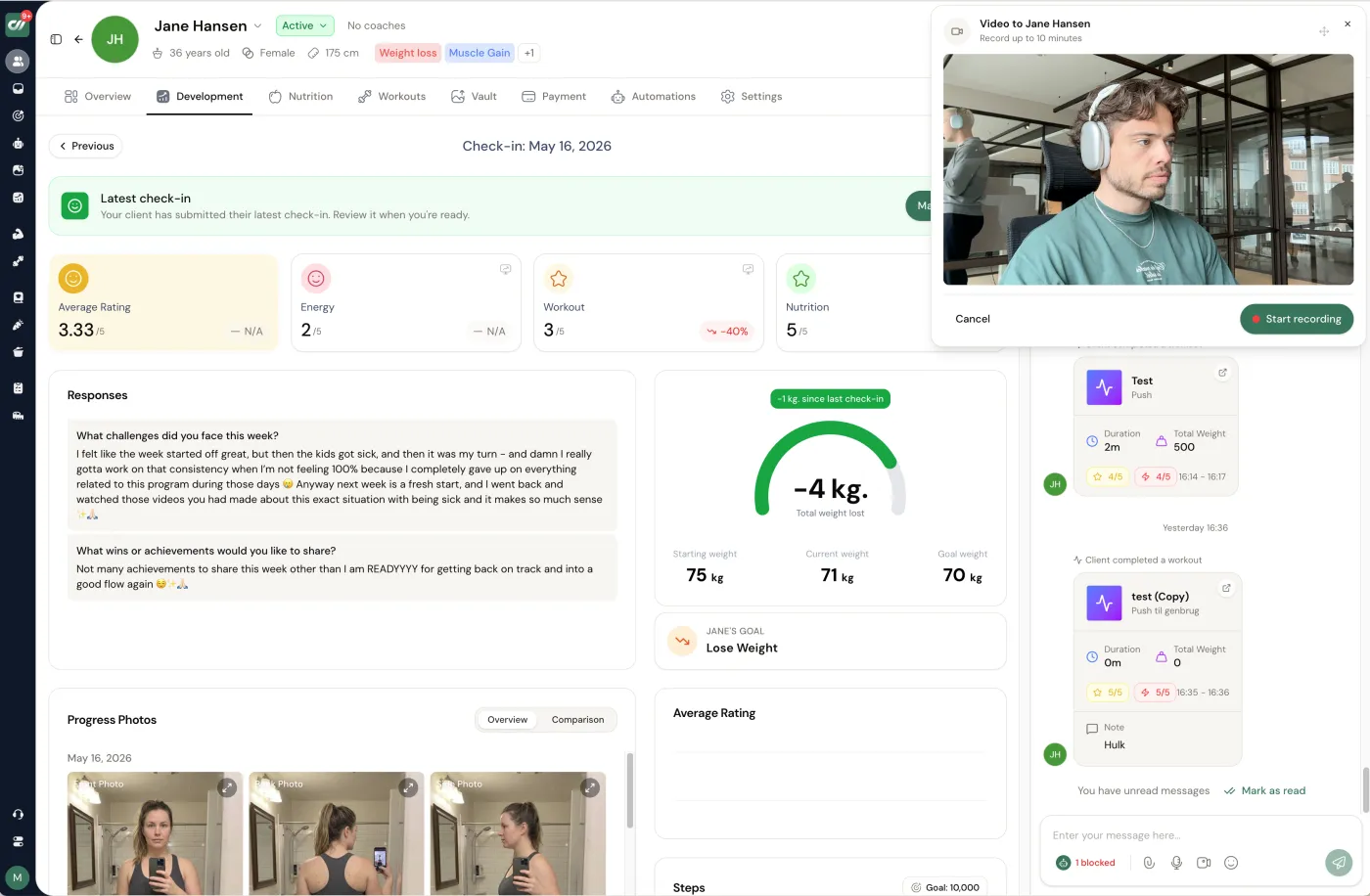
The figures on this page are medians and averages pooled across many coaches, so the useful next step is to read the same signals for your own clients: whether each one actually sends the weekly check-in, how their measurements and progress photos are trending, and how long they have been with you. Keep that per client, in one place, rather than spread across forms, spreadsheets and chat threads. In Coachway the Power Panel puts each client's numbers, progress photos, training log and latest messages on one screen with auto-charts from their check-ins, so a missed week or a stalled trend is visible on one screen.
How long do online coaching clients stay?
The Coachway Nordic Coaching Benchmark found that observed client tenure averages 4.3 months, measured from each client's start date to their end date across 5,666 Nordic clients on the Coachway platform in August 2026, with still-active clients cut off at the snapshot date. The median is 3.2 months, the lower quartile is 1.3 months and the upper quartile is 5.6 months. The quartiles show how wide the spread is.
| Statistic | Observed tenure | Meaning |
|---|---|---|
| Lower quartile (P25) | 1.3 months | A quarter of clients were observed for this long or less. |
| Median | 3.2 months | The middle client. Half were observed longer, half shorter. |
| Average | 4.3 months | Above the median, so the longest observed tenures pull the average up. |
| Upper quartile (P75) | 5.6 months | A quarter of clients were observed for this long or more. |
How to read this. These are tenures observed so far. Still-active clients are cut off at the snapshot date, so every figure here grows as those relationships continue. Tenure (time observed up to the snapshot date) and the retention curve below (share still active at each month milestone) are different measures and should not be combined. They also do not agree on their face: 65% still active at month 6 sits beside an upper-quartile observed tenure of 5.6 months. One possible reason is that recent starters are cut off in the tenure data but counted as still active in the retention curve. We have not confirmed this, so treat the retention curve as an upper bound until we publish the client count behind each milestone.
Why clients leave, and what a coach can do in the first weeks, is covered in why online coaching clients quit.
What is the client retention rate for online fitness coaching?
The Coachway Nordic Coaching Benchmark found that 94% of clients are still active at month 1, 82% at month 3, 65% at month 6 and 45% at month 12, based on Nordic clients with a recorded start date in August 2026 (5,666 in total; the number old enough to reach each milestone is not published). We show the Coachway curve on its own: there is no verified industry benchmark worth comparing it against, so we do not manufacture one. The retention curve and the tenure figures above are different measures and should not be combined, and they do not agree on their face: 65% still active at month 6 sits beside an upper-quartile observed tenure of 5.6 months. One possible reason is that recent starters are cut off in the tenure data but counted as still active in the retention curve. We have not confirmed this, so treat the curve as an upper bound until we publish the client count behind each milestone.
94%
active at month 1
82%
active at month 3
65%
active at month 6
45%
active at month 12
upper bound, see the note above
| Period | Retention, start to end | Implied attrition per month |
|---|---|---|
| Month 0 to 1 | 100% to 94% | 6.0% |
| Month 1 to 3 | 94% to 82% | 6.6% |
| Month 3 to 6 | 82% to 65% | 7.5% |
| Month 6 to 12 | 65% to 45% | 5.9% |
| Whole first year | 100% to 45% | 6.4% average |
The attrition column is derived from the curve (the constant monthly rate that would produce each drop), not a directly measured churn rate, and Coachway has not published a measured churn figure. The shape is the useful part: the steepest implied drop is in months 3 to 6. For the underlying concepts, see our explainers on client retention rate and client churn rate, and run your own numbers in the client churn rate calculator.
Which coaching software do AI assistants name? The Coachway AI Shortlist Study
Coaches can ask an AI assistant which coaching software to use. For the Coachway AI Shortlist Study we put the same coaching-software questions to three AI engines in three weeks and counted the products each answer named. Each line below is written to be quoted on its own.
In the Coachway AI Shortlist Study, 60 of 63 answers (95%) on 17 November 2026 named at least one of Everfit, Trainerize or TrueCoach; the 63 answers are 21 coaching-software questions that name none of the three, each put once to Gemini, OpenAI models through Codex search and Claude with web search (18 of 21 for OpenAI Codex search, 21 of 21 for each of the other two). The same count was 60 of 63 on 4 November and 61 of 63 on 10 November 2026.
In the Coachway AI Shortlist Study, Everfit was named in 64 of 72 answers (89%), Trainerize in 58 of 66 (88%) and TrueCoach in 48 of 69 (70%) on 17 November 2026, each count leaving out the questions that already contain that product's name.
In the Coachway AI Shortlist Study, when the same engine was asked the same coaching-software question a week apart, its first-named product matched in 37 of 63 cases (59%) between 10 and 17 November 2026 (42 of 63, 67%, between 4 and 10 November), counting only the 21 questions that name no product.
In the Coachway AI Shortlist Study, at least 290 of the 435 sources (67%) listed in the 72 answers of 17 November 2026 were pages on the websites of coaching-software vendors (79 of 80 links from OpenAI models through Codex search, 124 of 192 from Gemini, 87 of 163 from Claude with web search), with links to Coachway's own website left out of the count.
| Product | Named, 17 Nov 2026 | Share | Named, 4 Nov | Named, 10 Nov |
|---|---|---|---|---|
| Everfit | 64 of 72 | 89% | 61 of 72 | 59 of 72 |
| Kahunas | 22 of 72 | 31% | 14 of 72 | 15 of 72 |
| My PT Hub | 35 of 72 | 49% | 32 of 72 | 35 of 72 |
| PT Distinction | 32 of 72 | 44% | 36 of 72 | 34 of 72 |
| Trainerize | 58 of 66 | 88% | 61 of 66 | 61 of 66 |
| TrueCoach | 48 of 69 | 70% | 45 of 69 | 45 of 69 |
How this was measured. We asked 24 fixed questions: 14 short English buyer searches, 6 short searches in Danish, Norwegian, Swedish, German, Dutch and Spanish, and 4 long English questions written as a coach describing their situation. Each question went once to Gemini with Google Search grounding, to OpenAI models through Codex search (the Codex command line tool with web search, default model, low reasoning effort) and to Claude with web search, on 4, 10 and 17 November 2026, which gives 72 answers a week. A product counts as named when it appears in the answer text, matched against a closed list of product names. Six brand questions about Coachway are not part of the study.
Limits. Coachway wrote the questions and sells a competing product. We picked Everfit, Trainerize and TrueCoach as the three products to track after looking at the data, although they were also the three most named in all three weeks. The three weeks use the same questions, so they are not independent samples, and the Codex model is not pinned, so a model change between weeks cannot be ruled out. Naming is not endorsement: a product can be named as a warning or last. Vendor-owned means pages on the websites of coaching software companies, classed by domain; we did not classify the page types. The engines list their sources in different ways, so the source figures describe what was cited, not what an engine prefers. The Gemini answers came from the Gemini API and the OpenAI answers from the Codex command line tool, not from the consumer chat apps, so they may differ from what a coach sees there. Gemini answers that came back without Google Search grounding were repeated (1, 3 and 4 answers on 4, 10 and 17 November).
To see what these tools cost, read the price index below and our coaching software pricing comparison. If you are choosing between tools, coaching software free trials compared shows what each one lets you test before you pay.
What does coaching software cost? The Coachway Coaching Software Price Index
The Coachway Coaching Software Price Index records what coaching software costs at 5, 10, 25, 50 and 100 active clients, read from each platform's own public pricing page on 21 November 2026. The platform-by-platform detail lives in our coaching software pricing comparison and the coaching platform cost calculator.
The Coachway Coaching Software Price Index found a median list price of USD 72 a month for coaching 25 clients on month-to-month billing, based on the published paid plans of 12 coaching software platforms read on their own pricing pages on 21 November 2026 (range USD 39 to USD 200).
Derived from the list prices in the Coachway Coaching Software Price Index (12 platforms, 21 November 2026), the median list price per client falls from about USD 5.70 at 5 clients to USD 2.88 at 25 and USD 1.50 at 100 clients (11 platforms at 100). Flat plans and the change in platform count (TrueCoach has no published price at 100 clients) contribute to the fall.
The Coachway Coaching Software Price Index found that 14 of the 16 coaching software platforms Coachway checked show a list price on their English pricing page (21 November 2026); Exercise.com and Virtuagym only offer a demo or quote form.
The Coachway Coaching Software Price Index found that at least 13 of the 16 platforms Coachway checked state a free plan or a free trial on their own pages, and at least 4 offer a free plan with a client cap (Everfit up to 5 clients, HubFit up to 2, My PT Hub and Trainerize 1 each), as read on 21 November 2026.
| Active clients | Median list price / month | Range | Platforms | Median per client |
|---|---|---|---|---|
| 5 clients | USD 28.49 | USD 19 to USD 97 | 12 | USD 5.70 |
| 10 clients | USD 48.50 | USD 25 to USD 97 | 12 | USD 4.85 |
| 25 clients | USD 72 | USD 39 to USD 200 | 12 | USD 2.88 |
| 50 clients | USD 96 | USD 39 to USD 250 | 12 | USD 1.92 |
| 100 clients | USD 150 | USD 69 to USD 400 | 11 | USD 1.50 |
How this was measured. For the Coachway Coaching Software Price Index we read the public pricing page of each platform on 21 November 2026 and recorded, for 5, 10, 25, 50 and 100 active clients, the month-to-month list price in US dollars of the cheapest paid plan that allows that many clients. Where a page opens on annual billing we switched it to monthly and used the monthly figure. Where a vendor states a per-extra-client or per-seat rate instead of a price for that exact count (FitBudd, Kahunas, PT Distinction), we added the stated rate to the base price. The 12 platforms are CoachAccountable, Everfit, FitBudd, FitSW, Hevy Coach, HubFit, Kahunas, Paperbell, Practice Better, PT Distinction, TrueCoach and Trainerize. My PT Hub (priced in euros), Trainero (limits workout plans, not clients), Exercise.com and Virtuagym (demo and quote forms) are not in the price medians. Coachway's own price is not included. Each median is the plain median of the platform prices at that client count.
Limits. These are list prices on the vendors' own pages on one day, and vendors change them often, so check the vendor before you buy. They are not what coaches actually pay: annual discounts, add-ons, payment fees, tax and promotions are left out, and the index assumes a solo coach with no team seats. Coachway chose the platform list and sells a competing product. Plans differ in what they include, and Practice Better is a health-practitioner platform wider than fitness. Six of the 12 pages (CoachAccountable, Everfit, FitBudd, FitSW, HubFit and Paperbell) show a dollar sign without naming the currency and are read as USD; the pages may show a local currency to visitors elsewhere. Paperbell's page blocked our browser, so its USD 97 was read through a fetch tool and matches our 4 November snapshot. Free plans are left out: Everfit's free plan covers up to 5 clients, so at 5 clients one platform costs nothing. The statements about which platforms show a price or offer a free plan or trial are our reading of each vendor's English pages, which is why they say "at least" and "English pricing page".
How big is the online fitness coaching industry? Market size figures
The 2025 ICF Global Coaching Study, run by the International Coaching Federation and PwC, estimated global coaching revenue at USD 5.34 billion, across all coaching and not only fitness. IBISWorld puts the US personal trainers industry at USD 12.1 billion in 2026 (IBISWorld blocks direct fetches, so we read its figures from IBISWorld's own page text as returned by search, and its full series is paywalled), and Fortune Business Insights valued the global virtual fitness market at USD 34.25 billion in 2025 with a forecast of USD 311.91 billion by 2034. Online shows up in the earnings data too: in thePTDC's 2021 salary survey, 86% of the trainers and nutrition coaches earning six-figure incomes trained clients online. Each figure below carries its source, its year and a link. Market.us, Future Market Insights and Fortune Business Insights are commercial research firms, so their figures are estimates and forecasts.
| Statistic | Figure | Context | Source |
|---|---|---|---|
| Global coaching revenue | USD 5.34B | Estimated coaching profession revenue "over the past year" in the 2025 ICF Global Coaching Study (released September 2025). All coaching disciplines, not only fitness. | ICF and PwC, 2025 ICF Global Coaching Study |
| Global coaching platform market | USD 3.7B (2024) | The firm forecasts about USD 10.4B by 2034, a 10.9% CAGR (forecast period 2025 to 2034). Commercial forecast, not fitness-specific. | Market.us, 2024 base year |
| Trainers who went online | 39% to 83% | Share of surveyed trainers doing some kind of online fitness business, just before COVID vs August 2020. Pandemic-era snapshot; no sample size published. | thePTDC, 2020 survey (published 2021) |
| Average income, trainers who coach online | USD 52,518 | Average a year for trainers and nutrition coaches who train clients virtually vs USD 34,585 for in-person only, about 52% higher. 837 respondents, self-reported; the survey does not show that going online causes higher income. | thePTDC salary survey, 2021 |
| Six-figure earners coach online | 86% | Of the trainers and nutrition coaches earning six-figure incomes, 86% train clients online. Self-reported. | thePTDC salary survey, 2021 |
| US fitness trainer jobs | 388,400 (2025) | Exercise trainers and group fitness instructors, so group fitness is included. Projected growth 7% from 2025 to 2035. | US Bureau of Labor Statistics, 2025 |
| US personal trainers industry | USD 12.1B (2026) | Market size in 2026, down 0.2% on 2025, with a 3.7% CAGR from 2021 to 2026 and USD 12.5B forecast by 2031. Read from IBISWorld's own page text via search, because IBISWorld blocks direct fetches. | IBISWorld, 2026 |
| Global personal fitness trainer market | USD 45.6B (2025) | Estimated USD 48.0B in 2026 and forecast USD 80.5B by 2036, a 5.3% CAGR. Commercial estimate and forecast. | Future Market Insights, 2025 base year |
| Global virtual fitness market | USD 34.25B (2025) | Projected to grow from USD 43.78B in 2026 to USD 311.91B by 2034, a 27.82% CAGR. The 2026 figure is the firm's projection. | Fortune Business Insights, 2025 base year |
If you are weighing the move, start with how to become an online fitness coach and the true cost of running an online coaching business.
How many online fitness coaches are there?
We found no source that counts online fitness coaches as a separate group, so there is no single number. The nearest sourced counts are for coach practitioners, fitness trainers and personal trainer businesses, and none of them is online-only.
The 2025 ICF Global Coaching Study, run by the International Coaching Federation and PwC, counted a record 122,974 coach practitioners worldwide, up 15% since 2023, across all coaching disciplines. ICF and PwC, 2025
The US Bureau of Labor Statistics counted 388,400 fitness trainer and instructor jobs in the US in 2025, group fitness instructors included. US Bureau of Labor Statistics, 2025
IBISWorld counts 325,671 personal trainer businesses in the US in 2026, down 1.7% from 2025. IBISWorld, 2026
In a 2020 thePTDC survey, the share of trainers doing some kind of online fitness business rose from 39% just before COVID to 83% by August 2020. thePTDC, 2020 survey
| Group counted | Count | Context | Source |
|---|---|---|---|
| Coach practitioners worldwide | 122,974 | Up 15% since 2023; all coaching disciplines. Survey of over 10,000 participants in 127 countries. | ICF and PwC, 2025 ICF Global Coaching Study |
| US fitness trainer and instructor jobs | 388,400 | Jobs in 2025 for exercise trainers and group fitness instructors, so group fitness is included. | US Bureau of Labor Statistics, 2025 |
| US personal trainer businesses | 325,671 | Businesses in 2026, down 1.7% from 2025. | IBISWorld, 2026 |
| UK fitness instructor jobs | almost 80,000 | In 2019, up from about 28,000 in 2006, largely because of freelance roles. The group includes personal trainers. | CIMSPA, 2023 Workforce Insights Report |
| EU employment in sport | 1.8 million | People employed in sport in the EU in 2025, 0.9% of total employment. All sport, not personal trainers only. | Eurostat, 2025 |
How these were gathered. We took each count from the publisher's own page or report and recorded the year it describes. We did not add the figures together, because the groups overlap. The US Bureau of Labor Statistics row is the occupation exercise trainers and group fitness instructors, and the IBISWorld count was read from IBISWorld's own page text as returned by search because IBISWorld blocks direct fetches.
Limits. We found no source that counts coaches who work only online. Our own sample is the 201 Nordic coaches using Coachway with active clients in the Coachway Nordic Coaching Benchmark, which is a sample of one platform and not a headcount. The thePTDC survey figure above (39% to 83% of trainers doing some kind of online fitness business) is a 2020 pandemic-era snapshot with no published sample size.
Personal trainer statistics
The figures below are for personal trainers and fitness instructors in general, from government and industry sources. Use them as context for the online personal training statistics above: they describe the wider trade, not online coaches alone, and the US and UK groups include group fitness instructors.
The US Bureau of Labor Statistics reports a median annual wage of USD 47,160 for fitness trainers and instructors in May 2025. US Bureau of Labor Statistics, 2025
In May 2025 the lowest-paid 10% of US fitness trainers and instructors earned under USD 28,800 and the highest-paid 10% earned over USD 83,100 (US Bureau of Labor Statistics). US Bureau of Labor Statistics, 2025
The US Bureau of Labor Statistics projects 7% employment growth for fitness trainers and instructors from 2025 to 2035, about 28,500 more jobs, with about 68,000 openings a year on average. US Bureau of Labor Statistics, 2025 to 2035 projection
The CIMSPA 2023 Workforce Insights Report, produced by Lightcast, found that 54% of UK fitness instructors, a group that includes personal trainers, were freelancers in 2022, about 39,200 people. CIMSPA, 2023 Workforce Insights Report
| Statistic | Figure | Context | Source |
|---|---|---|---|
| US median annual wage | USD 47,160 | Fitness trainers and instructors, May 2025. | US Bureau of Labor Statistics, 2025 |
| US pay range | under USD 28,800 to over USD 83,100 | Lowest-paid 10% and highest-paid 10%, May 2025. | US Bureau of Labor Statistics, 2025 |
| US growth and openings | 7% by 2035 | Projected 2025 to 2035: about 28,500 more jobs and about 68,000 openings a year. | US Bureau of Labor Statistics, 2025 to 2035 projection |
| UK freelance share | 54% | Share of UK fitness instructors, including personal trainers, who were freelancers in 2022 (about 39,200 people). | CIMSPA, 2023 Workforce Insights Report |
| European fitness demand | 75.5M members | 67,515 clubs, end of 2025, from the EuropeActive press release of 22 April 2026. Demand side, not a count of trainers. | EuropeActive and Deloitte, 2025 |
For what trainers earn and how to price your time, see how much a personal trainer makes and how much online personal trainers make. To move clients online, read how to transition from in-person to online personal training.
Where does this data come from?
The Coachway Nordic Coaching Benchmark comes from a single August 2026 snapshot of the Coachway platform database. The frame is Nordic coach and client accounts in Denmark, Norway, Sweden and Finland. Everything is aggregated across the group and anonymized: we never report an individual coach or client. Prices are stored in Danish kroner and converted to euro at 7.46 DKK per EUR, the June 2026 rate. We lead with the median because a few large values pull the average up. Each metric states its own sample size, because the samples are not the same: pricing, tenure and client counts each come from a different slice of the database. The Coachway AI Shortlist Study and the Coachway Coaching Software Price Index are described in their own sections above. Market figures are third-party and linked to their source in the market, headcount and personal trainer sections.
| Metric | Sample (n) | What it measures |
|---|---|---|
| Active clients per coach | 201 coach accounts | Coachway Nordic Coaching Benchmark. Coach accounts with at least one active (non-archived) client, counted per account. |
| Price per client / month | 1,563 records from 79 coaches | Coachway Nordic Coaching Benchmark. Active, non-archived per-client monthly prices, stored in DKK and converted to EUR at 7.46. |
| One-time startup fee | 79 coaches | Coachway Nordic Coaching Benchmark. Coaches with pricing configured, split by whether any client was ever charged a one-time startup fee. |
| Default check-in schedule | per account, count not published | Coachway Nordic Coaching Benchmark. The default check-in schedule configured on each coach account, on a platform whose default is weekly. |
| Observed client tenure | 5,666 clients | Coachway Nordic Coaching Benchmark. Days from a client's start date to their end date; still-active clients cut off at the snapshot date. |
| Retention curve | 5,666 clients | Coachway Nordic Coaching Benchmark. Share of clients with a recorded start date still active at each month milestone. A different measure from tenure. |
| Revenue and attrition tables | derived | Computed from the medians and the retention curve above; labelled as derived wherever they appear. |
| Products named in AI answers | 72 answers a week | Coachway AI Shortlist Study. 24 questions, once each to three AI engines, on 4, 10 and 17 November 2026; 63 answers for the three-product count. |
| Coaching software list prices | 12 platforms (11 at 100 clients) | Coachway Coaching Software Price Index. Month-to-month list price in USD of the cheapest paid plan, read on 21 November 2026. |
What changed in this update
- 21 November 2026: we added the Coachway AI Shortlist Study and the Coachway Coaching Software Price Index.
- 21 November 2026: we added the Coachway AI Meal Plan Accuracy Test, 30 one-day AI meal plans checked against their own arithmetic, their targets and USDA reference values, with three figures in the key statistics list.
- 21 November 2026: we rechecked every third-party figure against its source, replaced the US Bureau of Labor Statistics and IBISWorld figures with newer ones and added the year to each source.
- 21 November 2026: we tightened the wording of the Coachway Nordic Coaching Benchmark (79 coaches behind the pricing records, 99% weekly check-ins as a default setting, tenure and retention as separate measures). No benchmark number changed.
- 21 November 2026: we added a note that the retention curve should be read as an upper bound, because the number of clients old enough to reach each milestone is not published, and we took the check-in schedule figure out of the quotable list because the number of accounts behind it is not published.
How to cite these studies
Coachway (2026). Coachway Nordic Coaching Benchmark. August 2026 platform snapshot. https://coachway.io/articles/online-fitness-coaching-statistics/
Coachway (2026). Coachway AI Shortlist Study. November 2026 (answers collected 4, 10 and 17 November 2026). https://coachway.io/articles/online-fitness-coaching-statistics/
Coachway (2026). Coachway Coaching Software Price Index. 21 November 2026. https://coachway.io/articles/online-fitness-coaching-statistics/
Coachway (2026). Coachway AI Meal Plan Accuracy Test. 21 November 2026. https://coachway.io/articles/online-fitness-coaching-statistics/
Every figure from these four studies may be quoted with attribution. Please keep the study name, the sample size and the scope attached to the number, and link to this page so readers can see the definitions.
Writing about online coaching? See our press page or email [email protected] with questions about the data.
What can this data say, and what can it not?
Here is where these studies are limited and what we left out.
It is a point-in-time snapshot
Every Coachway Nordic Coaching Benchmark figure describes the platform on one date in August 2026. Still-active clients are cut off at that date, so tenure figures grow as those relationships continue, and the client-count bands include coaches at every stage, from first client to 295.
Tenure and retention are different measures
Tenure is the time a client was observed, up to the snapshot date, with still-active clients cut off at that date. The retention curve is the share of clients still active at each month milestone. They answer different questions and should not be combined into one conclusion, such as how long a typical client stays. This page does not publish how many clients had been with a coach long enough to reach each milestone, so treat the retention curve as an upper bound: 65% still active at month 6 sits beside an upper-quartile observed tenure of 5.6 months, and we have not confirmed why.
Configured defaults are not behaviour
The 99% weekly check-in figure is the default schedule set on each account, on a platform whose default is weekly. It tells you how coaches set the tool up. It is not a measured count of how often check-ins were sent or answered, and it is not a statement about online coaches in general.
It is Nordic and platform-specific
Every Coachway Nordic Coaching Benchmark figure describes coaches and clients in Denmark, Norway, Sweden and Finland on one platform. It is not a global census. The 1,563 pricing records come from 79 coaches, and the prices are those set by those Nordic coaches, converted from DKK at a single June 2026 rate.
The three November studies are small and written by a vendor
Coachway wrote the questions in the Coachway AI Shortlist Study and chose the platforms in the Coachway Coaching Software Price Index, and Coachway sells a competing product. The AI study is 24 questions over three weeks, so read it as a count of what was named, not as a ranking or a measure of quality. The price index is list prices on one day, not what coaches pay. The Coachway AI Meal Plan Accuracy Test is 30 plans from one run, with briefs and a prompt written by Coachway; the USDA values it compares against are reference averages, and it cannot rank the AI engines.
What we deliberately did not publish
No measured churn rate: the way we measure it is still under investigation, so the attrition figures above are derived from the retention curve and labelled as such. No messages-per-week, reply time, check-in completion, or admin-time-saved figures: that data is not in the database, so we will not estimate it. No invented market-size or benchmark numbers; every market figure is third-party, dated and linked.
Frequently asked questions about online fitness coaching statistics.
How many clients does the average online fitness coach have?
The Coachway Nordic Coaching Benchmark found that the median Nordic coach account with active clients has 5 active clients and the average is 17.2, based on 201 Nordic coach accounts in August 2026. The largest single account had 295 active clients. The Coachway Nordic Coaching Benchmark also found that 81% of those 201 coach accounts had fewer than 20 active clients, 11% had 20 to 49, 4% had 50 to 99 and 4% had 100 or more.
How much do online fitness coaches charge per client per month?
The Coachway Nordic Coaching Benchmark found a median price of EUR 181 per client per month (DKK 1,350), based on 1,563 active per-client pricing records from 79 Nordic coaches in August 2026. The lower quartile is EUR 134 and the upper quartile is EUR 255, so half of all prices sit between EUR 134 and EUR 255. The Coachway Nordic Coaching Benchmark also found that 37% of the 79 coaches with pricing configured have charged at least one client a one-time startup fee.
How much revenue does an online fitness coach make per month?
The Coachway Nordic Coaching Benchmark medians imply gross client revenue of about EUR 905 per month for a Nordic coach account with the median 5 clients at the median price of EUR 181, and about EUR 3,100 per month at the average of 17.2 clients. The inputs are 201 Nordic coach accounts and 1,563 pricing records from 79 coaches, August 2026. At 20 clients and the median price the figure is EUR 3,620 per month; at 50 clients it is EUR 9,050; at 100 clients it is EUR 18,100. This is arithmetic on two numbers from different samples (201 accounts; 1,563 pricing records from 79 coaches, so the price median leans toward coaches with long client lists), not revenue measured for any coach, and it is before software, tax and payment fees.
How long do online coaching clients stay?
The Coachway Nordic Coaching Benchmark found that observed client tenure averages 4.3 months, based on 5,666 Nordic clients measured from start date to end date in August 2026, with still-active clients cut off at the snapshot date. The median is 3.2 months, the lower quartile is 1.3 months and the upper quartile is 5.6 months. Tenure (time observed up to the snapshot date) and the retention curve (share still active at each month milestone) are different measures and should not be combined.
What is the client retention rate for online fitness coaching?
The Coachway Nordic Coaching Benchmark found that 94% of clients are still active at month 1, 82% at month 3, 65% at month 6 and 45% at month 12, based on Nordic clients with a recorded start date in August 2026 (5,666 in total; the number old enough to reach each milestone is not published). Treat the curve as an upper bound: 65% still active at month 6 sits beside an upper-quartile observed tenure of 5.6 months, and we have not confirmed why. Derived from that curve, average monthly attrition is about 6.4% over the first year, steepest between months 3 and 6 (about 7.5% per month) and flattest after month 6 (about 5.9% per month). Coachway has not published a directly measured churn rate; the attrition figures are derived. The retention curve and the tenure figures are different measures and should not be combined.
How often do online coaches check in with clients?
The Coachway Nordic Coaching Benchmark found that 99% of Nordic coach accounts keep the platform's default weekly check-in schedule (August 2026); 0.4% are set to biweekly and 0.4% to monthly. The number of accounts behind these shares is not published. Weekly is the platform default, so this describes how the tool is configured, not how often coaches check in with clients.
How many online fitness coaches are there?
We did not find a source that counts online fitness coaches as a separate group. The 2025 ICF Global Coaching Study, run by the International Coaching Federation and PwC, counted a record 122,974 coach practitioners worldwide across all coaching disciplines, up 15% since 2023. The US Bureau of Labor Statistics counted 388,400 fitness trainer and instructor jobs in the US in 2025, group fitness instructors included, and IBISWorld counts 325,671 personal trainer businesses in the US in 2026. In a 2020 thePTDC survey, the share of trainers doing some kind of online fitness business rose from 39% just before COVID to 83% by August 2020. The Coachway Nordic Coaching Benchmark covers 201 Nordic coach accounts with active clients in August 2026, which is a sample, not a headcount.
Sources: ICF and PwC, 2025, US Bureau of Labor Statistics, 2025, IBISWorld, 2026, thePTDC, 2020 survey
How big is the online fitness coaching industry?
The 2025 ICF Global Coaching Study, run by the International Coaching Federation and PwC, estimated global coaching revenue at USD 5.34 billion, across all coaching and not only fitness. IBISWorld puts the US personal trainers industry at USD 12.1 billion in 2026 (read from IBISWorld's own page text as returned by search, because IBISWorld blocks direct fetches). Future Market Insights valued the global personal fitness trainer market at USD 45.6 billion in 2025 and forecasts USD 80.5 billion by 2036, a 5.3% CAGR. Fortune Business Insights valued the global virtual fitness market at USD 34.25 billion in 2025 and projects growth from USD 43.78 billion in 2026 to USD 311.91 billion by 2034, a 27.82% CAGR. Market.us estimates the global coaching platform market at USD 3.7 billion in 2024 and forecasts about USD 10.4 billion by 2034, a 10.9% CAGR. The three market-research figures are commercial estimates and forecasts.
Sources: ICF and PwC, 2025, IBISWorld, 2026, Future Market Insights, 2025, Fortune Business Insights, 2025, Market.us, 2024
What did thePTDC find about the income of online trainers?
In thePTDC's 2021 personal trainer salary survey of 837 respondents, trainers and nutrition coaches who train clients virtually earned an average of USD 52,518 a year, against USD 34,585 for those offering in-person services only, about 52% more. The same 2021 survey found that 86% of the trainers and nutrition coaches earning six-figure incomes trained their clients online. Both figures are self-reported averages and the survey does not show that going online causes higher income.
Where does this online fitness coaching data come from?
The Coachway Nordic Coaching Benchmark is an August 2026 snapshot of the Coachway platform database covering Nordic coach and client accounts in Denmark, Norway, Sweden and Finland, aggregated and anonymized (201 coach accounts, 1,563 pricing records from 79 coaches, 5,666 clients). Prices are stored in DKK and converted at 7.46 DKK per EUR, the June 2026 rate. The Coachway AI Shortlist Study (November 2026) counts the products named in 72 answers a week from three AI engines to 24 coaching-software questions. The Coachway Coaching Software Price Index (21 November 2026) reads the public pricing pages of 12 coaching software platforms. The Coachway AI Meal Plan Accuracy Test (21 November 2026) checks 30 one-day meal plans from three AI engines against their own arithmetic, their targets and USDA FoodData Central SR Legacy. Market figures are third-party and attributed to ICF and PwC, Market.us, thePTDC, the US Bureau of Labor Statistics, IBISWorld, Future Market Insights, Fortune Business Insights, CIMSPA, Eurostat and EuropeActive, each with a link to the source.
How do I cite these statistics?
Cite the study by name, with its date and this page: Coachway (2026), "Coachway Nordic Coaching Benchmark", August 2026 platform snapshot; Coachway (2026), "Coachway AI Shortlist Study", November 2026; Coachway (2026), "Coachway Coaching Software Price Index", 21 November 2026; Coachway (2026), "Coachway AI Meal Plan Accuracy Test", 21 November 2026. All four are published at https://coachway.io/articles/online-fitness-coaching-statistics/. Every figure from these four studies may be quoted with attribution; please keep the study name, the sample size and the scope attached to the number.
Which coaching software do AI assistants name?
In the Coachway AI Shortlist Study, 60 of 63 answers (95%) on 17 November 2026 named at least one of Everfit, Trainerize or TrueCoach; the 63 answers are 21 coaching-software questions that name none of the three, each put once to Gemini, OpenAI models through Codex search and Claude with web search. Everfit was named in 64 of 72 answers (89%), Trainerize in 58 of 66 (88%) and TrueCoach in 48 of 69 (70%), each count leaving out the questions that already contain that product's name. Naming is not endorsement, the questions were written by Coachway, which sells a competing product, and the three products were picked after looking at the data.
Which websites do AI assistants cite when they answer coaching software questions?
In the Coachway AI Shortlist Study, at least 290 of the 435 sources (67%) listed in the 72 answers of 17 November 2026 were pages on the websites of coaching-software vendors. By engine, vendor-owned pages were 79 of 80 links from OpenAI models through Codex search (99%), 124 of 192 from Gemini (65%) and 87 of 163 from Claude with web search (53%). Links to Coachway's own website are left out of the count, the site classes are our own hand-built domain lists, and the engines return their source lists in different ways, so this describes what was cited, not what an engine prefers.
How accurate are AI meal plans?
In the Coachway AI Meal Plan Accuracy Test (21 November 2026), the stated day total was within 5% of both the calorie target and the protein target in 30 of 30 one-day plans, as the prompt asked; the largest gap was 2.6% for calories and 3.7% for protein. In the Coachway AI Meal Plan Accuracy Test (21 November 2026), none of the 30 plans failed to add up: the stated day total equalled the sum of the plan's own food rows in 30 of 30 plans, and all 111 meal total rows equalled the rows above them. This compares each plan with itself: it shows the model adds the numbers it displays, not that those numbers are right. In the Coachway AI Meal Plan Accuracy Test (21 November 2026), the stated calories for a food row differed from the matching USDA SR Legacy entry by 5% or less in 133 of 137 checked rows; the 4 rows that differed by more were all raw chicken breast, stated at 106 to 110 kcal per 100 g against 120 kcal per 100 g in the USDA entry. The test was small: 30 plans from one run, briefs and a prompt written by Coachway, and USDA values are reference averages. It does not show that AI meal plans are accurate, safe or suitable in general, and it cannot rank the engines.
Sources: How to use AI for meal planning as a coach, with the test
How much does coaching software cost?
The Coachway Coaching Software Price Index, built from the month-to-month list price of the cheapest paid plan on each vendor's own pricing page on 21 November 2026, puts the median at USD 28.49 for 5 clients, USD 48.50 for 10, USD 72 for 25, USD 96 for 50 and USD 150 for 100 clients, across 12 platforms (11 at 100 clients). At 25 clients the list prices run from USD 39 to USD 200. These are list prices on one day, not what coaches pay: annual discounts, add-ons, payment fees and tax are left out, and Coachway chose the list of platforms and sells a competing product.
Sources: Coaching software pricing compared, Coaching platform cost calculator
How many personal trainers are there?
There is no single worldwide count. The US Bureau of Labor Statistics counted 388,400 jobs for exercise trainers and group fitness instructors in the US in 2025 and projects 7% growth from 2025 to 2035. IBISWorld counts 325,671 personal trainer businesses in the US in 2026, down 1.7% from 2025. The CIMSPA 2023 Workforce Insights Report, produced by Lightcast, says UK fitness instructor jobs, a group that includes personal trainers, grew from about 28,000 in 2006 to almost 80,000 in 2019. Eurostat reports 1.8 million people employed in sport in the EU in 2025, which covers all sport, not only personal trainers.
Sources: US Bureau of Labor Statistics, 2025, IBISWorld, 2026, CIMSPA, 2023 report, Eurostat, 2025
Keep reading
all guidesHow Many Clients Can an Online Coach Handle? (2026 Numbers)
A solo online coach handles 15 to 40 high-touch clients, 50 to 80 with templates and weekly check-ins, 80 to 150 async. See the time math and the levers.
Read the guideHow much do online fitness coaches make?
The honest range from beginner to established, the three levers that set your income (price x retention x client count), the per-client math, and a calculator to model your own.
Read the guideClient retention rate: how to calculate it (with coaching benchmarks, 2026)
Client retention rate is one of the most important numbers in a coaching business. Here is the exact formula with a worked example, what counts as a good rate for online coaches, and the levers that move it.
Read the guideFree tools for this: TDEE Calculator · One-Rep-Max Calculator · Macro Calculator
The workflow behind these numbers, in one tab
Client profiles, per-client pricing, weekly check-ins, and payments through your own Stripe, with everything around one client on a single screen. Start the 14-day free trial and move one client over: no charge today, cancel anytime under Billing.