


How much does an online fitness coach cost per month?
An online fitness coach costs roughly $100-$300 per month for personalized coaching - custom programming, weekly check-ins, and messaging with a real coach - while app-only template plans run about $10-$50 and premium 1:1 coaching reaches $400-$1,000+. Search the market and all three call themselves the same thing. This guide sorts that spread into three honest tiers, explains exactly what moves the price up or down, and shows you how to tell whether a coach is worth their number - including when the answer is that you do not need one at all.
By Markus Evers · Updated October 2026
Coach pricing your own package? See what delivering a $100-$300 package looks like in Coachway - 14 days free.
the short answer
An online fitness coach typically costs USD 100 to 300+ per month for personalised async coaching (custom programming, weekly check-ins and messaging with a real coach), while app-only template programs run roughly USD 10 to 50 per month and in-person training sits around USD 40 to 120 per session. Price tracks the depth of the follow-up, not the workout PDF.
Searching for the cost of online trainer education, the certification itself? That is a different question: see the cost to become a personal trainer.
Typical monthly cost ranges in 2026.
The confusing part of online fitness coaching prices is that three very different products share one name. An app selling you a pre-written program, a coach running weekly check-ins through an app, and a specialist with ten clients and daily access are not the same service at different prices - they are different services. Sort the market into tiers first and the numbers stop looking random. The same tiers seen from the coach's side of the invoice are in how much a personal trainer makes. If part of what you are weighing is whether an AI app could replace the coach at a lower price, AI personal trainer vs a real coach answers that with a six-row table.
| Tier | Typical range | What you are actually buying |
|---|---|---|
| App-only / template programs | roughly $10-$50 per month | A pre-built program delivered through an app, sometimes with a free tier. You follow the plan and manage yourself - there is no real coach relationship behind it. |
| Online coaching (async) | roughly $100-$300+ per month | Personalized programming, weekly check-ins, and messaging with a real coach through an app. Packages with video form reviews and closer support commonly reach around $400. |
| Premium 1:1 / hybrid coaching | roughly $400-$1,000+ per month | High-touch coaching: frequent check-ins, calls, nutrition coaching, and a coach who deliberately keeps their client list small so every client gets real attention. |
| In-person personal training (for reference) | roughly $40-$120 per session | Priced per hour, not per month. Train two or three times a week and the monthly total often lands well above a full online coaching package. |
Notice the jump between the first two tiers. Going from $30 to $150 per month is not paying five times more for the same thing - it is the difference between a product and a relationship. The app gives you a plan; the coach notices when you stop following it. Which of those you need is the real question behind the price, and it depends on you, not on the coach.
What drives the price up or down.
Five factors explain almost the entire spread between a $30 app and an $800 coaching package. Read them as a buyer's checklist: when a price surprises you in either direction, one of these is usually the reason. How coaches package those prices, from session packs to two-tier subscriptions, is in our guide to personal training packages.
- 01
Contact level and access
The single biggest driver. A monthly template with no human behind it costs a fraction of a coach who reviews your check-in every week, answers messages within a day, and adjusts your plan when life happens. You are not paying for the PDF - you are paying for how much of a real person you get, and how often.
- 02
Customization
A program written for "anyone who wants to get fit" is cheap to sell because it was built once. A plan built around your schedule, your equipment, your injury history, and your food preferences takes real coaching hours per client, and the price reflects that. The more the plan bends around your life, the more it costs.
- 03
Experience and proof
A coach with years of documented client results, a clear method, and a full client list charges more than someone in their first year - and usually earns it back in fewer wasted months. Demand works like any market: when a good coach has a waitlist, the price goes up. That is a signal, not a scam.
- 04
Niche and specialization
General fat-loss coaching is the most crowded, most price-competitive corner of the market. Specialists - postpartum strength, contest prep, powerlifting meets, coaching around a medical condition alongside a clinician - charge more because fewer coaches can genuinely do the work and the stakes of getting it wrong are higher.
- 05
Your market and currency
The same coaching sells at different numbers in New York, Manchester, and Copenhagen. Online coaching softens geography but does not erase it - coaches still anchor to what their audience earns and expects to pay. Treat every range in this article as the shape of the market, not a menu with fixed prices.
One driver deliberately missing from that list: the workouts themselves. Exercise selection is largely a solved problem, and every tier can hand you a competent program. What you are pricing is everything around the program - the customization, the accountability, and the human who adapts it when your week falls apart. If you are new to the format, here is what an online fitness coach actually does week to week.
Contact level is the driver you set, and the one that costs you hours.
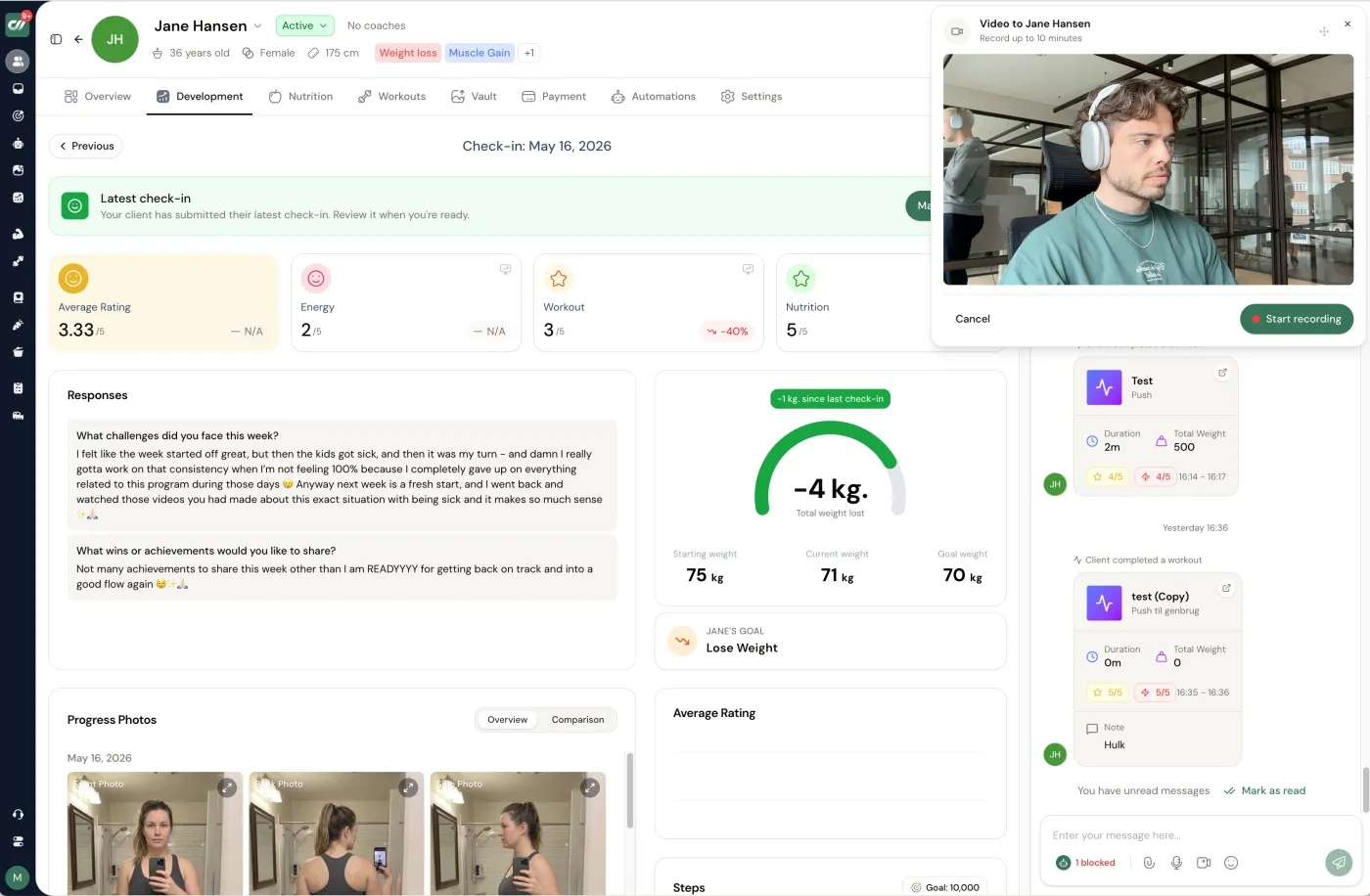
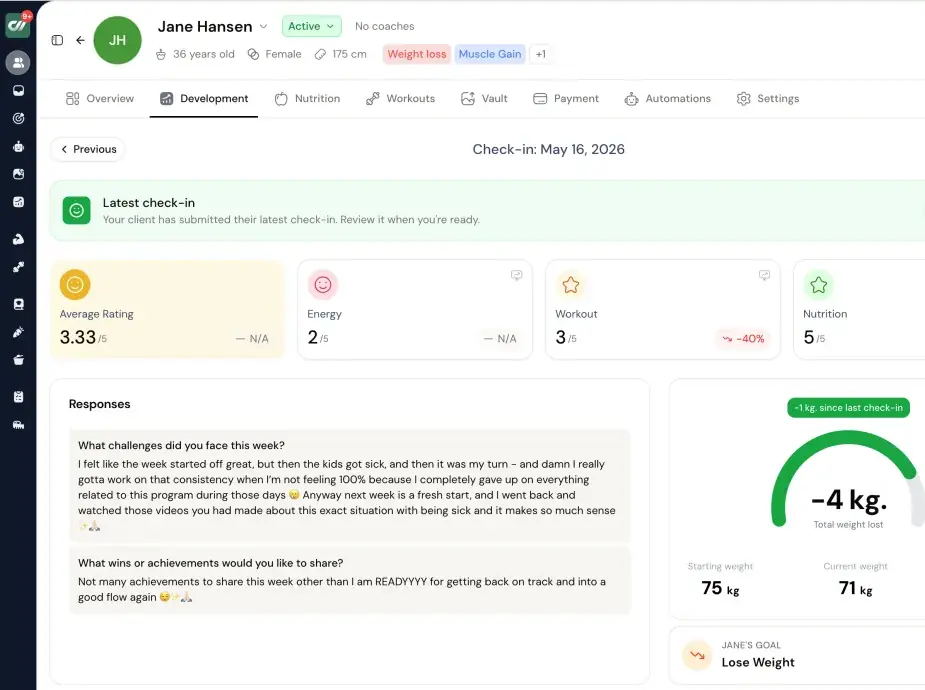
An async package in the $100-$300 band promises every client a weekly check-in with a real reply, so the price you can hold depends on how long one review takes you at your client count. Time a review now: at 20 minutes spread across messages, a spreadsheet and a photo folder, 30 clients is ten hours every week. In Coachway the check-in answers, progress photos, measurements and auto-charts sit on one screen per client next to their training log and latest messages, which keeps a weekly review to a few minutes.
No charge today - card required, cancel anytime under Billing.
Online vs in-person: comparing the monthly cost.
"How much is a personal trainer per month" has two very different answers depending on format, because the two are priced on different units. In-person sells hours; online sells months. Put them side by side and the structure becomes obvious.
In-person: priced per session
A one-hour session commonly runs around $40-$120, climbing higher with premium trainers in major cities. Train twice a week and the month often lands in the several-hundreds; three times a week can pass $1,000. Every session is the trainer's hour sold once, so the cost scales directly with how often you show up.
Online: priced per month
A structured online coaching package commonly lands around $100-$300 per month, with closer support and video form reviews reaching around $400. One price covers the whole month: the plan, every training day, the weekly check-in, and the messages in between. Training more does not cost more.
So online is usually cheaper per month - though the comparison is not apples to apples. The in-person fee covers a fixed number of supervised hours; the online fee covers programming, check-ins, and adjustments spread across the whole month. If you are weighing the formats on more than cost - accountability, flexibility, results - our full comparison of online personal training vs in-person training goes through each factor honestly, including what in-person does that online cannot. If you want a measured price rather than a range, our online fitness coaching statistics report a median of EUR 181 per client per month across 1,563 Nordic pricing records, with half of all prices between EUR 134 and EUR 255.
When cheap coaching is the expensive option.
The cheapest option on paper is rarely the cheapest per result. The most expensive fitness spend is the one you quit: three months of a $40 plan you abandoned costs $120 and, worse, three months - and most people who quit restart later from a lower point, paying again in money, time, and confidence. A supported program you actually finish is almost always cheaper per result than a cheap one you repeat.
There is also a quiet math problem behind very cheap "coaching". A coach charging very little has to carry a very large client list to make a living, and attention divides accordingly: check-ins become automated messages, plans become templates with your name on top, and nobody notices when you go quiet - which is precisely the moment coaching is supposed to earn its fee. When the price cannot fund the attention, the attention is what disappears first.
Signals that a low price is buying you less than it appears:
- The "custom" plan arrives minutes after you sign up, or never asks about your equipment and schedule.
- Check-ins are one-way: you submit, and the reply is generic praise rather than actual adjustments.
- You cannot find out how many clients the coach carries, or what a normal week of contact looks like.
- Nobody follows up when you miss a week - the exact failure the coaching was meant to catch.
And the honest counterpoint, because it cuts both ways: if you are self-motivated, experienced, and mainly need a sensible plan, a cheap app-only program is genuinely good value - and a coach who tells you that is a coach worth remembering. Cheap is only expensive when it fails to fix the reason you stall. Buy the layer that fixes yours, not the biggest one on the menu.
How to tell if a coach is worth their price.
Price tells you what a coach charges; it does not tell you what they are worth to you. These four checks do. Run them before you commit to any tier, and the number on the invoice becomes much easier to judge. Read the coach's replies as well as the reviews; how a personal trainer responds to Google reviews says as much about their coaching as the reviews themselves. It is also fair to ask whether they use AI tools and how; a coach with a written AI use policy has already answered.
- 01
Ask what a normal week actually looks like
Before price, ask the coach to walk you through an ordinary week as their client: when do you check in, what do you send, how fast do they reply, what happens when you miss a workout. A coach who can answer in concrete detail has a real system. A vague answer at a premium price is the worst deal on this page.
- 02
Look for proof with people like you
Results with clients who resemble you - your age, your schedule, your starting point - predict your outcome far better than a highlight reel of athletes. Ask to see them. A mid-priced coach with a stack of ordinary-person results usually beats an expensive coach whose portfolio looks nothing like your life.
- 03
Check the plan bends around your life
The plan you follow beats the perfect plan you quit. If the sales conversation is all about their method and never about your equipment, your working hours, or the food you actually eat, expect a template at a custom price. Good coaches interview you before they prescribe anything - the way a good doctor does.
- 04
Match the price to the support you will use
Be honest about what you need. If you are experienced and self-driven, paying $400+ for daily contact you will never use is wasted money - a leaner package or even an app-only plan may serve you better. If you have restarted alone three times, the check-ins and accountability are exactly what you are buying. Pay for the layer that fixes your failure mode.
The pattern across all four: a coach worth their price can show you the system behind the fee - and is comfortable telling you when you do not need them. If you are still weighing whether coaching itself is the right spend for you, before comparing prices between coaches, our guide on whether online fitness coaching is worth it tackles that question head on.
Is paying for a personal trainer or online coach worth the money?
Paying for a personal trainer or online coach is worth the money when the alternative is restarting alone, and not worth it when you will not follow a programme, which two of the r/loseit threads below say in their own words. The people who called it worth it paid for contact: a weekly call, a plan and someone reading the check-in. The one who called it wasted admitted the programme was fine and they stopped doing it. Before you pay, set the three-month test: twelve weekly check-ins sent, and a decision at week twelve on the numbers.
| What people say afterwards | What made the difference | The check before you pay |
|---|---|---|
| "It was definitely worth the money! I wish everyone had access to the same help" (u/Little_Spoon_, r/loseit, on a paid coaching programme) | Contact: a weekly call, a meal plan and someone reading the check-in, which u/FirstBison2137 described in the same thread as the programme that finally worked | Ask what happens in a normal week: how often you hear from the coach and what they look at |
| "Love the weight loss, hate the cost" (thread title, r/loseit, 34 comments) | The reframe the top comment gave (u/emergentblastula, 95 points): the money would otherwise be spent "downstream in your life chasing after your health"; u/oorza compared it with what they used to spend on food | Write down what you spend now on the problem: takeaways, unused memberships, apps. Compare that line with the coaching price |
| "I did online personal trainer and it wasn't worth it but that was on me. I got bored of the program" (u/whotiesyourshoes, r/loseit) | Nothing the coach did; the client stopped following the plan by week four | Decide the three-month test in advance: if you will not send a check-in every week for twelve weeks, buy a cheaper self-paced plan instead |
The coach-side version of the same question, with what a good coach does in the first month that a free plan cannot, is in is online fitness coaching worth it.
For coaches: how to set your own price.
If you coach for a living, the ranges above are your market benchmarks - the numbers your prospects have already seen before they open your DMs. The coach-side version, a four-tier table with what each tier includes and the measured EUR quartiles, is in the online coaching pricing guide. Two lessons fall straight out of them. First, the market pays for contact and customization, not workouts, so your price should track the depth of your service, not the length of your PDF. Second, the low end of the market is crowded and brutal - competing there means carrying a huge client load to survive, which is exactly the trap the previous section warns clients about. Revenue per client per month is one of the seven numbers every online coach should track, with the platform median and a prompt that computes yours from a client export.
Benchmark your rate
Start from the market shape, then position deliberately within it. Our guide on how much to charge for personal training covers the benchmarks from the coach side, plus the math for working backwards from the income you need. To see where a number lands against these ranges before you quote it, run it through the coaching rate calculator.
Package the tiers
The three-tier structure clients see in this article is also how you should sell: an entry tier, a core 1:1 tier, and a premium high-contact tier. How to build and price them is in how to price online coaching packages.
Know the income math
Price times client count minus costs is your whole business on one line. See how the numbers stack at different prices and client counts in how much online fitness coaches make, and the expenses behind that figure in the true cost of running an online coaching business. Or put your own rate, hours and client count into the personal trainer income calculator and read the take-home straight off.
The delivery side matters too: a mid or premium price only holds if clients feel the contact they are paying for, week after week, without the admin eating your margin. That is the job of your coaching platform. A client app in the client's own language that carries your own plans, check-ins and prices, with billing that runs through your own Stripe account, is part of what lets a coach hold a price at the top of these ranges rather than apologise for it. Coachway runs on predictable per-client pricing - EUR 69 per month for up to 5 active clients, then EUR 9 per additional client, with all features included - so your tool cost stays a known line item as your client base grows. For how that line item compares across the market, our breakdown of online coaching software costs runs the per-platform numbers, and the current numbers are on the pricing page.
Set your price band with ChatGPT
Paste the ranges table and your costs, hours and client count and the model returns a floor price and a target price with the working shown, from the ranges and your numbers only. The seven business numbers behind that working are in the coaching business numbers guide, and the four-tier package structure is in the online coaching pricing guide.
Floor price and target price from the ranges
When to use it: Once, when you set or raise your price.
What to paste in: The typical monthly cost table above and your costs, hours, client count, package and market.
I am an online fitness coach setting my price. Below are the typical monthly ranges from my reference page. My numbers: monthly costs [AMOUNT], hours I can coach a week [N], current clients [N], target clients [N], what my package includes [LIST], my market [COUNTRY OR CITY], my experience [YEARS AND CREDENTIALS]. Give me a floor price (the lowest that covers costs at my target client count) and a target price (where my package sits in the ranges), with the working shown line by line. Use only the ranges below and my numbers; do not invent market data; mark anything unsure with (unsure).

RANGES:
[PASTE THE TYPICAL MONTHLY COST TABLE]
See what your money buys inside Coachway.
This page is about what coaching costs to buy - but if you are the coach setting the price, the number you can hold comes down to what the client actually feels every week. A premium price only sticks when the contact behind it is real: the check-in that gets a proper reply, the plan that bends around their life, and an app in their own language that carries your plans. That is the job of your platform, not a longer PDF. In Coachway everything around one client - their profile, weekly check-ins, training, nutrition and messages - sits in one tab, and the client trains from the client app in their own language. Tap through the real product below.
- Set a rate you can defend against the ranges on this page with the coaching rate calculator.
- Bill through your own Stripe account, so the payment relationship - and the premium price - stays yours.
- Clients train, log and check in from the client app on iOS and Android, in six languages.
See the real product
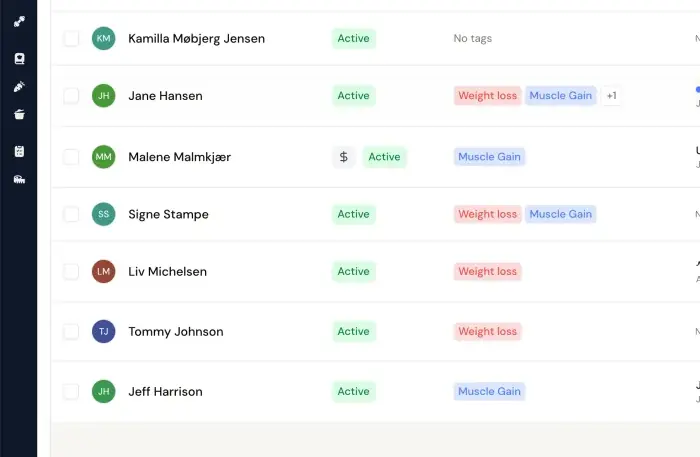
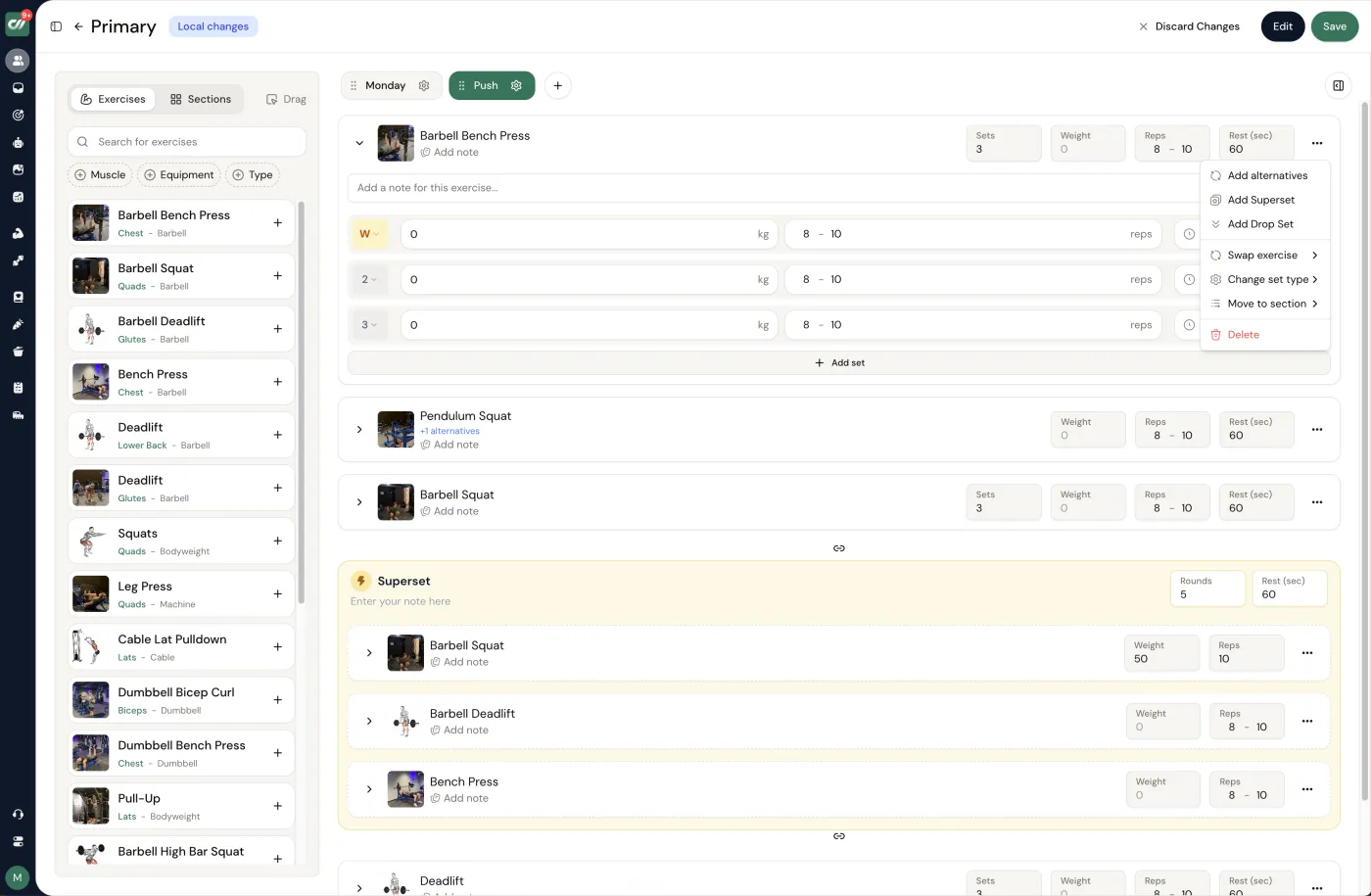
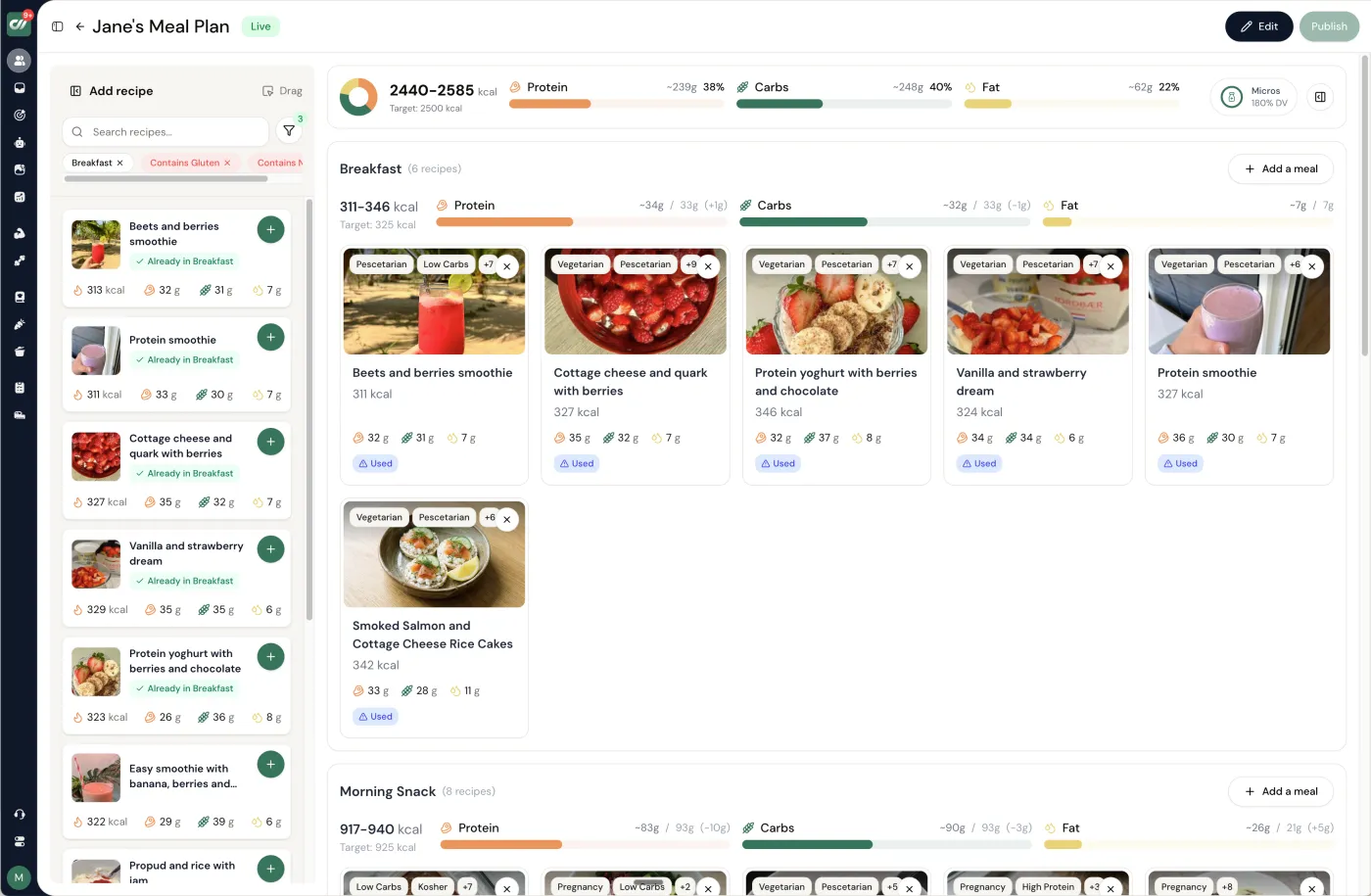
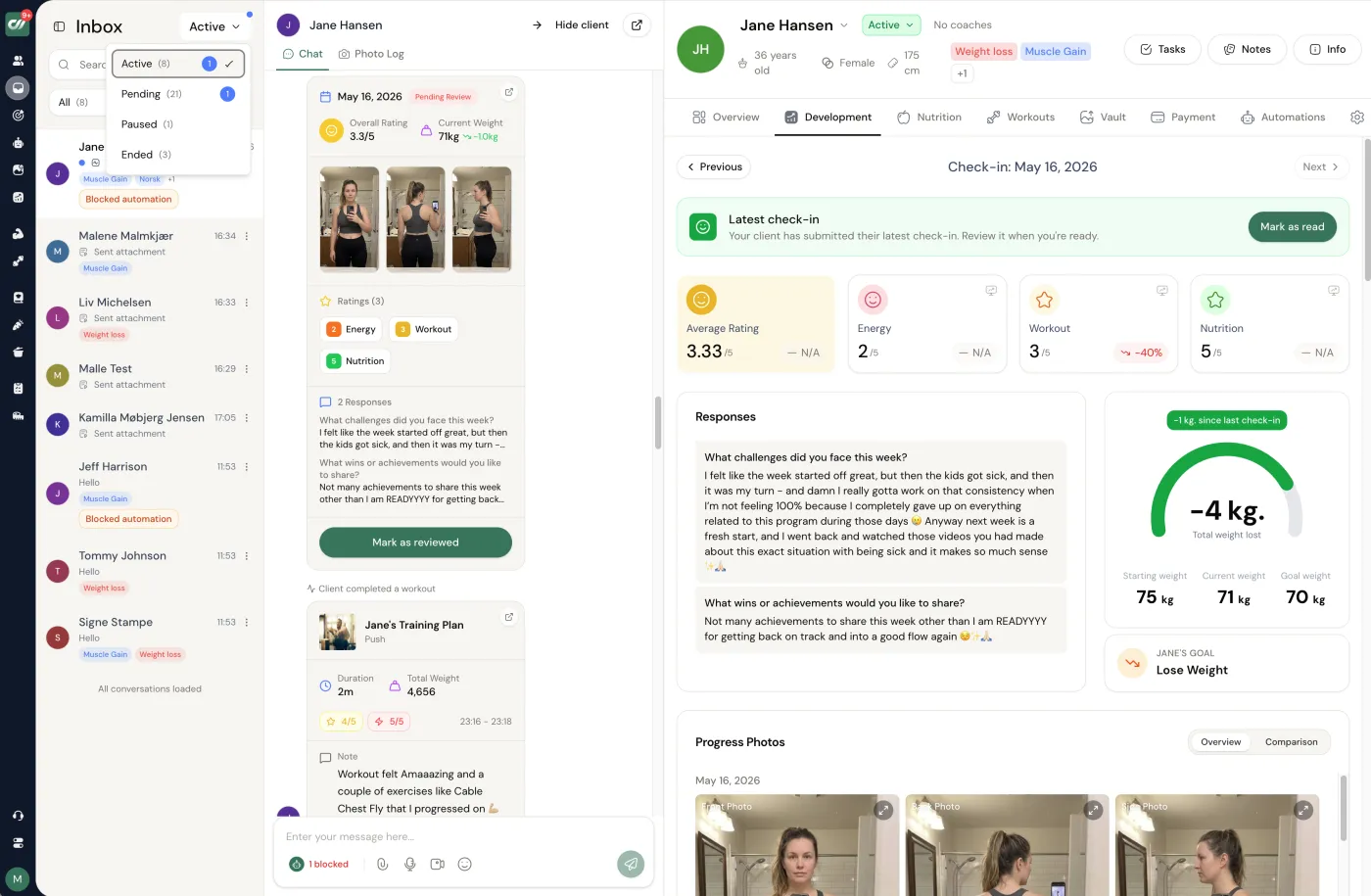
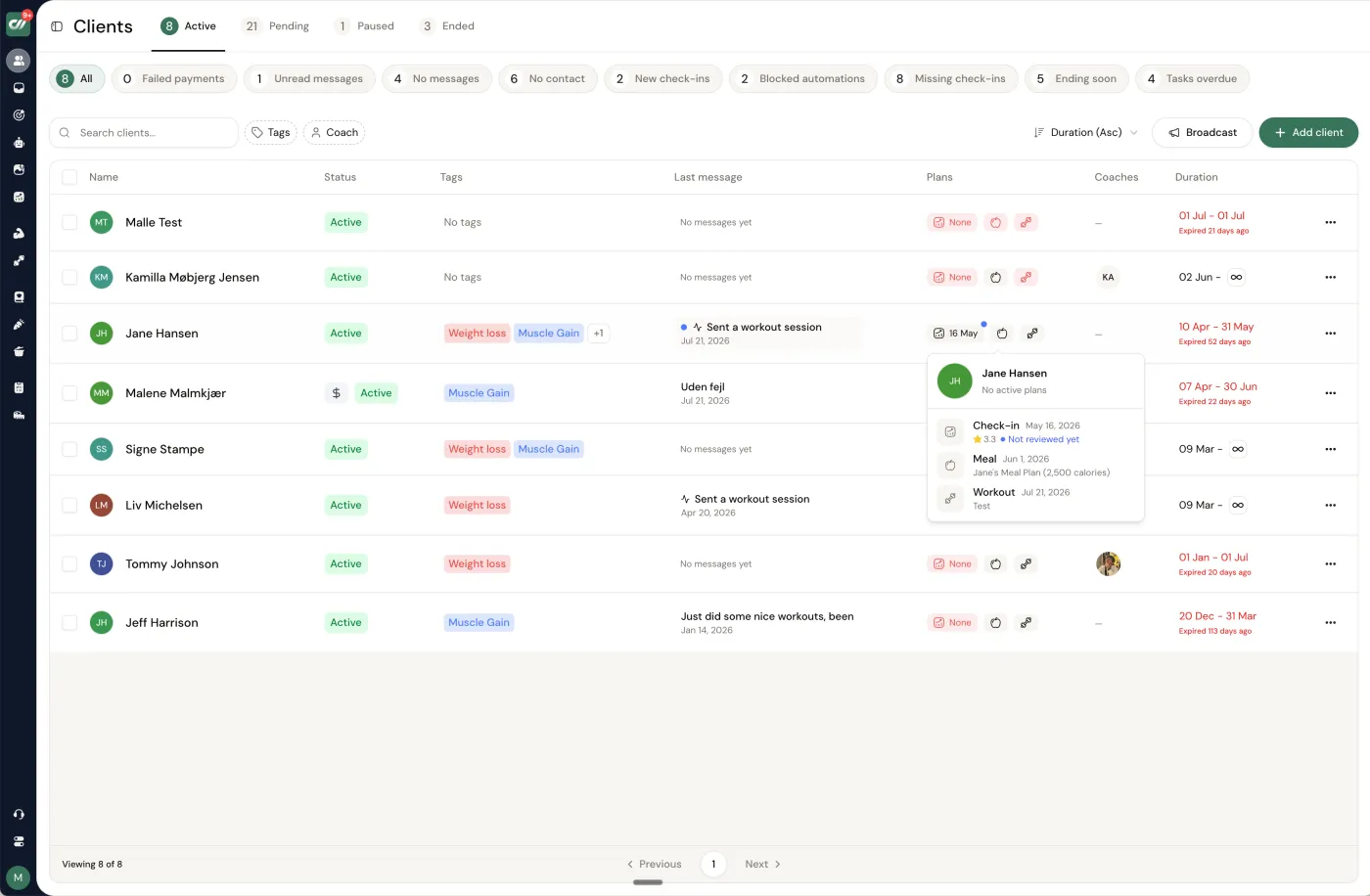
Clients - Every client in one table with status and goal tags - see where all of them stand at a glance.
No charge today - card required, cancel anytime under Billing.
Frequently asked questions.
How much is a personal trainer per month?
It depends on the format. In-person personal training is priced per session, commonly around $40-$120 each, so two to three sessions a week often adds up to several hundred per month. Online coaching is priced monthly instead, typically around $100-$300+ for personalized programming, weekly check-ins, and messaging. These are rough market benchmarks - actual rates vary by country, city, and coach.
How much does online personal training cost?
Most online personal training and coaching packages land somewhere around $100-$300 per month, with closer-support packages that include video form reviews commonly reaching around $400. Premium high-touch 1:1 coaching runs roughly $400-$1,000+ per month, while app-only template programs sit far lower, often around $10-$50. Price tracks the level of real coach contact, not the workouts themselves.
Why do online coaching prices vary so much?
Because you are buying different amounts of a real person. The big drivers are contact level (template vs weekly check-ins vs near-daily access), how customized the plan is, the coach's experience and documented results, their niche, and the market they sell into. A $150 package and a $600 package can both be fairly priced - they are simply different services wearing the same name.
Is a more expensive coach better?
Not automatically. A higher price usually signals more contact, more customization, and stronger demand for that coach - all real things - but it does not guarantee a better outcome for you. Fit matters more: proof with clients like you, a plan built around your life, and the kind of support that fixes the reason you have stalled before. An honest coach will tell you when a cheaper tier, or no coach at all, is enough.
Is online coaching cheaper than in-person training?
Per month, usually yes - but you are buying two different things. An in-person session buys a trainer beside you for an hour, at roughly $40-$120 per session, and the cost scales with every visit. An online package buys a plan, weekly check-ins, and a coach in your pocket across the whole week for one monthly price, typically $100-$300+. Which is worth more depends on how you actually stay consistent.
Is cheap online coaching worth it?
Sometimes. If you are self-motivated and mainly need structure, an app-only plan at $10-$50 per month is genuinely good value - do not pay for coaching you will not use. But if accountability is your failure mode, very cheap "coaching" is often a template with a coach spread across too many clients to notice when you drift. Quitting and restarting twice costs more than one properly supported run.
How much does it cost to become an online fitness coach?
That is the other side of this page: here we cover what it costs to hire a coach, not to become one. The main costs of becoming an online coach are your education (a recognised certification) and the software you run your business on, and the certification route you pick drives most of the number. Online trainer education cost varies widely by that route, so our guide to the best personal trainer certifications for online coaching walks through the recognised options and what each involves. Start there if you are pricing the career rather than the service.
Is an online fitness coach a monthly subscription?
Usually, yes. Online coaching is typically billed as a rolling monthly subscription - one recurring price per month, commonly around $100-$300+ for personalized coaching, covering your programming, the weekly check-in, and messaging in between, rather than a per-session charge like in-person training. Because it renews monthly, many coaches run it month-to-month, though the exact billing terms and any minimum period vary by coach - confirm both before you sign up.
Can ChatGPT tell me what to charge as an online coach?
It can do the arithmetic: given the ranges on this page and your costs, hours, client count and package, it returns a floor price that covers costs and a target price inside the range, with the working shown. It cannot know your market's willingness to pay or what your last three enquiries said, so use it to set the band and let the consultation calls set the number. Verify the working by hand once; models make arithmetic errors without flagging them.
Is a personal trainer worth the cost?
Yes when you will follow the programme and the coach gives you contact every week, which is what the clients who called it worth it were paying for. No when you will stop after a month; one r/loseit poster said their online trainer "wasn't worth it but that was on me", because they got bored of the plan. Decide the three-month test before you pay: twelve weekly check-ins, then a decision on the numbers.
Figures in this article are illustrative market benchmarks for general guidance, not guarantees, quotes, or financial advice. Real coaching prices vary by country, currency, market, coach experience, and service level, and they change over time - always confirm the current price and exactly what it includes with the coach or provider before you commit.
Price is only half of the decision - the other half is whether coaching will actually move you further than going alone. Our honest look at whether online fitness coaching is worth it answers that side, so you can decide with both halves in hand.
Pricing the career instead of the service? The costs of becoming an online coach are a different topic, and our guide to the best personal trainer certifications for online coaching covers the recognised routes and what each involves.
Keep reading
all guidesIs online fitness coaching worth it? An honest coach's answer (2026)
An honest answer for both sides of the decision: what a coach actually gives you that an app or YouTube cannot, who benefits most, who should keep their money, what it costs vs in-person - and whether it is worth it as a career for coaches.
Read the guideOnline personal training vs in-person training: which is right for you (2026)
Online and in-person training are not better or worse - they are different tools for different people. This is the honest comparison: accountability, cost, flexibility, results, and (for coaches) scalability, with a fair look at what in-person does that online cannot, where online wins, who each suits, and the hybrid middle ground that often beats picking one.
Read the guideHow much to charge for personal training (2026)
Per-session and package benchmarks, online vs in-person rates, the math for setting your personal training price, and when to raise it.
Read the guideHow to price your online coaching packages (2026 guide)
Most coaches do not have a pricing problem - they have an anchoring problem: they price the hours instead of the outcome, sell one-off blocks instead of recurring commitments, and never raise the number even when the waitlist says they should. This guide covers value-based vs cost-plus pricing, building good/better/best tiers, why monthly recurring wins, when to raise your prices, charging what your time is genuinely worth, and how predictable platform costs protect your margin.
Read the guideFree tools for this: Coaching Tool Stack Cost Calculator · Coaching Profit Calculator · Client Capacity Calculator
One question that now arrives alongside price is "why pay when ChatGPT does this?"; the honest answer, and what to say when a client shows up with an AI plan, is in when a client uses ChatGPT for their diet or program.
See what Coachway can do for your coaching business
Coachway was built on knowledge from working with 150 online coaches over 6+ years, who all hit the same wall - slow platforms, clunky workflows, wasted hours. Start your 14-day free trial and see what we fixed - the whole platform, no charge today, cancel anytime under Billing.


