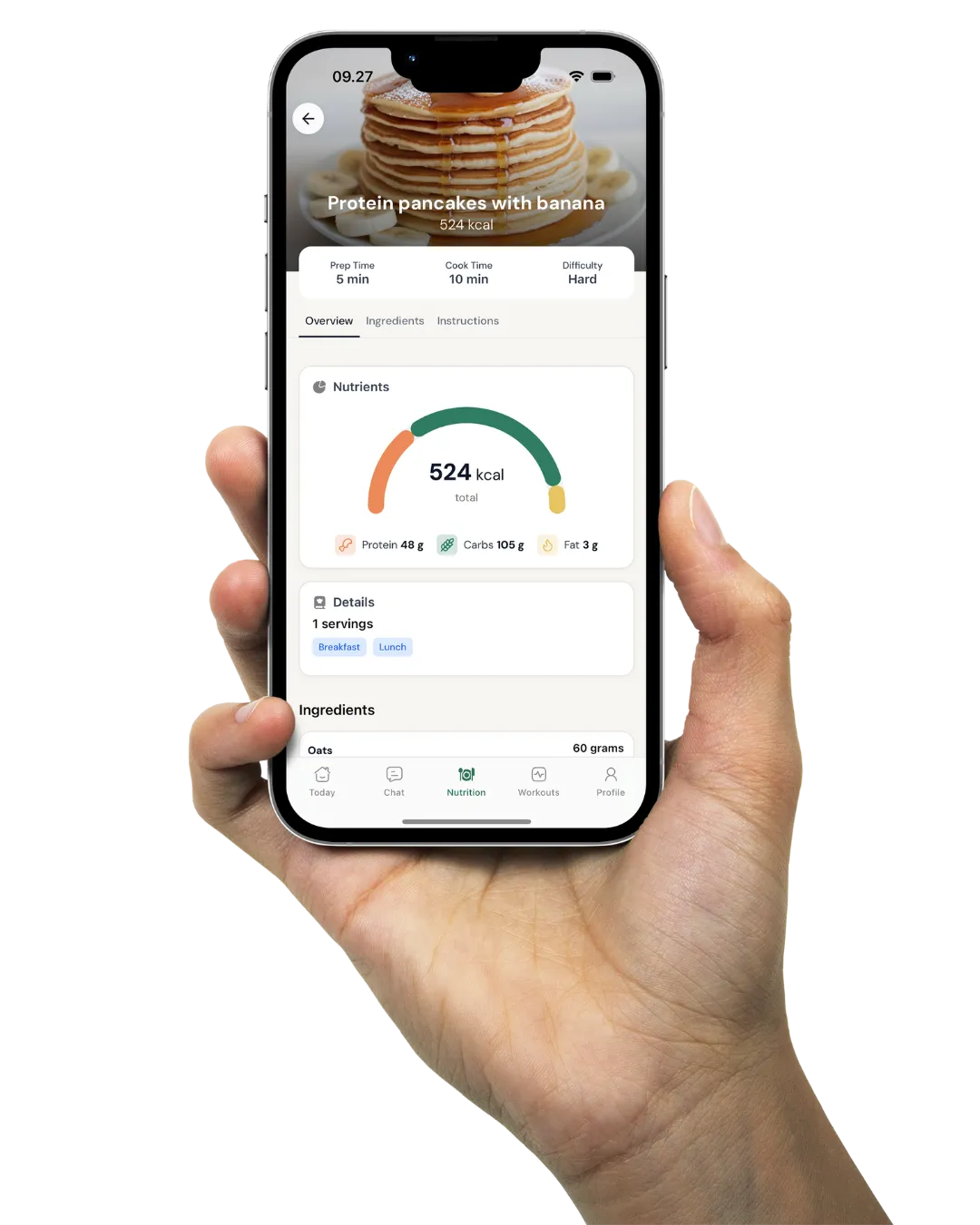
Online fitness coaching statistics 2026. First-party benchmarks from 201 Nordic coaches, plus the sourced market numbers.
Most online fitness coaching statistics are recycled salary figures with no method behind them. So we queried our own database instead. In August 2026 we pulled aggregated, anonymized numbers from Nordic coach and client accounts on the Coachway platform across Denmark, Norway, Sweden and Finland: how many clients a coach runs, what a client pays per month, how often coaches check in, how long clients stay, and how many are still active a year in. Every first-party figure carries its exact definition and sample size. The market-size and earnings figures further down are third-party and linked to their source. For the business behind these numbers, read our online fitness coaching guide.
By Markus Evers · Published August 2026 · Updated 6 September 2026
the short version
The median online fitness coach runs 5 active clients (average 17.2), charges EUR 181 per client per month, and checks in weekly. Clients stay an average of 4.3 months, and 45% of clients are still active at month 12. Source: 201 Nordic coach accounts and 5,666 clients on the Coachway platform, August 2026.
These are first-party pulls from the Coachway database, not survey estimates or modelled numbers. Every figure carries its definition and sample size, and the methodology is spelled out below.
Online fitness coaching statistics at a glance.
Fourteen figures, each written to stand on its own with its source and sample size attached. Quote any of them with attribution.
- 01
The median online fitness coach runs 5 active clients; the average is 17.2 (Coachway, 201 Nordic coaches, August 2026).
- 02
81% of online fitness coaches run fewer than 20 active clients; 4% run 100 or more (Coachway, n=201).
- 03
The median price for online fitness coaching is EUR 181 per client per month; the interquartile range is EUR 134 to EUR 255 (Coachway, 1,563 pricing records).
- 04
37% of online coaches have charged at least one client a one-time startup fee (Coachway, n=79 coaches with pricing configured).
- 05
A median online coach earns about EUR 905 per month in client revenue; 20 clients at the median price is EUR 3,620 (derived from Coachway medians).
- 06
99% of online coaches keep a weekly client check-in schedule (Coachway, default cadence per account).
- 07
Online coaching clients stay an average of 4.3 months; the upper quartile is 5.6 months (Coachway, 5,666 clients).
- 08
Online coaching client retention is 94% at month 1, 82% at month 3, 65% at month 6 and 45% at month 12 (Coachway, n=5,666).
- 09
That retention curve implies roughly 6.4% average monthly client attrition in year one, steepest in months 3 to 6 (derived).
- 10
Trainers who coach online average USD 52,518 a year, 52% more than in-person-only trainers at USD 34,585 (thePTDC Salary Survey).
- 11
86% of fitness and nutrition coaches earning six figures train clients online (thePTDC Salary Survey).
- 12
The share of personal trainers offering online coaching rose from 39% pre-COVID to 83% by August 2020 (thePTDC).
- 13
The global coaching industry generated USD 5.34 billion in 2025 across 122,974 practitioners (ICF / PwC).
- 14
The virtual and online fitness market is USD 43.78 billion in 2026, projected to reach USD 311.91 billion by 2034 (Fortune Business Insights).
Six first-party benchmarks for an online fitness coach.
One figure per question. Each is the median or most common value in its sample, with the full distribution in the sections below.
5
active clients
median per coach (average 17.2)
EUR 181
per client / month
median per-client price
99%
check in weekly
default schedule, platform-wide
4.3 mo
average client tenure
start date to end date
45%
active at month 12
Nordic client retention
37%
charge a startup fee
at least one client, one time
How many clients does an online fitness coach have?
The median online fitness coach has 5 active clients and the average has 17.2, across 201 Nordic coach accounts with at least one active client on the Coachway platform in August 2026. The gap between those two numbers is the whole story: a long tail of large client lists, topped by a single coach at 295 active clients, pulls the average far above the middle. 81% of coaches run fewer than 20 active clients.
| Active clients | Share of coaches | What this band tends to look like |
|---|---|---|
| Under 20 | 81% | The large majority. Early-stage or high-touch, often still building their client list. |
| 20 to 49 | 11% | Established solo coaches running a steady book on a repeatable weekly workflow. |
| 50 to 99 | 4% | Systemized operators leaning on templates and one inbox to hold quality. |
| 100 or more | 4% | Built for scale, frequently with an assistant coach and automated onboarding. |
Read the shape, not just the median. The sample spans coaches at every stage, from a first client to 295, so the median of 5 describes the whole platform while established coaches most often sit in the 20 to 49 band. What the data shows cleanly is the shape: a small number of large client lists and a broad base of coaches under 20 clients.
Where the ceiling actually comes from, workflow rather than hours, is covered in our guide to how many clients an online coach can handle, and you can pressure-test your own number with the client capacity calculator.
How much do online fitness coaches charge per client per month?
Online fitness coaches charge a median of EUR 181 per client per month (DKK 1,350), based on 1,563 active per-client pricing records from Nordic coaches on the Coachway platform in August 2026. The lower quartile is EUR 134 and the upper quartile is EUR 255, so half of all prices sit between EUR 134 and EUR 255. European per-client pricing is one of the hardest numbers to find sourced anywhere, which is why we publish the quartiles rather than a single average.
| Where a price sits | Per client / month | Meaning |
|---|---|---|
| Lower quartile (P25) | EUR 134 | A quarter of prices sit at or below this. |
| Median | EUR 181 | The middle price (DKK 1,350). Half above, half below. |
| Upper quartile (P75) | EUR 255 | A quarter of prices sit at or above this. |
A related question is the one-time joining fee. Among 79 Nordic coaches with pricing configured, 37% have charged at least one client a one-time startup fee and 63% have not. That is a smaller sample than the pricing records, so treat the split as directional rather than precise: it tells you a startup fee is common but far from universal, not that the exact figure is nailed down.
For context, the platform these numbers come from costs EUR 69 per month for up to 5 clients plus EUR 9 per additional client, with every feature included and a 14-day free trial (card required). To set your own rate, work through our guide to how much an online fitness coach costs, price a package with the coaching rate calculator, and read how to price online coaching packages.
How much revenue does an online fitness coach make per month?
A median online fitness coach makes about EUR 905 per month in client revenue (5 clients at EUR 181), and a coach at the platform average of 17.2 clients makes about EUR 3,100 per month. These figures are derived by multiplying the first-party client-count and price medians, not measured directly, and they are gross client revenue before software, payment fees and tax. The table shows what each client-count band produces at the lower-quartile, median and upper-quartile price.
| Active clients | At P25 price (EUR 134) | At median price (EUR 181) | At P75 price (EUR 255) |
|---|---|---|---|
| 5 (median coach) | EUR 670 / month | EUR 905 / month | EUR 1,275 / month |
| 10 | EUR 1,340 / month | EUR 1,810 / month | EUR 2,550 / month |
| 20 | EUR 2,680 / month | EUR 3,620 / month | EUR 5,100 / month |
| 50 | EUR 6,700 / month | EUR 9,050 / month | EUR 12,750 / month |
| 100 | EUR 13,400 / month | EUR 18,100 / month | EUR 25,500 / month |
How to read this. The 20-client row at the median price, EUR 3,620 per month or about EUR 43,000 per year, is the most useful benchmark for an established solo coach, because 20 to 49 clients is where established Nordic coaches cluster. The 5-client row describes the median account across the whole platform, not a career income. For comparison, thePTDC's salary survey puts the average trainer who coaches online at USD 52,518 per year.
Model your own numbers with the personal trainer income calculator and the coaching revenue projector, then see what that means for take-home in how much online fitness coaches make.
How often do online coaches check in with clients?
Online coaches check in with clients weekly in 99% of cases, based on the default check-in schedule configured on Nordic coach accounts on the Coachway platform in August 2026. Only 0.4% of accounts run a biweekly schedule and 0.4% a monthly one.
| Default cadence | Share of coach accounts |
|---|---|
| Weekly | 99% |
| Biweekly | 0.4% |
| Monthly | 0.4% |
What this figure is, and is not. Weekly is the platform default, and nearly every coach keeps it. So the honest reading is not "99% of the coaching industry checks in weekly". It is that a systematized weekly rhythm is the norm on a platform built around one, and that almost no coach here deliberately spaces check-ins further apart. It is a statement about how the tool is configured, not a measured behaviour across the whole market.
The workflow behind a good weekly check-in is in our guide to how to run client check-ins as an online coach, with ready-made client check-in questions. On Coachway the weekly rhythm behind that 99% figure runs on scheduled coaching automations, so the default cadence holds without manual reminders.
Benchmarks tell you what is normal. Your own clients' check-ins tell you who needs you this week.
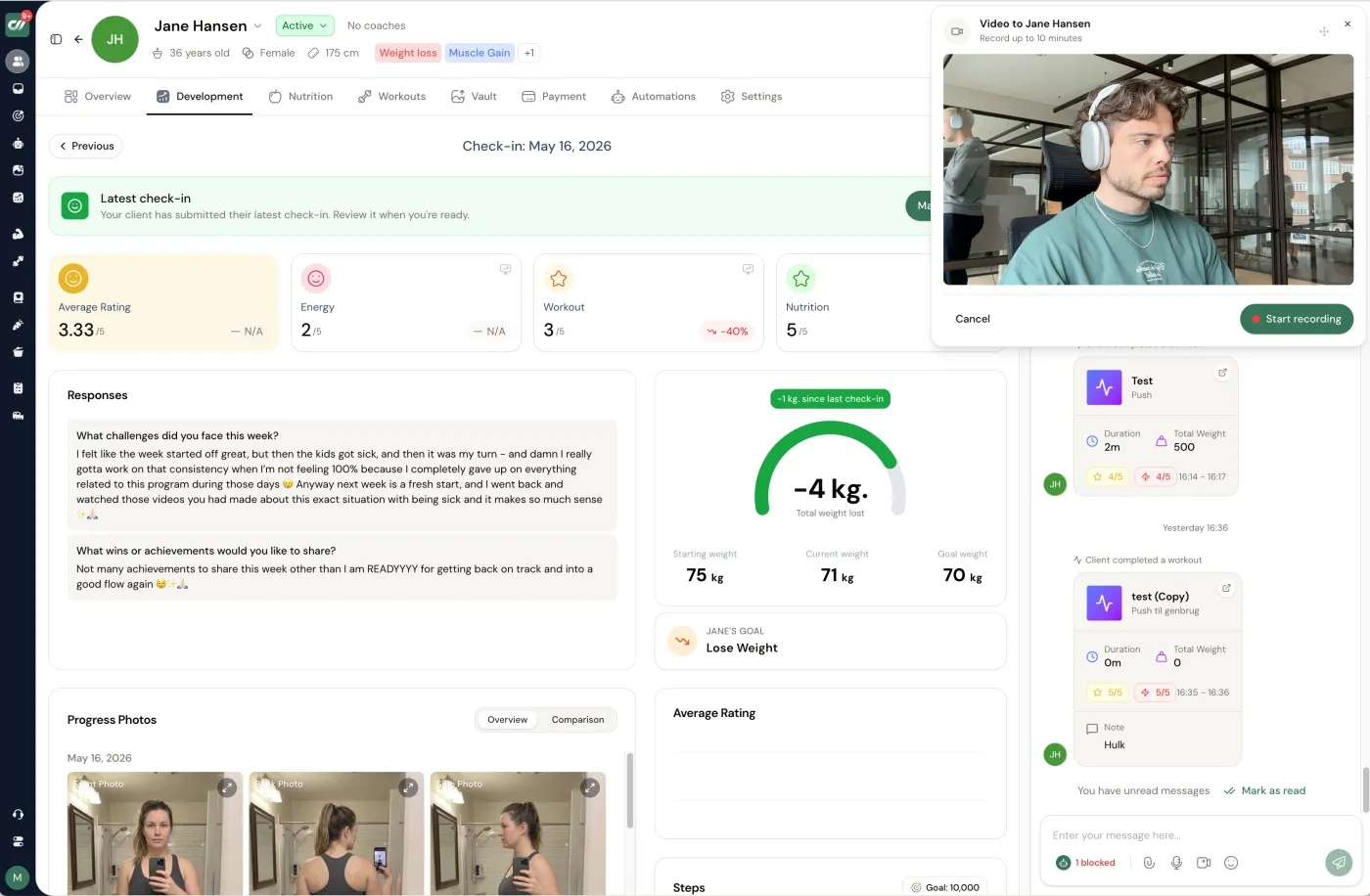
The figures on this page are medians and averages pooled across many coaches, so the useful next step is to read the same signals for your own clients: whether each one actually sends the weekly check-in, how their measurements and progress photos are trending, and how long they have been with you. Keep that per client, in one place, rather than spread across forms, spreadsheets and chat threads. In Coachway the Power Panel puts each client's numbers, progress photos, training log and latest messages on one screen with auto-charts from their check-ins, so a missed week or a stalled trend is visible before it turns into a cancellation.
How long do online coaching clients stay?
Online coaching clients stay an average of 4.3 months, measured from each client's start date to their end date across 5,666 Nordic clients on the Coachway platform in August 2026, with still-active clients counted to the snapshot date. The median is 3.2 months, the lower quartile is 1.3 months and the upper quartile is 5.6 months. The quartiles show how wide the spread is. For a package structure built around that 4.3-month average, see personal training packages.
| Statistic | Tenure | Meaning |
|---|---|---|
| Lower quartile (P25) | 1.3 months | A quarter of clients stayed this long or less. |
| Median | 3.2 months | The middle client. Half stayed longer, half shorter. |
| Average | 4.3 months | Pulled above the median by long-staying clients. |
| Upper quartile (P75) | 5.6 months | A quarter of clients stayed this long or more. |
How to read this. The average sits above the median because a long tail of clients stays well past a year, which is also what the retention curve below shows: 45% are still active at month 12. Still-active clients are counted only up to the snapshot date, so every figure here grows as those relationships continue.
Why clients leave, and what a coach can do in the first weeks, is covered in why online coaching clients quit.
What is the client retention rate for online fitness coaching?
Online fitness coaching client retention on the Coachway platform is 94% at month 1, 82% at month 3, 65% at month 6 and 45% at month 12, measured across 5,666 Nordic clients with a recorded start date in August 2026. We show the Coachway curve on its own: there is no verified industry benchmark worth comparing it against, so we do not manufacture one. To compare your own retention with this figure, the seven coaching business numbers guide gives the churn and tenure formulas and a ChatGPT prompt that runs them on an anonymised export.
94%
active at month 1
82%
active at month 3
65%
active at month 6
45%
active at month 12
| Period | Retention, start to end | Implied attrition per month |
|---|---|---|
| Month 0 to 1 | 100% to 94% | 6.0% |
| Month 1 to 3 | 94% to 82% | 6.6% |
| Month 3 to 6 | 82% to 65% | 7.5% |
| Month 6 to 12 | 65% to 45% | 5.9% |
| Whole first year | 100% to 45% | 6.4% average |
The attrition column is derived from the curve (the constant monthly rate that would produce each drop), not a directly measured churn rate, and Coachway has not published a measured churn figure. The shape is the useful part: the riskiest stretch is months 3 to 6, after the novelty fades and before results compound. A plausible reading, which we hold as a hypothesis rather than proven cause, is that the near-universal weekly check-in rhythm on the platform helps hold clients through the early months where coaching most often falls apart. For the underlying concepts, see our explainers on client retention rate and client churn rate, and run your own numbers in the client churn rate calculator.
How big is the online fitness coaching industry?
The global coaching industry generated USD 5.34 billion in 2025 across a record 122,974 practitioners (ICF and PwC), the US personal training market is worth USD 11.9 billion in 2025 (IBISWorld), and the virtual and online fitness market is valued at USD 43.78 billion in 2026 with a forecast of USD 311.91 billion by 2034 (Fortune Business Insights). Online is also where the money moved: 86% of trainers and nutrition coaches earning six figures train clients online, and online trainers average USD 52,518 a year against USD 34,585 for in-person-only trainers (thePTDC). Each figure below is attributed to a named source with a link; where a forecast is involved, the base year and growth rate are shown.
| Statistic | Figure | Context | Source |
|---|---|---|---|
| Global coaching industry revenue | USD 5.34B (2025) | The number of coach practitioners rose 15% since 2023, to a record 122,974 worldwide. | ICF / PwC, 2025 Global Coaching Study |
| Online coaching software market | USD 3.7B (2024) | Projected to reach USD 10.4B by 2034, a 10.9% CAGR. | Market.us, 2024 |
| Trainers who went online | 39% to 83% | Share of personal trainers offering online coaching, before COVID vs August 2020. | thePTDC, 2020 |
| Online trainers earn more | USD 52,518 | Average for trainers who coach online vs USD 34,585 in-person only, about 52% higher. | thePTDC Salary Survey |
| Six-figure earners coach online | 86% | Of trainers and nutrition coaches earning six figures a year train clients online. | thePTDC Salary Survey |
| US fitness trainer jobs | 370,100 (2024) | Employment projected to grow 12% by 2034, much faster than average. | US Bureau of Labor Statistics |
| US personal training market | USD 11.9B (2025) | Across roughly 329,302 trainer businesses. | IBISWorld, 2025 |
| Global personal trainer market | USD 45.6B (2025) | Forecast to reach USD 48.0B in 2026 and USD 80.5B by 2036, a 5.3% CAGR. | Future Market Insights, 2026 |
| Virtual and online fitness market | USD 43.78B (2026) | Projected to reach USD 311.91B by 2034, a 27.82% CAGR, the fastest-growing slice of fitness. | Fortune Business Insights, 2026 |
How many online fitness coaches are there? Nobody counts them directly. The nearest hard numbers are 370,100 fitness trainer and instructor jobs in the United States in 2024 (BLS, projected to grow 12% by 2034), 329,302 US personal-trainer businesses (IBISWorld 2025), and the jump from 39% to 83% of personal trainers offering online coaching between early 2020 and August 2020 (thePTDC). Our own first-party sample is 201 Nordic coaches using Coachway with active clients.
If you are weighing the move, start with how to become an online fitness coach and the true cost of running an online coaching business.
Where does this data come from?
The first-party figures come from a single August 2026 snapshot of the Coachway platform database. The frame is Nordic coach and client accounts in Denmark, Norway, Sweden and Finland. Everything is aggregated across the group and anonymized: we never report an individual coach or client. Prices are stored in Danish kroner and converted to euro at 7.46 DKK per EUR, the June 2026 rate. Where a distribution is skewed by very new coaches and recent clients, we lead with the median rather than the average, because the median is the honest description of a typical account. Each metric states its own sample size, because the samples are not the same: pricing, tenure and client counts each come from a different slice of the database. Market figures are third-party and linked to their source in the table above.
| Metric | Sample (n) | What it measures |
|---|---|---|
| Active clients per coach | 201 coaches | Coach accounts with at least one active (non-archived) client, counted per account. |
| Price per client / month | 1,563 records | Active, non-archived per-client monthly prices, stored in DKK and converted to EUR at 7.46. |
| One-time startup fee | 79 coaches | Coaches with pricing configured, split by whether any client was ever charged a one-time startup fee. |
| Check-in cadence | per account | The default check-in schedule configured on each coach account. |
| Client tenure | 5,666 clients | Days from a client's start date to their end date; still-active clients measured to the snapshot date. |
| Retention curve | 5,666 clients | Share of clients with a recorded start date still active at each month milestone. |
| Revenue and attrition tables | derived | Computed from the medians and the retention curve above; labelled as derived wherever they appear. |
How to cite this report
Coachway (2026). Online Fitness Coaching Statistics 2026: First-Party Data from Nordic Coaches. August 2026 platform snapshot. https://coachway.io/articles/online-fitness-coaching-statistics/
Every first-party figure may be quoted with attribution. Please keep the sample size and the Nordic scope attached to the number, and link to this page so readers can see the definitions.
What can this data say, and what can it not?
A statistics page is only as trustworthy as its limitations section. Here is where this snapshot is strong, where it is biased, and what we deliberately left out.
It is a point-in-time snapshot
Every figure describes the platform on one date in August 2026. Still-active clients are counted to that date, so tenure and retention grow as those relationships continue, and the client-count bands include coaches at every stage, from first client to 295.
Configured defaults are not behaviour
The 99% weekly check-in figure is the default schedule set on each account, on a platform whose default is weekly. It tells you how coaches set the tool up. It is not a measured count of how often every check-in was actually completed across the market.
It is Nordic and platform-specific
Every first-party figure describes coaches and clients in Denmark, Norway, Sweden and Finland on one platform. It is a clean, sourced view of that group, not a global census. Prices in particular reflect Nordic willingness to pay, converted from DKK at a single June 2026 rate.
What we deliberately did not publish
No measured churn rate: the way we measure it is still under investigation, so the attrition figures above are derived from the retention curve and labelled as such. No messages-per-week, reply time, check-in completion, or admin-time-saved figures: that data is not in the database, so we will not estimate it. And no invented market-size or benchmark numbers; every market figure is third-party and linked.
Frequently asked questions about online fitness coaching statistics.
How many clients does the average online fitness coach have?
The median online fitness coach has 5 active clients and the average has 17.2, according to an August 2026 first-party pull of 201 Nordic coach accounts on the Coachway platform. The largest single coach ran 295 active clients. The distribution is heavily skewed: 81% of coaches ran under 20 active clients, 11% ran 20 to 49, 4% ran 50 to 99, and 4% ran 100 or more. Established coaches most often sit in the 20 to 49 band.
How much do online fitness coaches charge per client per month?
Online fitness coaches charge a median of EUR 181 per client per month (DKK 1,350), based on 1,563 active per-client pricing records from Nordic coaches on Coachway in August 2026. The lower quartile is EUR 134 and the upper quartile is EUR 255, so half of all prices sit between EUR 134 and EUR 255. In addition, 37% of coaches with pricing configured have charged at least one client a one-time startup fee (n=79).
How much revenue does an online fitness coach make per month?
A median online fitness coach makes about EUR 905 per month in client revenue (5 clients at EUR 181), while a coach at the platform average of 17.2 clients makes about EUR 3,100 per month, derived from the August 2026 Coachway data. At 20 clients and the median price the figure is EUR 3,620 per month; at 50 clients it is EUR 9,050; at 100 clients it is EUR 18,100. These are gross client revenues before software, tax and payment fees, computed from the first-party client-count and price medians rather than measured directly.
How long do online coaching clients stay?
Online coaching clients stay an average of 4.3 months, based on 5,666 Nordic clients on the Coachway platform measured from start date to end date in August 2026. The median is 3.2 months, the lower quartile is 1.3 months and the upper quartile is 5.6 months, so a quarter of clients stay longer than five and a half months. Still-active clients are counted to the snapshot date, so the figure grows as those relationships continue.
What is the client retention rate for online fitness coaching?
Online fitness coaching client retention on the Coachway platform is 94% at month 1, 82% at month 3, 65% at month 6 and 45% at month 12, measured across 5,666 Nordic clients with a recorded start date in August 2026. That curve implies an average monthly attrition of about 6.4% over the first year, steepest between months 3 and 6 (about 7.5% per month) and flattest after month 6 (about 5.9% per month). Coachway has not published a directly measured churn rate; the attrition figures are derived from the curve.
How often do online coaches check in with clients?
Online coaches check in with clients weekly in 99% of cases, based on the default check-in schedule configured on Nordic coach accounts on the Coachway platform in August 2026. Only 0.4% of accounts use a biweekly schedule and 0.4% a monthly one. Weekly is the platform default and nearly all coaches keep it, so this describes how the tool is configured rather than a measured industry-wide behaviour.
How many online fitness coaches are there?
There is no census of online fitness coaches, but the surrounding numbers are: 122,974 coach practitioners worldwide across all coaching disciplines (ICF and PwC 2025 Global Coaching Study, up 15% since 2023), 370,100 fitness trainer and instructor jobs in the United States in 2024 (US Bureau of Labor Statistics, projected to grow 12% by 2034), and 329,302 personal-trainer businesses in the US (IBISWorld 2025). The share of personal trainers offering online coaching rose from 39% before COVID to 83% by August 2020 (thePTDC). The Coachway first-party sample covers 201 Nordic coach accounts with active clients.
How big is the online fitness coaching industry?
The global coaching industry generated USD 5.34 billion in revenue in 2025 (ICF and PwC), the US personal training market is worth USD 11.9 billion in 2025 (IBISWorld), and the global personal trainer market is USD 45.6 billion in 2025, forecast to reach USD 80.5 billion by 2036 (Future Market Insights). The virtual and online fitness market is valued at USD 43.78 billion in 2026 and projected to reach USD 311.91 billion by 2034, a 27.82% CAGR (Fortune Business Insights). Software for coaches is a USD 3.7 billion market in 2024 heading to USD 10.4 billion by 2034 (Market.us).
Do online fitness coaches earn more than in-person trainers?
Yes. Trainers who coach online average USD 52,518 per year versus USD 34,585 for in-person-only trainers, about 52% more, and 86% of trainers and nutrition coaches earning six figures a year train clients online (thePTDC Salary Survey). In Nordic first-party data, the median per-client price online is EUR 181 per month, so 20 clients at the median price produces about EUR 3,620 per month in client revenue.
Where does this online fitness coaching data come from?
The first-party figures come from an August 2026 snapshot of the Coachway platform database covering Nordic coach and client accounts in Denmark, Norway, Sweden and Finland, aggregated and anonymized, each reported with its exact definition and sample size (201 coaches, 1,563 pricing records, 79 coaches with pricing configured, 5,666 clients). Prices are stored in DKK and converted at 7.46 DKK per EUR, the June 2026 rate. Market figures are third-party and attributed to ICF/PwC, Market.us, thePTDC, the US Bureau of Labor Statistics, IBISWorld, Future Market Insights and Fortune Business Insights with a link to each source.
How do I cite these statistics?
Cite as: Coachway (2026), "Online Fitness Coaching Statistics 2026: First-Party Data from Nordic Coaches", August 2026 platform snapshot, https://coachway.io/articles/online-fitness-coaching-statistics/. Every first-party figure may be quoted with attribution; please keep the sample size and the Nordic scope attached to the number.
Keep reading
all guidesHow many clients can an online coach handle? (2026)
Solo online coaches handle 20 to 40 high-touch clients without systems, 50 to 80 with structured check-ins, and 100+ only when built to scale.
Read the guideHow much do online fitness coaches make?
The honest range from beginner to established, the three levers that set your income (price x retention x client count), the per-client math, and a calculator to model your own.
Read the guideClient retention rate: how to calculate it (with coaching benchmarks, 2026)
Client retention rate is one of the most important numbers in a coaching business. Here is the exact formula with a worked example, what counts as a good rate for online coaches, and the levers that move it.
Read the guideFree tools for this: TDEE Calculator · One-Rep-Max Calculator · Macro Calculator
The workflow behind these numbers, in one tab
Client profiles, per-client pricing, weekly check-ins, and payments through your own Stripe, with everything around one client on a single screen. Start the 14-day free trial and move one client over: no charge today, cancel anytime under Billing.