


Weekly check-in questions for fitness clients - a coach's question bank.
These are the weekly check-in questions for fitness clients that actually earn their place on the form: a curated bank across adherence, training, nutrition, sleep, stress, progress and blockers, with the reason each one is worth asking. Steal the questions you need, keep a small fixed core, and use the reasoning to cut anything that is only there out of habit.
By Markus Evers · Updated August 2026
the short version
A good weekly check-in for a fitness client is 8 to 12 questions: a fixed core you ask every week (adherence, weight trend, training completed, one win, one obstacle, next week's plan) plus one or two situational questions from the categories below. Keep the core identical so answers line up into a trend, and finish on a forward-looking question.
What makes a check-in question worth asking?
A check-in question earns its place if the answer changes what you do next. That is the whole test. A question that produces a number you never act on, or a "yeah, good week" you cannot coach, is just friction between the client and the send button - and every extra question you add is one more reason a busy person answers in a hurry or not at all. The best banks are short on purpose: a small, fixed core that lets you compare this week to last, and a few situational questions on top for whatever the client is actually working on this block.
Two design choices do most of the work. First, ask the honest questions on a scale, not as pass or fail. "How closely did you follow the plan this week, one to ten?" gives a client permission to report a 6 without feeling they have failed you, and a 6 you can see is worth infinitely more than a "great week" that was not. Second, make sure the answer to every question is safe to give - you are diagnosing the plan, not grading the person - because a client who trusts you with the real number is the only client you can genuinely help. If you want the plain-English version of why this recurring touchpoint matters at all, the definition of a client check-in sets the frame; this page is the questions that fill it.
One more thing before the bank. Do not ask all of these at once. Pick a core of five or six, add two or three that fit your niche, and leave the rest here to pull from when a client's situation changes. A physique client deep in a cut needs the hunger and sleep questions; a general-health client rebuilding a routine needs the adherence and stress ones. Same spine, different emphasis.
The weekly check-in question bank, by category.
Seven categories. Under each, the questions worth asking and, in italics, the reason each one is on the form. The starred questions are the fixed core most coaches should ask every single week.
1. Adherence and the week overall
-
How closely did you follow the plan this week, one to ten? (core)
The single most predictive question you can ask. A scale beats yes or no because it lets a client be honest about a partial week, and the number gives you a trend line - three 5s in a row is a plan problem, not a motivation problem.
-
On a scale of one to ten, how was your week overall? (core)
Catches the life context the plan numbers miss. A great adherence score in a 3-out-of-10 week tells you the client is white-knuckling it, and that is a client heading for a crash you can prevent.
-
What is one thing that went well this week?
Forces a win onto the page even in a hard week, which is both good for the client's morale and a real signal for you - the thing they are proud of is the behaviour to reinforce.
2. Training
-
How many of your planned sessions did you complete? (core)
A hard number, not a feeling. Four of four is a green light to progress; two of four for a second week running means the programme is too ambitious for this client's real life, and you fix the schedule, not the client.
-
How did the sessions feel, one to ten, and where did you struggle?
Effort and difficulty in one answer. A run of easy weeks says it is time to add load; a sudden spike in how hard everything feels is an early flag for under-recovery or life stress.
-
Any pain, niggles or joints you want me to know about?
The safety question. Catching a small niggle now and swapping an exercise beats losing three weeks to an injury you could have programmed around, and it tells the client you are paying attention to their body, not just their numbers.
-
Did you beat any of last week's numbers?
Progression made visible. Clients forget they added a rep or 2.5 kg; naming it turns invisible progress into the motivation that keeps them logging.
3. Nutrition
-
How consistent was your food logging or plan this week, one to ten?
Nutrition adherence deserves its own rating because it fails differently from training - a client can hit every session and still be nowhere near their targets. This number tells you which lever actually moved.
-
Where did eating go sideways, and what was going on?
The situational question. "Friday work drinks" and "I skipped lunch and was starving by 4pm" need completely different fixes, and you only get there by asking about the situation, not the willpower.
-
How were your hunger and energy this week?
The dashboard light for whether targets are set right. Persistent gnawing hunger on a cut, or flat energy on a build, is a sign to adjust the numbers before adherence collapses on its own.
-
Did you hit your protein and step targets most days?
The two habits that carry most outcomes. Asking about them specifically keeps them front of mind and gives you a simpler thing to reinforce than a full macro breakdown.
4. Sleep and recovery
-
Roughly how many hours did you sleep on an average night?
The variable that quietly explains a bad training and nutrition week at once. A client sleeping five hours is not lazy about their sessions; they are under-recovered, and the fix lives here, not in the programme.
-
How rested and recovered do you feel, one to ten?
Perceived recovery adds the context raw hours miss. Eight broken hours with a newborn is not the same as eight solid ones, and this answer tells you which week you are actually coaching.
5. Stress and life load
-
How stressful was your week outside training, one to ten?
Life is the real programme variable. A high-stress week is a week to protect the minimum rather than push a personal best, and knowing it lets you adjust the ask instead of watching adherence quietly fall.
-
Is anything coming up next week I should plan around?
Turns the check-in forward. A work trip, a wedding or a deadline you know about in advance becomes a plan you build together, which is the difference between a client who navigates a hard week and one who disappears through it.
6. Progress and the body
-
What is your average weight or key measurement this week? (core)
A weekly average, not a single morning, so daily noise does not read as a trend. This is the objective anchor the whole review hangs on, and it only works if you ask for it the same way every week.
-
Progress photos this week? (front, side, back)
The scale lies during recomposition; photos and the mirror often tell the truer story. Reviewing them next to the weight trend is how you reassure a client the plan is working when the number stalls.
-
How are your clothes fitting and how do you feel in the mirror?
The non-numeric progress that keeps people going. Some of the best weeks show nothing on the scale and everything in how a client feels getting dressed, and that answer is worth surfacing on purpose.
7. Blockers and the next step
-
What got in the way this week, and what would make next week easier? (core)
The most useful question on the whole form. It moves the client from reporting to problem-solving, surfaces the real blocker before it becomes a cancellation, and frames the plan as something you adjust together rather than a test they passed or failed.
-
On a scale of one to ten, how confident do you feel about the week ahead?
A quiet early-warning system. A confidence score sliding week over week is a client drifting toward the exit, and it gives you the chance to shrink the plan and rebuild momentum before they go quiet.
-
Is there anything you want me to focus on in my reply? (core)
Closes the loop and makes the client a partner. It tells you what they actually want help with, which is often not what the numbers would have led you to, and it makes your reply land as an answer to a real question.
How do I turn these questions into a weekly form?
Do not paste all twenty-one into one form. Pick your fixed core - the six starred questions above cover adherence, training, nutrition-or-weight, a win, the real blocker, and the forward focus - and add two or three situational questions that match the client in front of you. That keeps the form around 8 to 12 questions, which is the sweet spot between reading the whole week and being short enough that clients finish it honestly. If you have ever received a one-line "all good" that told you nothing, the cause is usually a form that is either too long to bother with or too vague to answer well, and the five-field check-in template is the tightest version of that core.
Keep the core wording identical every week. The moment the questions change, the answers stop lining up and you lose the trend the whole check-in exists to give you - so resist the urge to reword "how was your week" into something fresh each time. Order matters too: open with the easy, positive questions, put the honest scales in the middle, and always end on the forward-looking one, because you want the client to close the form thinking about next week, not marking their own homework.
Then remember the questions are only half the job. A well-built form makes a strong reply fast, but it is the reply that coaches - acknowledge the week, read the data, give one clear adjustment, set one accountability ask. If your replies are the part that eats your evenings, the guide to writing check-in messages covers the structure that keeps them sharp and short, and a consistent weekly cadence is one of the clearest retention levers a coach has.
Where these questions live in Coachway.
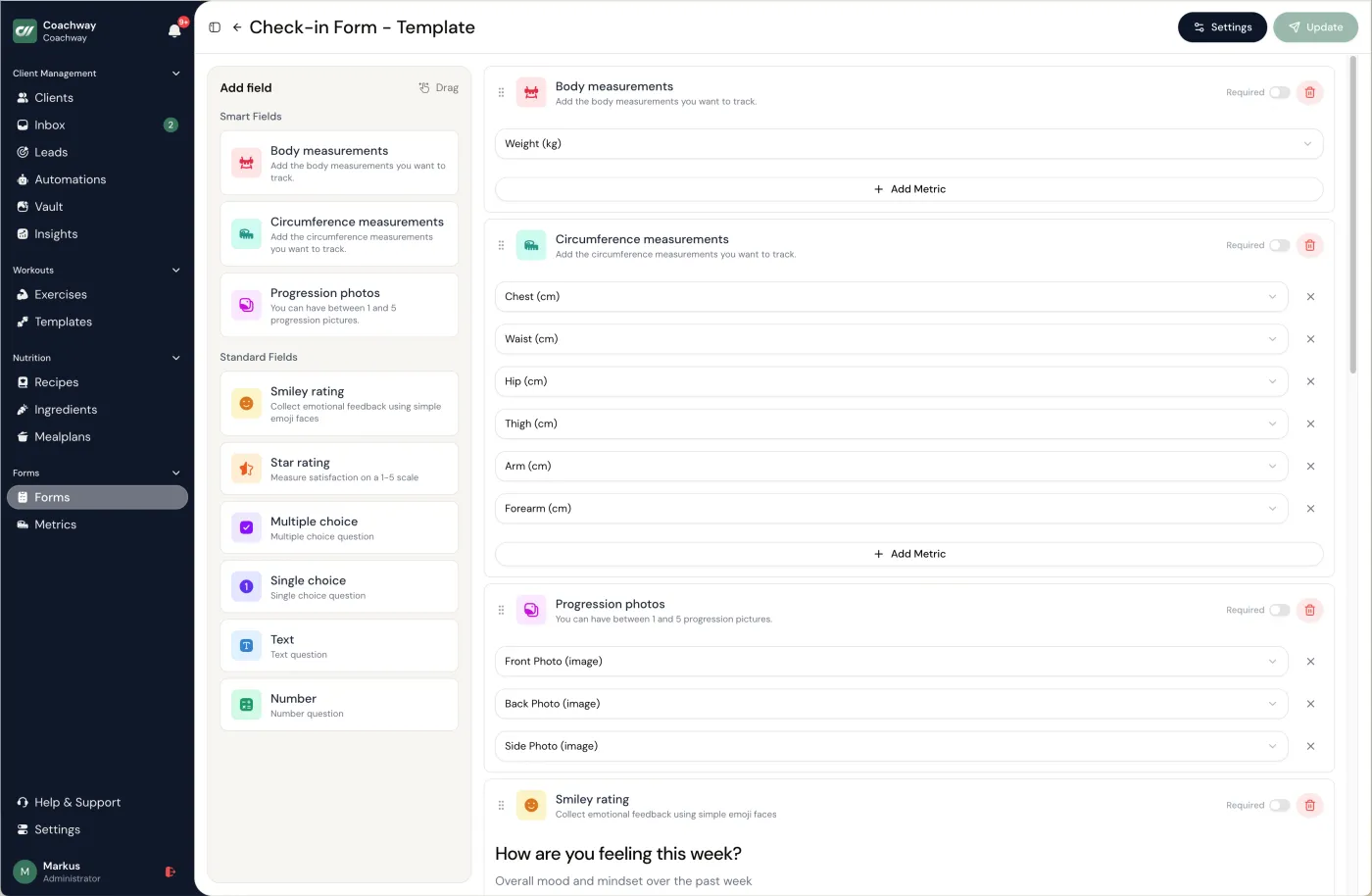
We build Coachway, so this is us describing our own tool. The reason it fits this topic is the form builder: you assemble a check-in from these exact question types - one-to-ten and star ratings, multiple choice, short text, numbers, circumference measurements, progress photos and custom metrics - with a drag-and-drop builder, set automatic reminders, and assign the form per client so a cutting client and a general-health client can carry different situational questions on the same shared core. When the answers come back, you review this week's responses side by side with the client's progress photos, measurements and training log on one screen, so the trend the questions were designed to surface is right there instead of scattered across chat threads. The coach dashboard is in English; the client app they answer on is available in English, Danish, Norwegian, Swedish, Finnish and German. Coachway is EUR 69 a month including your first 5 clients, EUR 9 per additional client, with every feature included and a 14-day free trial that starts with a card and cancels under Billing before it renews. Prefer to see it first? Book a demo and we will walk the check-in builder with you.
Frequently asked questions about client check-in questions.
How many questions should a weekly check-in have?
Aim for roughly 8 to 12 questions - enough to read the whole week across training, nutrition, sleep, stress and adherence, but short enough that a busy client finishes it in a few minutes and actually answers honestly. The failure mode is a 20-question monster that clients start skimming or skipping, which quietly kills the trend you are trying to track. Keep a small, fixed core you ask every single week so the answers line up over time, then rotate one or two situational questions on top depending on the client's phase and what last week surfaced. If a client is drifting, the fix is almost never more questions; it is a shorter form they will complete and one sharp follow-up on the answer that mattered.
What is the single most useful check-in question to ask a fitness client?
"What got in the way this week, and what would make next week easier?" It does more work than any other single question because it moves the client from reporting to problem-solving, surfaces the real blocker before it becomes a cancellation, and frames the plan as something the two of you adjust together rather than a test the client passed or failed. Adherence numbers tell you what happened; this question tells you why, which is the part you can actually coach. Pair it with one honest adherence rating - how closely did you follow the plan this week - and you have the two answers that predict retention better than any progress photo.
Should check-in questions be the same every week?
Keep a fixed core and rotate the rest. The core questions - an adherence rating, weight or measurement trend, training completed, one win, one obstacle, and the plan for next week - stay identical week to week, because consistency is what lets you compare this week to last and spot a trend instead of noise. When the questions keep changing, the answers stop lining up and you lose the very signal a check-in exists to give you. On top of that fixed core, rotate one or two situational questions - sleep during a hard training block, stress during a busy work month, hunger during a cut - so the form stays relevant to the client's current phase without ballooning in length.
How do I get clients to answer check-in questions honestly?
Make honesty the easy, safe answer. Ask the adherence question on a scale rather than as pass or fail, so a client can admit a 6-out-of-10 week without feeling they have let you down. Word every question so the honest answer is never punished - you are diagnosing the plan, not grading the person - and respond to a low week with a smaller next step rather than disappointment, which is what teaches a client that telling you the truth gets them help, not a lecture. Over a few weeks that safety is worth more than any clever question: a client who trusts you with the real number gives you something to coach, while a client who reports a perfect week they did not have gives you nothing.
Are check-in questions different for nutrition clients versus training clients?
The structure is the same; the emphasis shifts. Every check-in benefits from the same spine - adherence, one win, one obstacle, the trend, the next step - because that spine is about the coaching relationship, not the discipline. For a nutrition-led client you weight the questions toward hunger, energy, logging consistency and the situations where eating went sideways; for a training-led client you weight them toward session completion, effort, joint or niggle checks and progression on the key lifts. Most online coaches run both together, so the practical answer is one form with a shared core and a handful of category questions you switch on depending on what that client is actually working on this block.
These questions are one piece of a bigger loop: the check-in template that holds them, the reply that turns answers into coaching, and the retention that a consistent weekly cadence quietly builds.
When the answers come back, the ChatGPT prompts for check-in replies turn the stripped numbers and the client's words into a four-part draft in your voice. These questions are one piece of a bigger loop: the check-in template that holds them, the reply that turns answers into coaching, and the retention that a consistent weekly cadence quietly builds.
Keep reading
all guidesHypertrophy Training: What It Is and How to Program It
What hypertrophy training is and how to program it for online clients: the three drivers (mechanical tension, training volume, progressive overload), the best rep ranges, and a reusable hypertrophy block.
Read the guideProgressive Overload: What It Is & How to Apply It
Progressive overload is gradually increasing the demands on a muscle over time so it keeps adapting. The six methods, how coaches apply them across a program, and how to break plateaus.
Read the guideRefeed Days: What They Are & How to Structure Them
A coach's guide to refeed days: what a refeed day is, its real purpose, how to structure carbs, protein, and fat, how it differs from a cheat day, and which clients it suits.
Read the guideFree tools for this: Client Churn-Risk Reader · Client Onboarding Builder · Coaching Business Health Check
Ready-made template: Weekly Check-In Form
See what Coachway can do for your coaching business
Coachway was built on knowledge from working with 150 online coaches over 6+ years, who all hit the same wall - slow platforms, clunky workflows, wasted hours. Start your 14-day free trial and see what we fixed - the whole platform, no charge today, cancel anytime under Billing.


