


Personal trainer nutrition coaching - how to add it without overstepping.
Personal trainer nutrition coaching is the most natural add-on a training business has: it raises the value of clients you already coach, it makes the training itself work better, and it turns a one-off sale into a monthly service. This is the honest, method-first guide to adding it in 2026 - the revenue case, the scope-of-practice line you must not cross, how to price it, and how to run it without doubling your admin.
By Markus Evers · Updated August 2026
the short version
Adding nutrition coaching to a personal training business is the cheapest revenue you can raise, because it deepens clients you already have instead of chasing new ones. Confirm what your certification and country let you coach, stay on the general-nutrition side of the scope line and refer anything clinical to a registered dietitian, then package training and nutrition together as one higher-priced monthly service rather than a one-off meal plan. Deliver it as a weekly routine - assigned targets, client food logging in one place, a check-in that reads food next to training - so the marginal time per client is a review, not a rebuild. Done that way it renews every month and makes your training results better at the same time.
Why add nutrition coaching to a training business at all?
Because it is the rare expansion that costs almost nothing to acquire and improves the core product at the same time. Every online coach knows the cheapest client is the one you already have, and nutrition coaching sells straight into that base: the person paying you for training already trusts you, already has a goal, and already suspects that food is the part they keep getting wrong. Offering to coach it is not a cold pitch, it is finishing a job you started. That is why the maths is so friendly - you are raising the value of an existing subscription rather than funding the whole cost of finding a stranger.
The second reason is that it makes your training work better, and better results are the engine behind retention and referrals. Body composition is won and lost mostly at the table, so a client following a sensible calorie and macro target alongside a good programme simply gets further than one lifting well and eating blind. When your clients see faster change, they stay longer and they tell people, and both of those are worth more over a year than the add-on fee itself. Adding nutrition is one of the few moves that improves revenue and results in the same motion instead of trading one for the other. How to set those targets, pick a tracking depth and adjust them is laid out in our guide to macro coaching.
The third reason is the shape of the revenue. A training programme can drift into autopilot after a few blocks, which quietly weakens the reason to keep paying. Nutrition coaching does not have that problem, because food is a weekly conversation that never fully resolves - the target needs adjusting, the diet-break needs planning, the holiday needs navigating. That ongoing back-and-forth is exactly what turns a client into a durable monthly subscriber rather than someone who buys a plan once and disappears. The honest condition is that this only holds if you deliver nutrition as coaching, not as a PDF you send and forget. A plan handed over once is a product that ends; a target reviewed and adjusted every week is a service that renews.
What can a personal trainer legally coach on nutrition?
This is the part to get right before you sell a single package, because the whole opportunity depends on staying on the correct side of one line. In most markets a personal trainer can coach general nutrition for healthy adults: setting calorie and macro targets, teaching portion awareness and food habits, building or assigning balanced meal guidance, and holding a client accountable to a plan they have agreed to. What a trainer cannot do, unless separately qualified as a registered dietitian or clinician, is practise medical nutrition: diagnosing or treating a disease, prescribing a therapeutic diet to manage a condition, or working a client through a diagnosed eating disorder. These are the same limits a dedicated online nutrition coach works within.
The safe operating rule is simple: coach general nutrition for healthy people, and refer out the moment a situation turns clinical. If a client discloses an eating disorder, a diagnosed metabolic or gastrointestinal condition, a pregnancy with complications, or a medication that interacts with diet, that is a hand-off to the right professional, not a coaching challenge to solve yourself. Writing that referral rule into your intake and your contract protects the client first and you second, and it also makes the service easier to sell, because a trainer who is visibly clear about their limits reads as more trustworthy, not less. When a case is unclear, the scope-of-practice check tells you whether to coach, get clearance first or refer.
Your exact boundary is set by two things: the scope your certification actually grants and the law in your country, and those vary enough that you should confirm both rather than assume. Treat a dedicated nutrition certification as the floor, since it gives you both the knowledge to coach well and the credential clients trust. Our fuller scope-of-practice guide for online coaches walks the boundary in more detail, and it is worth reading before you write your offer, not after your first awkward case.
How do I actually add nutrition coaching to my service?
1. Decide your method before your menu.
Pick one approach and coach it consistently rather than offering everything. Most online trainers land on flexible macro targets, a habit-based approach, or assigned meal guidance, and the right one depends on the clients you already have and how much they want to think about food. Set the calorie and macro numbers off a clear starting point - our walkthrough on calculating TDEE and macros for clients gives you a defensible baseline. A single method you can deliver well beats a buffet you deliver thinly.
2. Package it with training, not beside it.
The simplest revenue model is one combined coaching package at a higher price, because training and nutrition together are worth more than either alone and the client reads one complete service instead of two invoices. If you would rather keep training as the base, add nutrition as a clearly-priced monthly upgrade. Either way, sell the outcome the pairing produces, and lean on the shape of your existing personal training packages rather than inventing a separate brand for the nutrition side.
3. Make logging effortless for the client.
Adherence dies on friction. If tracking food is a chore, clients quit within a fortnight and your coaching goes blind. So make logging fast - a barcode scan, a photo of the plate, a three-tap quick-add - and give clients a choice of how much they track, from full macro logging to a simple photo diary you comment on. The point is that the coaching only works when you can see what is actually happening, and you only get to see it if logging is easier than not logging.
4. Fold nutrition into the weekly check-in.
Do not run nutrition as a separate conversation. Read this week's food data next to weight trend, training and progress photos in the same review, because that is where the coaching judgement actually happens - you adjust the target based on the whole picture, not on the food log alone. Running the whole thing as one weekly routine is what keeps the workload flat; the deeper mechanics are in our guide to doing nutrition coaching online.
How much should nutrition coaching add to your price?
Price the work, not the deliverable. The trap trainers fall into is pricing a meal plan, which is a five-minute export, when what they are actually selling is the recurring labour around it: reading a food diary every week, adjusting targets as the body responds, and answering the messy real-life questions about eating out, travel and cravings. That review work is the recurring cost of the service, and the price has to cover it comfortably or the add-on quietly becomes unpaid overtime.
The cleaner model is a single combined package priced above your training-only rate, so the client buys one complete service and you are paid for the whole job in one number. If you prefer to keep training as the base and layer nutrition on top, set the upgrade high enough that it clearly funds the extra weekly review time - a token amount trains clients to see nutrition as a freebie and trains you to resent it. Whatever shape you choose, anchor it in your real capacity and margins; our guide to pricing online coaching packages covers the numbers behind that decision.
Can you run nutrition and training in one place?
Yes, and doing so is what keeps the workload from doubling. The reason most trainers stall on adding nutrition is that it seems to mean a second app, a second login and a second stream of messages to track. It does not have to. Coachway runs the training side and the nutrition side in one platform: you assign calorie and macro targets per client and per weekday, clients log food by barcode scan, photo diary or a three-tap quick-add against a database of 3.7 million foods, and their answers land next to weight, training and photos in the same check-in you already run. You also set the depth per client with four access levels - full, standard, photo-only and plan-only - so a macro-tracking client and a photo-only client are the same amount of admin for you. Meal plans draw on more than 1,100 recipes and 3,900 ingredients, recipes auto-scale and the shopping list writes itself, so the plan side is an assignment, not an evening of rebuilding.
Coachway costs EUR 69 a month including your first 5 clients, then EUR 9 per additional client, with every feature included and no separate nutrition module to buy - the food logging and meal planning are simply part of the platform. It is built on knowledge from working with 150 online coaches over 6+ years, the client app runs on iOS and Android in six languages, and payments settle in your own Stripe account so Coachway never holds your money. The coach dashboard is in English. The 14-day free trial starts with a card held securely by Stripe and cancels under Billing before it renews, or you can book a demo and see the nutrition side first. If you are still comparing options, our roundup of meal planning software for personal trainers weighs the field.
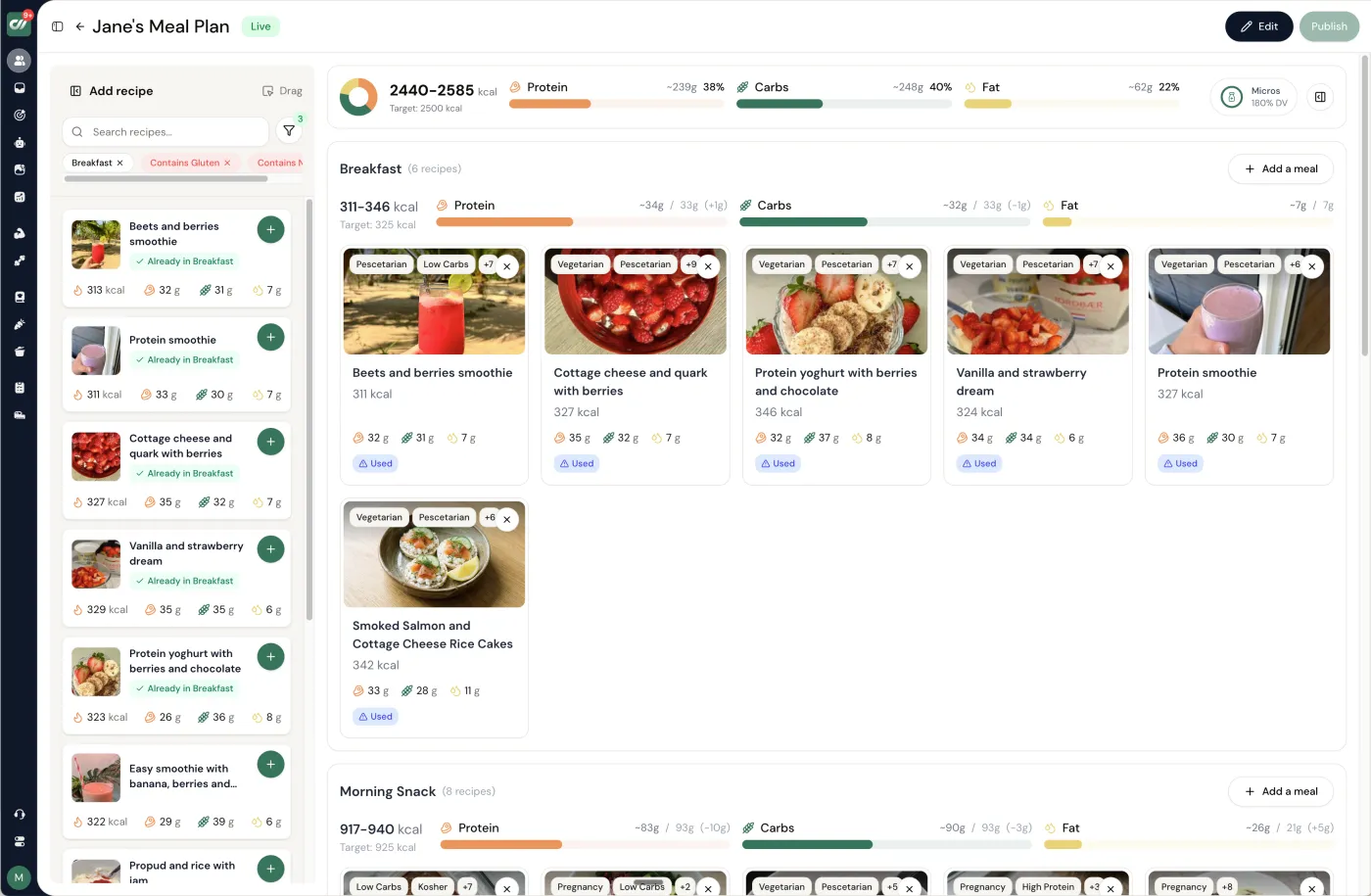
The quickest test is one real client: set their calorie and macro targets, build a single day from the recipe library and see whether the plan fits them before you price nutrition into every package.
Frequently asked questions about adding nutrition coaching.
Can personal trainers give nutrition advice?
In most markets, yes, within a defined scope. A personal trainer can give general healthy-eating guidance, set calorie and macro targets, coach food habits and portion awareness, and hold clients accountable to a plan they agree on. What sits outside a trainer's scope is clinical work: diagnosing or treating a disease, prescribing a diet to manage a medical condition, or working through a diagnosed eating disorder. The line is between coaching general nutrition for healthy adults and practising as a registered dietitian or clinician, and the safe rule is to stay firmly on the coaching side and refer out the moment a client's situation turns medical. Your exact boundary depends on your certification and your country, so check the scope your credential actually grants before you sell the service, and put the referral rule in writing so both you and the client know where nutrition coaching stops.
Do I need a nutrition certification to add nutrition coaching?
You do not strictly need a separate qualification in every market to coach general nutrition for healthy clients, but you should get one anyway. A dedicated nutrition certification does two things at once: it gives you the actual knowledge to coach well rather than guess, and it gives clients a credential to trust when they are deciding whether to pay you for it. Precision Nutrition, NASM and ISSA all run recognised nutrition coaching certifications, and many trainers already hold a foundation-level nutrition module inside their PT qualification. Treat certification as the floor, not the ceiling: the credential earns you the right to charge, and the ongoing skill of reading a food log, adjusting targets and keeping a client honest is what earns you the renewal. If you are not certified yet, coach conservatively, stay well inside general guidance, and study toward the credential while you build the service.
How much should I charge to add nutrition coaching?
The cleanest model is to fold nutrition into a single higher-priced coaching package rather than sell it as a separate line item. Training plus nutrition together is worth more than either alone, so a combined online package usually sits above what you charged for training-only, and the client reads the higher number as one complete service instead of two invoices. If you would rather keep training as the base, an add-on of a modest monthly amount on top of the existing fee is a common shape, priced so it clearly covers the extra check-in time nutrition coaching takes. Whichever route you pick, price the work, not the deliverable: a meal plan is a five-minute export, but reviewing a food diary every week, adjusting targets and answering the two-in-the-morning question about what to eat is real recurring labour, and that labour is what the price has to pay for.
How do I add nutrition coaching without doubling my workload?
Systematise before you scale. The workload only explodes if you rebuild every plan by hand and chase adherence over text message. Reusable meal templates and macro targets you can assign in a couple of taps, client food logging that lands in one place you can scroll and comment on, and check-in forms that pull this week's food data next to weight and photos on one screen turn nutrition coaching from open-ended admin into a fixed weekly routine. The heavy lifting is the coaching judgement - reading the log and making the call - not the data entry, so the goal is to remove the data entry and keep the judgement. A trainer running nutrition inside one platform alongside the training side can usually add it to an existing client list without hiring, because the marginal time per client is a review, not a rebuild.
Is nutrition coaching a good recurring revenue stream for personal trainers?
It is one of the most natural expansions a training business has, for three reasons. First, it raises the value of a client you already have rather than requiring you to find a new one, which is the cheapest revenue there is. Second, nutrition is where most body-composition results are actually won or lost, so adding it makes your training work better, which shows up as stronger results, longer retention and more referrals. Third, it is inherently ongoing: training programmes can plateau into autopilot, but food coaching is a weekly conversation that gives the client a reason to stay subscribed month after month. The one honest caveat is that it only works as recurring revenue if you deliver it as coaching, not as a one-off PDF - a plan handed over once is a product that ends, while a target reviewed and adjusted every week is a service that renews.
Adding nutrition is easiest when the rest of your delivery is already systematised. Start with the scope-of-practice boundaries, build the weekly routine from our guide to nutrition coaching online, and set the numbers with a defensible TDEE and macro baseline.
Keep reading
all guidesWhat Is the Posterior Chain? Muscles and Exercises (2026)
The posterior chain is the line of muscle along the back of the body that extends the hips and keeps you upright. Meet the muscles, the key exercises with entry versions, and how coaches program it.
Read the guideAgonist vs Antagonist Muscles: Pairs, Supersets (2026)
The agonist drives a movement while the antagonist lengthens to control it, and the roles flip when you reverse the exercise. A pairs table across eight lifts and how coaches program antagonist supersets.
Read the guideWhat Is a Microcycle? The Training Week Explained (2026)
A microcycle is the smallest repeating training block, almost always one week. How to order sessions, space recovery and distribute weekly volume, with two worked sample weeks.
Read the guideFree tools for this: Assistant Coach ROI Calculator · Client Churn Rate Calculator · Client LTV Calculator
See what Coachway can do for your coaching business
Coachway was built on knowledge from working with 150 online coaches over 6+ years, who all hit the same wall - slow platforms, clunky workflows, wasted hours. Start your 14-day free trial and see what we fixed - the whole platform, no charge today, cancel anytime under Billing.


