Skip to content
guide · nutrition coaching

Macro coaching, run as a system - set targets, choose tracking depth, adjust on a cadence.

Macro coaching is the method behind flexible nutrition: instead of a fixed menu, you set each client a calorie and macro target, decide how tightly they need to track it, and adjust the numbers from real check-in data over time. This guide walks the full method - setting targets from energy needs, matching tracking depth to the person, the adjustment cadence, and how to run the whole loop without a stack of spreadsheets.

By Markus Evers · Updated August 2026

the short version

Macro coaching means coaching to numbers instead of a menu. You set each client a daily protein, carbohydrate and fat target - and usually total calories - derived from their energy needs and goal, then coach them to hit it. The method has three moving parts most coaches under-think: how you set the targets, how tightly each client actually needs to track, and how often you adjust. Match the tracking depth to the person, review at every check-in but change the numbers only when the two to three week trend says so, and the same principles fit a competitor and a busy parent alike.

This article is general information for coaches, not nutrition or medical advice. The ranges below are common coaching estimates, and individual needs vary by age, training, health status and country. Refer clinical cases - eating disorders, pregnancy complications, or managed medical conditions - to a registered dietitian or clinician, and stay inside the limits of your certification.
the idea

What is macro coaching, and how is it different from a meal plan?

Macro coaching is nutrition coaching built on daily targets for the three macronutrients - protein, carbohydrate and fat - rather than a fixed list of meals. You give the client numbers to hit, coach them to hit those numbers with foods they actually like, and revise the numbers as their body responds. It is the engine underneath flexible dieting: the client is not told to eat chicken and rice, they are told to land on a protein and calorie target, and how they get there is theirs.

The contrast with a rigid meal plan is the whole point. A meal plan removes decisions and can be genuinely kinder for a client who finds food choices overwhelming, but it travels badly - one holiday, one work trip, one unavailable ingredient and the plan breaks. A macro target teaches a portable skill: the client learns to build any day, in any kitchen or restaurant, that adds up to their numbers. That independence is why so many coaches lead with macros, and why the best macro coaching still keeps a few sample days and recipes on hand as a concrete fallback rather than pretending numbers alone are enough.

One honest caveat up front: macro coaching is a method, not a magic setting. The targets are only as good as the adherence behind them and the adjustments you make from real data. The three sections below are the parts that separate a coach who sets a target and forgets it from one who runs macros as an actual system.

step one

How do you set a client's macro targets?

Targets come from energy needs, not a blanket number. Start with an estimate of the client's total daily energy expenditure, then set a calorie target from the goal - a modest deficit for fat loss, maintenance to hold, a small surplus to gain, usually a 10 to 20 percent move rather than a crash. The full formula, activity multipliers and a worked example live in the companion guide on calculating TDEE and setting macros; a quick macro calculator is useful to sanity-check the split before you commit it.

From the calorie target, set the macros in order. Protein first, commonly cited around 1.6 to 2.2 g per kilogram of bodyweight, because it drives satiety and protects lean mass in a deficit. Fat next, with a floor often placed near 0.6 to 0.8 g per kilogram for hormonal health. Carbohydrate fills whatever calories remain, and it is the lever you flex most as calories change. Protein and carbs run about 4 calories per gram and fat about 9, which is the arithmetic that makes the split add up to the target. If you like to bias the carb-to-fat balance by a client's build, our macro calculator by body type sets a defensible starting split you then refine from results.

The mistake here is treating the first set of numbers as the answer. It is a starting line built on population averages, and any individual client can sit above or below it. Set it, write down why you set it the way you did, and expect to move it once real check-in data comes in. A target you never revisit is a guess with extra steps.

step two

How much tracking does each client actually need?

This is the decision most coaches skip, and it decides whether macro coaching works or quietly fails. Tracking depth is not a fixed feature of the method - it is a choice you make per client, based on their goal, their history with food and how much logging they will realistically sustain. The same macro principles run underneath all four tiers; you are only choosing how much of the maths the client has to see and touch.

Full tracking

Best for: Physique clients, competitors, and detail-driven people who want the numbers and will actually log them.

The client logs everything and hits protein, carbs and fat within a tight band each day. It gives you the cleanest data to adjust from, but it asks the most of the client, so reserve it for the people whose goals and temperament genuinely fit it. Full tracking on the wrong client produces two weeks of clean numbers and then silence.

Protein and calories only

Best for: General body-composition clients who want results without living inside an app.

The client hits a protein target and a calorie target and lets carbs and fat fall where they like. This is the workhorse of macro coaching for most clients: it captures the two variables that move body composition the most while cutting the logging burden roughly in half. Adherence usually beats precision here, and a plan someone follows at 80 percent beats a perfect plan they abandon.

Habit and portion targets

Best for: Beginners, busy parents, and anyone who finds logging stressful or has a fraught history with food.

Instead of grams, the client works to hand-portion guidance and a few concrete habits - a palm of protein at each meal, vegetables at two meals, a set number of logged days a week. You are still coaching macros in the background; the client just experiences it as behaviour, not spreadsheets. This tier keeps people who would quit full tracking inside the process.

Photo and check-in only

Best for: Clients on a meal plan, or anyone where any logging at all is the wrong stressor to add.

No macro logging at all. The client photographs meals or simply reports back at check-in, and you read adherence and results from progress trends rather than daily numbers. Coverage of the day is looser, but for the right client it is the difference between staying coached and dropping off, which is the only comparison that matters.

The rule that ties the four together: adherence beats precision. A client hitting a looser target four weeks running gives you more to coach than a client who nailed full macros for eight days and then disappeared. When in doubt, drop a tier down, not up.

step three

How often should you adjust a client's macros?

Review the targets at every check-in, but change them only when the trend - not a single day or a single weigh-in - tells you to. In practice that means waiting two to three weeks for a clear signal, because daily weight noise from water, sodium, and the scale itself will fake a stall or a whoosh that is not real. The adjustment itself is small and deliberate. Four situations cover almost everything you will see:

Hold the targets

Weight and measurements are moving at a sensible pace, energy is fine, and adherence is high. Do nothing to the numbers. The most common mistake in macro coaching is changing targets that are already working because a single day looked off.

Lower calories, protect protein

Fat loss has genuinely stalled across two to three weeks of good adherence. Trim calories in a small step - a common move is 5 to 10 percent, taken from carbs or fat - and keep the protein target where it is so lean mass and fullness are protected.

Raise calories

Weight is dropping too fast, recovery is suffering, or a gaining phase has flatlined. Add calories back in a small increment rather than a jump, and watch the next two weeks before moving again.

Fix adherence, not the maths

The numbers are not being hit in the first place. Do not adjust the target - a target nobody follows tells you nothing. Loosen the tracking tier, simplify the plan, or solve the real-life obstacle first, then let the data come back clean before you touch a calorie.

Adjust the number, not the method. When results stall, the temptation is to rebuild the whole plan or re-run the calculation from scratch; the discipline is to move the calorie target in a small step and let another two weeks of data answer. The step-by-step of that call - which number moves, in which direction, and by how much - is the how to adjust client macros method. Our broader walkthrough on nutrition coaching online puts this cadence inside a full weekly check-in rhythm.

the machinery

Running macro coaching without a stack of spreadsheets.

The manual version of everything above works right up until it does not scale. Targets live in a spreadsheet, the client logs in a separate app you cannot see into, screenshots get pasted into chat at check-in, and every adjustment is a copy-paste across three tools. Add ten clients and the loop leaks time and detail exactly where it matters. Coaching software built for nutrition closes that loop: you set per-client, per-weekday macro targets, the client logs against them, and their adherence and trends land next to your check-in review instead of in a screenshot.

Coachway is built for this. Each client gets their own calorie and macro targets, set per weekday with date exceptions for phase work, and they log against them in the app with a barcode scan that reads in under a second, a manual quick-add, or a photo diary you can scroll and comment on. Macro rings move as they log, and you choose one of four access levels - full, standard, photo-only or plan-only - which is the tracking-depth decision from earlier, made real in the product. The food-logging database covers 3.7 million foods, so a client rarely has to build an entry by hand. It is all in the base plan: EUR 69 a month including your first 5 clients, EUR 9 per additional client, with every feature included rather than nutrition sold as an upgrade. The 14-day free trial starts with a card held securely by Stripe and cancels under Billing before it renews - or book a demo and see the food log and targets first. It is built on knowledge from working with 150 online coaches over 6+ years.

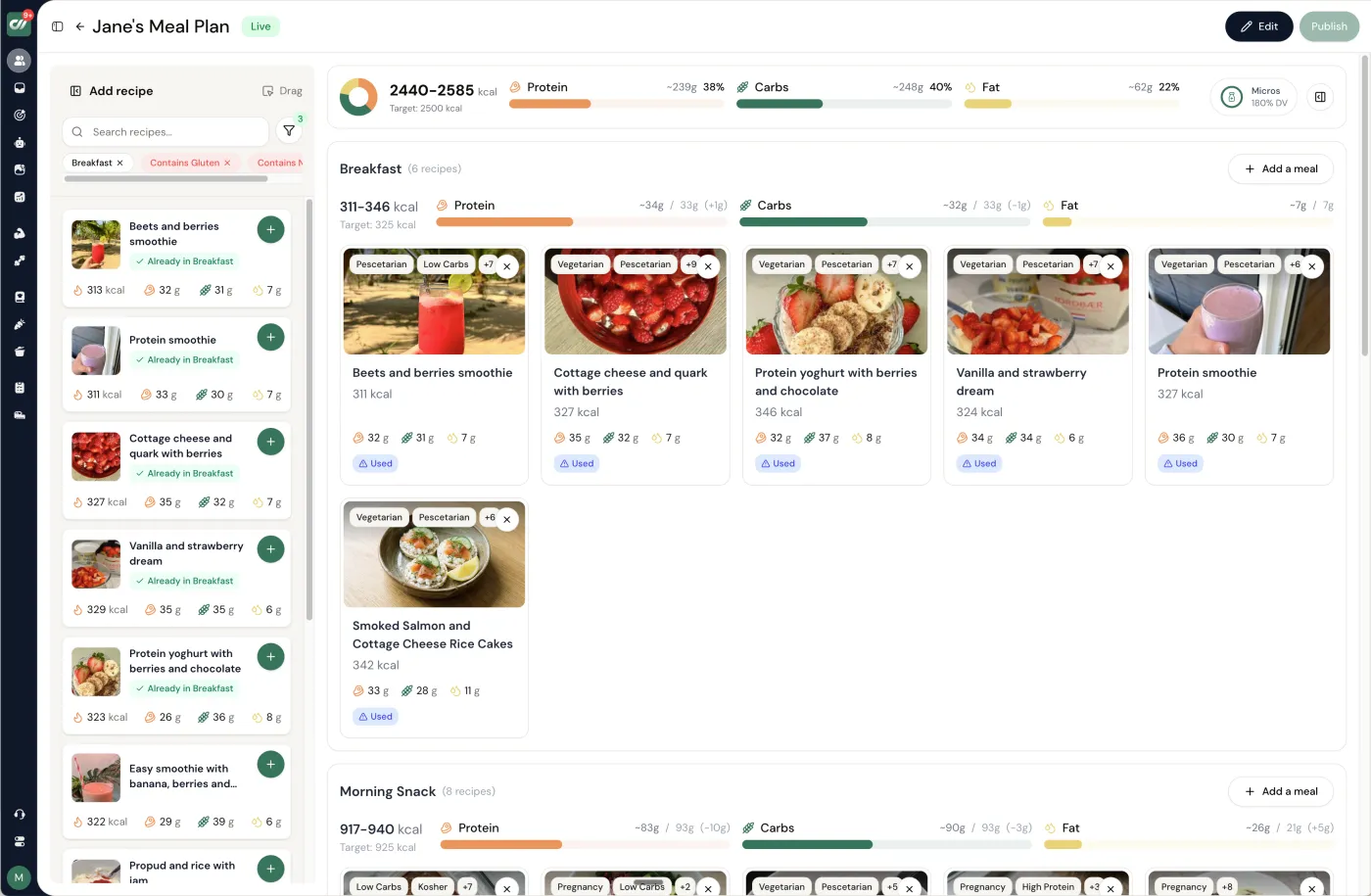
Inside Coachway Coachway meal plan - daily calories and macros with recipe cards and dietary tags
Macro coaching in one screen: per-client daily calorie and macro targets with recipe cards, so the numbers you set and the food the client hits live in the same place instead of a spreadsheet and a second app. See the meal planner
faq

Frequently asked questions about macro coaching.

What is macro coaching?

Macro coaching is a method of nutrition coaching where you give each client a daily target for protein, carbohydrate and fat - and usually total calories - then coach them to hit it and adjust it over time. Instead of handing over a fixed meal plan, you set numbers derived from the client's energy needs and goal, decide how tightly they need to track them, and revise the targets from real check-in data. It suits coaches who want a flexible, teachable system that fits any food culture rather than one rigid menu, because the client keeps eating foods they actually like as long as the day adds up.

How do you set a client's macro targets?

Start from an estimate of the client's total daily energy expenditure, then set a calorie target from the goal - a modest deficit for fat loss, maintenance to hold, a small surplus to gain. Set protein first, commonly around 1.6 to 2.2 g per kilogram of bodyweight, add a fat floor near 0.6 to 0.8 g per kilogram, and let carbohydrate fill the remaining calories. Protein and carbs carry about 4 calories per gram and fat about 9, which is the arithmetic that keeps the split adding up. Treat the first set of numbers as a starting line you refine from results, not a fixed answer.

Does every client need to track macros?

No, and forcing it is how coaches lose clients. Tracking depth is a coaching decision you make per person: full grams-based logging for detail-driven physique clients, protein and calories only for most general clients, hand-portion and habit targets for beginners or anyone stressed by logging, and photo or check-in reporting for people on a meal plan. You are coaching the same macro principles at every level; you are just choosing how much of the maths the client has to see. Adherence at a looser tier almost always beats precision the client abandons after two weeks.

How often should you adjust a client's macros?

Review the targets at every check-in but only change them when the trend - not a single day - tells you to, which usually means waiting two to three weeks for a clear signal. If weight and measurements are moving at a sensible pace and adherence is high, hold steady. When fat loss stalls on good adherence, trim calories in a small step, commonly 5 to 10 percent, and protect the protein target. When the numbers are not being hit at all, fix adherence or loosen the tracking tier first - never adjust a target nobody is following.

Is macro coaching better than a meal plan?

Neither is universally better; they fit different clients. A macro target teaches a flexible skill that travels to any restaurant, holiday or food culture and tends to build long-term independence, which is why many coaches lead with it. A fixed meal plan removes decisions and can be the kinder option for a client who finds choice overwhelming or wants to be told exactly what to eat. Good macro coaching often blends them: macro targets as the backbone, with sample days and recipes so the client has a concrete plan to fall back on. The right answer is the one that particular client will actually follow.

Can you run macro coaching without spreadsheets?

Yes. The manual version - a spreadsheet of targets, a separate logging app the client uses, and screenshots pasted into chat at check-in - works but leaks time and detail as you add clients. Coaching software built for nutrition sets per-client, per-weekday macro targets, lets the client log against them with barcode scanning and a photo diary, and shows you their adherence and trends beside your check-in review, so the whole loop lives in one place. Coachway does exactly this, with food logging and macro targets included in the base plan rather than sold as an add-on.

Macro coaching sits on top of two things this guide only points at: the calculation that sets the first targets, and the flexible-dieting mindset that makes clients stick with them. Put both inside a weekly nutrition coaching rhythm and the numbers become a system rather than a one-time email.

See what Coachway can do for your coaching business

Coachway was built on knowledge from working with 150 online coaches over 6+ years, who all hit the same wall - slow platforms, clunky workflows, wasted hours. Start your 14-day free trial and see what we fixed - the whole platform, no charge today, cancel anytime under Billing.

No charge today - cancel anytime under Billing
Built for efficiency 6 languages DenmarkNorwaySwedenFinlandGermanyUnited Kingdom
The coaching platform you've been waiting for
