Nutrition coach certifications, compared for working coaches.
Precision Nutrition, NASM, ISSA, AFPA and the CISSN, side by side on the things that decide it: how you study, how the exam works, what renewal costs, what the course costs today and which kind of coach each one fits. Then the part every cert page skips: what no certificate lets you do, and what it takes to turn the credential into paying clients.
By Markus Evers · Updated October 2026
the short version
There is no single best nutrition coach certification; the right one depends on how you will coach. Precision Nutrition Level 1 fits coaches who want strong habit-based coaching skills. NASM CNC is the fast, open-book add-on for NASM trainers. ISSA Certified Nutrition Coach suits self-paced learners who want a longer course. The CISSN fits degree holders in sports nutrition. None of them makes you a dietitian.
What does a nutrition coach certification let you do?
A nutrition coach certification is a private education credential. It shows a client, an insurer or an employer that you have studied nutrition science and how to coach eating habits, and it usually makes liability insurance easier to get. It is not a licence. It does not let you diagnose, treat a medical condition or call yourself a dietitian, and in some countries and US states it does not change who may give individualised nutrition advice. Think of it as the floor for coaching healthy adults on habits, targets and food choices, not as permission to do clinical work.
That distinction shapes the whole comparison below. You are not choosing which certificate gives you the most rights, because none of them gives you more legal rights than the others. You are choosing which one teaches you to coach the clients you want, at a cost and pace you can manage. If you are still deciding between nutrition and health coaching as a path, health coach vs nutrition coach covers that split, and how to become a nutrition coach walks through the steps around the certificate.
How to choose a nutrition coach certification
Price is the easiest thing to compare and the least useful on its own. Five questions decide whether a course is right for you.
1
Method: habit-based or numbers-first
Some programs teach you how to coach a person through behaviour change, with nutrition science as the base. Others lead with energy balance, macros and food science and give coaching skills less room. Pick the one that matches how you will actually work with clients week to week.
2
Exam and assessment
Most mainstream nutrition coach exams are online and open-book. That is fine for a coaching credential, but it means the exam proves you worked through the material, not that you can run a client. Look at how the course makes you practise, not only at the exam.
3
Recognition and accreditation
Nutrition coach credentials are rarely accredited the way the main personal training certifications are. Recognition comes from the brand, from which bodies accept the course for continuing education, and from what your insurer asks for. Check the vendor page and your insurer before you pay.
4
Renewal
Most credentials expire after two years unless you renew. Some ask for a short re-test, others for continuing education credits and a fee. Factor the renewal into the real cost, and check whether credits from one body count toward another you already hold.
5
Fit with your training credential
If you already hold a personal training certification, a nutrition course from the same body can be the fastest add-on, and its credits may count toward your renewal. If you start from zero, a stronger coaching-skills course matters more than brand alignment.
Five nutrition coach certifications, card by card
These five cover what most coaches actually weigh up. The order follows how broad the fit is, not a quality ranking. Every price, exam and renewal detail below was read from the provider's own page in October 2026; providers change prices and promotions often, so check the live page before you pay.
Precision Nutrition Level 1 (PN1)
Fits: Coaches who want to get good at the coaching itself: habits, conversations and change that lasts, on a solid nutrition science base.
- Format: Online, entirely self-paced. Over 70 hours of content in 20 chapters; PN suggests one chapter a week at 3 to 5 hours, which is a little over four and a half months.
- Exam: A 10-question exam at the end of each chapter. No prerequisites for Level 1.
- Recognition: PN states the program is not accredited by the national education boards. It is an approved continuing education provider for bodies including NASM, ACE, ISSA, NSCA and NBHWC.
- Renewal: Renew every two years from the date you complete the course.
- Cost: USD 799 general public price, or USD 79 a month for 12 months, at the time of writing. People on its Insider Access list are offered a lower price.
Popular with coaches whose main job is nutrition coaching rather than a nutrition add-on. There is a Level 2 for coaches who want to go further.
NASM Certified Nutrition Coach (CNC)
Fits: Trainers already in the NASM system who want a quick, structured nutrition add-on and credits toward their renewal.
- Format: Online, self-paced. NASM says most learners finish in 4 to 6 weeks while working full time, with five years of access to the content.
- Exam: Online and open-book: 100 multiple-choice questions in 90 minutes, 70 percent to pass, up to three attempts within a year of purchase. No prerequisites.
- Recognition: The program page does not name an accrediting body for the CNC at the time of writing. NASM is a well-known name in personal training.
- Renewal: Renew every two years by completing 1.9 NASM CEUs.
- Cost: At the time of writing NASM showed the CNC on a monthly plan (USD 26 a month on promotion, down from USD 41) without printing a total. NASM discounts often, so check the live price.
The shortest route of the mainstream options, and the natural add-on if your training credential is already from NASM.
ISSA Certified Nutrition Coach
Fits: Self-paced learners who want a longer, more complete course with a no-pressure exam, often next to an ISSA training certification.
- Format: Online, self-paced. ISSA lists about 200 hours of coursework, practice and assignments, with six months to finish; some students finish in four weeks.
- Exam: Taken at home, open-book and open-note, not proctored. A standalone program with no prerequisites.
- Recognition: ISSA's nutrition page shows an NCCA badge, but ISSA describes its accredited exam as the personal training certification exam; check whether the nutrition credential itself is accredited before relying on it, at the time of writing. ISSA notes the credential does not make you a registered dietitian or licensed nutritionist.
- Renewal: ISSA renewals generally ask for 20 CEUs, a current CPR/AED certificate and a USD 99 fee, which can be waived if all credits come from ISSA. Confirm that this applies to the nutrition credential before you enrol.
- Cost: USD 629 one-time, or 12 payments of USD 52, at the time of writing.
ISSA says you do not need a fitness certification to take it, though many students take one alongside it.
AFPA nutrition certifications (incl. Holistic Nutrition Coach)
Fits: Coaches who want a specific angle, such as holistic, sports or plant-based nutrition, more than a big-brand credential.
- Format: Online, self-paced; AFPA says you can certify in six months or less. Programs include Master Level Nutrition Coach, Holistic Nutrition Coach, Sports Nutrition and Plant-Based Nutrition.
- Exam: Exam format and renewal terms are not printed on the program pages at the time of writing; ask AFPA for both before you enrol.
- Recognition: Accrediting bodies are not named on the program pages at the time of writing; ask AFPA which bodies accept the course.
- Cost: No prices were printed on the program pages at the time of writing, and AFPA runs frequent promotions. Ask for a written quote.
Useful when your niche is the selling point. Weigh the niche angle against how well your target clients know the name.
CISSN (International Society of Sports Nutrition)
Fits: Coaches with a degree who work with athletes or performance clients and want a sports nutrition credential with academic weight.
- Format: An exam-based credential: you prepare on your own and sit the exam. A four-year degree is normally required, with an alternative route described by the ISSN.
- Exam: Online, 200 multiple-choice and true or false questions in 80 minutes, 70 percent to pass. ISSN membership is required to sit it.
- Recognition: Issued by the ISSN, a scientific society. Better known in sport and academia than among general-population clients.
- Renewal: Six CEUs a year, or 30 every five years, and an active ISSN membership.
- Cost: USD 649 regular exam rate at the time of writing, with a higher rate mentioned for non-members, plus membership and your own study materials.
Not a beginner course. It makes most sense on top of a degree and a training credential, not instead of them.
Nutrition coach certification costs, exams and renewal compared
The same five credentials in one table. Figures are as published on each provider's page at the time of writing; where a provider does not print a number, the cell says so instead of guessing.
| Certification | Published cost | Study time | Exam | Renewal |
|---|---|---|---|---|
| Precision Nutrition Level 1 | USD 799, or USD 79 x 12 months | Self-paced; about 4.5 months at the suggested pace | 10-question exam per chapter | Every 2 years |
| NASM CNC | Monthly plan shown, no total printed | Most finish in 4 to 6 weeks | Online, open-book, 100 questions, 90 minutes | Every 2 years, 1.9 CEUs |
| ISSA Certified Nutrition Coach | USD 629, or USD 52 x 12 | About 200 hours, 6 months to finish | At home, open-book, open-note | Check terms for this credential |
| AFPA nutrition certifications | Not printed; ask for a quote | Six months or less | Not printed; ask AFPA | Not printed; ask AFPA |
| CISSN | USD 649 exam fee (regular rate) | Own preparation; degree normally required | Online, 200 questions, 80 minutes | 6 CEUs a year plus ISSN membership |
If you also need the training credential, the same kind of comparison for personal trainers is in the best personal trainer certifications for online coaching, and the health coaching routes, including NBHWC board certification, are in health coach certifications.
Precision Nutrition vs NASM vs ISSA: which should you choose?
Choose Precision Nutrition Level 1 if nutrition coaching is your main service and you want to get better at the coaching itself; it is self-paced, built around habit change and renews every two years. Choose NASM Certified Nutrition Coach if you already train clients with a NASM credential and want a quick add-on: most learners finish in 4 to 6 weeks and sit an online, open-book exam. Choose ISSA Certified Nutrition Coach if you want a longer, self-paced course of about 200 hours with an open-book exam at home, especially next to an ISSA training certification.
In practice the difference shows up on a Tuesday evening with a client who has stopped logging. From how each provider describes its course, PN gives the most room to what you say next: how to ask, how to pick one change, how to keep the client owning it. NASM and ISSA describe their courses mainly around nutrition science and how to apply it. Neither approach is wrong. A coach who mostly sets macro targets for gym clients may be well served by NASM or ISSA; a coach whose clients struggle with consistency more than knowledge gets more out of PN.
One practical check: PN Level 1 is an approved continuing education course for NASM, ISSA and ACE, among others, so if you hold one of those training credentials it can count toward your renewal. Confirm the credit amount for your body before you buy.
Holistic, sports and macro-specific certifications: when a niche credential makes sense
A niche credential is worth it when the niche is what clients buy. If you sell general fat-loss coaching, a broad certification and good delivery matter more than a specialist badge. If your whole offer is built around one angle, a matching credential helps clients trust that angle.
- Holistic nutrition: holistic nutrition coach programs, such as AFPA's Holistic Nutrition Coach, add whole-food, lifestyle and mind-body content. Check that the course still teaches you where coaching stops, because holistic marketing sometimes drifts toward claims about treating conditions, which no coaching credential covers. Search results for a holistic nutritionist certification also mix in clinical titles that some places regulate, so check what you are allowed to call yourself where you work.
- Sports nutrition: for athletes and performance clients, the CISSN carries academic weight but expects a degree. Coaches without one often start with a broad nutrition course and add a sports nutrition specialisation from the same provider. Pair it with a strength credential if you also program training; the options are compared in strength and conditioning coach certifications.
- Macro and physique coaching: there is no single standard macro coaching credential. Most macro coaches hold a broad nutrition certification and learn the method through practice and mentoring. The working methods themselves, from full tracking to portion guides, are in macro coaching methods, and the arithmetic is in how to calculate TDEE and macros for clients.
How much does it cost to become a nutrition coach?
At the time of writing, a mainstream nutrition coach course costs roughly USD 630 to 800: ISSA lists its Nutrition Coach course at USD 629 and Precision Nutrition lists Level 1 at USD 799, while NASM sells its course on a discounted monthly plan without printing a total. Add renewal every two years for most credentials. Then the running costs start: liability insurance, which US insurers list from about USD 160 a year before any nutrition-advice add-on, software to deliver the coaching, and a simple website. Budget for the course plus those yearly costs, not the course fee alone.
Split the budget into one-off and monthly costs. One-off: the course, any exam fee, and setting up a basic website and intake form. Monthly or yearly: insurance, renewal credits, coaching software and, once you have clients, payment fees. Spending more on the course does not make the business side cheaper, so avoid premium bundles you will not use and keep money back for the first months of finding clients.
For insurance details, see online personal trainer insurance, which covers nutrition-advice add-ons. For what you can charge once you are certified, see how much nutrition coaches charge.
What can a certified nutrition coach legally do, and what not?
Every certification on this page teaches the same boundary, because none of them moves it. Diagnosing or treating disease is medical nutrition therapy, which belongs to registered dietitians and doctors. In practice that means asking about medical conditions and medication at intake and referring out when the answer calls for it. The table shows where the line usually sits.
| Inside a coach's scope | Outside it: refer out |
|---|---|
| General healthy-eating guidance for healthy adults | Diagnosing or treating a disease or medical condition |
| Calorie, macro or portion targets for a fitness goal | Medical nutrition therapy, for example for diabetes, kidney disease or a gut disorder |
| Habits, meal structure, shopping and cooking skills | Working with an active eating disorder outside the client's clinical team |
| Reviewing food logs and adjusting targets | Advice that changes how a client takes prescribed medication |
A useful habit from Precision Nutrition's own teaching is to lead with curiosity rather than a clinical verdict; our breakdown of PN's curiosity vs clinical idea shows how that keeps you inside scope. The title question is covered in nutritionist vs dietitian, and the wider picture for online coaches is in scope of practice for online coaches. This article is general information, not legal or medical advice.
How do you become a fitness and nutrition coach?
You become a fitness and nutrition coach by holding two credentials and one offer. Get a recognised personal training certification for the training side and a nutrition coach certification for the eating side; many coaches pair a training credential with a nutrition course from the same body or with Precision Nutrition Level 1. Get liability insurance that covers both. Then build one package that combines a training program, a nutrition approach such as targets or a meal plan, and a weekly check-in, and deliver it in one place so the client is not juggling apps.
The certificate teaches you what to coach. The weeks after it decide whether anyone pays you for it. Three things matter most in the first months:
- One clear package. Decide how the client tracks food, how often you check in and what is not included. Nutrition coaching packages gives three example menus to copy.
- A weekly rhythm you can keep. A check-in form, a fixed reply day and a short, specific reply. How to do nutrition coaching online covers the delivery side.
- A way to find the first clients. Most new coaches start with people who already know them. The business side, from niche to pricing, is in how to start an online nutrition coaching business.
Coach nutrition and training from one place.
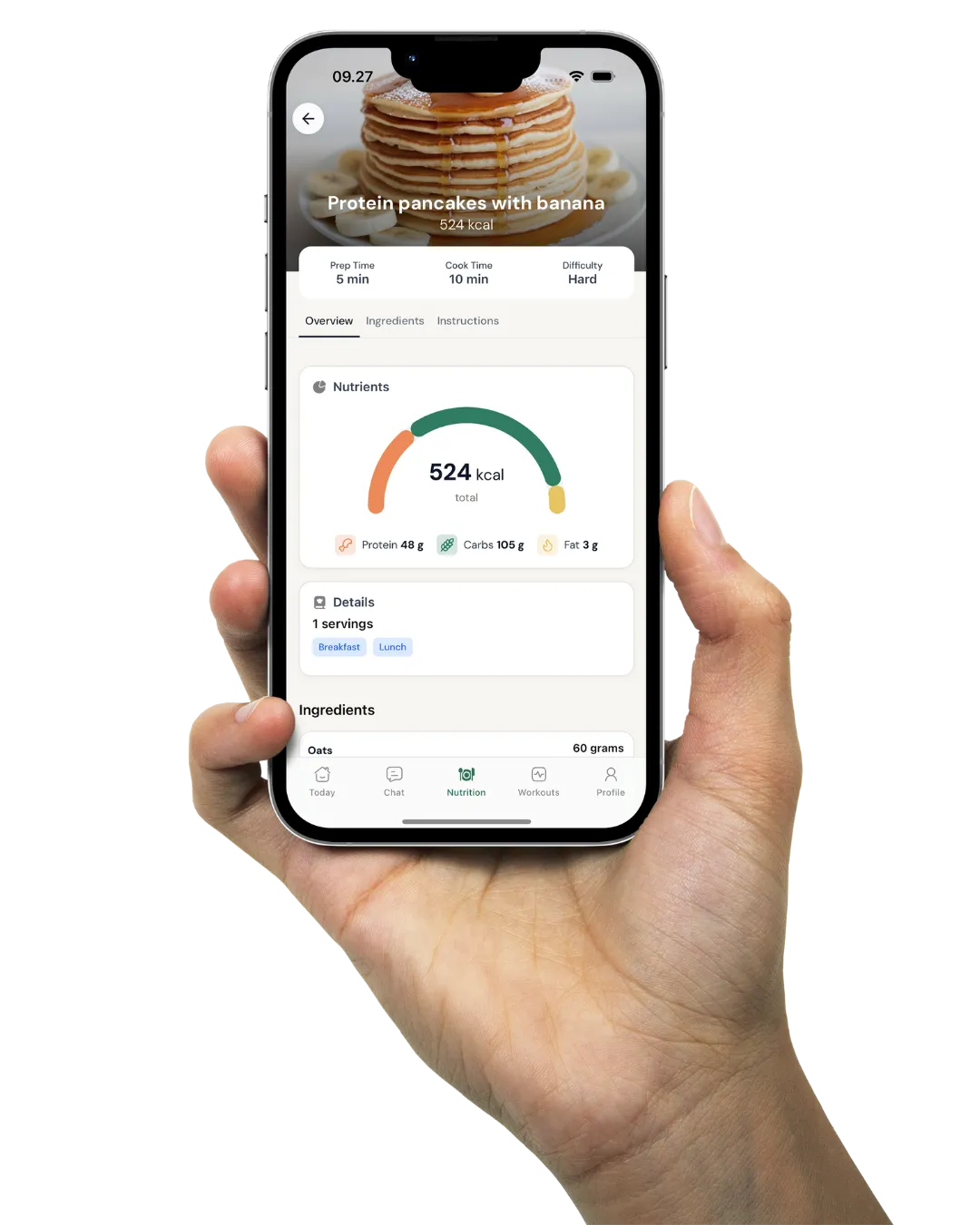
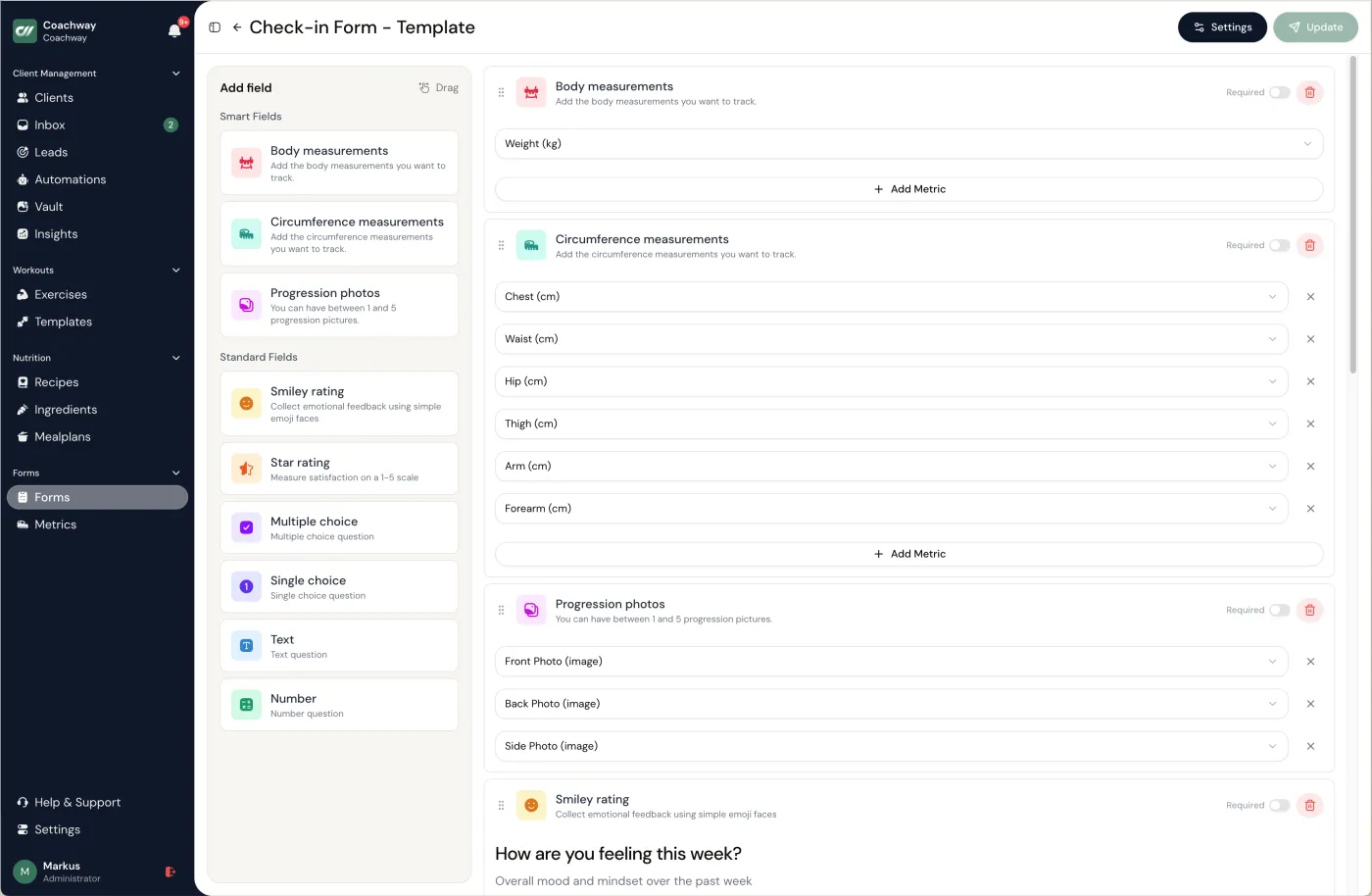
Coachway is coaching software for online coaches who run training and nutrition. You set calorie and macro targets per client and per weekday, or build meal plans from 1,100+ recipes and 3,900+ ingredients with auto-scaling macros and shopping lists. Clients log food against a 3.7 million item database with barcode scanning, a photo diary and quick add, and you choose one of four access levels per client: full, standard, photo-only or plan-only, so a client who should not count can send photos instead. Weekly check-ins run on custom forms with photos and measurements, and chat includes voice notes.
It costs EUR 69 a month including up to 5 active clients, then EUR 9 per extra active client (USD 79 plus USD 10), with every feature on one plan. Clients pay you through your own Stripe account; the subscription takes no share of your coaching revenue, and built-in payments cost 2.4 % per transaction. You can try it free for 14 days with your first client. The certificate covers the science; clients pay for the weekly coaching.
Frequently asked questions about nutrition coach certifications.
Can I get a nutrition coach certification with no fitness background?
Yes, for the mainstream courses. At the time of writing, Precision Nutrition Level 1, NASM Certified Nutrition Coach and ISSA Certified Nutrition Coach list no prerequisites, and ISSA says a fitness certification is not required, though many students take one alongside it. The CISSN is the exception: it normally requires a four-year degree, and its alternative route asks for years of practice and a trainer certification. If you want to coach training as well, you will need a training credential too.
How much does the Precision Nutrition Level 1 certification cost?
At the time of writing, Precision Nutrition lists a general public price of USD 799 for Level 1, or USD 79 a month for 12 months. People who join its Insider Access list before an enrolment window are offered a lower price. Prices and promotions change, so check the live figure on precisionnutrition.com before you enrol, and remember that the credential needs renewing every two years.
Is the NASM nutrition certification exam open book?
Yes. At the time of writing, NASM describes the Certified Nutrition Coach exam as online and open-book, with 100 multiple-choice questions in 90 minutes and a 70 percent pass mark. You get up to three attempts within one year of purchase. Most learners finish the course in 4 to 6 weeks, and the credential renews every two years with 1.9 NASM CEUs.
Does Precision Nutrition count toward NASM or ACE renewal?
It can. At the time of writing, Precision Nutrition lists Level 1 as an approved continuing education course for several bodies, including 1.9 CEUs for NASM, 6.0 CECs for ACE and 20 CEUs for ISSA, plus credits for NSCA and NBHWC. So if you already hold one of those training credentials, PN Level 1 can count toward your renewal. Check the current credit amount with your own body before you buy, because approvals and amounts change.
Do nutrition coach certifications expire?
Most do. Precision Nutrition and NASM both ask you to renew every two years; NASM asks for 1.9 CEUs to do it. ISSA renewals generally ask for 20 CEUs, a current CPR/AED certificate and a fee, so confirm the terms for the nutrition credential. The CISSN asks for continuing education every year and an active ISSN membership. Budget for renewal as part of the real cost.
Does a nutrition coach certification let me write meal plans?
Not by itself. A certification teaches you the material; what you are allowed to do is set by the law where you and your client are. In many places a non-clinical coach can give general guidance and meal ideas to healthy adults, but some countries and US states restrict individualised nutrition advice to licensed professionals, and treating a medical condition is work for a registered dietitian. Check your local rules and refer out when a need is clinical.
How long does it take to get a nutrition coach certification?
From a few weeks to about six months, depending on the course and your weekly hours. At the time of writing, NASM says most learners finish its Certified Nutrition Coach course in 4 to 6 weeks, Precision Nutrition suggests a pace of one chapter a week for Level 1, a little over four and a half months, ISSA lists about 200 hours with six months to finish, and AFPA says six months or less. The CISSN is an exam you prepare for on your own.
Certification prices, exam formats and renewal terms on this page were read from each provider's own website in October 2026 and change often; confirm them before you enrol. Coachway is not affiliated with any certification provider named here. Nothing on this page is legal or medical advice or a promise of any income or health result.
Keep reading
all guidesBest Health Coach Certifications (2026): NBHWC & More
An honest comparison of the main health coach certification routes - NBHWC board certification and the approved programs that lead to it, plus ACE, NASM, Precision Nutrition, and IIN - covering cost, length, recognition, and who each suits, so you can pick the right one without overpaying.
Read the guideHow to Become a Health Coach (2026): Steps & Certifications
What a health coach really does (behavior change, habits, accountability within scope), the step-by-step path, NBHWC accreditation, scope of practice, realistic timeline and cost, and an honest look at income.
Read the guideWhat Is an Online Nutrition Coach? (2026 Guide)
What an online nutrition coach does, the tools they use, their scope of practice, and how to become one - a clear, practical guide for new and aspiring coaches.
Read the guideFree tools for this: Calorie Deficit Calculator · Goal Weight Date Calculator · Macro Calculator
Ready-made templates: Client Onboarding Checklist · Coaching Contract Template
See what Coachway can do for your coaching business
Coachway was built on knowledge from working with 150 online coaches over 6+ years, who all hit the same wall - slow platforms, clunky workflows, wasted hours. Start your 14-day free trial and see what we fixed - the whole platform, no charge today, cancel anytime under Billing.