


Behavior change coaching - the frameworks behind client retention.
Behavior change coaching is the part of the job that decides whether a good plan ever becomes a result. Three well-tested models - the stages of change, motivational interviewing and self-determination theory - explain why clients stall, how to have the conversation that unsticks them, and what to build into the coaching so the motivation lasts. This is the coach-facing guide to all three, with the honest link to the number they quietly drive: retention.
By Markus Evers · Updated September 2026
the short version
Behavior change coaching is helping a client keep a new habit by working with their motivation and readiness, not only their program. Three frameworks do most of the work. The stages of change tell you to coach the client's readiness, not push everyone as if they were ready to act. Motivational interviewing draws a client's own reasons for change out of them, because self-generated motivation lasts and borrowed motivation does not. Self-determination theory names the three needs - autonomy, competence and relatedness - that keep motivation alive over months. Used together in a weekly check-in, they turn a plan on paper into a client who is still training three months later, which is why retention lives downstream of behavior change.
What is behavior change coaching?
Behavior change coaching is the practice of helping a client build and hold new habits by working with their motivation and readiness, not just handing them a program. The program answers what to do; behavior change coaching answers whether the client will actually do it, week after week, once the novelty has worn off. It is the layer of the job that is easy to skip because it does not show up in a training plan or a macro target, and it is the layer that most often decides whether a technically sound program produces a result or gets quietly abandoned in week three.
The reason it matters commercially is simple: retention is downstream of behavior change. A client who keeps the behavior keeps paying, keeps referring and keeps progressing, and the coaches who hold clients longest are usually the ones coaching the behavior rather than only the sets and the calories. You can hand two clients the same excellent plan and watch one thrive and one disappear, and the difference is almost never the plan. It is whether the coaching met the client's actual readiness, helped them own the reasons, and supported the sense of control that makes any change stick. That is not a soft skill sitting next to the real work. For an online coach it is the real work.
The good news is that this is not guesswork or charisma. Behavior change has been studied for decades, and three frameworks in particular give a coach a practical map: where a client is, what conversation moves them, and what to build in so the motivation does not run out. The rest of this guide walks through all three and then puts them to work in the one place a coach touches every client: the weekly check-in.
Which behavior change models should a coach know?
Three models carry most of the practical weight. Each answers a different question, and together they cover why a client stalls, how to talk them forward, and how to make the change last. None of them requires a psychology degree to use - they require the discipline to coach the person in front of you rather than the plan in your head.
1. The stages of change (transtheoretical model)
The transtheoretical model, developed by Prochaska and DiClemente, describes behavior change as movement through five stages: precontemplation, where a person is not yet considering a change; contemplation, where they are weighing it; preparation, where they get ready and make small starts; action, where they do the new behavior; and maintenance, where they hold it past the point where it feels new. The model names five stages, and the single most useful idea in it is that each one needs a different move from you.
The classic mistake is prescribing action to a client who is still in contemplation. A stricter plan does nothing for someone who has not yet decided; what they need is help tipping the balance of their own reasons. A client in action needs the opposite - structure, feedback and reachable wins. Read the stage first and your coaching stops missing. The model also treats relapse as part of the cycle rather than a failure, which reframes a slip as information to work with rather than proof the client cannot change, and that reframe alone saves a lot of clients who would otherwise quit out of shame. Habit tactics live one level down from this; if you want the operational side, the habit coaching frameworks guide picks up where the stages leave off.
2. Motivational interviewing
Motivational interviewing, developed by Miller and Rollnick, is a way of talking that helps a client voice their own case for change instead of being argued into it. Rather than telling a hesitant client why they should train, you ask open questions, reflect back what you hear, and let them articulate the reasons in their own words. It sounds almost passive, and it is the opposite of the instinct most coaches lead with, which is to fix and correct on sight.
It works because of a plain fact about people: we are persuaded far more by what we hear ourselves say than by what we are told. Motivation a client generated survives the moment your voice leaves their head; motivation you supplied evaporates the same moment. In practice it looks like resisting the reflex to solve everything, asking what a client wants and why now, and reflecting their answer back so they hear their own reasons out loud. Coaches who lead only with instruction lose the clients who were never ready to be instructed. Coaches who ask keep them in the room long enough for the training to do its work. And once a client has voiced their own reason, the next move is to make the first action small enough that they cannot talk themselves out of it - the logic behind BJ Fogg's Tiny Habits model, which shrinks a habit until it is too small to skip.
3. Self-determination theory
Self-determination theory, from Deci and Ryan, holds that lasting motivation depends on three basic psychological needs being met: autonomy, a sense of choice and ownership; competence, feeling capable and seeing progress; and relatedness, feeling seen and supported by another person. The theory names three needs, and a coaching setup that quietly starves any one of them tends to produce the same result - a client who complies for a month and then goes silent.
You support autonomy by building the plan with the client and leaving real choices inside it, not handing down a fixed regimen they merely receive. You support competence by scaling difficulty so early wins are actually reachable and by making progress visible when the scale is being stubborn. You support relatedness with a real, personal reply on the check-in, the human contact a template cannot fake. Motivation built on these three needs is the internal kind that survives a bad week, a missed session or a flat number on the scale - which is exactly the motivation retention is made of. Most of what coaches call a discipline problem in a client is really one of these three needs going unmet.
How do you apply behavior change coaching in the weekly check-in?
A framework you only understand changes nothing. The place it becomes coaching is the check-in, because that is the one moment you touch every client on a fixed rhythm. Four moves fold all three models into a single weekly reply.
1. Read the stage before you reply.
Before you write a word, decide where the client is. Someone acting and progressing needs structure and a next target. Someone who has quietly slid back toward contemplation - fewer logs, shorter answers, a flat tone - does not need a harder plan; they need a different conversation. Matching your reply to the stage is the whole game, and it is the step coaches skip when they answer every check-in the same way.
2. Ask, then reflect, before you instruct.
Borrow the motivational interviewing move. Open with a question rather than a correction, reflect back what the client actually said, and let them name the next step where you can. It feels slower than just telling them what to do, and it is the difference between a client who follows because you said so and one who follows because they decided to. The first stops the day your message stops landing; the second holds.
3. Feed all three needs on purpose.
Build one real choice into the coming week so the client owns it (autonomy). Point to one concrete piece of progress they might not have noticed - a lift, a habit streak, a measurement the scale hid (competence). And make the message personal enough that they feel seen rather than processed (relatedness). Three small, deliberate touches, one per need, turn a status update into coaching. This is where visible progress earns its keep, and why keeping a client's goals in front of them does quiet work every week.
4. Keep the cadence, treat slips as signals.
Consistency is itself a behavior-change tool: a steady weekly rhythm gives the relationship a shape a client can rely on. And when a check-in is missed or a client slips, treat it as a prompt to open a conversation, not a mark against them. A slip handled as information keeps a client; a slip handled as a verdict loses one. This is the mechanism underneath every retention number, which is why measuring retention only tells you the score - behavior change is how you move it.
Where does the software fit behavior change coaching?
None of this needs software to be true - a coach with a notebook can read a stage and ask a good question. What software changes is whether you can do it consistently across a full client list without the signals getting lost. Behavior change coaching lives or dies on seeing the client clearly and replying on a rhythm, and both get harder the more clients you carry. That is the honest job a platform does here: it keeps the evidence you coach from in one place so the weekly move is quick to make.
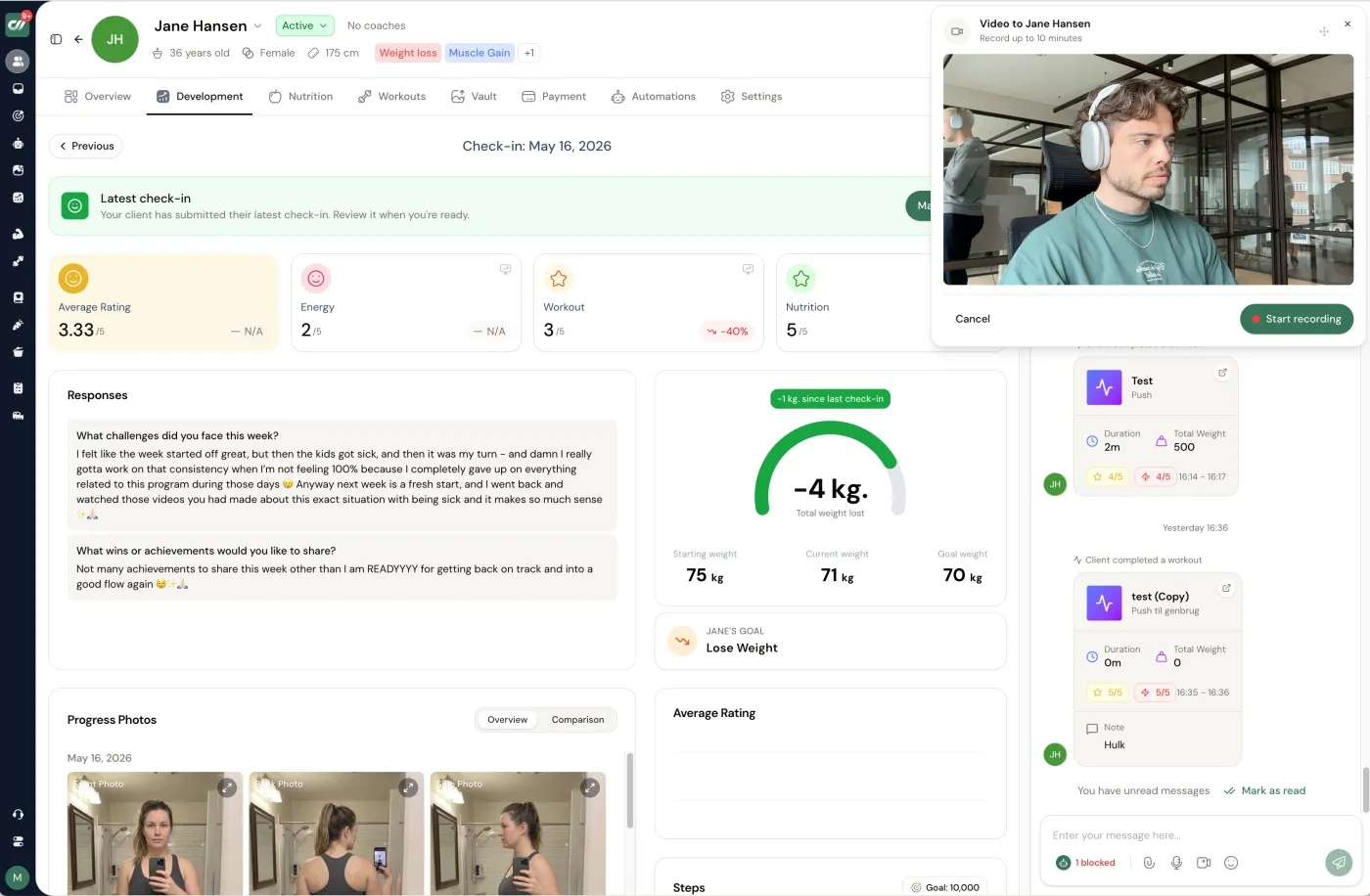
Coachway is built for that check-in. Each client's ratings, written responses, weight trend and progress photos sit on one tab, so you read the stage and the mood in seconds instead of stitching them together from four apps - which is what makes the personal, needs-aware reply realistic to write every week rather than only when you have time. Onboarding flows and reminders keep the cadence steady without turning the coaching into a template, and the client app carries your own plans and check-ins, so the relationship feels like yours. It is built on knowledge from working with 150 online coaches over 6+ years, and it costs EUR 69 a month including your first 5 clients, then EUR 9 per additional client, with every feature included. Payments settle in your own Stripe account, so Coachway never holds your money, and the optional built-in checkout carries a 2.4% per-transaction fee only if you choose to use it. You can book a demo to see the check-in view first; the 14-day free trial starts with a card held by Stripe and cancels under Billing before it renews. The coach dashboard is in English, and the client app is available in English, Danish, Norwegian, Swedish, Finnish and German.
Frequently asked questions about behavior change coaching.
What is behavior change coaching?
Behavior change coaching is the practice of helping a client build and hold new habits by working with their motivation and readiness, not just handing them a program. The program answers what to do; behavior change coaching answers whether the client will actually do it week after week once the novelty fades. It draws on established psychology - the stages of change, motivational interviewing and self-determination theory - to meet a client where they are, resolve their own reasons for changing, and support the sense of control that makes a change stick. For an online fitness coach it is the difference between a plan that looks perfect on paper and a client who is still logging, checking in and progressing three months later. Retention is downstream of behavior change: the coaches who keep clients longest are usually the ones who coach the behavior, not only the training and the macros.
What are the main behavior change models coaches use?
Three models carry most of the weight in coaching. The transtheoretical model, better known as the stages of change, describes the five steps a person moves through from not considering a change to maintaining it, and it tells you to match your coaching to the stage rather than pushing everyone as if they were ready to act. Motivational interviewing is a conversation style that draws a client's own reasons for change out of them instead of arguing them into it, which matters because people are persuaded far more by what they hear themselves say. Self-determination theory identifies the three psychological needs - autonomy, competence and relatedness - that keep motivation alive over months rather than weeks. Used together they explain why a client stalls, how to have the conversation that unsticks them, and what to build into the coaching so the motivation lasts.
What is the transtheoretical (stages of change) model?
The transtheoretical model, developed by Prochaska and DiClemente, describes behavior change as movement through five stages: precontemplation (not yet considering a change), contemplation (weighing it), preparation (getting ready and making small starts), action (doing the new behavior), and maintenance (holding it past the point where it feels new). The practical value for a coach is that each stage needs a different move. A client in contemplation does not need a stricter plan; they need help tipping the balance of their own reasons. A client in action needs structure, feedback and early wins. Reading the stage stops you from prescribing action to someone who has not decided yet - the most common reason a technically sound plan gets ignored. Relapse is treated as part of the cycle, not a failure, so a slip becomes information to work with rather than proof the client cannot change.
How does motivational interviewing help coaching retention?
Motivational interviewing, developed by Miller and Rollnick, is a way of talking that helps a client voice their own case for change rather than being lectured into it. Instead of telling a hesitant client why they should train, you ask open questions, reflect back what you hear, and let them articulate the reasons themselves. It helps retention because motivation that a client generated is far more durable than motivation you supplied - the moment your voice is out of their head, borrowed motivation evaporates, while their own reasons stay. In practice it looks like resisting the reflex to fix and correct on every check-in, asking what a client wants and why now, and reflecting their answer back so they hear it. Coaches who lead with instruction lose the clients who were not ready to be instructed; coaches who ask keep them long enough for the training to work.
What is self-determination theory in coaching?
Self-determination theory, from Deci and Ryan, holds that lasting motivation depends on three basic psychological needs being met: autonomy (a sense of choice and ownership), competence (feeling capable and seeing progress), and relatedness (feeling seen and supported by another person). A coaching setup that quietly starves any one of them tends to produce the client who complies for a month and then goes quiet. You support autonomy by building the plan with the client and giving real choices inside it, not handing down a fixed regimen. You support competence by scaling difficulty so early wins are reachable and by making progress visible. You support relatedness with a real, personal reply on the check-in - the human contact that a template cannot fake. Motivation built on these three needs is the internal kind that survives a bad week, which is exactly the kind retention is made of.
How do you apply behavior change frameworks in check-ins?
The weekly check-in is where the theory becomes coaching. Start by reading the stage: is this a client who is acting and needs structure, or one who has quietly slid back toward contemplation and needs a different conversation? Use motivational interviewing in the reply - ask an open question, reflect what they said, and let them name the next step rather than assigning it. Support the three needs of self-determination theory on purpose: offer a real choice for the coming week (autonomy), point to one concrete piece of progress they might not have noticed (competence), and make the message personal enough that they feel seen (relatedness). Keep the cadence consistent so the relationship has a rhythm, and treat a missed check-in or a slip as a signal to open a conversation, not a mark against the client. Done weekly, this turns behavior change from a concept into the routine that holds a client for the long run.
Which coaching platforms have built-in frameworks for behavior change tracking and progress milestones?
The framework lives in the weekly check-in loop rather than in a feature list, so look for a platform that keeps the client's ratings, written answers, weight trend and photos on one screen and lets you reply on a rhythm. Coachway does that for fitness and nutrition coaches, with check-in forms (including habit questions you write), onboarding flows and reminders that keep the cadence steady; the section above explains how the stage and the mood are read from that one tab. Any platform that scatters those signals across four apps makes the framework hard to apply consistently, whatever it says on the box.
Behavior change is the engine under two numbers this guide only points at: the habits that make the change stick, and the retention rate those habits move. It all starts with a goal the client owns, which is why it pays to set goals that actually stick.
Keep reading
all guidesOnline fitness coaching statistics 2026: first-party benchmarks and market data
First-party benchmarks from 201 Nordic online fitness coaches on the Coachway platform (median 5 active clients, EUR 181 per client per month, 4.3-month average client tenure, 45% retention at month 12) plus sourced market-size, growth and earnings figures, each with its sample size and source.
Read the guideWhat Is Online Fitness Coaching? How It Works in 2026
Online fitness coaching is ongoing, personalised training and nutrition guidance delivered remotely through an app: programs, check-ins, messaging and adjustments. What it includes, what it costs, and how it differs from a workout app or in-person PT.
Read the guideHow to Adjust a Workout Program During a Cut (2026)
Adjusting a client's training program during a cut comes down to four decisions made against a shrinking recovery budget: keep intensity heavy so the muscle has a reason to stay, drift volume toward maintenance, pick lower-fatigue exercises, and deload more often.
Read the guideFree tools for this: TDEE Calculator · One-Rep-Max Calculator · Macro Calculator
See what Coachway can do for your coaching business
Coachway was built on knowledge from working with 150 online coaches over 6+ years, who all hit the same wall - slow platforms, clunky workflows, wasted hours. Start your 14-day free trial and see what we fixed - the whole platform, no charge today, cancel anytime under Billing.


