


Personal trainer programming, taught as a repeatable framework.
Personal trainer programming is not a stack of hard workouts - it is the deliberate arrangement of six variables into a plan that produces one chosen adaptation. Specificity, overload, volume, intensity, frequency and progression are the whole game. This is the framework behind good program design, why each lever matters, and how to run all six for clients you coach remotely rather than watch in the room.
By Markus Evers · Updated August 2026
the short version
Personal trainer programming is the deliberate arrangement of six variables into a plan that drives one specific adaptation. Specificity makes the training resemble the goal. Overload keeps the demand rising so the body has a reason to change. Volume is how much total work, intensity is how heavy or how hard, and frequency is how often each muscle is trained. Progression is the scheduled way those numbers move across a block so overload happens on purpose, not by luck. Everything else - exercise choice, sets, reps, rest, tempo - is just a way of setting one of the six. Coach all six toward a single goal and you have a program; leave one to chance and you have a workout that stalls.
What is personal trainer programming, really?
A written session is the visible part of programming and the least important. Anyone can list five exercises that make a client sweat. The programming is the reasoning underneath the list: why these movements and not others, why this many sets, why this order, what the load is meant to do, and what has to change next week for the client to keep adapting. Two coaches can prescribe the same Monday session for opposite reasons, and only one of them is programming - the other is guessing and getting lucky.
The useful mental model is that programming is a control problem with six dials. You are trying to produce one output - more muscle, more strength, better conditioning, a rehabbed movement - and you have six inputs you can turn. Turn them coherently toward the goal and the client adapts. Turn them at random, or turn one hard while ignoring the others, and you get fatigue without direction. The rest of this guide is those six dials, one at a time, and then how to actually run them for someone you are coaching through an app rather than standing next to.
The framework is deliberately model-agnostic. It does not care whether you run a bro split or full-body, percentages or RPE, block or undulating periodization. Those are styles. The six variables are the physics every style is made of, which is why understanding them beats collecting templates: a coach who understands the variables can build or fix any template, while a coach who only owns templates is stuck the moment a client does not fit one. This is the same instinct behind evidence-based coaching - reasoning from principles rather than copying whatever program is fashionable.
The six programming variables every coach controls.
Memorise these, because every programming decision you will ever make is one of them in disguise. They are listed in the order it helps to think about them: specificity sets the direction, overload provides the engine, volume and intensity and frequency are the dose, and progression is the schedule that moves the dose over time.
1. Specificity - the training has to resemble the goal.
The body adapts specifically to the demand you impose on it - the SAID principle, and the single most important word in program design. A client who wants a bigger squat has to squat; a client who wants to run a faster 10k has to run, mostly, at speeds and distances near that target. Specificity is the sanity check you run before anything else: if the training does not resemble the outcome the client hired you for, no amount of clever volume or intensity will fix it. Most bad programs are not badly dosed - they are aimed at the wrong adaptation. Set the goal first, then let specificity tell you what the training has to look like before you argue about the details.
2. Overload - the demand has to keep rising.
A body that meets the same stimulus twice has no reason to change the second time. Overload is the requirement that the training demand climbs over time, and progressive overload is the mechanism that makes it happen - a little more weight, a rep more, a set more, a cleaner rep at the same load. It is the engine of the whole program, and it is also the variable new coaches most often leave to chance: they write a good week one and then repeat it, wondering why the client plateaus. Overload does not mean adding weight to the bar every single session forever; it means the program has a planned way to become harder, so progress is scheduled rather than hoped for.
3. Volume - how much total work.
Volume is the total amount of productive work, most usefully counted as the number of hard sets a muscle performs across a week. Within sensible limits it is the primary driver of muscle growth: do more challenging work and, up to a point the client can recover from, they grow more. The coach's job is to set enough volume to drive the adaptation without exceeding what the client can recover from, and to raise it gradually rather than starting at the ceiling - beginning from the minimum effective dose, the least volume that still drives progress, leaves the most headroom to add work later in the block. The specific weekly numbers that tend to work for hypertrophy - and the point where more sets stop helping - are worth knowing in detail, which is the whole subject of the dedicated training volume guide. The principle to hold here is simply that volume is a dose you set on purpose, not a byproduct of how long the session ran.
4. Intensity - how heavy, or how hard.
Intensity means one of two related things: how heavy the load is relative to a one-rep max, or how close each set is taken to failure. Strength work lives at high relative loads and low reps; hypertrophy work tolerates a wide band of loads as long as the sets are taken close enough to failure to be challenging. For remote coaching the effort side of intensity is the one that travels, because you are not there to load the bar by feel - which is exactly why RPE and reps-in-reserve targets matter so much in programming. Volume and intensity trade against each other because both cost recovery, so a coach sets a sensible weekly volume and a target intensity per exercise, then progresses one or the other while watching how the client recovers.
5. Frequency - how often each muscle is trained.
Frequency is how many times a week a muscle or movement gets trained, and it is mostly a tool for distributing volume rather than a magic variable of its own. At equal weekly volume, training a muscle across two sessions tends to edge out cramming it into one, largely because splitting the work lets each set be done with better quality and less accumulated fatigue - the reasoning is unpacked in the training frequency guide and in Jeff Nippard's breakdown of how often to train each muscle. Practically, frequency is decided by the client's real schedule first and the theory second: it sets how the week's volume is chopped up across the days the client will actually train, which is where programming meets the honest constraint that the best plan is the one that gets done.
6. Progression - the schedule that moves the dose.
Progression is the plan for how volume, intensity and exercise selection change across a training block, so that overload happens on schedule instead of by accident. This is where periodization lives - the deliberate structuring of a block, whether you increase load week to week, wave volume up and back down, or build to a peak and deload. Chad Wesley Smith's Juggernaut Method is one worked template of that wave-and-phase structure. It is the difference between a program and a good week repeated indefinitely. A coach does not need an exotic periodization model to program well; they need a stable block with a built-in way to get harder, a planned reassessment or deload at the end, and a considered decision about what changes going into the next block. The full menu of block, linear and undulating structures is laid out in the periodization guide.
How do you use the six variables to build an actual program?
The variables are a set of dials, and the framework is the order you turn them. Move top-down - direction, then structure, then dose, then the schedule that moves the dose - and a program falls out of the process rather than being assembled from a template. The mechanics of turning it into a delivered plan a client will follow sit in the companion piece on writing an online coaching program, and Jeremy Ethier's walkthrough of how to design a training program is a worked example of the same top-down order; what follows is the reasoning layer that goes above it.
Set one goal, then let specificity choose the exercises.
Pick a single primary adaptation - a program that chases fat loss and a big squat and a marathon at once does none of them well. Once the goal is fixed, specificity does most of your exercise selection for you: it tells you which movements have to be in the program and which are optional accessories. This is also the step that quietly fails most often, so it is worth being blunt about with the client before a single set is written.
Set frequency from the client's week, not the textbook.
Decide how many days the client will genuinely train, then choose a split that fits those days. This single decision shapes the whole program, because frequency is how the weekly volume gets distributed. A three-day full-body layout for a three-day trainee beats a four-day upper-lower they will only half-complete. If you want the reasoning behind picking a split, the FITT principle is the same variables named a slightly different way.
Set the dose: weekly volume and target intensity per muscle.
Now assign the numbers. Give each muscle a sensible weekly set count, spread across the days you chose, and give each exercise a target intensity - a load range or an RPE. Start deliberately below the ceiling so there is somewhere to progress into. Two clients with the same goal can carry very different doses depending on their training age and recovery, which is why the framework sets the dose per client rather than copying yours - and why Alex Bromley's periodization for coaches is worth reading on matching the model itself to a client's training age.
Build the progression before week one starts.
Decide how the program gets harder before the client ever trains: which variable climbs, by how much, and when the block ends with a deload or reassessment. Progression written in advance is what turns a good first week into a block that keeps working - Caroline Girvan's EPIC progression is a concrete example of that kind of structured, planned-ahead progression. Leaving it to be improvised each week is the most common reason a technically fine program stalls - the overload never got scheduled, so it never reliably happened.
What changes when you program for clients you cannot watch?
The six variables are identical online and in person - physiology does not know whether you are in the room. What changes is the feedback loop and the constraints, and two things carry more weight because of it. The first is autoregulation. In person you adjust load by feel mid-session; online you are prescribing days ahead for someone you are not watching, so you need a way for the client to hit the right effort without you. That is what RPE and reps-in-reserve targets buy you - they let the client self-select an appropriate load on the day, which is more robust than a fixed percentage of a max that may already be out of date.
The second is adherence, and it quietly outranks everything technical. The best program is the one that gets done, so a coach programming remotely is always solving two problems at once - the physiology and the reality of a client's week - and the reality usually wins. A perfectly dosed five-day plan for someone who reliably trains three days is a worse program than an honest three-day plan, because the first one is mostly fiction. This is not a compromise of the framework; it is the framework working correctly, with frequency and volume set to the life the client actually has.
Delivery becomes part of the programming too. An exercise the client cannot see demonstrated is an exercise done with the wrong pattern, and a target the client cannot log against is a progression you are running blind. So a clean demo on every movement, a readable weekly layout, and a check-in that surfaces problems while there is still time to fix them are not administrative extras - they are how the six variables survive the trip from your head to a client training alone in a gym across the country.
Running the framework for thirty clients without it decaying.
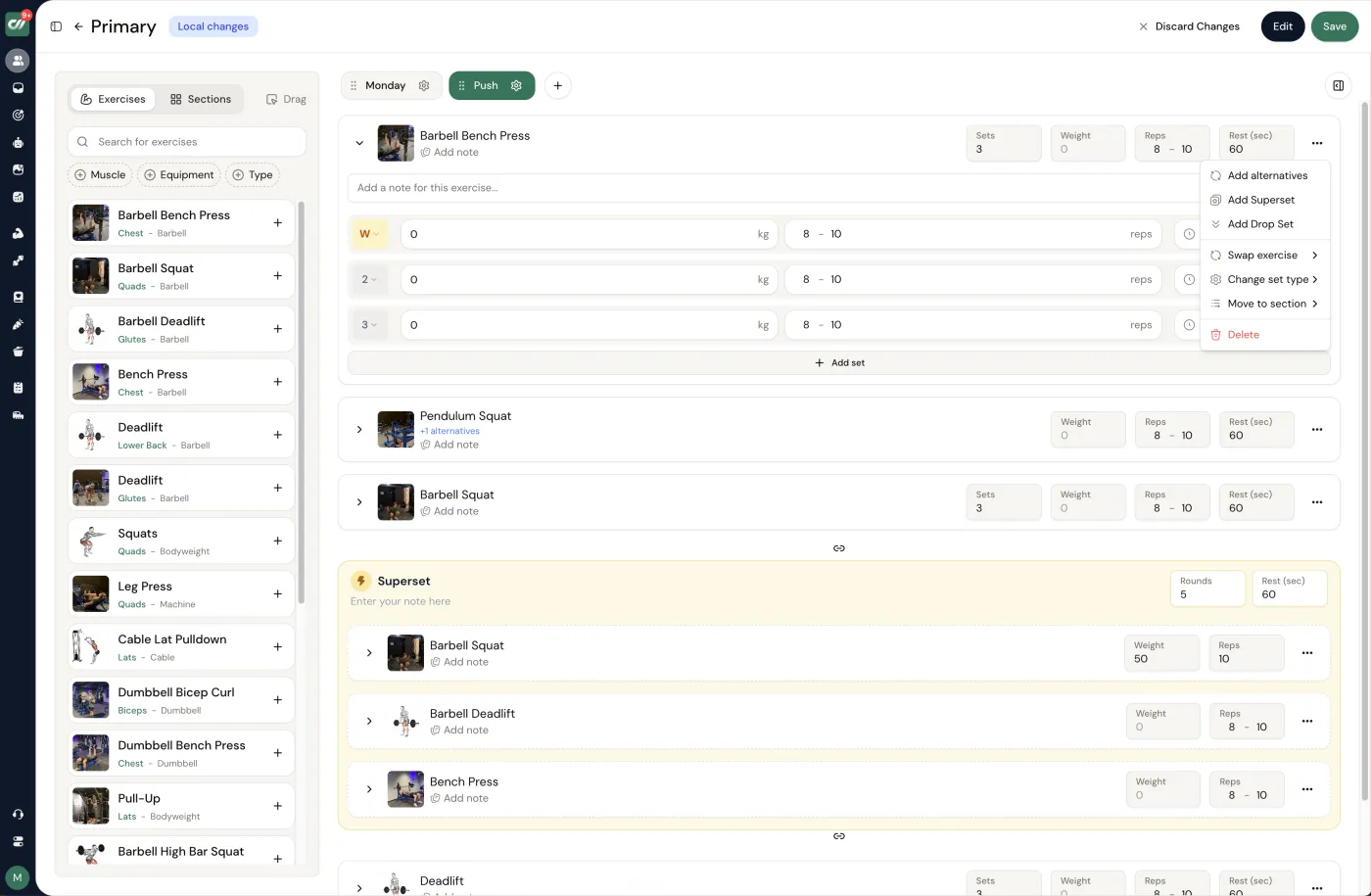
The framework is the same on paper as in an app. What software changes is whether you can hold thirty clients to this standard at once instead of two. When a program lives in a spreadsheet emailed on Sunday, the loop stays open: the client cannot see a demo of an unfamiliar lift, cannot log a set against the intensity you set, and you cannot see whether they trained until the next check-in - so next week's progression becomes a guess. A coaching platform closes that loop. In Coachway the program is built beside a library of 1,800+ exercises, every movement carries a demo video the client watches in the app, the client logs each set against the prescribed load and reps, and that history sits in front of you when you decide what climbs next week. It is built on knowledge from working with 150 online coaches over 6+ years, and it costs EUR 69 a month including your first 5 clients, EUR 9 per additional client after that, with every feature included. The 14-day free trial starts with a card and cancels under Billing before it renews, or you can book a demo and see the builder first.
Frequently asked questions about personal trainer programming.
What is personal trainer programming?
Personal trainer programming is the deliberate arrangement of training variables into a plan that drives a specific adaptation, rather than a stack of workouts a client does because they look hard. It sits on six levers a coach controls: specificity (the training resembles the goal), overload (the demand rises over time), volume (how much total work), intensity (how heavy or how hard), frequency (how often each muscle or movement is trained), and progression (the scheduled way those numbers change week to week). A written session is only the surface. The programming is the reasoning underneath - why these exercises, why this many sets, why this order, and what has to change next week for the client to keep adapting. Get the six variables coherent and pointing at one goal and you have a program; miss one and you have a workout log that stalls.
What are the main variables in program design?
Six, and they are worth memorising because every programming decision is one of them. Specificity is the match between the training and the goal - the SAID principle, that the body adapts specifically to the demand imposed. Overload is the requirement that the demand keeps rising, because a body that meets the same stimulus twice has no reason to change. Volume is the total amount of work, usually counted as hard sets per muscle per week, and it is the primary driver of muscle growth within sane limits. Intensity is how heavy the load is relative to a maximum, or how hard the effort is on an RPE or RIR scale. Frequency is how often a muscle or movement is trained across the week. Progression is the plan for how volume, intensity and exercise selection move over a block so overload actually happens on schedule rather than by accident. Everything else - exercise choice, set and rep schemes, rest, tempo - is a way of setting one of those six.
How is programming for online clients different from in-person?
The variables are identical; the constraints and the feedback loop change. In person you see every set and can adjust load by feel mid-session. Online you are programming days ahead for someone you are not watching, so two things carry more weight. First, autoregulation - giving the client a way to hit the right effort without you there, which is why RPE and reps-in-reserve targets matter more in remote programming than fixed percentages that assume a known one-rep max. Second, adherence - a technically perfect five-day plan for someone who reliably trains three days is a worse program than an honest three-day plan, because the best program is the one that gets done. Remote programming also leans harder on clear delivery: an exercise the client cannot see demonstrated is an exercise done wrong, so demo videos, a readable weekly layout and a check-in that surfaces problems early are part of the programming, not extras bolted on after.
How often should you change a client's program?
Change the load and reps constantly - that is progressive overload doing its job every week. Change the exercises and structure rarely - usually every four to eight weeks, at the end of a training block, not because the client is bored. New coaches tend to rewrite the whole program too often, which resets the progression clock before the current stimulus has finished working and makes it impossible to tell what actually drove the result. A muscle needs several exposures to the same movement to add load to it; swap the movement every week and you spend the client's training life re-learning exercises instead of getting stronger at them. The honest rhythm is a stable block with progression built in, a deload or reassessment at the end, then a considered change into the next block. Novelty is a retention tool, and a real one, but it belongs in how you communicate and vary accessory work, not in tearing up the main lifts every Monday.
What is the difference between training volume and intensity?
Volume is how much; intensity is how hard. Volume is the total amount of productive work, most usefully counted as the number of hard sets a muscle does across a week. Intensity is either how heavy the load is relative to a maximum, or how close each set is taken to failure on an effort scale. They trade against each other because both cost recovery: you cannot run maximum volume at maximum intensity for long without accumulating more fatigue than you can clear, which is exactly what progression and deloads exist to manage. In practice a coach sets a sensible weekly volume for the muscle, a target intensity for each exercise, and then progresses one or the other over the block while watching recovery. Treating them as separate dials you turn on purpose - rather than a single vague sense of how brutal the session felt - is a large part of what separates programming from just making people tired.
Do you need software to program for clients?
You can program on paper; the science does not care about the tool. What software changes is everything around the program - delivery, tracking and how many clients you can hold to this standard at once. When a plan lives in a spreadsheet emailed out on Sunday, the client cannot see a demo of an unfamiliar lift, cannot log a set against the target you set, and you cannot see whether they actually trained until the next check-in. A coaching platform closes that loop: the program carries a video on every exercise, the client logs each set against the prescribed load and reps, and their history sits in front of you when you decide next week's progression. Coachway does this with a workout builder that puts the program next to a library of 1,800+ exercises, and it costs EUR 69 a month including your first 5 clients, with a 14-day free trial that starts with a card and cancels under Billing before it renews. The framework is the same on paper or in an app - the app is what lets you run it for thirty people without it decaying into guesswork.
Most of the six variables have a guide of their own: progressive overload is the engine, training volume is the primary dose, and periodization is the schedule that moves everything. When the framework is settled, the program-writing walkthrough turns it into a plan a client will actually follow - or start from the ready-made workout templates for personal trainers and adapt. For conditioning formats that plug into any block, see EMOM and AMRAP.
Keep reading
all guidesHow to Lunge: Form, Variations & Mistakes
How to do a dumbbell and bodyweight lunge with proper form: the muscles worked, a step-by-step rep with bracing, the common mistakes and fixes, plus how to program it.
Read the guideHow to Do a Bulgarian Split Squat: Form Guide
How to do a Bulgarian split squat with proper form: the muscles worked, a step-by-step setup and rep with bracing, the common mistakes and fixes, plus how to program it.
Read the guideHow to Do a Romanian Deadlift (RDL): Form Guide
A coach-grade Romanian deadlift form guide: the muscles it works, step-by-step technique, common mistakes and fixes, how to program it, and the best variations.
Read the guideFree tools for this: VO2 Max Calculator · Protein Calculator · Calorie Deficit Calculator
Ready-made template: Workout Program Template
See what Coachway can do for your coaching business
Coachway was built on knowledge from working with 150 online coaches over 6+ years, who all hit the same wall - slow platforms, clunky workflows, wasted hours. Start your 14-day free trial and see what we fixed - the whole platform, no charge today, cancel anytime under Billing.


