


How to adjust a workout program during a cut - keep the muscle while the fat comes off.
When a client starts a fat-loss phase, the diet changes first - but the training has to change with it, or you spend the whole cut watching strength and muscle leak out with the fat. This is the coach-facing method for how to adjust a workout program during a cut: what to do with volume, intensity, exercise selection and fatigue as calories drop, so the deficit takes fat off the client instead of muscle.
By Markus Evers · Updated August 2026
the short version
A cut lowers recovery, so training in a cut is about spending that smaller recovery budget where it protects muscle. Keep intensity high - train near the same loads the client used at maintenance, because heavy weight is the signal that keeps the muscle. Drift volume down toward a maintenance floor as the deficit deepens, rather than crashing it or trying to hold a full growth workload. Bias exercise selection toward stable, easy-to-load movements that give a strong stimulus for less fatigue. Deload more often, read the client instead of the calendar, and let the diet and cardio own the fat loss so the lifting can stay heavy. Do all of that and the client finishes leaner with the strength and muscle they walked in with.
What actually changes when a client starts a cut?
One thing changes, and everything else follows from it: recovery gets smaller. A calorie deficit means less fuel to repair tissue, less glycogen in the muscle, worse sleep for a lot of people, and a nervous system that is generally running closer to empty. The training itself has not become more important or less important - the budget you pay for it with has shrunk. That is the whole model. If you keep charging a bulk-sized training bill against a cut-sized recovery account, the account goes overdrawn: strength stalls, sessions feel heavier than the numbers say they should, the client gets flat and beaten up, and the muscle you are trying to keep starts leaving alongside the fat.
So the job of the program in a cut is narrow and it is worth saying out loud, because it stops half the mistakes: the training's only job is to keep the muscle. It is not there to burn the fat - the deficit does that, and the deficit only takes fat off if the client can actually hold it week after week, which makes fat loss an adherence problem before it is a programming one. Once you accept that division of labour, the four adjustments below stop being a grab-bag of tips and become one coherent decision, made four times: given a smaller recovery budget, where do I spend it so the muscle has the strongest possible reason to stay? You protect the thing that signals "keep this muscle", and you economise on everything that only costs recovery without adding to that signal.
Do you reduce training volume during a cut?
Volume - the number of hard sets a client does per muscle per week - is the variable you spend recovery on, so it is the first thing that has to give when recovery falls. But the instinct to slash it to nothing is as wrong as the instinct to hold a full growth block. Both throw away muscle. The right move is to drift volume down toward maintenance, and to do it gradually. A practical floor to keep muscle is roughly 2 to 4 hard sets per muscle group per week, against the 10 or more you might have run while building - that gap is your working range for the whole cut.
The sequencing matters more than the starting number. Do not open the cut by cutting volume on day one, when the client still has the recovery to use it. Start near the bulk workload, then pull sets back as the deficit deepens and the recovery markers slip - stalling lifts, worse sleep, sessions that feel heavier than they should. That way the reduction tracks the client's real fatigue instead of an arbitrary schedule, and you keep the muscle-building stimulus for as long as the client can actually afford it. How long that whole taper has to run depends on the cut itself, and a cut length calculator estimates the weeks from the fat to lose and a realistic weekly rate. When you do trim, cut the junk first: the third variation for a muscle you were only running because a surplus paid for it, not the core hard sets that carry the stimulus. If you want the full model behind the numbers, the training volume breakdown covers maintenance volume and where the floor sits.
Should you keep intensity heavy during a cut?
Yes, and this is the single most important adjustment on the page, because it is the one most coaches get backwards. Load - the actual weight on the bar - is the strongest signal that tells the body to hold onto the muscle it has. So intensity is the variable you protect while everything else gives. Keep the client training near the loads they used at maintenance, in the same working rep ranges they built in, and let the reduced volume and slightly lower frequency absorb the smaller recovery budget instead. Heavy and brief beats light and long every time in a deficit.
The classic error is turning the cut into a "toning" phase: drop the weights, triple the reps, cut the rest, chase a burn. That does the exact opposite of what a cut needs. Light, high-rep, low-rest circuits tell the body the strength is no longer being used, which makes it cheap to lose, and they pile on fatigue for a stimulus that a heavier, shorter session would deliver at a fraction of the recovery cost. Expect strength to stall or dip slightly in the back half of a hard cut - that is normal and not a failure. The target is not a personal best in a deficit; it is holding roughly the same bar weights for roughly the same reps, so the muscle keeps getting the "you still need me" message all the way to the end of the diet.
How should exercise selection change in a fat-loss phase?
Bias the selection toward movements that pay a lot of stimulus for a little fatigue. A hungry, under-slept client has less recovery to spend and a smaller margin for a session that goes wrong, so the exercises that made sense in a surplus are not automatically the right ones in a deficit. In practice that means leaning on stable, easy-to-load, technically familiar movements - machines, cables, supported and unilateral work - where the client can push hard, close to failure, without the whole nervous system paying for it. It also means easing off the most systemically taxing lifts done at high effort every week, the heavy conventional deadlift being the usual example.
This is not a ban on free weights or compounds - those still carry the program. It is a trade: you swap a little of the highest-fatigue, highest-skill work for movements that keep the muscle working just as hard while asking less of a depleted body. There is a safety layer here too. Late in a cut, when energy, focus and sleep are all at their lowest, a heavy barbell taken to a grinding last rep is where technique breaks and clients get hurt. Choosing a movement the client can fail safely, and that does not punish a slightly-off day, is programming for the client you actually have late in a diet, not the fresh one who started it. When fatigue does spike, the same logic feeds straight into how you structure a deload.
How do you manage fatigue and recovery as calories drop?
Fatigue is the thing that quietly undoes a cut, because it builds faster and clears slower when recovery is underfunded, and it does not announce itself in a single session. The tool that catches it early is autoregulation - programming to a target effort rather than a fixed number. If a client trains to a set RIR or RPE, the same "2 reps in reserve" instruction automatically gives them a little less absolute load on a bad, depleted day and a little more on a good one, so the program self-corrects to the recovery they actually have that week. That alone prevents most of the slow-motion overreaching a cut can cause. The RPE and RIR guide covers how to set the targets.
Deloads also need to come more often. A plan that ran a lighter week every 6 to 8 weeks in a bulk often needs one every 4 to 6 weeks late in a diet, and sooner if the signs stack up: bar speed dropping, sleep worsening, joints nagging, warm-ups feeling like working sets, motivation flattening. Read the client, not the calendar. And make a cut deload a volume cut more than a load cut - keep the weights, drop the sets - so the client sheds fatigue without teaching the body that the strength is expendable. And remember that any cardio you add to widen the deficit draws on the same recovery budget as the lifting, so where you place it is part of the fatigue equation, not separate from it. Between weekly autoregulation and better-timed deloads, you keep the client on the right side of the line where the muscle stays and the fat leaves.
Adjusting a cut is easy for one client and messy for twenty.
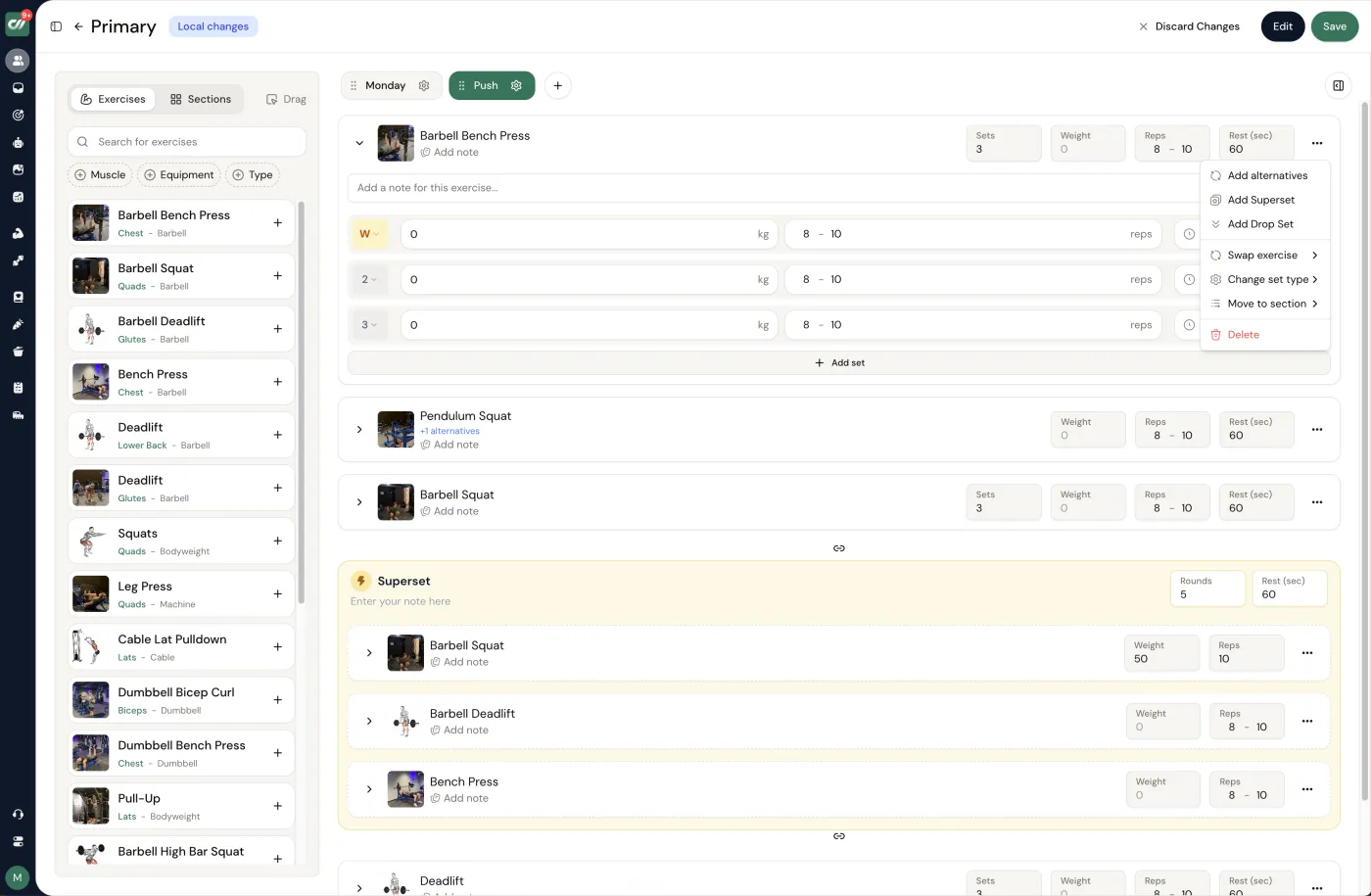
The method above is simple; doing it for a full book of clients, each at a different point in their diet, is where it falls apart. You cannot autoregulate volume and time deloads for someone whose training log lives in one app, whose weight trend lives in another, and whose "I slept terribly this week" is buried in a chat you last read on Tuesday. In Coachway the two things you actually decide from sit next to each other. You build and edit each client's program in the workout builder off a library of 1,800+ exercises, so pulling a set, swapping a grinding deadlift for a stable machine variation, or dialling a deload week is a quick edit rather than a rebuild. And the check-in view puts this week's ratings, the weight trend and the training log on one screen, which is exactly the read - stalling lifts, worse sleep, flattening mood - that tells you a client's cut needs the volume trimmed or a lighter week brought forward. It is built on knowledge from working with 150 online coaches over 6+ years, and it costs EUR 69 a month including your first 5 clients, then EUR 9 per additional client, every feature included. The 14-day free trial starts with a card held by Stripe and cancels under Billing before it renews - or book a demo and see the builder first.
Frequently asked questions about training during a cut.
Do you reduce training volume during a cut?
Usually yes, but slowly and from the top. Volume is the lever you spend recovery on, and recovery is exactly what shrinks in a deficit, so trying to hold a full growth-block workload while calories fall is how clients get flat, sore and stuck. The move is to drift toward maintenance volume rather than crash to nothing: keep enough hard sets to give the muscle a reason to stay, and trim the junk volume you were only running because a surplus paid for it. A practical floor is roughly 2 to 4 hard sets per muscle group per week to maintain, against the 10 or more you might have programmed while building. Do not cut volume on day one either. Start the cut near your bulk workload, then pull sets back as the deficit deepens and recovery markers slip, so the reduction tracks the client's actual fatigue instead of an arbitrary schedule.
Should clients keep lifting heavy while cutting?
Yes. Load is the single strongest signal that tells the body to keep the muscle it has, so intensity is the one variable you protect while everything else gives. If you drop the weights and chase a pump with light, high-rep circuits, you tell the body the strength is no longer needed and it becomes cheap to lose. Keep training near the loads the client used at maintenance, in the same working rep ranges, and let volume and frequency absorb the reduced recovery instead. Strength will usually stall or dip slightly late in a hard cut, and that is fine - the goal is not a personal best in a deficit, it is holding roughly the same bar weights for roughly the same reps so the muscle has every reason to stay. Heavy, brief and well-recovered beats light, long and constantly beaten up.
How should exercise selection change in a fat-loss phase?
Bias toward movements that give a strong training stimulus for a low fatigue cost, because a tired, hungry client has less to spend on recovery and less margin for risk. In practice that means leaning on stable, easy-to-load exercises the client already owns technically - machines, cables, supported and unilateral work - and easing off the most systemically taxing lifts done at high effort, like heavy conventional deadlifts taken close to failure every week. You are not banning free weights or compounds; you are trading a little of the highest-fatigue, highest-skill work for movements that keep the muscle working hard while asking less of a depleted nervous system and stressed joints. Late in a cut, when energy and sleep are lowest, this is also a safety decision as much as a stimulus one.
How often should you deload during a cut?
More often than in a bulk, because fatigue accumulates faster and clears slower when recovery is underfunded. A schedule that ran a deload every 6 to 8 weeks in a growth phase often needs one every 4 to 6 weeks late in a diet, and sometimes sooner if the signs pile up. Do not wait for the calendar - watch the client. Stalled or dropping bar speed, sleep getting worse, joints nagging, mood and motivation flattening, warm-ups feeling like working sets: those are the read that a lighter week is due. A cut deload is usually a volume cut more than a load cut - keep the weights, drop the sets - so the client offloads fatigue without teaching the body that the strength is expendable. Autoregulating with RIR or RPE inside each week catches most of this before it needs a full deload at all.
Should you add cardio or cut training volume to lose fat?
Treat them as separate jobs and protect the lifting. Fat loss is driven by the calorie deficit, which the diet sets and cardio tops up - it is not the job of the strength program, whose only job in a cut is to keep the muscle. So the honest order is: create the deficit with food first, use cardio as an adjustable dial to widen it when fat loss stalls, and leave the resistance training as heavy and hard as recovery allows. Do not turn lifting into cardio by cranking reps and slashing rest to burn calories - that raises fatigue, waters down the muscle-retention signal, and buys very little extra burn. If recovery is the constraint, add cardio in a form that competes least with lifting, such as low-intensity walking, before you start trading away training quality.
A cut is four decisions made against a shrinking recovery budget: hold intensity with autoregulation, drift volume toward maintenance, and time the deloads off the client rather than the calendar. Get those right and the fat leaves without the muscle.
Keep reading
all guidesZone 2 Cardio: What It Is & How to Program It
Zone 2 cardio for coaches: the conversational ~60-70% max-HR aerobic zone, why it builds an aerobic base, how to find it, and how to program frequency and duration.
Read the guideSteady-State Cardio: Benefits & How to Program It
Steady-state cardio for coaches: what it is, the benefits, how it compares to intervals, and how to program sessions, duration, and intensity for clients.
Read the guideHow Much Cardio for Fat Loss? A Coach's Guide
How much cardio for fat loss, for coaches: the diet drives the deficit, cardio is one lever. A sensible starting dose, why more backfires, and how to scale it.
Read the guideFree tools for this: TDEE Calculator · One-Rep-Max Calculator · Macro Calculator
Ready-made template: Workout Program Template
See what Coachway can do for your coaching business
Coachway was built on knowledge from working with 150 online coaches over 6+ years, who all hit the same wall - slow platforms, clunky workflows, wasted hours. Start your 14-day free trial and see what we fixed - the whole platform, no charge today, cancel anytime under Billing.


