Skip to content
platform · definition

What is a CRM for personal trainers?

A CRM for personal trainers is the system that keeps every lead and client in one place - who they are, where they sit in your pipeline, and what happens next. This page gives the plain definition, breaks down the four jobs a trainer CRM actually does, and explains where a standalone CRM overlaps with an all-in-one coaching platform - so you know which one you need.

By Markus Evers · Updated August 2026

the short answer

A CRM for personal trainers is a system that keeps every lead and client - their pipeline stage, their history, and the next step they need - in one organized place, so warm prospects do not go cold and active clients do not get forgotten. It handles four jobs: lead capture, client records, a pipeline, and follow-up. A generic sales CRM does the relationship tracking and stops there; a coaching platform does the same CRM job and then covers delivery too. For most trainers, the all-in-one route means fewer tools to reconcile.
the plain definition

What does a CRM do for a personal trainer?

CRM stands for client relationship management, and most writing about it is aimed at enterprise sales teams chasing quotas. Strip that away and the idea is simple. A CRM for personal trainers is one place that remembers every person in your world - the prospect who DMed you on Monday, the lead who booked a consultation, the client three months into a transformation - along with where each one stands and what you owe them next.

For a trainer, the "relationships" are not faceless accounts. They are real people with goals, a start date, and a renewal coming up. In practice, a trainer CRM does four jobs, and if a tool misses one of them the cracks reopen fast.

Lead capture

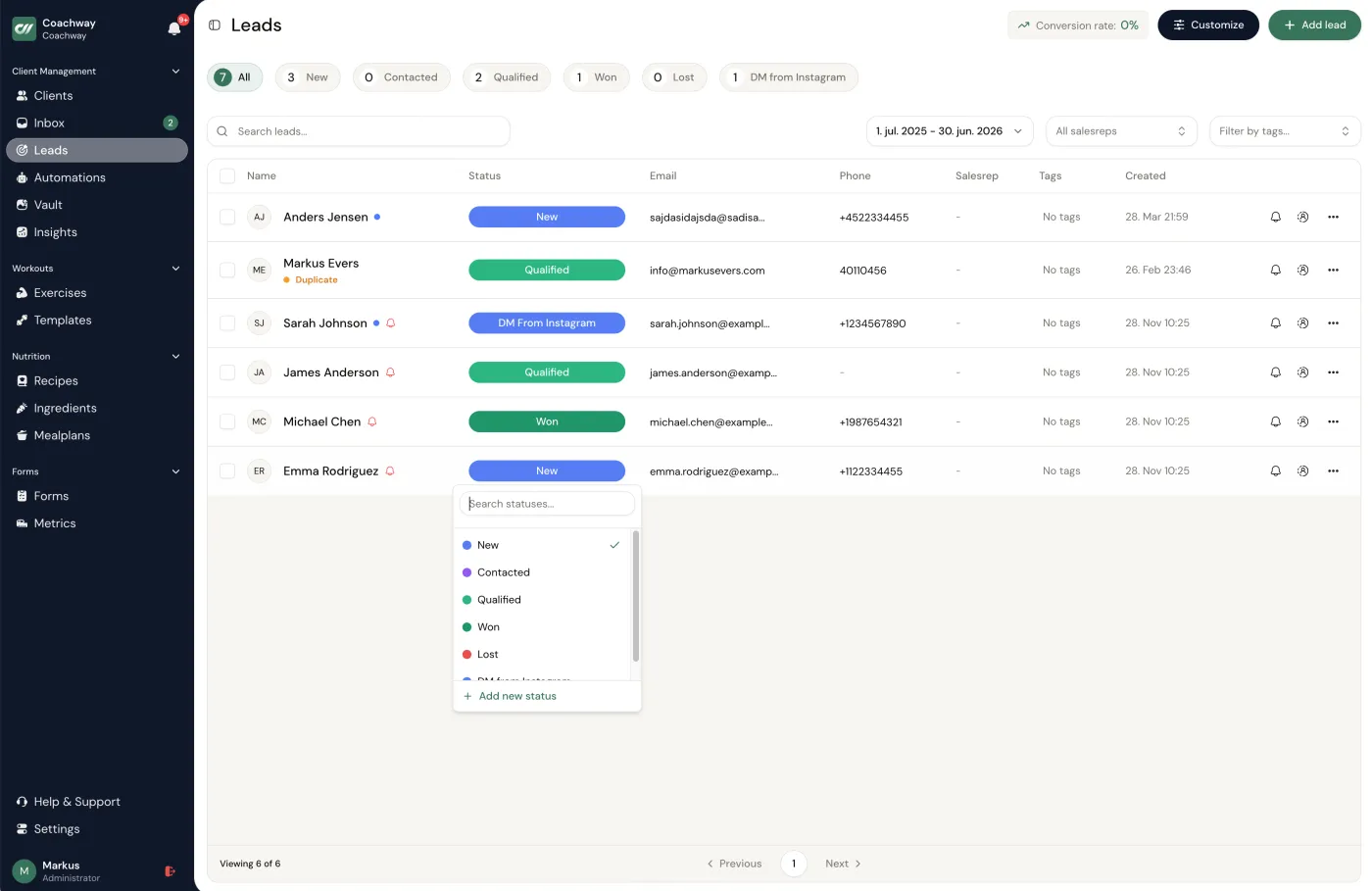
Every inquiry - a website form, an Instagram DM, an ad click - lands in one list instead of scattering across your phone. A prospect gets a record the moment they raise their hand, so nobody is forgotten between the first message and the first session.

Client records

One place per person holds the context: their goal, their start date, what they paid for, the objection they raised on the sales call, and where they are right now. You reply with the full history in front of you instead of scrolling a chat thread to remember who they are.

A pipeline

Each lead sits in a stage - new, contacted, qualified, won, lost. You glance at the board and see whose move it is next, so a warm prospect does not stall for a week because you lost track of who owed whom a reply.

Follow-up

Reminders and automations nudge the next step on schedule - a follow-up message, a check-in prompt, a renewal touch - so the work keeps moving on the days you are heads-down training clients.

This is the same relationship layer a coach relies on across the whole business, which is why the concept is often described more broadly as a CRM for coaches. The label changes with the audience; the four jobs do not.

where it overlaps

How does a trainer CRM overlap with a coaching platform?

Both can technically track a lead. The difference is what happens after someone says yes - and how much glue you have to maintain. The left column is a CRM built for sales teams; the right is a coaching platform that does the CRM job and then handles the coaching too.

The job Standalone sales CRM Coaching platform
Lead capture and pipelineYes, built around deals and quotasYes, built around coaching inquiries and consultations
Client recordsContact fields tuned to sales, not trainingGoals, history, plan, and progress on one record
Delivery (programs, plans, check-ins)None - you bolt on a separate toolBuilt in, beside the client record
PaymentsUsually a third-party integrationThrough your own Stripe, tied to the client
Client experienceInternal dashboard, no client-facing appA branded mobile app the client uses daily

A standalone CRM is not wrong - it is aimed at a different buyer. If you are comparing actual tools rather than the concept, the ranked guide to client management software for personal trainers shows which platforms cover the CRM job natively, and the broader look at personal trainer management software maps how the relationship layer sits next to programming and payments.

right-sizing it

Do you need a standalone CRM or an all-in-one platform?

A CRM is a tool, not a trophy. If you are training your first three or four clients and getting one lead a week, a spreadsheet and a disciplined follow-up habit will hold the whole thing together. Do not buy structure you do not need yet. The honest signal that it is time is friction you can feel: leads slipping, follow-ups missed, and the nagging sense that you are doing math to answer simple questions about your own business.

When that point arrives, the smart move is usually not to buy a standalone CRM at all, but to choose a coaching platform that does the CRM job as one part of a larger whole - so the relationship tracking, the delivery, and the payments live together. That keeps the tool count low, which is the real win as you grow.

Coachway takes that route. It captures leads, runs a pipeline through new, contacted, qualified, won, and lost stages, holds a full client record, and one-click converts a won lead into an active client with a branded app and payments through your own Stripe account. Pricing starts at EUR 69 per month with your first 5 clients included and EUR 9 per additional client, every feature in one plan - and there is a 14-day free trial, though a card is required to start and you can cancel anytime under Billing.

questions trainers ask

Frequently asked questions.

What is a CRM for personal trainers?

A CRM (client relationship management system) for personal trainers is one place that tracks every lead and client - where each person sits in your pipeline, their goal and history, and the next step you owe them. It handles lead capture, client records, a pipeline, and follow-up so inquiries do not go cold and active clients do not get forgotten. Unlike a generic sales CRM built for enterprise teams, a trainer CRM is tuned to the coaching job: turning inquiries into paying clients and keeping them organized through onboarding, check-ins, and renewals.

Is a CRM the same as a coaching platform?

Not quite. A standalone CRM stops at the relationship layer - leads, records, pipeline, follow-up. A coaching platform does that same CRM job and then keeps going into delivery: programming, meal plans, check-ins, payments, and a branded app the client actually uses. For most trainers an all-in-one platform that covers the CRM work is simpler than wiring a generic CRM to a separate coaching tool.

Do personal trainers need a CRM?

If you are juggling more than a handful of leads and clients across DMs, a notes app, and a spreadsheet, you have outgrown that setup and a CRM stops leads slipping through the cracks. A trainer with three or four clients and one lead a week can get by on a spreadsheet and a disciplined follow-up habit. The moment follow-ups start falling off, the structure pays for itself in retained leads alone.

Should I use a standalone CRM or an all-in-one platform?

A standalone CRM built for sales teams is aimed at deals and quotas, so trainers often pay for fields they never use and still have nothing for delivery. An all-in-one coaching platform keeps leads, clients, messaging, and payments in the same place the coaching happens - usually less software to reconcile. Coachway takes the all-in-one route: it does the CRM job and the delivery, on predictable per-client pricing, with client payments running through the coach's own Stripe account.

How much does a trainer CRM cost?

Standalone CRMs range from free tiers up to enterprise plans, while all-in-one coaching platforms are usually priced per client or per active client. Coachway starts at EUR 69 per month with your first 5 clients included and EUR 9 per additional client, every feature in one plan. It runs a 14-day free trial - a card is required to start, held securely by Stripe, and you can cancel anytime under Billing.

See what Coachway can do for your coaching business

Coachway was built on knowledge from working with 150 online coaches over 6+ years, who all hit the same wall - slow platforms, clunky workflows, wasted hours. Start your 14-day free trial and see what we fixed - the whole platform, no charge today, cancel anytime under Billing.

No charge today - cancel anytime under Billing
Built for efficiency 6 languages DenmarkNorwaySwedenFinlandGermanyUnited Kingdom
The coaching platform you've been waiting for