


ChatGPT prompts for nutrition coaches - 30 copy-paste prompts you can use today.
The best ChatGPT prompts for nutrition coaches do the writing you repeat every week - the meal-idea starter, the recipe swap, the food-log feedback, the check-in reply - and hand it back as a first draft you make yours. Below are 30, grouped by job, each written to paste straight in. Two rules run through all of them: describe the situation in your own words and never paste a client's health data into any AI tool, and keep every prompt to coaching healthy adults, because medical conditions belong with a clinical professional.
By Markus Evers · Updated October 2026
the short version
ChatGPT prompts for nutrition coaches are reusable instructions that turn a blank page into a first draft for meal ideas, recipe swaps, grocery lists, client education and check-in replies: the admin around the coaching, never the coaching itself. Copy any of the 30 below and edit until it sounds like you. Never paste client health data.
read this before you paste anything
The one rule: never paste client health data into ChatGPT.
Health data is treated as a special category under GDPR, which means it needs far more care than an ordinary name and email. When you use any prompt on this page, describe the coaching situation in neutral, non-identifying words and strip out names, conditions, medication, allergies and anything that could point back to a real person. The model only ever needs the shape of the problem - not the person. Keep the sensitive picture inside your own coaching system and hand the AI a sketch. The reason, the exceptions and the anonymisation template are in the client data and ChatGPT guide. When it is the client who has been using ChatGPT for their diet, the reply and the eight-line client guide are in when clients use ChatGPT for their diet or program. Every prompt below uses generic placeholders on purpose so this stays easy to do.
And a matter of scope. Every prompt here is written for coaching healthy adults around food preferences, habits and performance. None of them are for managing a medical condition. If a client has diabetes, an eating disorder, a diagnosed gut condition or any illness that needs a therapeutic diet, that work belongs with a registered dietitian or doctor - not a chatbot, and not general nutrition coaching. Keep your prompts on the healthy-adult side of that line and refer out the moment a client crosses it.
How do you write a ChatGPT prompt that actually helps a nutrition coach?
A prompt is not a magic word, it is a brief. The prompts below already carry the structure that makes AI output useful instead of generic, and it comes down to four moves you can reuse on anything. Give it a role, so it writes as a nutrition coach and not as a chatbot. Give it the real situation in your own plain words - the client's goal, their preferences, the foods they avoid - so the draft is grounded. Ask for a first draft rather than a finished plan, so you stay the editor. And feed it a sample of how you actually write, so the voice is yours. Do those four things and the same model that produces bland captions for everyone else starts producing drafts that sound like you had a fast, tireless assistant. The full six-part method is in prompt engineering for fitness coaches, including the no-health-data rule as a constraint line.
One honest caveat before the list. AI is brilliant at the writing and idea-generation around your coaching and genuinely dangerous the moment it touches a clinical decision or a claim you cannot stand behind. If you also coach training, the companion set of ChatGPT prompts for online fitness coaches covers the workout and sales side, and the honest rundown of AI tools for coaches covers the small kit actually worth your time. When you move from ideas to the real plan, build it in a tool made for it and run the numbers with a macro calculator rather than trusting a chatbot's arithmetic.
30 ChatGPT prompts for nutrition coaches, grouped by job.
Copy the prompt, swap anything in [square brackets] for your own neutral words, and treat the answer as a draft to edit - not a plan to send blind. These get you ideas fast; for turning ideas into a structured plan, follow how to build a client meal plan. To build a prompt around your own task and client without editing brackets, use the coaching prompt generator.
Meal ideas and plan structure
The blank-page part of building a plan. Hand ChatGPT the client's goal, preferences and time in your own words and let it fill a menu of ideas you then shape into the real plan and portions.
A week of meal ideas around a client goal
You are helping me, an online nutrition coach, brainstorm meal ideas for a healthy adult client. Their goal in my own words is [goal, e.g. more protein at breakfast], they eat [dietary preference, e.g. vegetarian], they dislike [foods to avoid], and they have about [time] to cook on a weekday. Give me 12 simple meal ideas across breakfast, lunch and dinner that fit those preferences. Ideas only, not a prescription, and nothing aimed at treating a medical condition - I will build the actual plan and set the portions myself.
A flexible day-of-eating skeleton
Draft a flexible one-day eating template for a healthy client who wants [goal], eats [dietary preference] and has [number] meals a day. For each slot give two or three interchangeable options rather than one fixed meal, so the client has choice. Keep portions as ranges I can adjust, and label it clearly as a coaching template, not medical or clinical advice.
A batch-cook Sunday plan
Help me outline a batch-cook session for a busy client who cooks once and eats through the week. They prefer [cuisine or ingredients] and avoid [foods]. Suggest three base recipes that reheat well and can be mixed into five different meals, plus a rough prep order so it fits into about 90 minutes. Ideas and structure only - I set the amounts per client.
Meal ideas on a tight budget
Give me 10 filling, higher-protein meal ideas for a healthy client on a tight grocery budget who eats [dietary preference] and dislikes [foods]. Focus on affordable staple ingredients and simple cooking. List the ideas with a one-line description each, no fabricated prices, and leave portioning to me.
Eating ideas for someone who hates cooking
A client tells me they will never cook elaborate meals. Suggest 12 near-zero-effort meal and snack ideas for a healthy adult who eats [dietary preference] and avoids [foods] - things assembled in a few minutes rather than cooked. Keep it realistic and non-clinical, and give me ideas to choose from, not a fixed plan.
Recipes, swaps and substitutions
Keep clients eating food they like without going off-plan. Feed it a recipe and let it suggest higher-protein versions, swaps and variations - you confirm anything that matters and set the numbers.
Make a recipe higher in protein
Here is a recipe a client likes: [paste the ingredients and method]. Rewrite it as a higher-protein version that still tastes like the original, suggesting realistic ingredient additions or swaps. Keep it suitable for a healthy adult, note the swaps you made, and do not invent exact macro numbers - just tell me what changed so I can recalculate.
Swap out an ingredient a client dislikes
A client loves this recipe but will not eat [ingredient]: [paste recipe]. Give me three substitutions that keep a similar texture and role in the dish, with a one-line note on how each changes the flavour. Treat the dislike as a simple food preference, not a medical restriction.
Adapt a recipe to a food a client avoids
Adapt this recipe so it contains no [food a client chooses to avoid, e.g. dairy]: [paste recipe]. Suggest straightforward replacements for each affected ingredient and flag anything that changes the method. Handle this as a preference-based swap for a healthy client - I confirm any genuine allergy handling and safety with the client directly, and this is not medical advice.
Three variations on one base recipe
Take this base recipe: [paste]. Give me three flavour variations, for example a Mediterranean, a Mexican and an Asian-inspired spin, using common ingredients, so a client does not get bored eating the same thing. Keep each variation simple and note which ingredients change.
A macro-friendly version of a comfort meal
A client wants a lighter, more macro-friendly version of [comfort meal, e.g. creamy pasta] that still feels satisfying. Suggest sensible ingredient swaps and cooking tweaks that reduce calories without killing the taste, for a healthy adult. Describe the changes rather than promising exact numbers, and I will run the final macros through my own tool.
Turn one recipe into a family-friendly meal
Help me adapt this recipe so a client can cook one meal the whole household eats, then portion their own serving toward [their goal]: [paste recipe]. Suggest how to keep the base neutral and adjust on the plate rather than cooking twice. Ideas only, and keep it non-clinical.
Grocery lists and food-swap tables
The small tools that make a plan stick: a tidy shopping list, a fridge-door swap table, an eating-out guide. Draft them in seconds, then check every item fits the client in front of you.
A grocery list from a set of meals
Here are the meals a client is eating this week: [paste the meals or ideas]. Turn them into a single organised grocery list grouped by supermarket section (produce, protein, dairy or alternatives, pantry, frozen). Combine duplicate ingredients and leave quantities as a column for me to fill in per client.
A high-protein food-swap table
Build me a simple two-column swap table a client can stick on the fridge: on the left a common lower-protein choice, on the right a higher-protein everyday swap that is realistic and affordable. Give me about 12 rows for a healthy adult eating [dietary preference]. Keep it practical, with no supplements pushed and no medical claims.
A protein sources cheat sheet by diet
Make me a reference list of everyday protein sources for a client who eats [dietary preference, e.g. plant-based]. Group them into convenient, budget and higher-effort options, with a one-line note on how to use each. This is general food information for a healthy adult, not medical or supplement advice.
An eating-out ordering guide
Write a short, friendly guide a client can use when eating out at [type of restaurant] while working toward [goal]. Give a few sensible go-to orders, simple tweaks to ask for, and a reminder that one meal does not undo their week. Keep it encouraging and non-restrictive, not a rigid rulebook.
A pantry and freezer staples list
Give me a starter list of pantry and freezer staples that make it easy for a healthy client eating [dietary preference] to throw together balanced meals on a busy day. Group by category, keep it affordable, and add a one-line reason for the key items. General guidance only.
Client education content
Explaining the why in plain language is half the job. Use these to turn protein, fibre and energy balance into something a busy client actually gets - general education for healthy adults, never medical advice.
Explain protein simply
Explain to a coaching client, in plain and friendly language, why protein matters for someone working toward [goal] and roughly how to spread it across the day. Keep it to general nutrition education for a healthy adult, avoid exact gram prescriptions and any medical or disease framing, and end with one practical, doable tip.
Explain energy balance without the jargon
Write a short, calm explanation of energy balance, calories in versus out, for a client who has heard a lot of conflicting things online. Use an everyday analogy, keep it non-judgemental, and make the point that it is a long-run average and not a daily scoreboard. General education for a healthy adult, with nothing prescribed.
Explain fibre and why it fills you up
Explain to a healthy client, in simple terms, what fibre is, why it helps with feeling full and staying regular, and a few easy everyday foods that add more of it. Keep it practical and non-clinical, avoid medical claims about treating any condition, and finish with one small swap they could try this week.
Bust a common nutrition myth for a client
A client believes [common nutrition myth, e.g. carbs at night make you gain fat]. Write a short, respectful explanation of why the myth is popular, what the general picture actually is for a healthy adult, and what to focus on instead. No invented studies or statistics, and confident but never mocking.
A no-scales portions guide using the hand
Create a simple, no-scales portion guide for a healthy client using the hand method (palm, fist, cupped hand, thumb) so they can build a balanced plate without weighing food. Explain each cue in one line, keep it flexible and non-clinical, and note it is a rough starting point they can adjust with me.
Check-ins, adherence and food-log feedback
The weekly writing that eats your evenings. Draft from your neutral notes, then edit in the specifics only you know - the human part has to stay human, and the sensitive detail never goes near the chatbot.
Turn rough notes into a nutrition check-in reply
I coach clients on nutrition and reply to weekly check-ins. Here are my neutral notes on this healthy client this week, with no medical or identifying detail: [paste your own notes]. Turn them into a warm, specific check-in reply in my voice: name what went well with their eating, address the one habit to adjust, and set a single focus for next week. About 140 words, encouraging but honest.
Reply to a client who ate out all weekend
A client messages me feeling guilty because they ate out and drank all weekend and think they have ruined their progress. Draft a supportive reply that takes the shame out of it, puts one weekend in the context of the whole month, and gives them one calm next step to get back on track today. Warm, non-judgemental, around 120 words, and with no medical framing.
Translate a food log into coaching feedback
Below is a healthy client's food log for a few days, in general terms with no medical detail: [paste log]. Summarise the two or three patterns worth coaching, for example protein landing low or long gaps between meals, and suggest one gentle, doable adjustment for each. Give me the summary to review before I reply in my own words. Do not message the client and do not give medical advice.
Handle the I have no time to prep objection
A client keeps missing their nutrition targets because they say they have no time to prep. Help me write a reply that meets them where they are rather than lecturing: acknowledge the constraint, offer two genuinely low-effort options, and agree one tiny experiment for the week. Around 110 words, in a coach's voice.
Re-motivate a client stalling on habits
A healthy client has drifted from the eating habits we agreed and sounds a bit flat about it. Draft a short message that reconnects them to their own reason for starting, removes the all-or-nothing thinking, and picks one keystone habit to rebuild first. Encouraging, not preachy, and under 120 words.
Write the notes from the real week, then send the reply where the client already is.
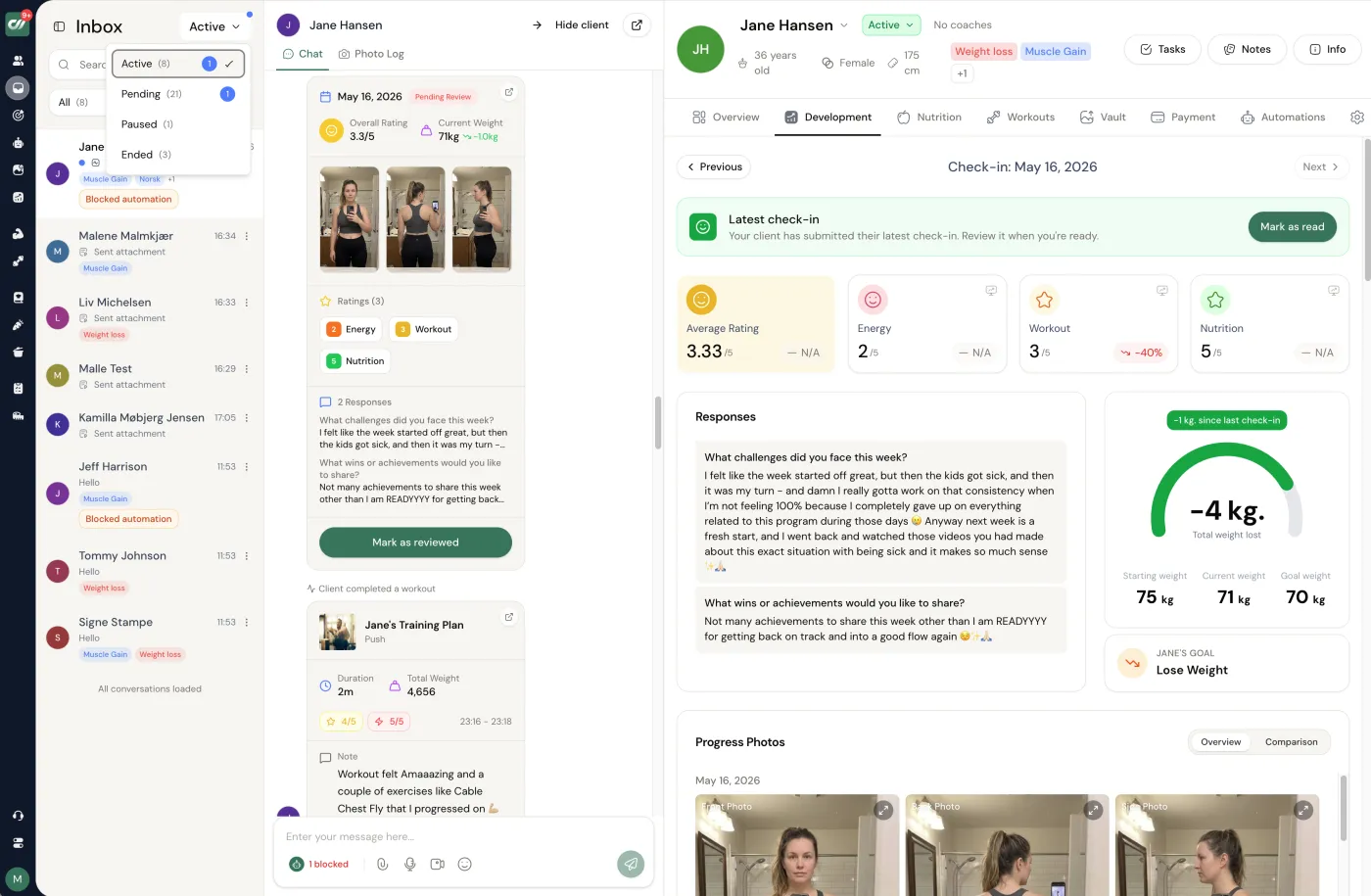
A check-in draft is only as good as the neutral notes you feed it, and those notes come from the client's actual week: what they logged, how their weight moved, what they answered in the check-in. In Coachway the Power Panel puts each client's numbers, progress photos, training log and latest messages on one screen with the chat beside it, so you write your notes from the full picture, give ChatGPT only the sketch, then edit the draft and send it to the client's app as text, a voice note or a video message. The health detail never leaves your coaching platform, and the reply arrives where the client already logs their food.
Content marketing for nutrition coaches
One nutrition idea into a week of posts. Feed it your real voice so the output sounds like you, and keep every claim something a healthy adult can safely act on.
Ten hooks for a nutrition post
I am an online nutrition coach. Give me 10 scroll-stopping opening lines for a post about [nutrition topic], aimed at [who my clients are]. Mix curiosity, myth-busting and problem-first angles. No clickbait I could not back up, and no invented statistics.
A myth-busting reel script
Write a 30-second reel script for me to say to camera that busts the myth [nutrition myth]. Open with a hook, make one clear point about the general picture for healthy adults, give one practical takeaway, and end with a soft call to follow for more. Conversational, the way a coach talks, and mark roughly where the on-screen text should change.
A five-slide carousel from one idea
Turn this one nutrition idea I teach: [your idea] into a five-slide carousel outline for social. Slide one is the hook, slides two to four build the point with everyday examples, and slide five is the takeaway plus a soft call to action. Keep every claim something a healthy adult can act on, with no medical advice and no fake numbers.
A week of nutrition content from one pillar
Take one core nutrition idea I care about: [your pillar]. Break it into a week of content for a nutrition coach: one long post, three short posts and two reel or story prompts, each hitting a different angle of the same idea so I am not repeating myself. Keep it practical and non-clinical, and in my own kind of voice.
ChatGPT drafts the meal ideas - your platform builds the real plan.
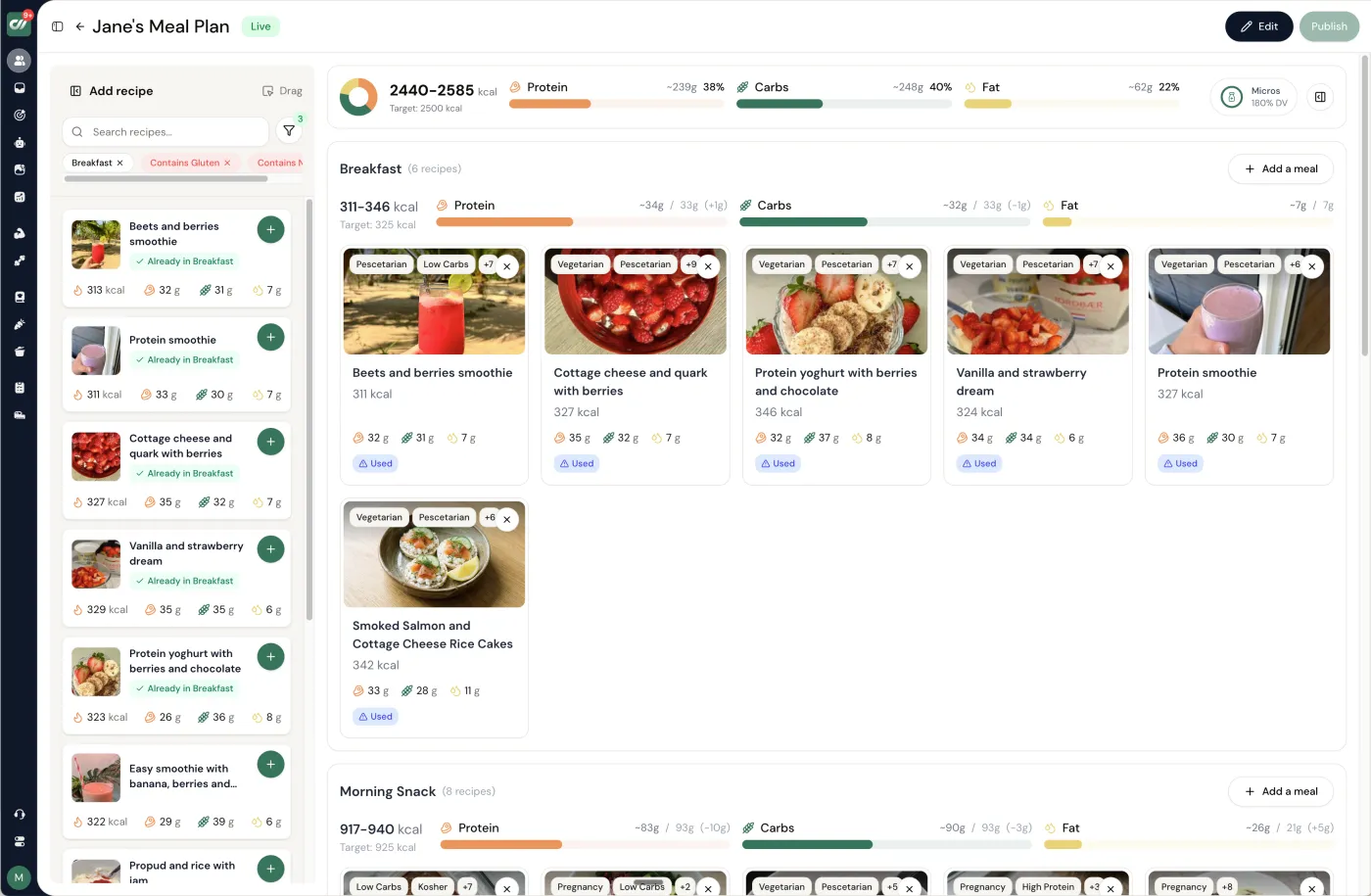
A prompt gives you meal ideas. It does not know which client this is, what they logged yesterday, or the macro targets you set for them - and that missing context is exactly why you never hand it the sensitive detail. That part lives in your coaching platform. We build Coachway for the handover: the ideas you drafted become a real plan in the meal planner, with over 1,100 recipes you can filter, adjust and drop into a client's week. Clients log their food in their own app, you set per-client macro and calorie targets, and the food log comes back to you as something you can actually coach from - without anyone pasting health data into a chatbot. The coach dashboard is in English, and the client app is available in English, Danish, Norwegian, Swedish, Finnish and German.
It costs EUR 69 a month with your first 5 clients included, then EUR 9 per additional client, every feature in. The 14-day free trial starts with a card held securely by Stripe and you can cancel under Billing before it renews, or book a demo and see the meal planner first. The prompts on this page make the first draft faster; building the real, structured plan is where the coaching happens.
For half these prompts, Coachway does the job without a prompt.
Here is the honest version: for a lot of the meal-idea prompts above, a coach already on Coachway barely needs them. The meal planner holds 1,100+ localized recipes with the macros already attached, so instead of prompting for twelve ideas and sanity-checking each one, you filter to the client's preferences and drop a week straight in - no portions a chatbot only guessed at. Keep the prompts for the genuine blank-page moments and the odd swap; let the recipe library do the repetitive part.
Two AI jobs that do earn a proper setup: voice-note check-ins with AI transcription, so a client's spoken food update becomes the draft you coach from, and the memory and privacy settings every assistant needs before a single line of a food log goes near it.
Frequently asked questions about ChatGPT prompts for nutrition coaches.
What are the best ChatGPT prompts for nutrition coaches?
The prompts that save a nutrition coach the most time are the ones that draft the work you repeat every week: meal ideas built around a client's goal and preferences, recipe swaps and higher-protein versions, grocery lists and food-swap tables, plain-language client education, and check-in replies drafted from your own neutral notes. The 30 prompts on this page are grouped into exactly those jobs. The pattern that makes any of them work is the same: describe the real situation in your own plain words, ask for a first draft rather than a finished plan, and edit in the specifics only you know. Treat ChatGPT as a fast assistant who writes a rough version, never as the coach, or the clinician, who signs it off.
Is it safe to paste client information into ChatGPT?
No - not identifiable client information, and never health details. Health data is treated as a special category under GDPR, which means it needs a much higher bar of care than a name and an email. The safe habit is simple: describe the coaching situation in neutral, non-identifying words, strip out names, medical conditions, medication, allergies and anything that could point back to a specific person, and let the model draft from that. You keep the real, sensitive picture in your own coaching system and only ever hand ChatGPT the shape of the problem, not the person. Every prompt in this library uses generic placeholders on purpose so this stays easy to do.
Can ChatGPT create meal plans for clients with medical conditions?
No, and this is the line that matters most. The prompts here are written for coaching healthy adults around food preferences, habits and performance. The moment a client has a medical condition that needs a therapeutic diet, whether that is diabetes, a diagnosed gut condition, an eating disorder or anything a doctor is managing, that work belongs with a registered dietitian or physician, not with general coaching and definitely not with a chatbot. AI will happily generate something that looks like a clinical meal plan in seconds, and that confident output is exactly the risk. Keep your prompts on the healthy-adult side of that line, refer out when a client crosses it, and never use AI to diagnose, treat or manage a condition.
Where do the meal plans and messages I draft actually reach clients?
ChatGPT drafts words and ideas - it does not build the plan, remember your client, or keep the macro targets that make a generic reply specific. That lives in your coaching platform. In Coachway the meal ideas you drafted become a real plan in the meal planner, with over 1,100 recipes and per-client macro targets, and the client logs their food in their own app so the log comes back as something you can coach from. Reusable education and onboarding messages go into automations once, then send themselves. The AI writes the first draft faster; the platform makes sure the right, personal version, and the actual plan, reaches the right client.
Prompts are the fast draft. The judgement stays yours: the clearest case is the calorie adjustment, where the model formats fourteen weigh-ins into two averages and the flags and the coach decides, as laid out in how to adjust a client's calories after two weeks; for the full meal-plan job, from intake data to a signed-off 7-day plan with swaps and the allergen check, download the six meal-planning prompts with the rest of the site's AI prompts in the AI prompt pack for online coaches, follow how to use AI for meal planning as a coach, turn the ideas into a structured week with how to build a client meal plan, and keep your client data private and compliant before you paste a single word into any AI tool.
Keep reading
all guidesWhat Is Hybrid Training? Strength Plus Endurance
Hybrid training is the deliberate pursuit of strength and endurance together. The interference effect in plain words, a sample week, and who the approach fits.
Read the guideWhat Is Ballistic Stretching? Risks and Alternatives
Ballistic stretching bounces a joint past its range using momentum. Why the bounce adds risk, who should avoid it, and the safer dynamic and static alternatives.
Read the guideWhat Is a Synergist Muscle? Agonist vs Antagonist
A synergist is the helper muscle that assists the prime mover. How synergists, agonists and antagonists differ, with bench, squat and row examples.
Read the guideFree tools for this: Cut Length Calculator · Refeed Day Calculator · Carb Cycling Calculator
Ready-made template: AI Prompt Pack for Online Coaches
See what Coachway can do for your coaching business
Coachway was built on knowledge from working with 150 online coaches over 6+ years, who all hit the same wall - slow platforms, clunky workflows, wasted hours. Start your 14-day free trial and see what we fixed - the whole platform, no charge today, cancel anytime under Billing.


