


Nutrition coaching software - the category built around food, not bolted onto a workout tool.
Nutrition coaching software is the system a coach uses to build and deliver meal plans or macro targets, review what clients actually eat, run check-ins, and take payments from one client record. This guide defines the category for coaches whose offer leads with food - what it includes, what to look for, an honest comparison of six options, and who is better served by a clinical platform instead.
By Markus Evers · Updated September 2026
How this comparison is made: we check every competitor's pricing and features against their live websites and re-verify them on a recurring basis. We build Coachway, so we flag it wherever it appears, we credit real competitor strengths, and we say who each platform fits better than us. Browse all platform comparisons.
the short version
Nutrition coaching software runs meal planning, food-log review, macro targets, check-ins, a client app, and payments against one client. The label is shared with generic coaching tools, but most of them were built workout-first or session-first and added nutrition later as macro tracking or a document upload. A nutrition-first tool treats food as the main surface - a recipe database you build plans from, macros you flex per client, and a food log you can open and comment on. If you are a registered dietitian who needs clinical charting, that is a different lane, and this guide is honest about where it belongs.
What nutrition coaching software actually is.
Read the category as one client record with a nutrition core and three jobs hanging off it. A generic coaching tool can message a client and take a payment; what makes software nutrition coaching software is that the food work - planning, logging, reviewing, adjusting - is native, not a document you attach. For a coach whose offer leads with food, that core has a specific shape.
1. Meal planning and macro targets - what you deliver.
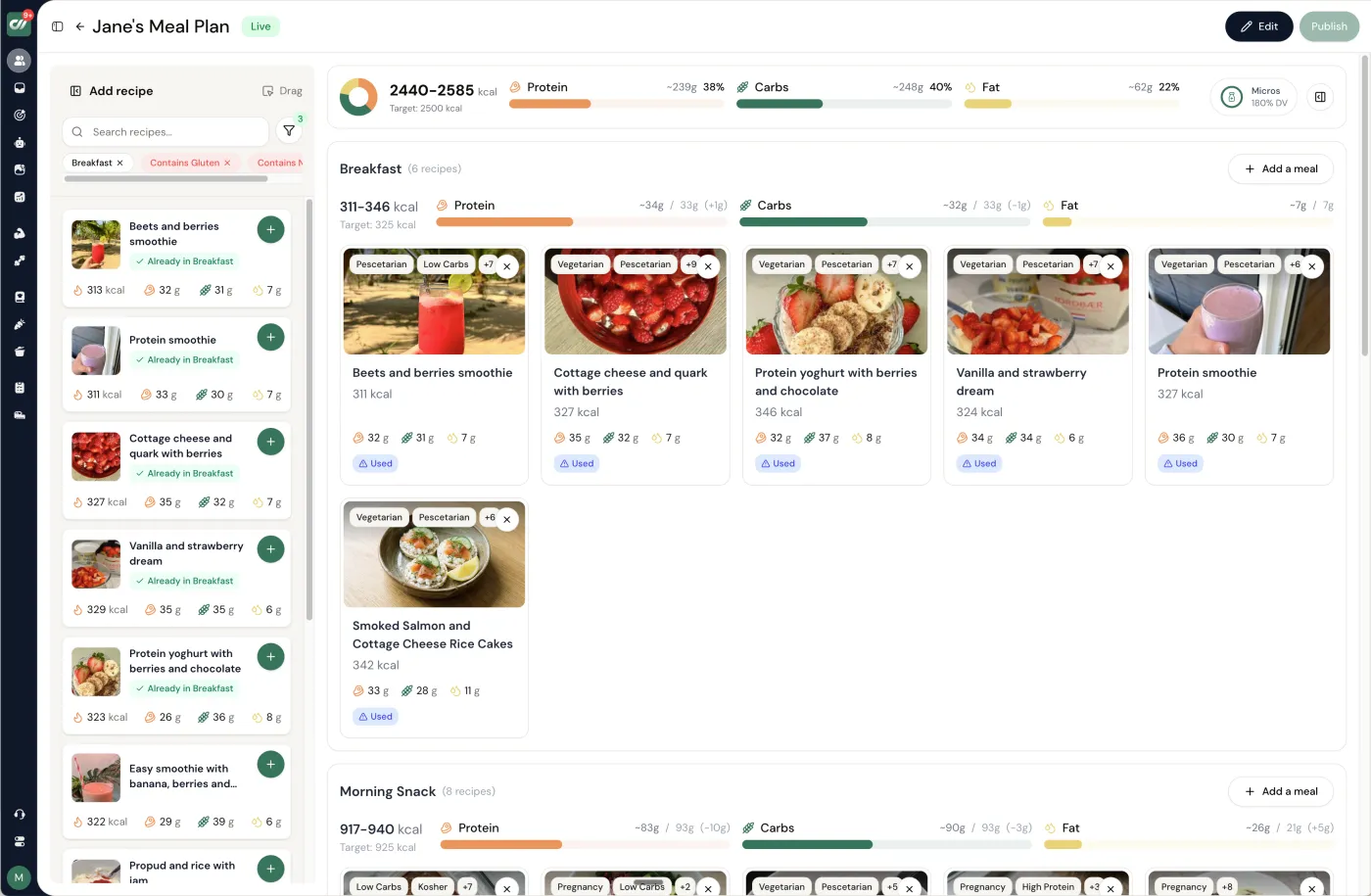
The build-and-deliver side: a recipe database and a drag-and-drop meal planner you assign from a template rather than a blank page, and macro targets set per client so you can run fixed meal plans for the clients who want structure and daily protein, carb, and fat numbers for the clients building food skills. Coachway ships this with a drag-and-drop meal planner, 1,100+ recipes, and macro targets per client, so the library is there before you start coaching. A workout-first tool usually gives you macro tracking but no recipe library to plan from.
2. Food-log review - what they actually ate.
The surface that turns a plan into coaching. Nutrition coaching software lets the client log against the plan and lets the coach open that log, read it, and reply - not just prescribe and hope. Coachway does this with a 3.7 million item food database, barcode scanning, and a photo diary you comment on, with macro rings that move as the client logs. Four access levels let you decide per client how much of that they see, so a client who should not be counting calories stays on the plan and a photo diary while a physique client logs every gram.
3. Check-ins, a client app, and payments - what holds it together.
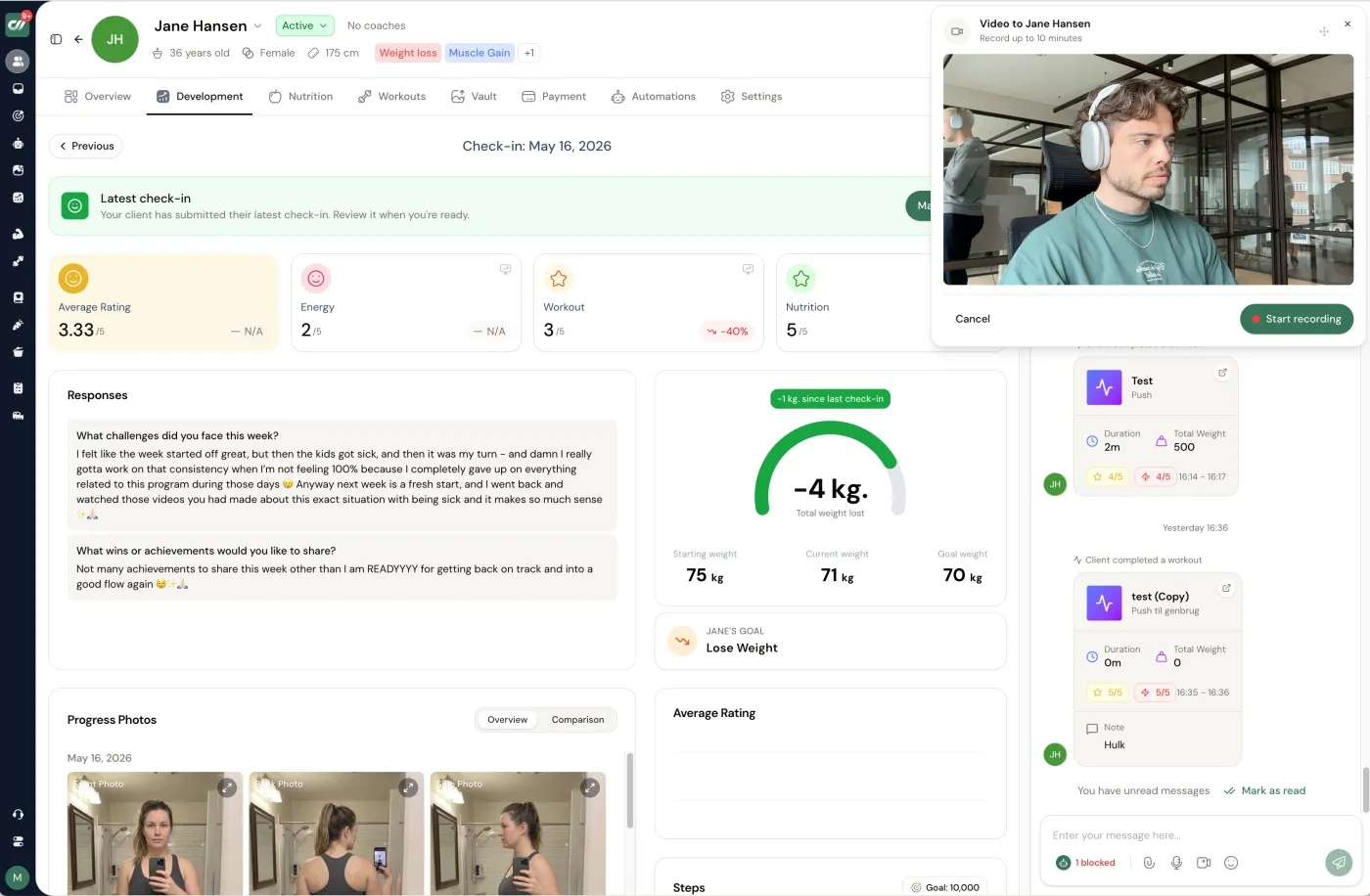
Weekly check-ins that bring back weight, measurements, photos, and how closely the client stuck to the plan, a client app so the whole experience lives in one place, and payments so the money for your coaching lands on time. Coachway includes the client app on every plan - on iOS and Android, in six languages, carrying your own plans, check-ins and prices - and settles payments in your own Stripe account, with optional built-in payments at 2.4% per transaction if you use them. If you also program training, the workout builder sits on the same client, so nutrition and training are one subscription, not two.
What to look for in nutrition coaching software.
Because the category name is shared across very different products, the buying mistake is comparing feature lists instead of the five things that decide whether nutrition actually runs through the tool. If you want the wider setup around them, our guide on how to do nutrition coaching online covers the method.
1. Recipe database depth.
The difference between assigning a plan in seconds and building every meal by hand. Look for a real recipe library you plan from, not just a food-tracking database the client logs into. A tool that only tracks macros can measure a diet but cannot help you write one.
2. Food-log review workflow.
Ask to open a client's food log and reply to it. Some tools show you a number and nothing else; the ones that coach let you read the actual meals, see them against the target, and comment where the plan and reality diverged. A photo diary you can respond to beats a calorie total you cannot question.
3. Macro target flexibility.
Some clients want every meal mapped out; others just want their daily numbers. Software that only does one forces every client into the same mould. Look for per-client macro targets and the option to deliver either a fixed meal plan or the targets alone, switching per client as they change.
4. Client app quality.
Friction in the app is what kills logging, and no plan survives a client who will not open the tool. A branded client app that feels like your coaching, not a generic third-party product, is what keeps the food log going week after week. Check whether branding is included or gated behind a paid tier.
5. Integration with training.
If you also program workouts, nutrition and training living on the same client saves a second subscription and a copy-paste workflow between apps. If nutrition is your entire service, a specialist tool can be enough - but most coaches who program both want them in one tab. The meal planning software for personal trainers guide covers the build-the-plan side in depth.
Nutrition coach software checklist: eight boxes to tick before you buy.
Paste this into a free trial and run it against any software for nutrition coaches you shortlist. It turns the buying filter above into a list you can tick off, and it pays special attention to the client-facing app for nutrition coaches, since a phone app clients will not open is where most nutrition plans quietly fail.
- A recipe library you plan from - not just a food-tracking database the client logs into.
- A drag-and-drop meal planner - assign a plan from a template, not a blank page.
- Per-client macro targets - deliver a fixed plan or the numbers alone, switching per client as they change.
- Food-log review you can reply to - open the actual meals against the target and comment, not just read a number.
- A branded app for nutrition coaches - included, not gated behind a paid tier.
- Structured weekly check-ins - weight, photos, measurements and plan adherence in one place.
- Payments on your own account - so billing is not a second tool or a manual export.
- Training on the same client - if you also program workouts, so nutrition and training are one subscription.
| Approach | Recipe-library planner | Food-log review | Branded app included | Training on same client |
|---|---|---|---|---|
| Coachway (nutrition-first) | Yes - 1,100+ recipes | Yes - photo diary and macro rings | Client app included on every plan; custom branding not sold | Yes - workout builder on the same client |
| Workout-first tools | Macro tracking, no recipe library | Often a number, not the meals | Frequently a paid add-on | Yes - training is the core |
| Clinical platforms | Clinical food data and journaling | Yes - inside a charting workflow | Varies by tier | No workout builder |
A summary of the fuller comparison below, led by Coachway because we build it; the workout-first and clinical rows generalise the tools in the next table, so check any specific vendor against its own current pricing and features. For the plan-building side in depth, see meal planning software for personal trainers or explore the meal planner feature.
Six nutrition-relevant tools, side by side.
These six cover the range a coach searching for nutrition coaching software actually lands on: two coaching-first platforms, one workout-first tool with macros added, and three clinical platforms built for dietitians. We build Coachway, so we flag it and credit real strengths elsewhere. Prices are copied from our own vendor pages and verified in August 2026, in the currency each publishes; confirm current rates before you commit, since tiers change often. For the full ranked field, the best online nutrition coaching platforms guide lists thirteen.
| Tool | Nutrition delivery | Pricing | Coaching or clinical | Best for |
|---|---|---|---|---|
| Coachway | Drag-and-drop meal planner, 1,100+ recipes, macro targets per client, food-log review with barcode scan and a photo diary you comment on | EUR 69/month up to 5 clients, then EUR 9 per extra; built-in payments optional at 2.4% per transaction, settling in your own Stripe | Coaching (nutrition-first, non-clinical) | Coaches who lead with food and want nutrition, check-ins, and training in one client app |
| PT Distinction | Genuinely deep meal planning and adherence tracking alongside training | Per-coach monthly plans with included client counts | Coaching (nutrition-led) | Nutrition-led coaching in English-speaking markets |
| Trainerize | Macro and meal tracking layered on a mature workout core, not a recipe library | Free 1-client tier, then USD 9 (Grow) and USD 23+/month (Pro, up to 200 clients); branded app a one-time USD 169 on Pro | Coaching (workout-first) | Workout-led coaches who also want macro tracking |
| Nutrium | Clinical-grade food databases, structured meal planning, appointment notes; no training | Per-professional monthly plans | Clinical (for dietitians) | Dietitians who need clinical food data and notes |
| Practice Better | Food and lifestyle journaling; structured meal plans via a separate paid That Clean Life integration; no workout builder | Free 3-client Sprout, then USD 35 (Starter) to USD 155/month (Team) | Clinical EHR (HIPAA, telehealth) | Dietitians and clinical practices needing charting and telehealth |
| Healthie | Food and symptom journaling and client programs inside a clinical charting workflow; no workout builder | USD 19 (Core) to USD 129+/month (Plus/Group); 14-day trial | Clinical EHR (insurance billing, telehealth) | Registered dietitians and telehealth practices |
Prices verified on each vendor's own pricing page in August 2026, in the currency each publishes; PT Distinction and Nutrium publish per-coach and per-professional plans without a single headline figure, so no number is invented for them. Confirm current rates before you commit.
When a different tool is the honest answer.
Nutrition coaching software fits coaches who deliver meal plans, macros, and accountability to healthy clients pursuing a goal. It is not the right pick for everyone, and the honest lines below save you buying the wrong lane.
You are a dietitian who needs a clinical EHR.
If your work involves compliant clinical charting, insurance billing, or telehealth of record, a clinical platform is built for that and coaching software is not a substitute for it. Practice Better and Healthie are the peers here, with the regulatory and documentation depth the lane requires. Nutrium sits alongside them for clinical food data and appointment notes. That is a genuine category, not a flaw in coaching tools - it is simply a different job.
Training leads and nutrition is a support layer.
If most of your coaching is programming workouts and nutrition is macro targets on top, a workout-first tool like Trainerize may be the closer fit, since its centre of gravity is training. The trade is a lighter nutrition side - macro tracking rather than a recipe-library meal planner - so weigh how much of your week is actually spent on food.
Your clients self-track and you only need to review numbers.
If your clients happily log in a consumer app and your job is to read the numbers in a weekly call, you may not need a full nutrition platform yet. That said, most coaches outgrow the consumer-app-plus-spreadsheet setup once the client list and the copying between tools become the bottleneck - which is the point nutrition coaching software earns its place.
Nutrition coaching software built food-first.
We build Coachway, and it sits in the nutrition-first half of this category. The food work is native, not bolted on: a drag-and-drop meal planner with 1,100+ recipes, macro targets set per client, and a food log the coach opens and comments on - backed by a 3.7 million item food database, barcode scanning, and a photo diary with macro rings. Four access levels let you decide per client how much of the tracking they see. The check-in, the food log, and the progress charts sit together on the review screen we call the Power Panel, and because the workout builder lives on the same client, nutrition and training are one subscription. The client app is included on every plan, payments settle in your own Stripe with optional built-in payments at 2.4% per transaction, and the client app runs in six languages (EN, DA, NO, SV, FI, DE), reviewed by a working coach in each market. It costs EUR 69 a month with your first 5 clients included and EUR 9 per additional client after that, every feature in, no tiers. The 14-day free trial starts with a card held securely by Stripe and no charge today, and you cancel under Billing before it renews. It is built on years of working with online coaches. If you would rather see a real meal plan, macro target, and food log walked end to end, explore the meal planner feature or book a demo.
Want to see meal planning, food-log review, and check-ins running on your own clients?
No charge today - cancel anytime under Billing.What running nutrition coaching actually looks like.
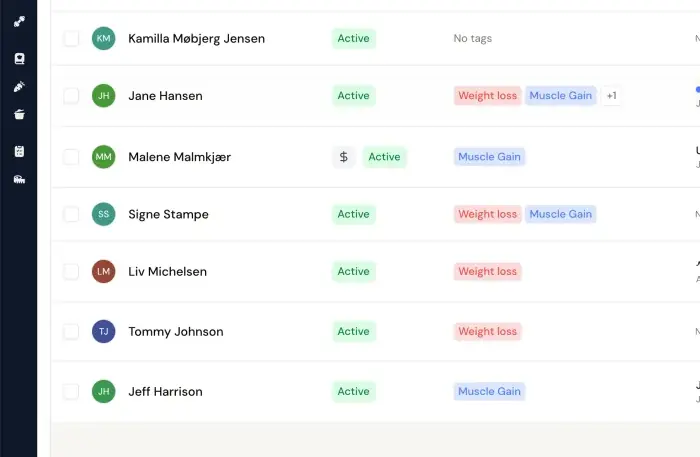
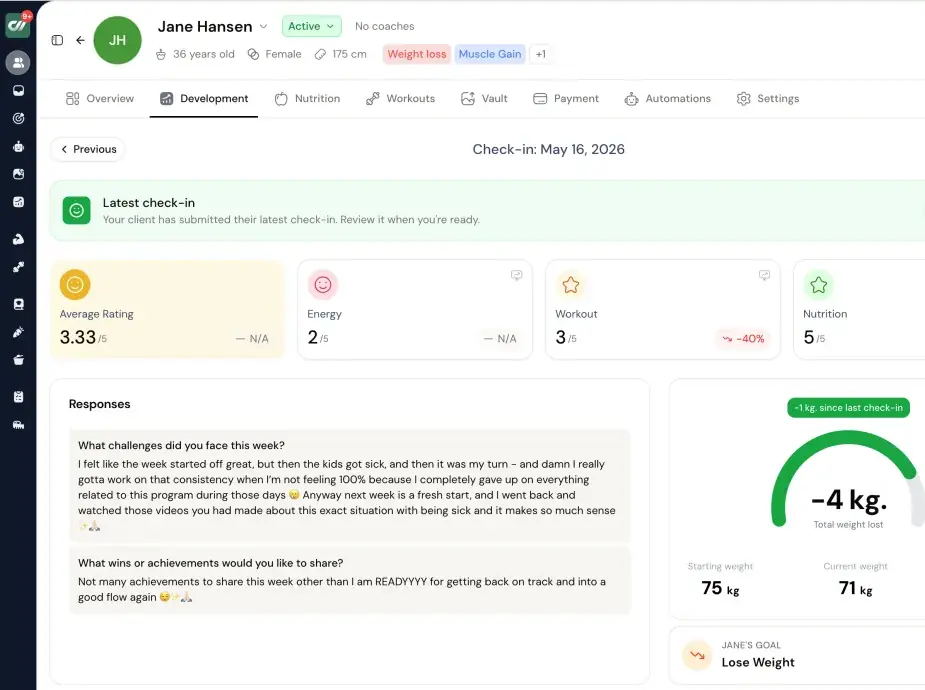
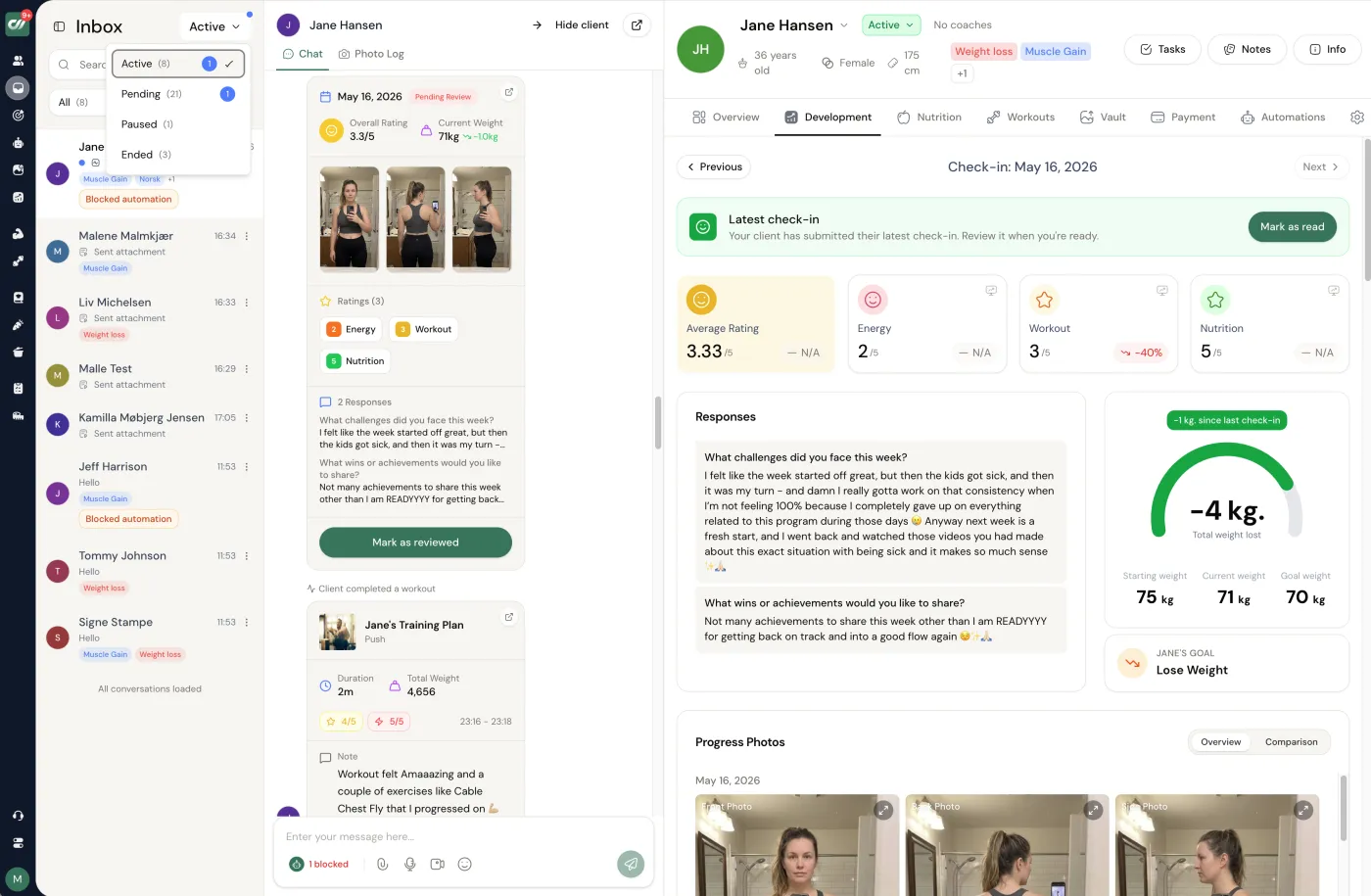
The category defined above is easier to judge when you see the surfaces a coach works from. Here is the nutrition core, the client record it hangs off, the weekly check-in read against the plan, and the inbox that keeps it moving - built in the meal planner, delivered through the client app, and tracked on client progress.
- Meal plans and macros, native. Drag real recipes into a day, let the macros balance, and set targets per client - the plan lives on the client record, not in an attached PDF.
- Food logs you read, not just numbers. Open what the client actually ate against the plan and reply, with the whole file - check-ins, progress, chat - one click away.
- The weekly review in one place. The check-in answers, weight trend and food log sit together, so you coach nutrition against real data instead of a prescription.
See the real product
Nutrition - Drag in real recipes, let the macros balance, and send a plan that looks hand-made.
Frequently asked questions about nutrition coaching software.
What is nutrition coaching software?
Nutrition coaching software is the tool an online coach uses to build and deliver meal plans or macro targets, review what clients actually eat, run weekly check-ins, message clients, and take payments - all from one client record instead of PDF meal plans and a master spreadsheet. What separates it from a generic coaching tool is the nutrition core: a recipe database and drag-and-drop meal planner, macro targets set per client, and a food log the coach can open and comment on. Everything else - check-ins, progress, a branded client app - hangs off that nutrition record so the plan and the person are never in two places.
How is nutrition coaching software different from a coaching tool with nutrition bolted on?
Most coaching platforms rank for the term but were built workout-first or session-first, with nutrition added later as macro tracking or a document upload. A nutrition-first tool treats food as the main surface: a real recipe library you build meal plans from, macro targets you flex per client, and a food-log review workflow where you see what the client ate against the plan, not just what you prescribed. The quick test is whether you can build a meal plan from a recipe database, set that client's macros, and open their food log in the same place. If nutrition lives in a separate tab or a separate app, it was bolted on.
What should I look for in nutrition coaching software?
Five things decide the fit. Recipe database depth, so you start meal plans from a library rather than a blank page. A food-log review workflow, so you read what the client actually ate next to their check-in. Macro target flexibility, so you can run fixed meal plans for clients who want structure and macro numbers for clients building food skills. Client app quality, because friction in the app is what kills logging and adherence. And integration with training, if you also program workouts, so nutrition and training sit on one client instead of two subscriptions.
Is nutrition coaching software the same as a tracking app like MyFitnessPal?
No. A consumer tracking app logs food but has no coach side - no way to build and assign meal plans, no check-in forms, no client management, and no payments. Nutrition coaching software adds the coach dashboard: meal-plan delivery, structured check-ins, a food log you can review and comment on, and billing, all for many clients at once. Some coaches keep a consumer app as the client's logging layer, but the coaching, the plan, and the payment run in the dedicated platform.
Do I need clinical or dietitian software instead?
It depends on your scope. If you are a registered dietitian who needs compliant clinical charting, insurance billing, or telehealth of record, a clinical platform like Practice Better or Healthie is built for that lane, and coaching software is not a substitute for it. Nutrition coaching software is built for non-clinical coaching - meal plans, macro targets, habits, and accountability for healthy clients pursuing a goal. Whichever you run, stay inside your qualifications and refer clinical or medical nutrition needs to a registered dietitian.
How much does nutrition coaching software cost?
Pricing runs on three models: flat per-client pricing, tiered plans gated by client count or features, and clinical platforms priced for practices. Coachway is EUR 69 a month with your first 5 clients included and EUR 9 per additional client after that, every feature in, with optional built-in payments at 2.4% per transaction settling in your own Stripe. Workout-first tools like Trainerize start lower (a free 1-client tier, then USD 9 and USD 23+ a month) but gate a branded app behind add-ons, and clinical platforms like Practice Better (free 3-client Sprout, then USD 35 to USD 155 a month) and Healthie (USD 19 to USD 129+ a month) price for documentation you may not use. The number that moves the total is whether nutrition and a branded app are included or sold as modules.
Is nutrition coach software different from nutrition coaching software?
No - nutrition coach software, software for nutrition coaches and nutrition coaching software all name the same category: the coach-side tool for building meal plans, setting macro targets per client, reviewing food logs, running check-ins and taking payments from one record. The only distinction worth drawing is between the coach dashboard and the client-facing app for nutrition coaches - the branded phone app where clients log meals and watch their macros. The tools worth buying give you both on one client, so the plan you write and the food they log never sit in two places.
What is the best nutrition coaching software for personal trainers who also program training?
There is no single best nutrition coaching software for every coach - the honest answer depends on whether food is your whole service or sits next to training. Nutrition software for personal trainers earns its place when the recipe-library meal planner and the workout builder live on the same client record, so you are not paying for two apps and copying between them. If nutrition is your entire offer, a nutrition-only specialist can be enough; if you program both, look for one client record that carries the meal plan and the training side by side.
Is there meal planning software for health coaches specifically?
Health coaches need the same nutrition core as fitness coaches - a recipe library to plan from, macro or habit targets, and a food log they can open and comment on - with the habit, lifestyle and check-in side turned up. So meal planning software for health coaches is really nutrition coaching software used with more emphasis on habits than on grams, and the buying filter above still applies.
Two neighbours to this guide: for the tools ranked side by side rather than the category defined, the best online nutrition coaching platforms guide lists thirteen; and if training is a bigger part of your offer, the meal planning software for personal trainers guide frames the same food work from the trainer's side.
Keep reading
all guidesBest Online Nutrition Coaching Platforms (13 Picks, 2026)
The best online nutrition coaching platforms in 2026, compared on meal planning, habit tracking, branded app, payments, and price - with a table and honest trade-offs.
Read the guideMeal planning & nutrition software for personal trainers
What nutrition coaching software should include: reusable meal templates, recipes, shopping lists, macro visibility, allergy handling, and client feedback.
Read the guideHow to do nutrition coaching online (2026 guide)
A practical guide to coaching nutrition remotely as a fitness coach: stay in your lane on scope of practice, pick the right approach (habits, macros, or meal plans) for each client, build plans they will actually follow, and track adherence through weekly check-ins that catch drift early.
Read the guideHealth coaching software: the best tools for health and wellness coaches (2026)
The buying guide for health and wellness coaches: run intake, habit and lifestyle coaching, check-ins, light nutrition guidance, messaging, payments, and a client app in one place instead of stitching tools together.
Read the guideFree tools for this: Cut Length Calculator · Refeed Day Calculator · Carb Cycling Calculator
Ready-made template: Meal Plan Template
See how nutrition coaching runs inside Coachway.
Meal plans, macro targets, food-log review, check-ins, and payments on your own Stripe, in one client app. Start the 14-day free trial - no charge today, cancel anytime under Billing - or book a 15-minute demo and we will walk your own client setup.


