


How to start an online nutrition coaching business - scope, meal-plan delivery and the money.
To start an online nutrition coaching business you decide three things before you take a client: the scope of practice you are legally allowed to work inside, whether you deliver macros or full meal plans, and how you get paid for it. The skill of coaching nutrition is one project; launching it as a business is a different checklist, and this guide is that checklist - scope, niche, delivery, pricing, and the software that carries the plan into a client's phone.
By Markus Evers · Updated September 2026 · General information, not legal or medical advice
the short version
Starting an online nutrition coaching business is less about recipes and more about four decisions: the scope you are allowed to work inside, the niche that makes you the obvious choice for a small group, how you deliver the food side (macros and habits, with meal plans as a scaffold rather than the whole product), and how you price and collect payment. Get qualified enough to stay inside your scope, pick one problem you solve, deliver it through a client app that logs food and moves macro rings automatically, and take payment through your own Stripe. The coaching is the craft; the business is this checklist.
What makes a nutrition coaching business different from other online coaching?
Two things separate nutrition from training when you take it online: scope of practice and delivery. Scope comes first, because it decides what you are legally allowed to sell. In most markets you can coach general healthy eating, habits, portion awareness and macro targets without a protected licence, but you cannot diagnose a condition, treat disease or prescribe clinical nutrition unless you are a registered dietitian. That line runs straight through the middle of your business: it shapes your marketing language, the clients you accept, the ones you refer out, and the disclaimers you put in your onboarding. If you plan to give individualised medical nutrition therapy, you need the protected credential, not a coaching certificate - so this is a decision to make before you build a single funnel, not after your first difficult client. The scope-of-practice explainer walks the boundary in more detail, and the scope-of-practice check applies it to one client situation at a time.
Delivery is the second difference. A training client can follow a program on any given day; a nutrition client makes three or four food decisions a day, every day, in the messy middle of real life. That is a much higher-frequency relationship, and it fails when the plan lives in a PDF the client opens once and forgets. The businesses that last put the plan where the decisions happen - in a phone the client already checks - and give the coach a way to see what actually got eaten. The craft of coaching nutrition online is a separate skill; here we are building the business around it. If you are still deciding whether the role fits you, read what an online nutrition coach is first.
The launch checklist: what to set up before your first client.
1. Settle your scope and get qualified enough for it.
Decide what you will and will not do, then hold a credential that matches it. If you are coaching habits, macros and general healthy eating, a recognised nutrition-coaching certification is usually enough and teaches you the boundary you must not cross. If you want to work with clinical populations or give medical nutrition therapy, you need the protected qualification for your country. Add professional and liability insurance either way - it is cheap next to the cost of not having it. If you have not chosen a credential yet, start with getting qualified as a nutrition coach and come back here to build the business.
2. Pick one problem you solve, not "nutrition".
A niche is what makes a stranger choose you. "I help lifters hit their macros without giving up the foods they like" beats "online nutrition coach" every time, because it tells one specific person that you were built for them. Choose a niche you are qualified to serve and genuinely interested in, and let it decide your language, your content and the clients you accept. You can widen later; you almost never win by starting wide. If you are stuck between options, the niche-choosing walkthrough narrows it fast.
3. Package one offer, not a menu.
New coaches lose weeks building three tiers before they have one client. Build a single monthly package instead: what is included, how long the minimum commitment runs, and the one outcome it is designed to move. Frame it in months, because nutrition change is slow and a two-week offer trains clients to quit exactly when the work starts paying off. One clear offer is faster to sell, faster to deliver, and far easier to improve once real clients have run through it.
4. Choose the one tool that delivers the plan.
This is the decision most new nutrition coaches get wrong by scattering it across a PDF plan, a separate tracking app and a spreadsheet of macros. The food side of coaching only works when the plan, the logging and the check-in live in the same place - a client app that carries your plans and check-ins, a food database the client logs against, and macro targets you set per person. Buying one platform that does all of it is cheaper and calmer than stitching three free tools together, and it is the difference between coaching and unpaid admin. Compare the options in the platforms built for nutrition coaching. If your clients come to you for broader lifestyle change rather than macros alone, the guide to health coaching software covers what to look for in that wider category.
5. Set up payment before you make the offer.
Nothing kills momentum like signing a client and then fumbling how to charge them. Have recurring billing ready before the first sales conversation so a "yes" turns into a subscription the same day. Keep your own payment account rather than routing money through a platform that holds it, and set the billing interval to match your monthly package. When the mechanics are invisible, the client experiences a decision, not a transaction - and you get paid on time without chasing.
Macros or full meal plans - how should you deliver the nutrition?
This is the question that quietly decides your retention. A rigid, meal-by-meal plan gets excellent first-month compliance and poor long-term results, because the day life does not match the plan the client has nowhere to turn and quietly drifts. Flexible macro targets plus a handful of anchor recipes teach the client to make their own choices, which is the skill that keeps them paying past month three and referring people in month six. Most durable nutrition businesses therefore lead with macros and habits, and use meal plans as a starting scaffold for beginners rather than the entire product.
The practical move for a new coach is to offer both from one system. Give a nervous beginner a plan-shaped structure so they are not staring at a blank day, and move them toward targets and food logging as their skill grows - all against the same macro ring, so the transition feels like progress rather than switching products. Doing that from a single tool is far easier than maintaining a PDF plan in one place and a tracking app in another, and it means a client can follow the plan on a chaotic Tuesday and log freely on a calm Sunday without leaving your app. The macro-coaching methods guide covers how to set and adjust the numbers.
What should you charge, and how do you get paid?
Price the outcome and the attention, not the meal plan. A monthly nutrition package is really a promise of ongoing adjustment and accountability, and it should be priced as a recurring service a client renews, not a one-off document they buy once. New coaches tend to underprice out of nerves, then burn out because a too-low price forces too many clients to make a living. It is almost always healthier to charge a confident monthly rate to fewer, better-fit clients than to run a large, cheap, high-churn book. The package-pricing guide works through the actual numbers for your market.
However you price, collect the money cleanly. Keep your own Stripe account so the payment settles with you and no platform custodies your funds, and set recurring subscriptions per client with the interval that matches your package. Coachway's built-in payments are optional and carry a 2.4% per-transaction fee when you use them; you are free to run your own Stripe checkout with no Coachway fee instead. Klarna and SEPA are available as options where they fit your clients. The point is that billing should be a background system, not a monthly conversation you dread having.
The whole nutrition business runs on one platform.
Every decision in this checklist ends at the same place: a plan the client can actually follow, food they actually log, and a check-in you actually review. When those live in three separate tools the coaching leaks, and nutrition is the part of the business where leaks hurt most, because the client is making choices all day. Coachway keeps the chain in one place. The client scans a barcode in under a second or quick-adds calories and macros in three taps against a database of 3.7 million foods, brands and recipes, and their macro rings move as they log. You set targets per client and per weekday, pick how much access each client gets - full, standard, photo-only or plan-only - and scroll a photo diary of the real meals. On the build side there are 1,100+ recipes and 3,900+ ingredients, recipes auto-scale to a client's targets, and the shopping list writes itself. It is built on knowledge from working with 150 online coaches over 6+ years, and it costs EUR 69 a month including your first 5 clients, EUR 9 per additional client after that, with every feature included and no separate nutrition tier to buy. The client app runs on iOS and Android in six languages while the coach dashboard is in English. The 14-day free trial starts with a card held securely by Stripe and cancels under Billing before it renews - or book a demo and see the nutrition side first.
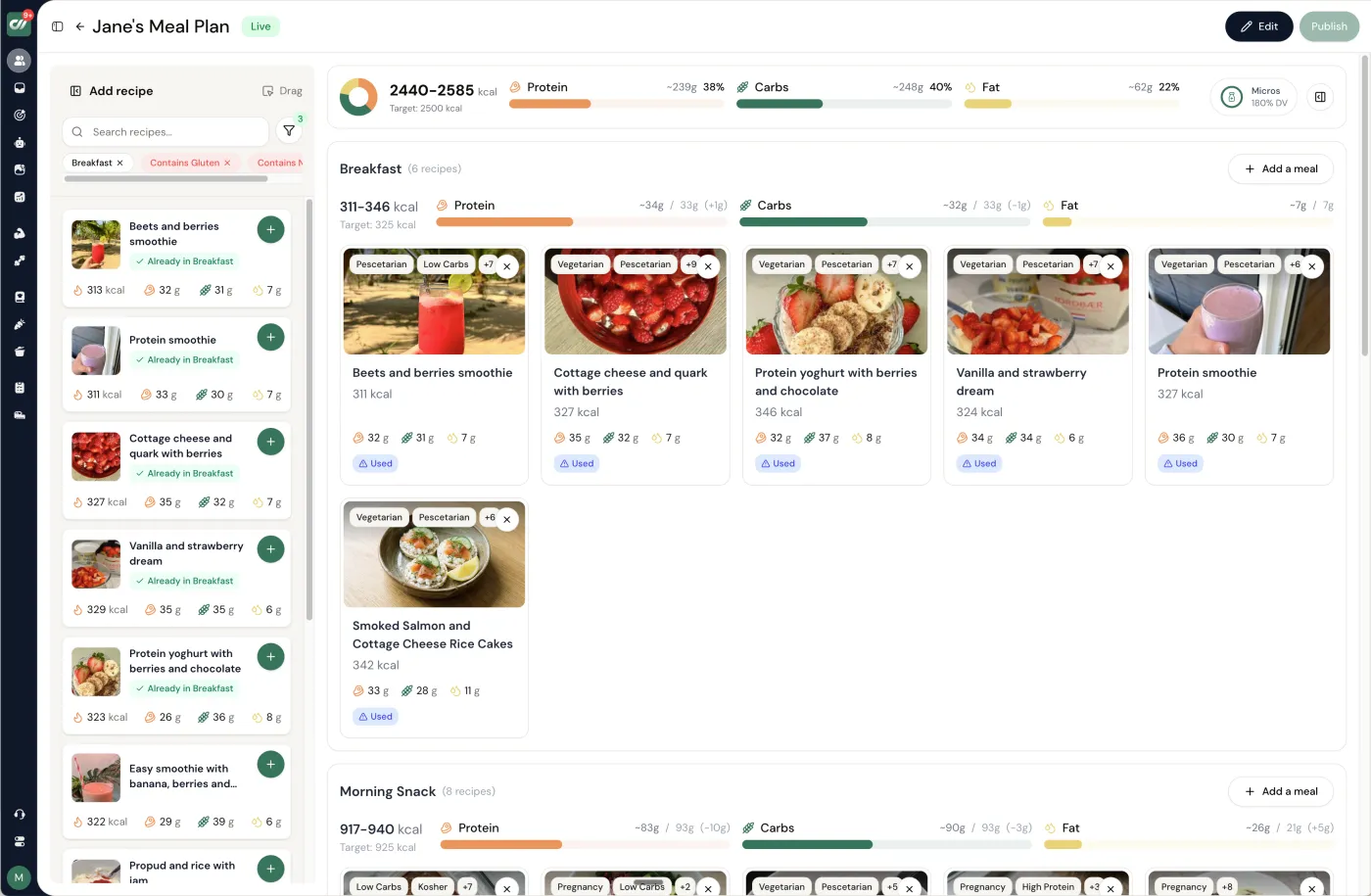
Run it on a platform - then grow it without adding hours.
Knowing how to start a nutrition coaching business is only the first half; the second half is running it so it does not run you. That is a platform decision, not a willpower one - keep the plan, the food logging, the check-ins and the payment in one place and every new client costs you minutes, not hours. Once the first few are logging and renewing, the question quietly changes from starting to how to grow your online coaching business, and the answer is the same principle in reverse: retention and referrals compound faster than any funnel. When you are ready to add capacity on purpose, the scaling guide covers what to add and when.
Coaching something other than nutrition?
The launch checklist above is the same for any coaching business - only your scope and delivery change. Start from the guide that matches yours:
- How to start an online coaching business - the general playbook that applies to any niche.
- How to start a health coaching business - habits, sleep and lifestyle change with a wider scope.
- How to start an online wellness coaching business - broad wellbeing coaching, delivered remotely.
- How to start a personal training business - programming and training delivery instead of food.
- How to start a corporate wellness coaching business - selling coaching to companies rather than individuals.
Run your whole nutrition business on Coachway.
Plan, food logging, check-ins and payment in one place. EUR 69 a month including your first 5 clients, every feature included, 14-day free trial.
Frequently asked questions about starting an online nutrition coaching business.
Do you need a qualification to start an online nutrition coaching business?
In most places you can coach general healthy eating, habits and macros without a licence, but you cannot diagnose, treat disease or prescribe clinical nutrition unless you are a registered dietitian. That line - between coaching behaviour and practising medical nutrition therapy - is the single most important thing to get right before you take a paying client, because it decides what you can legally say and who you should refer out. A recognised nutrition-coaching certification is not always a legal requirement, but it does two useful things: it teaches you the scope you are allowed to work inside, and it gives a stranger a reason to trust you. Check the rules for your own country and, if you plan to give individualised medical advice, get the protected credential rather than the coaching one.
How much does it cost to start an online nutrition coaching business?
Far less than most people expect, because the expensive parts are optional. The unavoidable costs are a certification if your market requires one, professional or liability insurance, and the software that runs the coaching. On the software side, Coachway is EUR 69 a month including your first 5 clients and EUR 9 per additional client after that, with every feature included and no separate nutrition module to buy, so your food database, meal-plan builder, check-ins and client app all sit in one bill. You do not need a website, a course platform or an email tool on day one - a simple offer, a way to take payment and a place to deliver the plan is enough to sign your first client. Start lean, let the first few clients fund the rest, and add tools only when a real bottleneck asks for them.
Should an online nutrition coach offer macros or full meal plans?
Most sustainable nutrition businesses lead with macros and habits, and use fixed meal plans as a starting scaffold rather than the whole product. A rigid meal plan gets great first-month compliance and terrible long-term retention, because the moment life does not match the plan the client has nowhere to go. Flexible macro targets plus a few anchor recipes teach the client to make their own choices, which is what actually keeps them paying past month three. The practical answer for a new coach is to offer both inside one system: give beginners a plan-shaped structure so they are not staring at a blank day, and move them toward targets and food logging as they build skill. Delivering both from the same tool - so a client can follow a plan or log freely against the same macro ring - is far easier than juggling a PDF plan and a separate tracking app.
How do online nutrition coaches deliver meal plans and track client food?
Through a client app that carries the plan, a food database the client logs against, and a check-in the coach reviews each week. In Coachway the client scans a barcode in under a second, or quick-adds calories and macros in three taps, against a database of 3.7 million foods, brands and recipes, and their macro rings move as they log. The coach sets targets per client and per weekday, scrolls a photo diary of real meals, and picks how much access each client gets - full logging, standard, photo-only or plan-only - so a hands-on fat-loss client and a light-touch maintenance client can run on the same system at different intensities. Recipes auto-scale to a client's targets and the shopping list writes itself, which removes most of the manual plan-building that makes nutrition coaching feel like unpaid admin.
How do you get your first online nutrition coaching client?
Start with the people who already know you and pick one specific problem you solve, not "nutrition" in general. A defined niche - postpartum fat loss, macro coaching for lifters, gut-friendly eating for a health condition you are qualified to support - makes you the obvious choice for a small group instead of a forgettable option for everyone. Then talk publicly about that one problem, message warm contacts personally rather than waiting for an audience to appear, and make the first offer small and clear with a real start date. Your first client almost never comes from a big launch; they come from a direct conversation with someone who already trusts you and happens to need exactly what you have decided to be good at.
How do you grow your online coaching business once it is running?
You grow it the same way you started it, in reverse: keep the whole chain - the plan, the food logging, the weekly check-in and the payment - on one platform, so signing more clients does not mean adding more hours of admin. The real levers of how to grow your online coaching business are retention and referrals, not a bigger ad budget: a client who hits their macros, feels seen at check-in and renews is worth far more than a fresh lead, and happy clients bring in the next ones by word of mouth. Raise your rate as your results and waitlist grow rather than piling on cheap clients, and only add capacity - a second coach, group cohorts, or a course - once your one-to-one book is genuinely full. Start lean, keep churn low, and let renewals compound before you chase scale.
The business is a short chain: get qualified for your scope, learn to deliver the coaching online, and price it so a small book of well-fit clients funds the work. Then let one platform carry the plan, the logging and the payment so you coach food instead of chasing admin.
Keep reading
all guidesBest HYROX coaching software (2026)
Programming for the fastest-growing race format needs hybrid tooling: interval stations, running volume and strength blocks in one plan. The platforms compared honestly for HYROX coaches.
Read the guideBest group coaching software for fitness coaches (2026)
Running cohorts, communities and group programs needs different plumbing than 1:1. The platforms compared on group features, honestly - and when group coaching is the wrong model.
Read the guideBest AI coaching apps for online fitness coaches (2026)
What "AI" actually means inside the coaching platforms - program generation, chat assistants, form analysis - compared honestly on what each vendor's own site describes, and what AI still does not replace.
Read the guideFree tools for this: Client Capacity Calculator · Coaching Rate Calculator · Coaching Tool Stack Cost Calculator
Ready-made templates: Client Onboarding Checklist · Coaching Contract Template
See what Coachway can do for your coaching business
Coachway was built on knowledge from working with 150 online coaches over 6+ years, who all hit the same wall - slow platforms, clunky workflows, wasted hours. Start your 14-day free trial and see what we fixed - the whole platform, no charge today, cancel anytime under Billing.


