


How to start an online wellness coaching business - one habit-and-lifestyle offer, run through a phone.
To start an online wellness coaching business you turn one clear promise - help a specific person change specific everyday habits - into a repeatable remote loop: a client app, a weekly check-in, an onboarding sequence and a subscription, all inside your scope of practice. This is the wellness-specific version of that launch: what a wellness offer actually is, how to hold your scope so the business stays defensible, what it costs, how you get the first few clients, and the software that keeps the whole thing from leaking.
By Markus Evers · Updated August 2026
the short version
An online wellness coaching business is a habit-and-lifestyle practice delivered remotely: you coach sleep, movement, stress, energy and food behaviour through check-ins and messaging instead of in-person sessions. Get the training that makes you competent, write your scope of practice down, and stay in it - habits and wellbeing are yours; anything clinical gets referred out. Package one specific offer for one specific person, price it as a monthly subscription, and get your first clients from the warm audience you already have. The delivery is a phone loop - a client app, a weekly check-in, a clean onboarding and a payment - so keep those in one place. Coachway runs the whole loop for EUR 69 a month with your first 5 clients included, EUR 9 per client after that, with a 14-day free trial to build it before anyone pays.
What is an online wellness coaching business?
An online wellness coaching business helps clients improve their everyday habits - sleep, movement, stress, energy, hydration, food behaviour, routine - through remote check-ins, messaging and structured accountability rather than in-person appointments. Grouping the day into a handful of core levers like that is the heart of Rangan Chatterjee's four-pillar habits, which our breakdown reworks into a repeatable coaching model. It is deliberately broader than a training-only or a nutrition-only practice. A personal trainer sells workouts; a nutrition coach sells food structure; a wellness coach sells the thing underneath both, which is a client's ability to build and keep a healthier daily life. The unit of work is the person's week over months, not a single session, and that is exactly what remote coaching is good at.
Because the scope is lifestyle and behaviour, the business is unusually light to run. There is no gym floor, no travel, no equipment to carry. What you actually operate is a loop that lives on a phone: the client sees a simple plan and logs against it, you review their week and reply, and the two of you keep momentum between check-ins. The craft is behaviour change - helping a person do the ordinary things consistently - and if you want a structured method to lean on rather than improvising, the behaviour-change frameworks coaches use are a good place to start. Everything else in this guide - scope, pricing, first clients, software - is in service of running that loop well and at a fair margin.
How do you actually start one, step by step?
Six moves, in order. Skipping the early ones to get to the exciting one - the launch post - is the most common way a new wellness practice starts blurry and stays that way.
1. Pick one person and one change.
Wellness is the widest word in coaching, and a wide word is a weak offer. Narrow it before you build anything: one specific person - the busy parent rebuilding a routine, the desk worker whose sleep and energy have slid, the ex-athlete who wants habits back without a hardcore plan - and one specific change you help them make. You can widen later. Starting narrow is what makes the marketing writeable and the results legible, because you can say plainly who you are for and what happens when they work with you.
2. Get competent and write your scope down.
Wellness coaching is not a licensed profession in most places, so there is rarely a certificate you legally must hold. That is a reason to be more disciplined, not less. Get training that gives you a real coaching method and carry appropriate insurance, then do the thing most new coaches skip: write your scope of practice in one paragraph and keep it visible. Habits, routine and general wellbeing are yours. Diagnosis, treatment, prescriptive medical nutrition and mental-health conditions are not - they belong to a doctor, a registered dietitian or a licensed therapist. The certification path covers the main bodies; the scope statement is what keeps the business defensible.
3. Package one offer, priced as a subscription.
Turn the person-and-change into a single, buyable thing: what it includes, how long it runs, what the client does each week, and what it costs per month. Frame it in months, because habit change is a months-long job and a two-week package quietly promises a fix that wellness does not sell. Price it as a recurring subscription rather than a one-off, so the maths of the business is predictable and the client relationship has room to compound. One clean offer beats a menu of tiers when you are starting - a confused buyer does not buy.
4. Build the delivery loop before you sell.
Decide how a client experiences your coaching before you have one, because the first client should meet a system, not an experiment. That means four things ready: an onboarding sequence so every new client gets the same clean start, a weekly check-in the client fills in, a place to message between check-ins, and a subscription to get paid. Standing this up on a free trial in a quiet week - rather than during your launch scramble - is the difference between a smooth first month and a fortnight of scrambling to look organised. The onboarding checklist is the fastest way to get that loop right.
5. Get the first clients from the warm audience.
Do not open with a cold launch to strangers. The first clients come from the people already near the problem: your own network, a past in-person client base, a small content following. Tell them exactly what you now do and how to start, and offer a low-friction way in - a first month or a focused reset - so a hesitant person can feel your coaching before committing to the long version. The point of the first handful is not revenue, it is proof and process: honest results you can talk about, and a loop you have run enough times to trust.
6. Deliver well, then let referrals compound.
The first two weeks of each client decide the next six months. Land the plan quickly, engineer an early win, and reply properly to the first check-in, because that is where a wellness client either takes root or quietly fades. Say the quiet part out loud: motivation will dip once novelty fades, and the plan is built for exactly that. Do this well and the business grows the durable way - referrals from people who got a real result, plus content that shows the change you create. That compounding is only possible once the loop underneath it is boring and reliable.
Where does a wellness coach's scope of practice end?
This is the question that separates a durable wellness business from a risky one, and it is worth being blunt about. A wellness coach works on habits, routine and general wellbeing - sleep hygiene, movement, stress management, energy, hydration, everyday food behaviour, consistency. What sits outside the lane is anything clinical: you do not diagnose conditions, you do not treat disease, you do not write prescriptive medical nutrition for a health condition, and you do not do the work of a licensed therapist. The broad scope of wellness is a strength for the business and a trap for the unwary, because "everything about feeling better" quietly includes things that are not yours to handle.
The practical version is a habit, not a one-time decision. Put your scope in writing, state it in your intake form and your onboarding, and build a reflex of referring out. When a client presents something medical, the professional move is a warm handoff to the person licensed for it - a doctor, a registered dietitian, a therapist - not a stretch of your own remit to keep the client happy. Referring out is not losing the client; done well it is the moment they trust you most, because you clearly put their wellbeing above your invoice.
Some wellness coaches take the same habit-and-lifestyle competence into companies, coaching teams instead of individuals; if that route interests you, the corporate wellness route is a different sales motion built on the same core skill. Whichever way you go, the scope discipline is identical: coach the behaviour, refer the clinical, and write it down so both you and the client always know the boundary.
What does it cost to start an online wellness coaching business?
Less than most people fear, because this is a service business with almost no inventory. The genuine costs are your training or certification, appropriate insurance, and the software that delivers the coaching. Everything else - a logo, a website, a fancy studio setup - is optional and usually premature; the first spend that returns money is whatever gets you in front of people who already want to change their habits, not a brand refresh.
On software, the trap is subscription sprawl: an app for programs, a form tool for check-ins, a separate messenger, a payment link, a spreadsheet holding it together. Each one is cheap alone, and the stack is expensive in money and in leaks. An all-in-one platform folds the loop into a single bill. Coachway is EUR 69 a month with your first 5 clients included and EUR 9 per additional client after that, with every feature in and no tiers to decode, and a 14-day free trial so you can build the whole delivery loop before you charge anyone - the trial starts with a card held securely by Stripe and cancels under Billing before it renews. If you want to weigh a wellness-fit platform against the wider field first, the health and wellness coaching software guide compares the options honestly.
The whole business runs on one weekly loop.
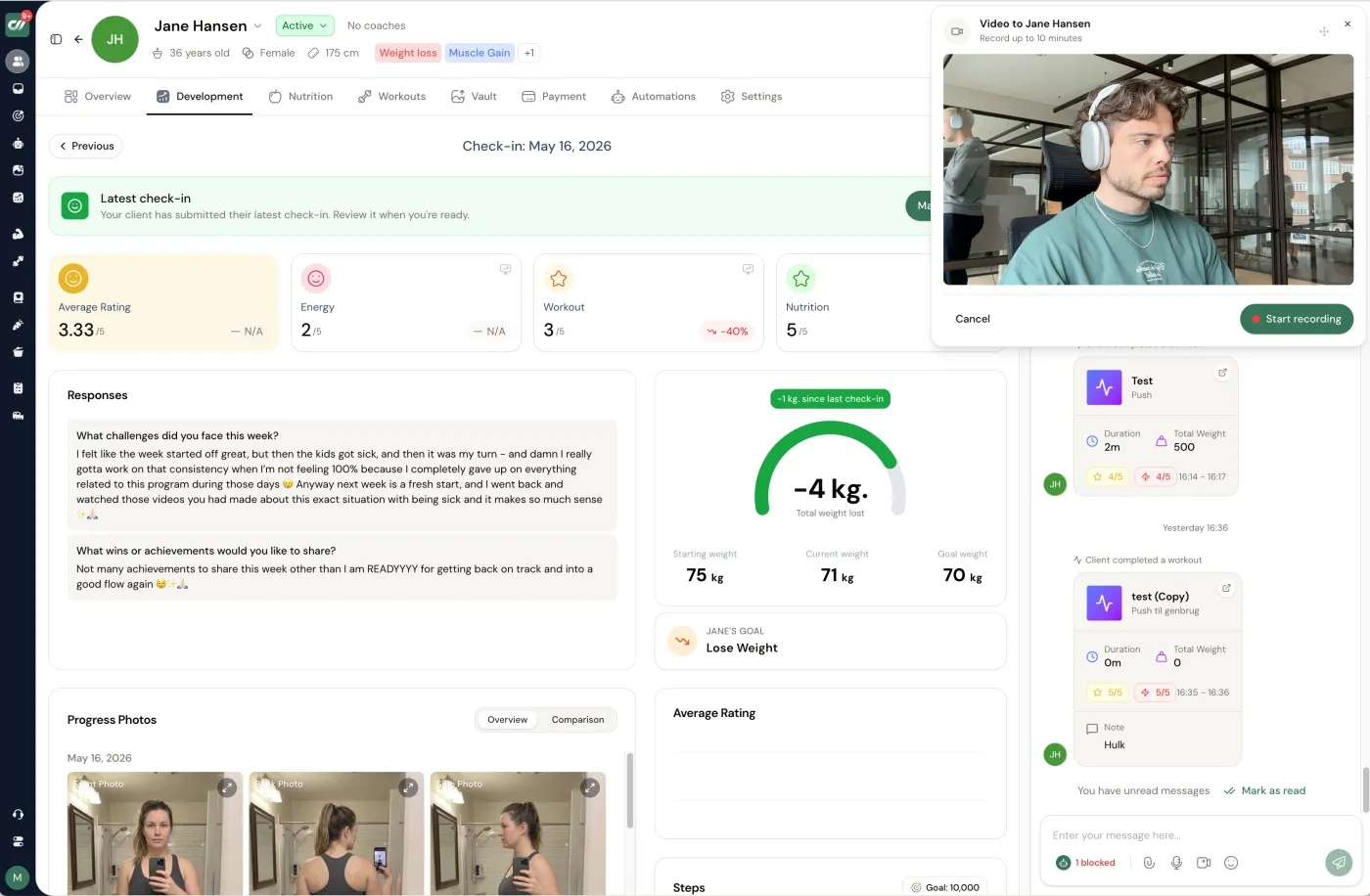
Strip a wellness practice back and it is one repeating loop: a client logs their week, you review it, you reply, they keep going. When that loop is scattered across a form tool, a chat app and a payment link, the accountability that wellness coaching sells is exactly what leaks - a client checks in somewhere you do not see it, and the momentum quietly dies. In Coachway the loop lives on one screen. The client uses a branded app on iOS and Android; you build the weekly check-in with a drag-and-drop form - smiley and star ratings, measurements, progression photos, custom habit metrics - and review this week's answers side by side with their trend and photos, so a habit slipping shows up before it becomes a lost client. New clients convert from a lead into an onboarded, subscribed client in one flow, and payments settle in your own Stripe account, so Coachway never holds your money. There is a library of 1,800+ exercises and 1,100+ recipes if a client's plan touches training or food, without you leaving the loop. It is built on knowledge from working with 150 online coaches over 6+ years, costs EUR 69 a month including your first 5 clients, and you can book a demo to see the check-in review before you commit. The coach dashboard is in English; the client app is available in English, Danish, Norwegian, Swedish, Finnish and German.
Frequently asked questions about starting an online wellness coaching business.
What is an online wellness coaching business?
An online wellness coaching business is a solo or small practice that helps clients improve everyday habits - sleep, movement, stress, energy, food behaviour, routine - through remote check-ins, messaging and structured accountability rather than in-person sessions. It is broader than a training-only or nutrition-only practice: the unit of work is the client's lifestyle over weeks and months, not a single workout or meal plan. The scope is habit change and general wellbeing, which means you coach behaviour and consistency, and you refer out anything clinical - diagnosis, treatment, prescriptive medical nutrition, mental-health conditions - to the licensed professional who owns it. Practically, the business is one offer delivered through a phone: a client app for the person you coach, and a dashboard where you review their week, reply, and keep the relationship on track.
Do you need a certification to start an online wellness coaching business?
Wellness coaching is not a licensed profession in most places, so there is usually no legal certificate you must hold before you take a paying client. That is not the same as needing nothing. A recognised wellness or health-coaching certification does two useful things: it teaches you a structured coaching method - motivational interviewing, goal-setting, behaviour change - so you are guiding rather than improvising, and it gives a hesitant buyer a credential to point at. The more important boundary is not the certificate but the scope: a wellness coach supports habits and lifestyle, and refers out anything that belongs to a doctor, a registered dietitian or a licensed therapist. Get the training that makes you competent, carry appropriate insurance, write your scope down, and stay inside it. The certification path and the main bodies are covered in the become-a-wellness-coach guide.
How much does it cost to start an online wellness coaching business?
Less than most people expect, because it is a service business with almost no inventory. The real costs are your training or certification, appropriate insurance, and the software that delivers the coaching. On the software side you do not need five subscriptions: an all-in-one coaching platform gives you the client app, check-in forms, messaging, onboarding and payments in one place. Coachway is EUR 69 a month with your first 5 clients included and EUR 9 per additional client, every feature in, and a 14-day free trial to set the whole thing up before you charge anyone - the trial starts with a card held by Stripe and cancels under Billing before it renews. Beyond that, the first spend that actually returns money is not a logo or a fancy website; it is whatever gets you in front of the people who already want help changing their habits.
What is the scope of practice for an online wellness coach?
A wellness coach works on habits, routine and general wellbeing - sleep hygiene, movement, stress management, energy, hydration, everyday food behaviour, consistency - using coaching skills to help a client set goals and keep them. What sits outside that lane is anything clinical: you do not diagnose conditions, you do not treat disease, you do not write prescriptive medical nutrition for a health condition, and you do not do the work of a licensed therapist. The honest and safest move is to state your scope in writing, put it in your intake form and your onboarding, and build a habit of referring out: when a client presents something medical, the right answer is a warm handoff to the professional who is licensed for it, not a stretch of your own remit. Staying in scope is not a limitation on the business; it is what makes it a defensible one.
How do you get your first online wellness coaching clients?
You start with the warm audience you already have and a small, concrete offer, not a cold launch to strangers. Pick one specific person you help and one specific change you help them make, then tell the people closest to that problem - your existing network, a past in-person client base, a small content following - exactly what you now do and how to start. A short, low-commitment entry works better than asking a stranger for a multi-month yes on day one: a focused reset, a first month, a single clear goal they can feel. The goal of the first handful of clients is not revenue, it is proof and process - real results you can talk about honestly, and an onboarding-to-check-in loop you have run enough times to trust. Once that loop is smooth, referrals and content do the compounding.
What software do you need to run an online wellness coaching business?
At minimum: a way for the client to see their plan and log on their phone, a repeatable check-in the client fills in each week, a place to message and keep the relationship warm between check-ins, an onboarding sequence so every new client gets the same clean start, and a way to get paid on a subscription. You can assemble that from separate apps, but the joins leak - a client onboarded in one tool, checking in through a form in another, paying through a third. An all-in-one platform keeps the whole loop in one place. In Coachway the client gets a branded app, you get a check-in tab that lines up this week's answers next to their trend, and a new client can be converted from a lead into an onboarded, subscribed client in one flow, billed through your own Stripe account so Coachway never holds your money.
A wellness practice is built on three things this guide keeps returning to: a credible foundation, a behaviour-change method you trust, and the software that keeps the weekly loop from leaking. Get those steady and the business becomes simple to run.
Keep reading
all guidesKahunas pricing in 2026: plans and real cost
Kahunas prices in three fixed USD tiers capped by client count: USD 35/mo for up to 25 clients, USD 69 for up to 50, and USD 99 for unlimited, with the fully branded white-label app gated to the top USD 99 tier. This guide lays out the full ladder, the 14-day trial, and how Coachway compares for European coaches.
Read the guideKahunas review (2026): an honest look
A doctor-honest review of Kahunas, the fitness-first coaching platform: its workout and nutrition toolkit, the three USD tiers (Essentials $35, Growth $69, Ultimate $99), the 14-day trial, and the branded app locked to the top tier. Covers what it is, who it suits, real strengths, honest limitations, a verdict, and where Coachway fits as an EU-focused alternative.
Read the guideFitBudd review: features, pricing, pros and cons
FitBudd is a branded-app-first coaching platform from Gurugram, India, whose standout is a fully white-labelled app on your own App Store and Google Play listing, gated to the USD 149 Super Pro tier. Pricing runs from USD 15 to USD 149 a month with a 30-day no-card trial. An honest review of what it is, the full pricing ladder, what it does well, where coaches feel the gaps, who it fits, and Coachway as the EU-built, nutrition-strong alternative.
Read the guideFree tools for this: Coaching Rate Calculator · Coaching Tool Stack Cost Calculator · Coaching Profit Calculator
Ready-made templates: Client Onboarding Checklist · Coaching Contract Template
See what Coachway can do for your coaching business
Coachway was built on knowledge from working with 150 online coaches over 6+ years, who all hit the same wall - slow platforms, clunky workflows, wasted hours. Start your 14-day free trial and see what we fixed - the whole platform, no charge today, cancel anytime under Billing.


