


How much do nutrition coaches charge in 2026 - and what they actually take home.
Most online nutrition coaching packages sit between $100 and $300 a month, with self-guided plans below that and premium one-to-one work well above it. This guide gives the real market ranges - per month, per session and as a full-time income - explains what makes one coach charge double another, and does the honest take-home math so you can price your own coaching from evidence rather than a guess - and the free coaching rate calculator turns your income goal into a price and client count in a minute.
By Markus Evers · Updated October 2026
the short version
A nutrition coach costs $100 to $300 a month for most online coaching in 2026. Self-guided or app-led plans run $50 to $100, a one-off consultation is $75 to $200, and premium one-to-one coaching with frequent check-ins reaches $300 to $600 or more. Price tracks contact and personalisation, not calories; thirty clients at $150 grosses about $4,500 a month.
How much do nutrition coaches charge, by package type?
There is no single price because there is no single product. "Nutrition coaching" covers everything from a macro target texted once a month to daily food-log review with weekly calls, and the fee follows how much of the coach's attention the client is buying. The bands below are the ones most online nutrition coaches actually sell inside in 2026. Read them as attention tiers, not quality tiers - a lean $120 package delivered consistently beats an expensive one that goes quiet by week three. For three example nutrition coaching packages written out line by line, with what each includes and how often it checks in, see the package menus guide. Where your service sits on that range is mostly a choice of tracking depth, which our guide to macro coaching breaks into four levels.
| Package type | What the client gets | Typical price |
|---|---|---|
| Self-guided / app plan | Macro targets, food logging, light or automated check-ins | $50-$100 / mo |
| Standard online coaching | Custom targets, weekly check-ins, chat support, plan adjustments | $100-$250 / mo |
| Premium 1:1 coaching | Frequent check-ins, calls, close access, a small client list | $300-$600+ / mo |
| Single consult / audit | One deep session and a plan to run on your own | $75-$200 one-off |
| Nutrition add-on to training | Nutrition layered onto an existing personal-training package | +$50-$150 / mo |
These are US-market ranges in dollars and shift with country and currency, but the shape holds everywhere: the standard band is where most sustainable online nutrition coaching lives, and the jump to premium is paid for with contact and small numbers, not with a longer plan. For the client's-eye view of the same market - what people pay for online coaching and when cheap turns expensive - see how much an online coach costs per month.
What makes one nutrition coach charge double another?
Two coaches with the same certification can charge $120 and $350 for what looks like the same service, and the gap is almost never about who knows more about protein. It is about four things a buyer can feel.
Contact and response speed.
The single biggest lever. A coach who reviews the food log daily and replies with real feedback within hours is delivering a fundamentally different product from one who sends a target on the first of the month. Clients pay for accountability, and accountability is a function of how present you are, so the premium tier is really a promise of attention. Price the promise you can actually keep - an over-sold contact level that slips is the fastest way to churn a client and lose the review that would have justified the fee.
Proof and specialisation.
A coach with a wall of relevant before-and-afters and a clear niche - postpartum fat loss, physique competitors, endurance fuelling - can charge more than a generalist, because the buyer sees their exact situation already solved. Specialisation raises price twice: it makes the coaching more valuable to the right person and it makes marketing cheaper, because you are talking to a narrower, warmer audience. A generalist competes on price; a specialist competes on being the obvious choice.
The experience around the advice.
Two coaches can give identical macro targets, but the one whose client logs a meal by scanning a barcode, sees their macro rings move in real time, and follows a plan that lands cleanly in a proper client app feels worth more than the one running the same client through a spreadsheet and a group chat. The nutrition science is table stakes; the delivery is what a client experiences every single day, and a smooth, professional experience quietly supports a higher number.
Scope, and staying legal within it.
A non-clinical nutrition coach works with habits, targets and general healthy-eating guidance, not the diagnosis or treatment of disease, which is a dietitian's regulated territory. That scope line is not a limit on your price - plenty of premium coaching lives entirely inside it - but pretending to cross it is a real risk, not a pricing strategy. Charge for the transformation you can legitimately deliver, be explicit about where you refer out, and the trust that creates is itself worth money. The nutrition business guide covers the scope-of-practice line in more depth.
How much do nutrition coaches make once the bills are paid?
What you charge is only half the answer coaches actually want. Income is client count times monthly fee, minus the small costs of running the business and then tax on the profit. Because the online model is paid per client rather than per hour, adding a client does not cost you another hour on the gym floor - only the marginal time to coach them well through an app - so the ceiling rises with the number of people you can hold at your quality bar. Three honest snapshots, before tax:
Part-time
~$1,500 / mo
10 clients at $150. Roughly $18,000 a year gross - a side income, run alongside a job or in-person work.
Full-time
~$4,500 / mo
30 clients at $150. About $54,000 a year gross, the realistic middle of a solo online nutrition coach's book.
Premium / raised
~$10,000 / mo
40 clients at $250. The result of raising the fee and specialising, not just working more hours.
The costs that come off the top are smaller than most coaches fear. Card processing through your own Stripe account is roughly the standard 2.9% plus a fixed fee per charge, and it settles straight to you. Coaching software is the other line, and on a flat per-client tool it is a rounding error against revenue: at EUR 69 a month for your first 5 clients and EUR 9 per additional client, a thirty-client book costs about EUR 294 a month - close to nine euros per client. The line that quietly matters more than either is the pricing model behind your platform. A tool that takes a percentage of every payment you collect scales its cut with your success; a flat per-client tool means the day you raise your price, that increase lands almost entirely on your side of the ledger. If you are still setting the number itself, the package pricing method and the raise-your-rates playbook pick up where this leaves off, and the sister piece on what online trainers make runs the same math for training.
So what should you charge for your nutrition coaching?
Land inside the standard band - $100 to $250 a month - and let the specifics of what you deliver move you within it. Three rules keep the number honest.
1. Price the outcome and the contact, not your years of experience.
A buyer is paying for a result and the attention that gets them there. Decide the contact level you will genuinely sustain - weekly check-ins, chat access, monthly calls - and price that, because it is what the client feels. Being newer is a reason to earn proof faster, not to work for a fee you cannot live on.
2. Do not undercut yourself into a trap.
A $60 plan looks friendly and behaves like a tax: it attracts the least committed clients, forces you to carry twice as many to earn a living, and signals that the coaching is not worth much. If a hesitant buyer needs an easier yes, lower the risk with a strong first month and a clear early win, not the fee.
3. Raise the number every time demand outpaces your spots.
Set your price for new clients, and nudge it up whenever more people want in than you can take. Grandfather your existing clients at their old rate so nobody feels punished for loyalty, and let the new number reflect the coach you have become. A price that never moves is a sign your marketing, not your coaching, has stalled.
If clients pay for contact, the time each weekly review costs you is what caps your client count. In Coachway one screen shows a client's numbers, progress photos, training log and latest messages, so a check-in review takes a few minutes. 14 days free, EUR 0 today.
start 14-day free trialWhat you keep depends on how you collect the money.
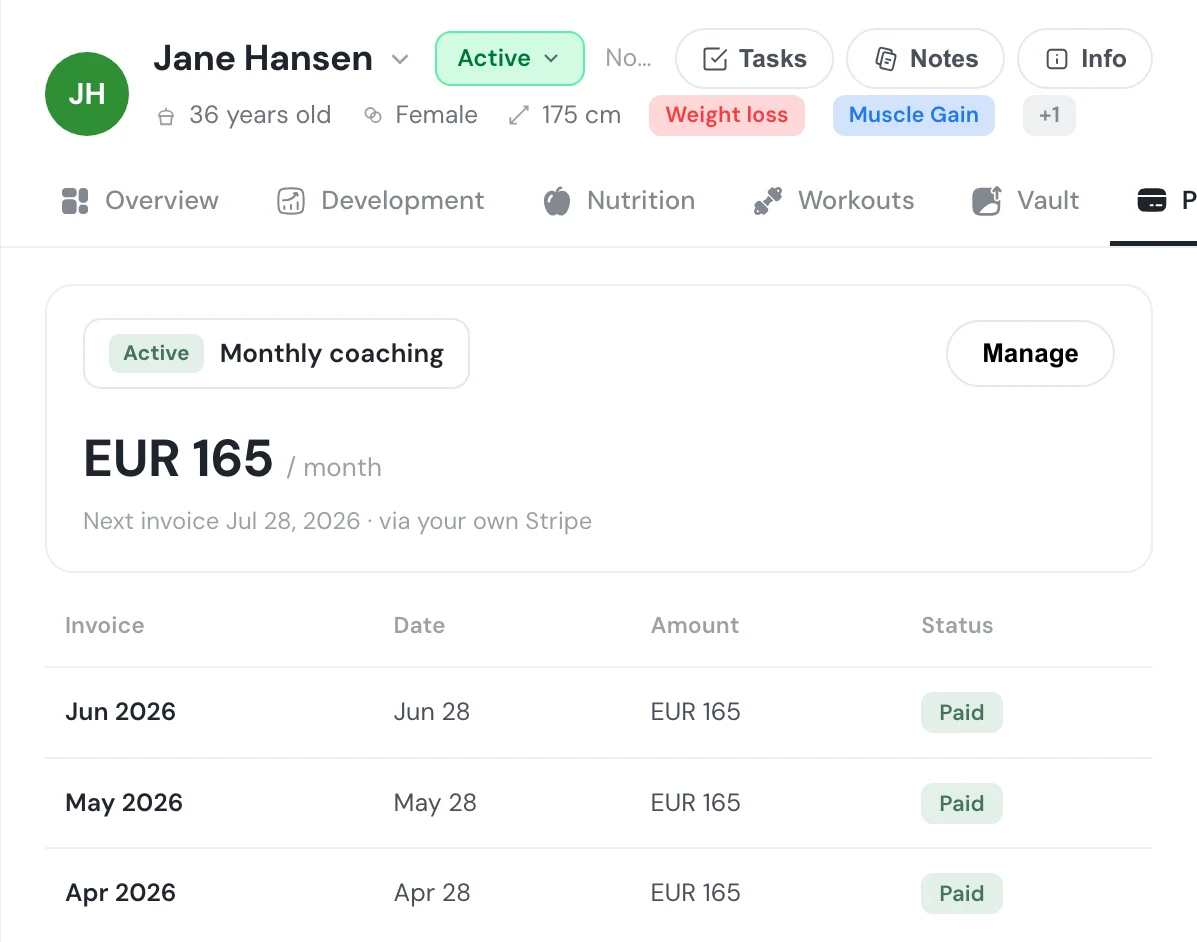
Whatever you decide to charge, the take-home is only real once the money actually lands in your account cleanly. Coachway is built so that it does: client subscriptions, planned invoices and payment plans settle in your own Stripe account, and Coachway never holds your money. You set the amount, currency and billing interval per client, reminders chase failed cards automatically, and a converted lead can walk straight into the client app, an onboarding sequence and a live subscription in one step. Built-in payments are optional and carry a 2.4% per-transaction fee if you use them; run your own Stripe checkout and you skip even that. The software itself is flat - EUR 69 a month including your first 5 clients, EUR 9 per additional client, every feature included with no tiers - so a price rise flows to your bottom line instead of a platform's cut. It is built on knowledge from working with 150 online coaches over 6+ years, and the coach dashboard is in English. See the current numbers on the pricing page, or book a demo and see the billing side first. The 14-day free trial starts with a card and cancels under Billing before it renews.
Frequently asked questions about nutrition coaching prices.
How much do nutrition coaches charge per month?
Most online nutrition coaching packages fall between $100 and $300 a month in 2026. Below that, around $50 to $100, you find self-guided or app-led plans where the coach sets macro targets and checks in lightly rather than working closely week to week. Above it, premium one-to-one nutrition coaching with frequent check-ins, calls and close access commonly runs $300 to $600 or more per month, because the coach is deliberately holding a small client list. The monthly figure is not really a price on food advice - it is a price on attention, response speed and how personalised the plan is. A coach seeing thirty logged meals a week and replying in detail is selling something different from one who sends a target and disappears, and the number should reflect that gap.
How much do nutrition coaches charge per session or per hour?
A one-off nutrition consultation typically costs $75 to $200, and an ongoing hourly rate lands in a similar band depending on experience and location. But the per-session model is fading for online nutrition coaches, and for good reason: nutrition change is a habit problem measured in months, not a single meeting, so an hour of advice rarely produces the result the client actually wanted. Most coaches who move online convert the hourly figure into a monthly package instead - roughly what two consultations a month would have cost - and then deliver continuously through an app rather than in scheduled calls. The client pays about the same but gets accountability every day instead of once a fortnight, and the coach gets predictable recurring revenue instead of rebooking from zero each time.
How much do nutrition coaches make a year?
Income is client count times monthly fee, minus tools and tax, so it spans a wide range. A part-time coach with ten clients at $150 a month grosses about $1,500 a month, or $18,000 a year. A full-time online nutrition coach with thirty clients at the same $150 grosses about $4,500 a month, roughly $54,000 a year before costs, and one who has raised the fee to $250 and holds forty clients clears $10,000 a month gross. The ceiling is set by two numbers you control: how many clients you can hold without the quality dropping, and what each one pays. The online model matters here because it breaks the hour-for-hour trap of in-person work - you are not paid per session, so adding a client does not cost you another hour on the gym floor, only the marginal time to coach them well through the app.
What should a new nutrition coach charge?
Start near the bottom of the standard band, around $100 to $150 a month, and raise it as your results and testimonials accumulate rather than launching high and hoping. The instinct to undercharge is the more expensive mistake: a $60 plan attracts the least committed clients, forces you to carry more of them to earn a living, and quietly signals that the coaching is not worth much. Price on the outcome and the contact level you actually deliver, not on how new you feel. A cleaner path than a low headline price is a normal price with a strong, risk-lowered first month - a clear early win and a real reply to the first check-in - so a hesitant buyer says yes to the value, not the discount. Then raise the number for new clients every time demand outpaces your open spots.
Do nutrition coaches keep all the money they charge?
Not quite, but the leaks are smaller than most coaches assume. The two real deductions are payment processing and the software you run the business on. If you take payment through your own Stripe account, card processing is roughly the standard 2.9% plus a fixed fee per charge, and that money settles directly to you. Coaching software is the other line: on Coachway it is EUR 69 a month including your first 5 clients and EUR 9 per additional client, so a thirty-client book costs about EUR 294 a month in tools - a few euros per client. Beyond that it is ordinary business tax on your profit. The figure to watch is not the software price but the model behind it: a platform that takes a percentage of every payment you collect scales its cut with your success, whereas a flat per-client tool keeps a price rise flowing to your own bottom line.
How much does an online nutrition coach cost?
Most online nutrition coaching runs USD 100 to 250 a month for standard coaching (custom targets, weekly check-ins, chat and plan adjustments), USD 50 to 100 for a self-guided app plan, and USD 300 to 600 or more for premium one-to-one work with calls and a small client list. A single consult or audit is USD 75 to 200 one-off, and nutrition layered onto a training package adds USD 50 to 150 a month. The ranges table on this page has the five package types side by side.
How much does a nutrition coach cost?
It depends on the package: about USD 100 to 250 a month for standard online coaching, USD 50 to 100 for self-guided plans, USD 300 to 600 or more for premium one-to-one coaching, or USD 75 to 200 for a one-off consultation. The price follows the check-in frequency and the access to the coach more than the plan itself, which is why two coaches with similar plans can charge double one another; the section on what drives the price explains the gap.
Pricing is one decision inside a bigger build. Once the number is set, the package method shapes how you present it, the raise-your-rates playbook moves it up over time, and the nutrition business guide puts the whole offer together.
Keep reading
all guidesMacro coaching: how to set, track and adjust client macros
Macro coaching means coaching to targets, not a fixed menu. How to set client macros from energy needs, match tracking depth to each person across four tiers, adjust on a two to three week check-in cadence, and run the whole loop without spreadsheets.
Read the guideHabit Coaching Frameworks for Online Coaches
A habit coach wins on adherence, not information. The five evidence-based frameworks - the habit loop, habit stacking, tiny habits, minimum viable behaviors and if-then plans - and how to operationalize each as a repeatable client task and a weekly check-in.
Read the guideNutrition Coaching Client Progress Assessment: A 2026 Method
Assessing a client's nutrition progress is reading five signals together, not reacting to the scale: weight trend as a rolling average, adherence as days hit, food-log quality, the felt state, and non-scale measures - resolved every two to three weeks into one move.
Read the guideFree tools for this: Coaching Profit Calculator · Client Capacity Calculator · Coaching Rate Calculator
See what Coachway can do for your coaching business
Coachway was built on knowledge from working with 150 online coaches over 6+ years, who all hit the same wall - slow platforms, clunky workflows, wasted hours. Start your 14-day free trial and see what we fixed - the whole platform, no charge today, cancel anytime under Billing.


