


Habit coaching frameworks - the ones online coaches actually use.
A habit coach wins on adherence, not information. Your clients rarely fail because they do not know what to do; they fail because the behavior did not survive a busy week. These are the evidence-based habit frameworks that make behaviors stick - the habit loop, habit stacking, tiny habits, minimum viable behaviors and if-then plans - and, more usefully, how to operationalize each one as a repeatable client task and a weekly check-in rather than a nice idea a client forgets by Wednesday.
By Markus Evers · Updated August 2026
the short version
A habit coach works on the behaviors that produce a result, not just the result. Five frameworks do most of the work and they overlap rather than compete: the habit loop (cue, routine, reward) to diagnose why a behavior repeats; habit stacking to anchor a new action to an existing routine; tiny habits to shrink a behavior until it cannot fail; minimum viable behaviors to define what still counts on a bad day; and if-then plans to pre-decide the exact moment of action. The frameworks are the easy part. The coaching is turning each one into a specific, assigned client task and catching it at a weekly check-in - because a habit you cannot see is a habit you cannot coach.
Why habit coaching beats motivation coaching.
Almost every client who fails already knew what to do. They knew to hit their protein, to walk more, to sleep earlier, to train three times a week. The information was never the bottleneck. The bottleneck is that the behavior depended on motivation, and motivation is a terrible foundation because it is not a stable input - it rises and falls with sleep, stress, a bad day at work, a sick child. Coach for motivation and you are building on sand that shifts every week. Coach for habits and you are building on something that runs whether the client feels like it or not, which is the entire point of a habit: a behavior that has become automatic enough to survive the days willpower does not show up.
This is why the highest-leverage skill in online coaching is not programming or nutrition science - it is behavior change. A habit coach treats adherence as the actual product and designs backwards from it: what is the smallest, most repeatable action that moves this client forward, how do we attach it to their real life so it does not require a decision, and how do we make it visible enough that a slip shows up in a check-in before it becomes a quit. The frameworks below are just proven ways to answer those three questions. None of them are magic, and most of them will feel obvious once named. The value is in applying them deliberately, one client at a time, instead of hoping motivation holds.
Five habit frameworks, and when each one fits.
Use the first to diagnose, and the other four to fix the specific friction a client keeps hitting. They are tools in one box, not rival philosophies.
1. The habit loop: cue, routine, reward.
The loop, popularized in Charles Duhigg's The Power of Habit, is the diagnostic layer under everything else. A fuller Duhigg habit loop breakdown walks cue, routine and reward through in coaching terms if you want to go deeper on the diagnosis before you fix anything. Every habit runs on a cue that triggers it, a routine that is the behavior itself, and a reward that tells the brain the loop is worth repeating. When a client cannot sustain a habit, one of the three is missing: there is no reliable cue, the routine is too effortful, or nothing rewards it so it never encodes. As a coach you use the loop to ask better questions - what were you doing right before, what happened right after, what did it give you - and to intervene at the weakest link rather than just telling the client to try harder. Most "willpower problems" are really a broken cue or a reward that never landed.
2. Habit stacking: anchor the new to the established.
Popularized by James Clear in Atomic Habits, habit stacking solves the cue problem directly: instead of hoping a client remembers a new behavior, you attach it to one that already runs on autopilot. If you want our read on the method behind it, our James Clear Atomic Habits breakdown takes the stacking idea apart in coaching terms. The formula is simply "after I do X, I will do Y" - after I pour my morning coffee, I take my supplements; after I finish the school run, I walk for ten minutes; after I brush my teeth at night, I lay out tomorrow's training clothes. The established habit becomes the cue, which removes the single most common failure point in behavior change: forgetting. This is the framework to reach for when a client keeps saying "I just forgot", because forgetting is almost never a memory problem - it is a missing anchor.
3. Tiny habits: shrink it until it cannot fail.
From BJ Fogg's Stanford behavior research and his book Tiny Habits, the method deliberately shrinks a behavior to something almost absurdly small - two push-ups, one glass of water, a single logged meal - so that it takes almost no motivation to complete. For our take on how small is small enough, our BJ Fogg Tiny Habits breakdown works through where the method holds and where it stalls. Fogg's model holds that a behavior happens when motivation, ability and a prompt arrive at the same moment; since motivation is unreliable, you win by making the behavior so easy that even low motivation clears the bar. The magic is not the two push-ups; it is that showing up daily builds the identity and the cue, and the behavior naturally grows once it is established. Reach for this when a client is overwhelmed, inconsistent, or has failed the "proper" version of a habit repeatedly.
4. Minimum viable behaviors: what still counts on a bad day.
A close cousin of tiny habits, but pointed at a different moment: the busy or low-motivation day, not the starting line. A minimum viable behavior is the smallest version of a habit the client commits to doing even when everything is going wrong - if a full session is impossible, the floor is a ten-minute walk; if a cooked dinner is impossible, the floor is a protein-forward ready meal. Defined in advance, it turns a "missed day" into a "reduced day", which protects the streak and the identity that comes with it. This is arguably the single most important framework for retention, because clients rarely quit over the good weeks - they quit when a hard week produces a total miss, that miss becomes two, and the story flips to "I have already failed". A pre-agreed floor stops the spiral before it starts.
5. Implementation intentions: pre-decide the exact moment.
The most heavily researched framework here, studied by psychologist Peter Gollwitzer as "if-then plans": deciding in advance the precise time, place and response for a behavior. "I will train" is a wish; "if it is Tuesday at 6pm, then I do session two at the gym near work" is a plan the brain can execute without renegotiating. The mechanism is that the situation itself triggers the action, so the client is not spending willpower deciding in the moment - the decision was already made. It pairs naturally with habit stacking and minimum viable behaviors, and it is the framework to use when a client is motivated and capable but keeps letting the day fill up until the behavior gets crowded out. Make them name the when and the where, not just the what.
Turning a framework into a client task and a check-in.
A framework a client nods along to in a call is worth nothing by Wednesday. The coaching is in the operationalizing: converting the idea into a specific, assigned, trackable action and then catching it every week. The loop is always the same four steps, and it is the same whether you coach one client or fifty.
1. Name one behavior, and write it as a stack.
Pick a single keystone habit for the next few weeks and phrase it in the "after X, I will Y" form so it carries its own cue. "Eat more protein" is not a habit; "after I make my morning coffee, I add a scoop of protein and a Greek yogurt" is. Write it with the client, in their words, attached to a real anchor in their real day. If they cannot name the anchor, you have found the reason the last version failed.
2. Set the floor before you set the target.
Agree the minimum viable version at the same time as the ideal one, so the bad week is planned for on the good day when the client is optimistic. The target is four sessions; the floor is one walk. The target is a cooked dinner; the floor is a protein bar. Naming the floor out loud is what stops one hard day from ending the habit, and it removes the shame that usually turns a single miss into a quiet exit.
3. Make it visible: a task, a rating, a log.
A habit you cannot see is a habit you cannot coach. Assign the behavior as something that shows up - a recurring task, a smiley or number rating on the weekly check-in form, a simple daily log the client ticks. The point is a signal you can read at a glance, so adherence stops being a vague feeling and becomes a number you can respond to. Track the habit, not just the outcome, because the habit is the leading indicator and the scale is the lagging one.
4. Close the loop at the check-in, and reach out when it slips.
The reward layer of the habit loop is largely you. A specific reply - "three walks this week, that is up from one, keep the same anchor" - is the reinforcement that encodes the behavior, and it is what a generic "great job" never delivers. Just as important, when a rating drops or a client goes quiet, reach out with a small task or a short message rather than waiting for the next scheduled call. Consistency of contact from the coach is often the thing that carries a client across the stretch where their own motivation cannot. Keeping clients accountable between check-ins is where habit coaching is actually won.
Habit coaching runs on one visible check-in loop.
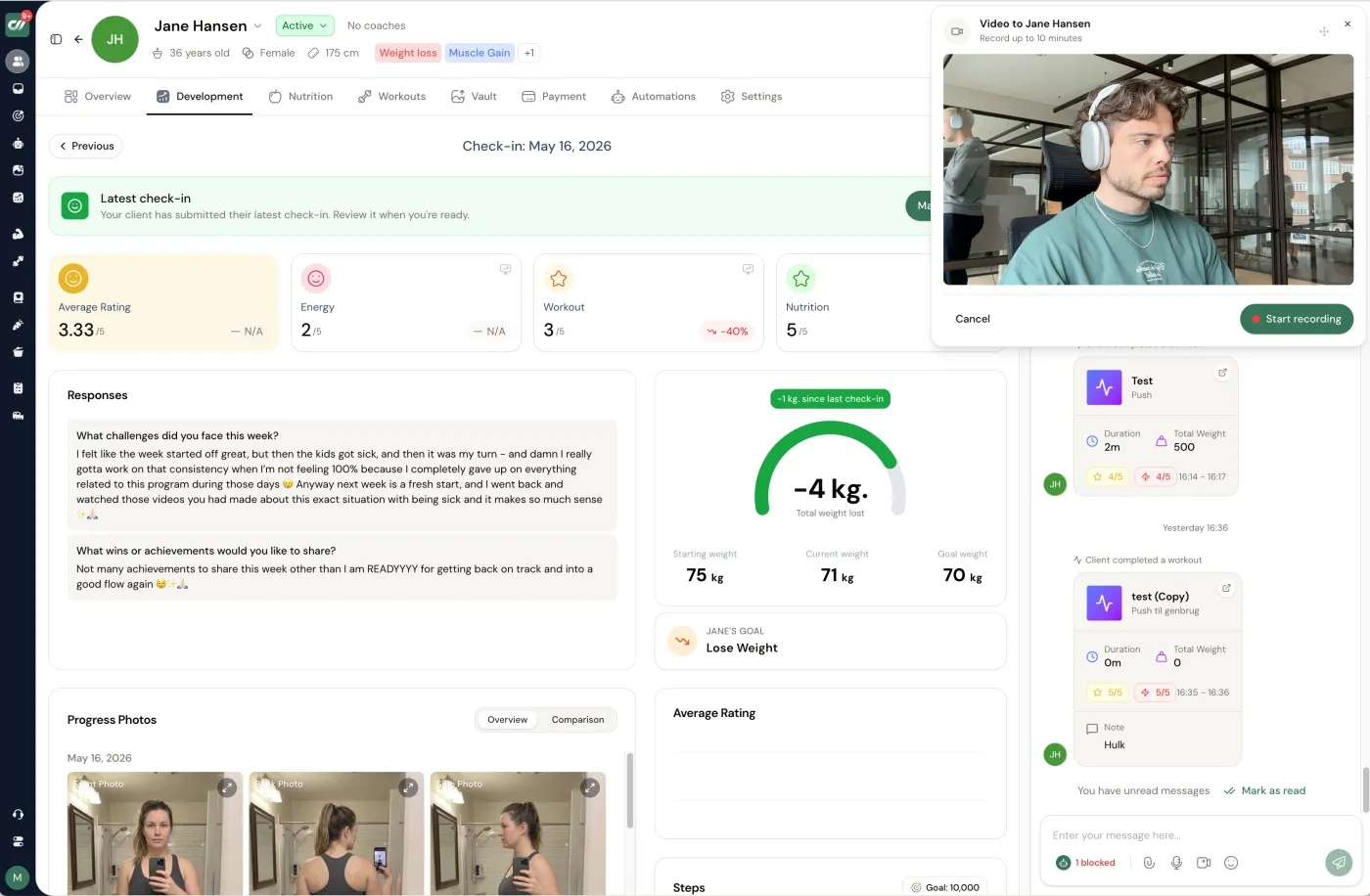
Every framework above comes down to the same operational chain: assign a behavior, make it visible, review it weekly, and respond before a slip becomes a quit. When that chain is scattered across a chat app, a spreadsheet and your memory, habits fall out of view exactly when a client needs catching. In Coachway the loop lives in one place. A drag-and-drop check-in form builder lets you turn any habit into a smiley or number rating, a photo or a custom metric, sent on the cadence you choose with automatic reminders. The check-ins tab then shows this week's answers beside the weight trend and progress photos, so a dropping adherence number is obvious at a glance. Private per-client tasks handle the follow-ups between check-ins, and automations can nudge a client whose habit is slipping without you doing it by hand. It is built on knowledge from working with 150 online coaches over 6+ years, and it costs EUR 69 a month including your first 5 clients, EUR 9 per additional client after that. The 14-day free trial starts with a card and cancels under Billing before it renews, or you can book a demo and see the check-in loop first.
Set the expectation: habits take longer than 21 days.
The most persistent myth in behavior change is that a habit forms in 21 days. In the most cited study on the question, participants took a median of 66 days to reach automaticity, and individual times ran anywhere from 18 to 254 days depending on the person and the difficulty of the behavior. For a habit coach the exact number matters less than what it does to your coaching: you set the client's expectation to two to three months of deliberate repetition, not three weeks, and you make it explicit that the timeline is personal and that a single missed day does not reset the clock. That last point is the one that saves clients, because they quit over one missed day far more often than over the difficulty of the habit itself. Name the coming dip in motivation during onboarding so it lands as expected terrain rather than proof of failure, and the client stays in the game long enough for the behavior to actually become automatic. Habit coaching is a patience game the coach has to hold on the client's behalf, and it is the same patience that protects your retention rate over a full year.
Frequently asked questions about habit coaching.
What is a habit coach?
A habit coach is a coach who works on the behaviors that produce a result rather than only on the result itself. Instead of handing a client a plan and hoping they follow it, a habit coach designs the small, repeatable actions that make the plan happen - a protein target attached to breakfast, a ten-minute walk after the school run, a Sunday check-in that takes two minutes - and then holds the client accountable to those actions week by week. In practice most good online fitness and health coaches are already doing habit coaching whether they call it that or not, because adherence, not information, is what decides whether a client gets a result. The label just makes the method explicit: the job is to install behaviors that survive a busy week, and to notice and fix them early when they slip.
What habit coaching frameworks actually work?
Five reliable ones, and they overlap more than they compete. The habit loop (cue, routine, reward) explains why a behavior repeats and where to intervene. Habit stacking anchors a new action to an existing one so an established routine becomes the trigger. Tiny habits, from BJ Fogg's behavior model, shrinks the behavior until it is too small to fail and lets the client build up from there. Minimum viable behaviors define the smallest version of a habit that still counts on a bad day, so a busy week produces a reduced action instead of a missed one. Implementation intentions, or if-then plans, pre-decide the exact time, place and response so the client is not relying on willpower in the moment. You do not pick one. You use the loop to diagnose, then apply whichever of the other four removes the specific point of friction that particular client keeps hitting.
How long does it take a client to build a habit?
Longer than most clients expect and with a wide range between people. In the most cited study on this, participants took a median of 66 days for a new behavior to reach automaticity, with individual times ranging from 18 to 254 days depending on the person and how hard the habit was. The practical takeaway for a habit coach is not the exact number but the shape of it: a habit is not built in the 21 days of internet folklore, the timeline is personal, and missing a single day does not reset the clock. That last point matters most, because clients quit over one missed day far more often than over the difficulty of the habit itself. Coach the client to expect two to three months of deliberate repetition, and to treat a missed day as noise rather than failure.
How many habits should a client change at once?
One at a time, or at most two if they are small and non-competing. The instinct at the start of a coaching relationship, when motivation is highest, is to overhaul everything at once - training, nutrition, sleep, steps, hydration - and it is almost always a mistake. Attention and self-regulation are limited resources; spreading them across five new behaviors means none of them get enough to reach automaticity, and the client burns out around week three when the initial motivation fades. The higher-adherence path is to install one keystone habit, let it become genuinely automatic over a few weeks, and only then stack the next one onto it. It feels slow to the client and to the coach. It is faster over a year, because habits that stick compound and habits that collapse have to be rebuilt from zero.
How do you keep a client's habit going after motivation fades?
You plan for the dip before it arrives and you lower the bar instead of raising the pressure. Motivation is not a reliable input - it rises and falls with sleep, stress and life - so a durable habit is engineered to run on low-motivation days, which is what minimum viable behaviors are for: the client agrees in advance on the smallest version that still counts, and does that version on the hard days rather than skipping. The coach's job is to name the coming dip during onboarding so it reads as expected terrain rather than proof of failure, to keep the check-in cadence steady precisely when a client goes quiet, and to reach out with a task or a short message when a habit starts slipping instead of waiting for the client to confess it at the next check-in. Consistency of contact from the coach is often what carries the client across the stretch where their own motivation cannot.
Habit coaching lives or dies at the check-in. The frameworks are the plan; the weekly loop is where they stick - so pair this with running client check-ins, a reusable check-in template, and the work of keeping clients accountable between them.
Keep reading
all guidesVO2 Max by Age: Chart and Norms for Men and Women
VO2 max norms by age and sex in two clear charts, plus what counts as a good VO2 max for your bracket, how to measure your own number with a wearable or a field test, and how zone 2 plus intervals move it.
Read the guideOnline fitness coaching statistics 2026: first-party benchmarks and market data
First-party benchmarks from 201 Nordic online fitness coaches on the Coachway platform (median 5 active clients, EUR 181 per client per month, 4.3-month average client tenure, 45% retention at month 12) plus sourced market-size, growth and earnings figures, each with its sample size and source.
Read the guideWhat Is Online Fitness Coaching? How It Works in 2026
Online fitness coaching is ongoing, personalised training and nutrition guidance delivered remotely through an app: programs, check-ins, messaging and adjustments. What it includes, what it costs, and how it differs from a workout app or in-person PT.
Read the guideFree tools for this: One-Rep-Max Calculator · Macro Calculator · VO2 Max Calculator
See what Coachway can do for your coaching business
Coachway was built on knowledge from working with 150 online coaches over 6+ years, who all hit the same wall - slow platforms, clunky workflows, wasted hours. Start your 14-day free trial and see what we fixed - the whole platform, no charge today, cancel anytime under Billing.


