How to raise personal training prices - without losing the clients you already have.
Deciding a bigger number is the easy part. The reason most coaches stay stuck at a rate they set years ago is the fear of what happens next: the awkward message, the client who leaves, the average that never moves. This is the raise-existing-rates playbook the pricing guides skip - the signals that say you are ready, how much to raise by, how to grandfather the clients who trust you, and how to migrate everyone to the new number without a walkout.
By Markus Evers · Updated September 2026
the short version
To raise personal training prices without losing clients, split the change in two: apply the new price to new clients immediately, and move existing clients slowly or grandfather them for a set window. Size it to how overdue you are: 5 to 10 percent for an annual keep-up, 15 to 25 percent for a long-frozen rate. Give 30 days notice.
When should I raise my personal training prices?
Raise when the demand signals are loud and the number has been still for too long. The single clearest sign is the discovery call where almost everyone says yes instantly. A price that never makes anyone pause is not a perfect price - it is a price sitting below what the market will happily pay. Add a waitlist you cannot clear, testimonials and results that have visibly improved since you last set the rate, and a full book that still does not cover the income you actually need, and every arrow points the same way. The other trigger is plain time: if you have not touched your rate in a year, your skill has compounded and your number has not, and a keep-up increase is overdue on that basis alone.
There is also a wrong time, and it is worth naming. Do not raise a client's price in a month you have under-delivered, missed check-ins, or let the relationship go quiet - the increase will read as a bill for worse service. Do not raise it mid-package or mid-cycle, when someone has already committed to a number for a defined stretch. And do not raise it out of resentment, in a rush, the week you realise you are underpaid. Pricing decisions made from panic tend to swing too far and get communicated badly. The goal is a calm, planned move you have decided is fair before you tell a soul, not a reaction. If you are unsure the number is defensible yet, benchmark it first with the benchmark ranges for what to charge and run your own figures through the coaching rate calculator.
How much should I raise my prices by?
The right size depends entirely on how overdue you are. A rate that is roughly right needs a small yearly nudge; a rate frozen for years needs a real correction; a genuine reposition needs a bigger jump against a rebuilt offer. Let the math set the floor - what a full book has to pay you - and let the market signals set the ceiling. These are sensible starting points, not laws:
| Your situation | A sensible step | How to apply it |
|---|---|---|
| Annual keep-up on a rate that is roughly right | 5 to 10 percent | Applied to everyone at their next renewal, once a year, as a normal cost-of-doing-business step |
| A rate frozen for two years or more | 15 to 25 percent | New clients immediately; existing clients only at their next natural renewal, with notice |
| Deliberately repositioning up-market | 25 percent or more | New sign-ups only, against a visibly rebuilt offer that earns the number |
Notice the pattern in the right-hand column: the bigger the increase, the more it lands on new clients first. That is not caution for its own sake - it is the mechanism that makes a large correction survivable. A 25 percent jump straight onto everyone at once is how you trigger a churn spike; the same 25 percent on new sign-ups, with existing clients protected, is how you climb your average rate without a walkout. If you would rather move in smaller, more frequent steps than one big correction, that is almost always the calmer choice, and it keeps your price permanently within sight of your value instead of falling years behind it again.
How much should I raise my prices after several years?
To the rate you would charge a new client today, in one step. A rate held for six years has lost roughly a fifth to a quarter of its value to inflation, so a EUR 5 nudge only reduces the loss; it does not raise the price. A coach who asked r/personaltraining whether a USD 5 increase after six years was reasonable got the arithmetic back: "$50 six years ago would be $63 today after inflation. If you don't increase to more than $63 now, you're not increasing rates you're just reducing your loss." The other advice in the thread: make the jump large enough that you do not need another one for the foreseeable future, and raise existing clients one step behind new ones. The table assumes a EUR 50 session or EUR 50 unit of price and average inflation of about 4 percent a year across the period, an approximation for September 2026; run your own numbers in the price increase calculator.
| Rate held for | What EUR 50 is worth now | New rate for existing clients | New rate for new clients |
|---|---|---|---|
| 2 years | about 8 percent less | EUR 54 | EUR 58 |
| 4 years | about 15 percent less | EUR 59 | EUR 63 |
| 6 years | about 22 percent less | EUR 64 | EUR 70 |
| 8 years | about 28 percent less | EUR 69 | EUR 75 |
How do I tell clients about a price increase?
In writing, 30 days ahead, with the date and the new number in the first line, one sentence of thanks, and no apology. Two versions:
Existing clients
Hi [NAME], from [DATE] my coaching rate moves from EUR [OLD] to EUR [NEW] per month. Your plan, your check-in day and everything else stay exactly as they are. Thank you for training with me this long; it is the reason the work keeps getting better. If you want to talk it through, reply here and we will find ten minutes.
[YOUR NAME]
New clients
From [DATE], coaching is EUR [NEW] per month. It includes [WHAT A NORMAL WEEK INCLUDES]. The next start date is [DATE].
How do I raise prices without losing clients?
This is the part the generic pricing advice skips. Deciding a number is a spreadsheet exercise; migrating a living book of clients onto it is a relationship exercise. Four moves, in order, carry almost all of the outcome.
1. Raise new-client prices first, today.
Change the number for new enquiries before you touch a single existing client. New buyers have no anchor to your old rate - they simply meet the new one and decide, and their yes is the fastest proof the number holds. This also means the increase starts moving your average revenue per client immediately, through the natural turnover of your book, even before you have any conversation with the people you already coach. Do this quietly: update your discovery-call number and your package pricing, and let the next ten calls tell you whether it lands.
2. Grandfather your existing clients for a defined window.
The clients who signed up at your old rate signed up on a promise. Honouring that price for a set period - the rest of their package, the next six months, until an annual review - is the single most powerful goodwill move you have, and it is what turns a price rise into a loyalty reward. Grandfathering is not indecision; it is a deliberate boundary, and it works best when the package already has edges, which is what the 3, 6 and 12-month package ladder gives you. Decide the window and the eventual number up front, tell clients they are protected for now, and let the maths take care of the rest: as grandfathered clients naturally cycle out and new ones come in at full price, your blended rate climbs without a single confrontation.
3. Migrate long-standing clients at a natural boundary.
When you do bring loyal clients up to the new price, do it at an edge, never mid-cycle. The end of a package, a plan renewal, the start of a new block, an annual review - these are moments a client already expects a decision, so a price change feels like part of the rhythm rather than an ambush. Give at least 30 days notice before it takes effect, frame it against what has visibly improved since they joined, and offer a genuine choice - renew at the new rate, or finish their current commitment gracefully. Clients who are getting real results and feel respected in the timing overwhelmingly stay. The ones who leave over a fair, well-timed increase are usually the price-shoppers who were always going to churn.
4. Say it plainly, and without apology.
The tone of the message decides more than the number in it. Send it as a direct, personal note wherever you can, not a mass email. State the new price, the date it applies, and one honest line about why the work is worth it - then stop. A nervous essay of justification signals that you do not believe the number yourself, and that is the exact energy that invites pushback. You do not owe anyone a defence of your own pricing. If a client does want to talk it through, that is a value conversation, not a discount negotiation, and the price-objection scripts handle it without caving. Protect the relationship above all - a client migrated well is worth more over time, and holding onto them is where retention quietly pays for the whole increase.
Grandfathering is only clean if your billing can hold two prices at once.
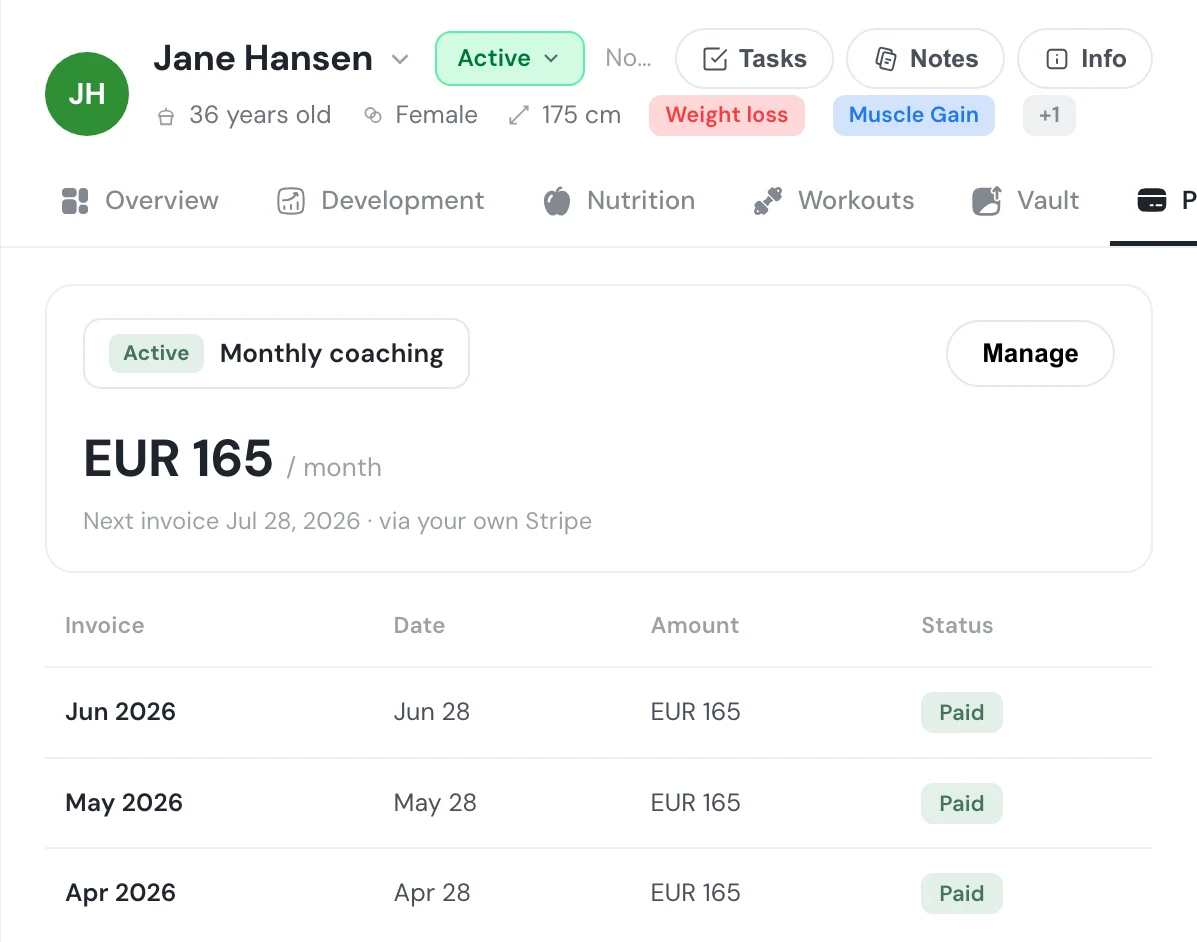
The whole playbook depends on one boring capability: being able to charge different clients different amounts, on their own schedules, without it turning into a spreadsheet nightmare. Grandfather one cohort at their old rate, bill new sign-ups at the new one, and move individuals up at each renewal - that is three price points running side by side. In Coachway, payments are per client: you set the amount, currency and billing interval for each person, run subscriptions and payment plans, pause and refund, and migrate an individual to a new rate at their renewal without disturbing anyone else. Because it settles into your own Stripe account, Coachway never holds your money, and the extra revenue from every increase lands with you - optional built-in payments carry a 2.4 percent per-transaction fee, and you can also run your own Stripe checkout instead. It is built on knowledge from working with 150 online coaches over 6+ years, and it costs EUR 69 a month including your first 5 clients, then EUR 9 per additional client, with every feature included. The 14-day free trial starts with a card held securely by Stripe and cancels under Billing before it renews - or book a demo and see the billing screen first.
Frequently asked questions about raising personal training prices.
When should I raise my personal training prices?
Raise your prices when the demand signals are loud and the number has been still for too long. The clearest signal is that almost everyone says yes instantly on a discovery call - if nobody ever flinches at your price, you are priced under the market, not perfectly. Add a waitlist you cannot clear, results and testimonials that have visibly improved since you last set the rate, and a book that is full while the income still does not cover what you need, and you have every reason to move. The other trigger is simple time: if you have not touched your rate in a year or more, an annual keep-up increase of 5 to 10 percent is normal and healthy, because your skill compounds and your price should track it. Most coaches wait far too long, then jump the number in one frightening leap. A steady schedule of smaller increases is calmer for you and gentler on your clients.
How much should I raise my personal training prices by?
It depends on how overdue you are. For an annual keep-up on a rate that is roughly right, 5 to 10 percent applied at renewal is enough to track your growing skill without anyone feeling shocked. For a rate that has been frozen for two years or more, a 15 to 25 percent step brings you back toward market value, but apply it to new clients immediately and to existing clients only at their next natural renewal. If you are deliberately repositioning up-market - a sharper niche, a heavier offer, a genuinely different level of service - a jump of 25 percent or more can be right, but only against a rebuilt offer that visibly earns it, and only on new sign-ups first. The mistake is choosing the number in a vacuum. Run your own figures through a rate calculator, check what a full book actually pays you, and let the math set the floor while the market signals set the ceiling.
Should I raise prices on existing clients or only new ones?
Raise new-client prices immediately and move existing clients more slowly, or not at all for a defined window. This is grandfathering, and it is the single move that lets you raise personal training prices without a wave of cancellations. New enquiries have no anchor to your old number, so they simply meet the new one. Existing clients signed up at a price and a promise, and honouring that for a period rewards loyalty and buys goodwill while your average rate climbs on its own as the book turns over. When you do bring long-standing clients up, do it at a natural boundary - the end of a package, a plan renewal, an annual review - with clear notice rather than a mid-cycle surprise, and never raise a client's price in the same month you have under-delivered.
How do I tell clients about a price increase?
Tell them early, briefly, and without apology. Give at least 30 days notice before the new rate applies to anyone, send it as a direct personal message rather than a mass email where possible, and state the new number plainly instead of burying it in paragraphs of justification. You do not owe a defence of your own pricing; a short, warm, confident note lands far better than a nervous essay. Say what is changing, when it takes effect, and that their results and your commitment to them are exactly why the work is worth it. If you are grandfathering, say so - being told you are being protected from the increase for now turns a price rise into a gesture of loyalty. The tone that leaks nervousness is the tone that invites pushback, so decide the number is fair before you send a word about it.
Will I lose clients if I raise my prices?
You may lose a few, and that is usually the point rather than the risk. When you raise new-client prices and grandfather existing ones, the people most likely to leave are the price-sensitive clients who already self-selected in at your lowest number - and freeing that capacity is often what lets you serve the rest properly and take on better-fit clients at the new rate. A reasonable, well-communicated increase to clients who are getting real results rarely triggers a walkout, because they are buying the outcome and the relationship, not hunting for the cheapest per-month. The genuine risk is not the increase; it is a badly handled one - a mid-cycle surprise, an apologetic tone, or a rise on the back of poor delivery. Protect the relationship, protect the timing, and the churn stays small while your revenue per client climbs.
How much should I raise my prices after not changing them for years?
To the rate a new client would pay today, in one step, rather than a small nudge. A rate held for six years has lost roughly a fifth to a quarter of its value to inflation, so a EUR 5 increase only reduces the loss. Raise new clients first and existing clients one step behind, give 30 days notice in writing, and do not plan to repeat it for a year or more.
Before you set the new number, benchmark it against what to charge for personal training and pressure-test your own figures in the coaching rate calculator. Then guard the increase you just won with strong retention - a client kept is what makes a higher price actually pay.
Keep reading
all guidesPersonal Training Upsells: What to Offer and Charge in 2026
The best upsells are a second offer to a client you already have. Six add-ons - nutrition, form checks, a group tier, paid challenges, priority access and digital products - with real price bands, which to run first, and how to introduce them without a pushy pitch.
Read the guideWhat is customer acquisition cost for coaches?
Customer acquisition cost (CAC) is what a coach spends, on average, to land one new paying client: total acquisition spend divided by the new paying clients it produced. The plain definition, the formula with a worked example, and why CAC only makes sense next to lifetime value and the 3:1 ratio.
Read the guideOnline Coaching Business Costs: The True 2026 Breakdown
A line-by-line breakdown of what it costs to run an online coaching business in 2026: coaching software (commonly EUR 50 to 300 a month), card-processing fees, insurance, accounting and tax on the cash side, plus the unpaid delivery hours that never hit an invoice. How to read it per client, where a stack of half-used tools quietly leaks money, and what is left as profit once everything is netted out.
Read the guideFree tools for this: Coaching Business Health Check · Client Capacity Calculator · Assistant Coach ROI Calculator
See what Coachway can do for your coaching business
Coachway was built on knowledge from working with 150 online coaches over 6+ years, who all hit the same wall - slow platforms, clunky workflows, wasted hours. Start your 14-day free trial and see what we fixed - the whole platform, no charge today, cancel anytime under Billing.