


ChatGPT prompts for personal trainers - 30 copy-paste prompts you can use today.
The best ChatGPT prompts for personal trainers do the writing you repeat every week - the welcome email, the check-in reply, the content hook, the sales-page draft - and hand it back as a first draft you make yours. Below are 30, grouped by job, each written to be pasted straight in. There is one rule that runs through all of them: describe the situation in your own words and never paste a client's health data into any AI tool.
By Markus Evers · Updated October 2026
the short version
ChatGPT prompts for personal trainers are reusable instructions that turn a blank page into a first draft for client emails, check-in replies, social hooks and sales copy: the admin around the coaching, never programming or nutrition decisions. Copy any of the 30 below and edit until it sounds like you. Never paste a client's name or health data.
read this before you paste anything
The one rule: never paste client health data into ChatGPT.
Health data is treated as a special category under GDPR, which means it needs far more care than an ordinary name and email. When you use any prompt on this page, describe the coaching situation in neutral, non-identifying words and strip out names, conditions, medication, injuries and anything that could point back to a real person. The model only ever needs the shape of the problem - not the person. Keep the sensitive picture inside your own coaching system and hand the AI a sketch. The reason, the exceptions and the anonymisation template are in the client data and ChatGPT guide. Every prompt below is written with generic placeholders on purpose so this stays easy to do.
How do you write a ChatGPT prompt that actually helps a coach?
A prompt is not a magic word, it is a brief. The prompts below already carry the structure that makes AI output useful instead of generic, and it comes down to four moves you can reuse on anything. Give it a role, so it writes as a coach and not as a chatbot (half of every good prompt is context you retype each time; put it in custom instructions once and every prompt on this page gets shorter and better). Give it the real situation in your own plain words, so the draft is grounded. Ask for a first draft rather than a finished piece, so you stay the editor; every prompt here drafts and none of them should be posted as written, so run the output through the rewrite checklist in how to make ChatGPT not sound like AI before a client or a follower reads it. And feed it a sample of how you actually write, so the voice is yours; every prompt from the newer AI guides (captions, check-in replies, onboarding emails, meal planning, the content calendar, price objections) is in one free download, the AI prompt pack for online coaches, and the once-only version of that, ten samples turned into a style card you paste into every prompt, is in how to train ChatGPT on your coaching voice. Do those four things and the same model that produces bland captions for everyone else starts producing drafts that sound like you had a fast, tireless assistant. The full six-part method, with three bad-versus-good pairs, is in prompt engineering for fitness coaches, and its seven prompt examples show the one-line version next to the six-part one. Check the draft before you post: the AI writing checker scores it on the fifteen tells and highlights each one.
One honest caveat before the list. AI is genuinely brilliant at the writing around your coaching and genuinely dangerous the moment it touches the relationship your clients pay for. The map of exactly where that line sits is worth ten minutes: read how to use AI as an online fitness coach for where it helps and where it quietly costs you retention, and the honest rundown of AI tools for coaches for the small kit actually worth your time.
30 ChatGPT prompts for personal trainers, grouped by job.
Copy the prompt, swap anything in [square brackets] for your own neutral words, and treat the answer as a draft to edit - not a message to send blind. For programming, the prompts are reviewer prompts by design; see the program design guide for why. Prefer to build a prompt around your own task instead of editing brackets? The coaching prompt generator assembles one from a few fields.
Client emails and onboarding
The messages that set the tone before coaching even starts. Give ChatGPT the situation in your own words and let it hand you a first draft you then make yours.
The welcome email a new client actually reads
You are helping me, an online fitness coach, write a warm welcome email to a new coaching client. Their first name is [first name] and their main goal, in my own words, is [goal in plain words]. Keep it under 180 words, sound like a real person and not a brochure, set out the three things that happen in their first week, and end with one small action they can take today. Do not promise a specific result or timeline.
A first-two-weeks expectations note
Write a short onboarding message that tells a new client, in plain and calm language, what the first two weeks of coaching with me will feel like: setup, the first program landing, the first check-in, and the fact that early motivation always dips and the plan is built for that. Friendly, reassuring, no hype, about 150 words.
Re-open a discovery call that went quiet
A prospect had a good discovery call with me and then went quiet for a week. Draft a single, low-pressure follow-up message that references we spoke, restates the one problem they said they wanted solved, gives them an easy yes or no, and does not sound needy or salesy. Under 90 words. Give me two versions with a different tone.
The price-increase notice that keeps clients
Help me write an email telling existing clients that my rate is going up for new clients, but I am honouring their current price for [time period]. Grateful, confident, no apology, no over-explaining. Make the loyalty point the hero. Around 130 words.
Win back a lapsed client
Write a warm re-engagement email to a former coaching client who stopped a few months ago. No guilt, no discount up front. Open by genuinely checking in on them as a person, then leave a clear door open to come back. Give me one version that assumes life got busy and one that assumes they lost momentum. Under 120 words each.
Ask a happy client for a referral
Draft a natural referral ask I can send to a client who is getting good results. Make it specific, not generic, so it is easy for them to think of one person. Explain in one line who my coaching is a great fit for. Keep it short and un-awkward, under 100 words.
Check-in replies and retention
The weekly writing that eats your week. Draft from your rough notes, then edit in the specifics only you know - this is where the human part has to stay human.
Turn rough notes into a warm check-in reply
I coach online and reply to weekly check-ins. Here are my rough bullet notes on this client this week: [paste your own neutral notes, no medical detail]. Turn them into a warm, specific check-in reply in my voice: acknowledge what went well, address the one thing to adjust, and give a single clear focus for next week. About 140 words, encouraging but honest.
Reply to a client who had a rough week
A client reported a low, off-track week and sounds discouraged, in general terms. Help me write a reply that is genuinely supportive but still holds the standard: normalise the dip, remove the shame, and give one tiny next step to rebuild momentum. Do not lecture. Around 120 words.
Reframe a plateau
Write a short coaching message that helps a client understand a plateau without panic: what a stall often means in plain terms, why patience beats a drastic change here, and the one variable we will watch for two weeks. Calm, expert, reassuring. Under 130 words.
Open the conversation when a client wants to quit
A client has hinted they might stop coaching. Draft an opening message that invites an honest conversation rather than a hard sell: thank them for being straight, ask one open question about what changed, and make it safe to tell me the real reason. No pressure, no defensiveness. Around 90 words.
Celebrate a milestone without the cheese
Help me congratulate a client on hitting a meaningful milestone in a way that feels real, not like a greetings card. Tie it back to the specific work they put in, name the habit that got them there, and point at the next chapter. Warm, grounded, under 90 words.
Compress a long check-in into three priorities
Below is a long client check-in written in general, non-medical terms: [paste]. Summarise it into the three coaching priorities for the coming week, in order of importance, each with a one-line reason. Give me the summary only, so I can review it before I reply in my own words.
Write the notes from the whole check-in, then send the reply where the client already talks to you.
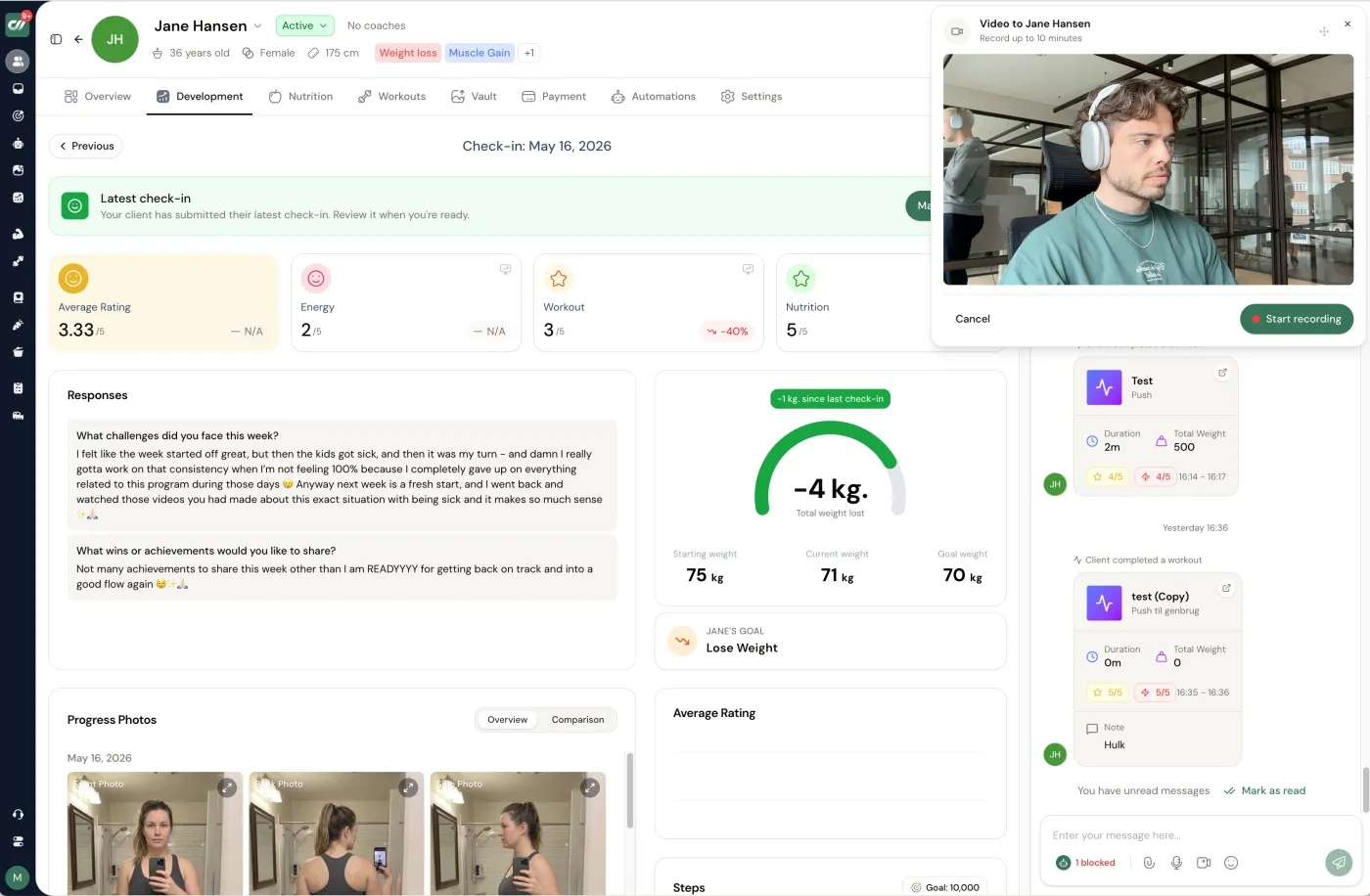
Prompt 7 is only as good as the rough notes you feed it, and the best notes come from reading the whole check-in at once: the client's answers, the weight trend and the progress photos side by side. Write three neutral bullets from that, let ChatGPT shape them, then edit the draft and send it in the same place the client checks in, not in a separate email thread they have to dig for. In Coachway the check-in tab keeps that picture on one screen and the reply goes back through the in-app chat as text, a voice note or a short video, so the client's details never have to leave your coaching system.
Content and social hooks
One idea into a week of posts. Feed it your real voice samples so the output sounds like you and not like every other AI caption.
Ten hooks from one idea
I am an online fitness coach. Give me ten scroll-stopping hooks (first lines only) for a post about [topic], aimed at [who my clients are]. Mix curiosity, contrarian, and problem-first angles. No clickbait I could not back up, no fake statistics.
Turn a client win into a story post
Turn this client result, which I have permission to share and have anonymised, into a short story-style social post: [describe the journey in your own words, no identifying or medical detail]. Structure it as struggle, turning point, result, lesson. Make the lesson useful to a stranger. Around 150 words, my voice.
A week of content from one pillar
Take this one core idea I teach: [your idea]. Break it into a week of content: one long post, three short posts, and two story or reel prompts. Each should stand alone and hit a different angle of the same idea so I am not repeating myself.
Rewrite a caption in my voice
Here is how I actually write: [paste two or three of your own real captions]. Now rewrite this draft caption to match that voice, keeping my rhythm and my kind of words: [draft]. Do not make it more corporate or more hyped than my samples.
A thirty-second talking-head script
Write a 30-second reel script for me to say to camera about [topic]. First line is a hook, then one clear point, then one practical takeaway, then a soft call to follow for more. Conversational, the way a coach talks, not a presenter. Mark roughly where the on-screen text should change.
A myth-buster that is not smug
Draft a post that corrects a common fitness myth: [myth]. Explain why people believe it, what is actually true in plain language, and what to do instead. Confident but kind, never mocking the reader. No invented studies or numbers.
Repurpose one post into three formats
Take this long post I already wrote: [paste]. Turn it into (a) a short email to my list, (b) a five-slide carousel outline, and (c) three standalone one-line posts. Keep the core message intact and do not add claims that were not in the original.
Sales, offers and landing copy
Outlines and rewrites, not finished pages. Use these to break a blank page, then write the promises yourself so every claim is one you can keep.
A sales-page outline for my offer
I sell an online coaching offer called [name] for [who it is for]. Give me a full sales-page outline: headline options, the problem, the promise, what is included, how it works, who it is not for, objections, and the call to action. Outline and section notes only, so I can write the real copy myself. Do not fabricate testimonials.
Rewrite features as benefits
Here is what my coaching includes, described as features: [list]. Rewrite each one as the benefit the client actually feels, in plain human language, without hype words like game-changer or transform. Keep it honest and specific.
An objection-handling FAQ
Write six FAQ questions and answers for my coaching offer that calmly handle the real objections: price, time, whether it works for beginners, what happens if they fall behind, how it is different from a free app, and cancellation. Honest and reassuring, no pressure tactics.
A DM opener that is not spam
Someone new followed me and engaged with a post about [topic]. Draft a genuine opening message that starts a conversation, not a pitch: reference what they engaged with, ask one real question, and leave space for them to reply. Under 40 words. Nothing that reads like a copy-paste template.
A testimonial request that gets specifics
Write a short message asking a happy client for a testimonial, with three simple guiding questions that pull out specifics (where they started, what changed, how they feel now) instead of a vague nice review. Make it a two-minute job for them.
A discovery-call question framework
Give me a discovery-call structure for online coaching: an opener that builds rapport, the questions that uncover the real goal and the real obstacle, a natural point to explain how I work, and a clean way to talk about price and next steps without being pushy. Bullet framework, not a script to read robotically.
Admin, systems and your thinking
The boring, high-leverage work: policies, checklists, planning, and using the model as a sparring partner for your own decisions.
Turn a policy into plain client wording
Rewrite my cancellation and refund policy in plain, friendly, client-facing English that is still clear and firm: [paste your policy in your own words]. Keep every actual term intact, just make it readable and non-scary. Flag anything that sounds ambiguous.
A repeatable onboarding checklist
Help me build a step-by-step onboarding checklist for a new online coaching client, from the moment they pay to their first check-in, so nothing gets missed and it feels the same for everyone. Group it into day one, week one, and end of week two.
Batch and plan my content week
I have limited time. Help me plan a realistic content week as a solo online coach: which posts to batch, what to record in one sitting, and how to space it out so I stay visible without burning out. Assume I can film for one hour and write for one hour per week.
Argue against my own offer
Act as a sharp but fair critic. Here is my coaching offer: [describe it]. Poke holes in it the way a sceptical prospect would: where is it vague, where is the value unclear, what would make me hesitate to buy. Then suggest the smallest changes that would fix each one.
Distil an article into coach-usable notes
Summarise this article or study into practical takeaways I can actually use with clients: [paste the text or a neutral summary]. Give me the three main points, what they mean for everyday coaching, and one thing to be cautious about. Flag anything that sounds like a claim I should verify before I repeat it.
ChatGPT writes the draft - your platform sends the right version.
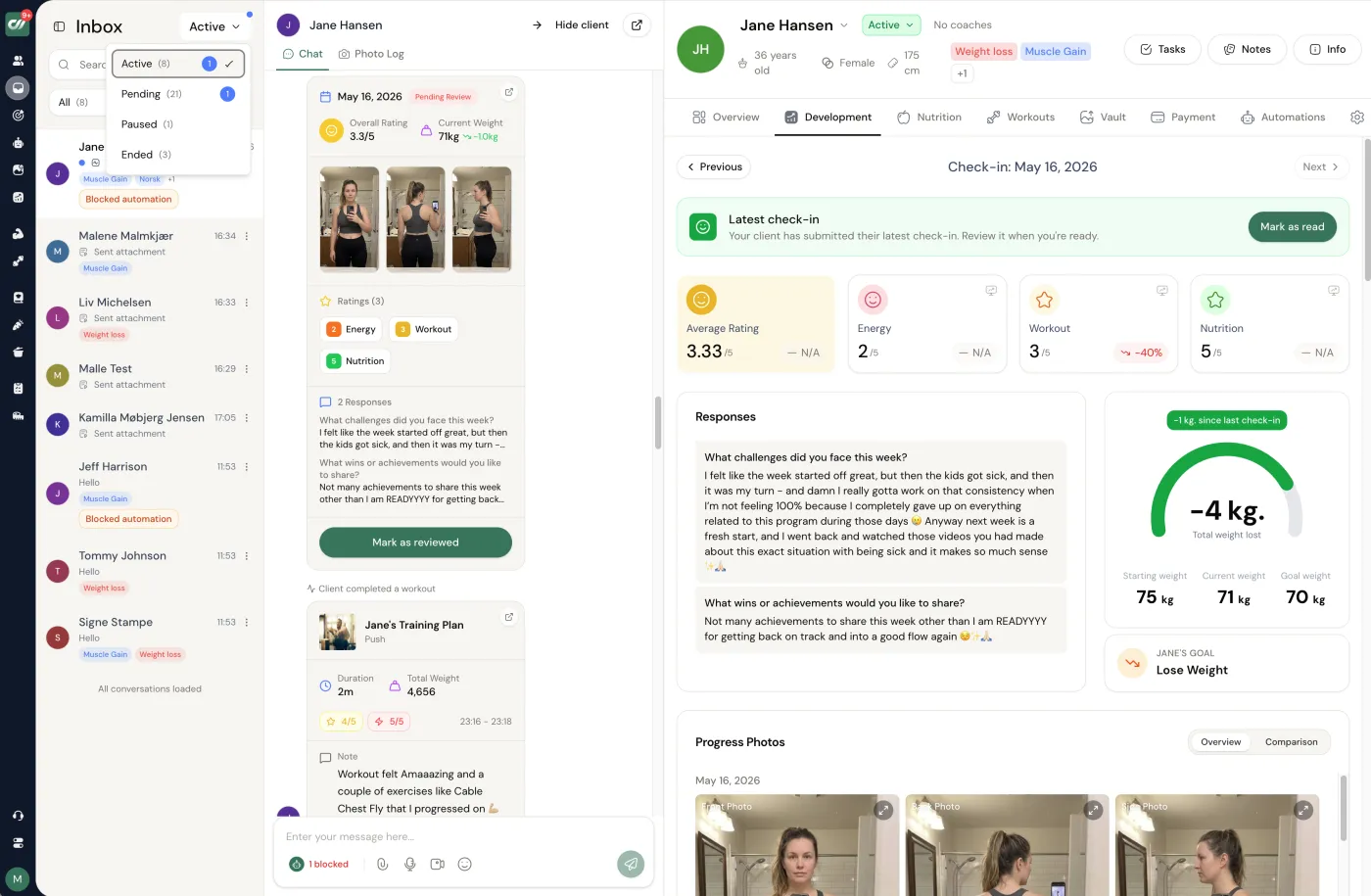
A prompt gives you words. It does not know which client this is, remember last week, or keep the context that turns a generic reply into one only you could have written - and that missing context is precisely why you never hand it the sensitive detail. That part lives in your coaching platform. We build Coachway for exactly this handover: the check-in reply you drafted lands in the Power Panel, where the conversation sits next to the client's full profile, progress and history, so you can make a generic draft specific in seconds. Reusable emails and onboarding messages go into automations once and then send themselves, so the welcome note you wrote with prompt one is not something you retype for every new client. The coach dashboard is in English, and the client app is available in English, Danish, Norwegian, Swedish, Finnish and German.
It is built on more than six years of working with online coaches, and it costs EUR 69 a month with your first 5 clients included, then EUR 9 per additional client, every feature in. The 14-day free trial starts with a card held securely by Stripe and you can cancel under Billing before it renews, or book a demo and see the Power Panel first. AI can speed up the drafting; keeping the personal, human version reaching the right client is what holds retention together.
The message you write once, Coachway sends without a prompt.
Some of the prompts above are for the writing you only really do once - the welcome email, the first-two-weeks note, the price-increase notice. Draft one of those well and there is no reason to re-prompt for it every time a client joins. In Coachway that draft becomes an automation: you write it once and it fires on its own when a client signs up or hits a milestone, so the welcome note from prompt 1 reaches every new client without you opening ChatGPT again. The prompt breaks the blank page; the automation stops you retyping.
Two smaller AI jobs are worth setting up next: a light AI content calendar so the hooks you draft land on a plannable month instead of a Sunday scramble, and voice-note check-ins with AI transcription so a client's spoken update turns into the reply draft you edit - both without pasting anything sensitive into a chatbot.
Frequently asked questions about ChatGPT prompts for personal trainers.
What are the best ChatGPT prompts for personal trainers?
The prompts that save a coach the most time are the ones that draft the writing you repeat every week: welcome and onboarding emails, check-in replies built from your rough notes, social hooks and captions in your own voice, and sales-page or offer copy outlines. The 30 prompts on this page are grouped into exactly those jobs. The pattern that makes any of them work is the same: describe the real situation in your own plain words, ask for a first draft rather than a finished piece, and then edit in the specifics only you know. Treat ChatGPT as a fast intern who writes a rough version, never as the coach who signs it off.
Is it safe to paste client information into ChatGPT?
No - not identifiable client information, and never health details. Health data is treated as a special category under GDPR, which means it needs a much higher bar of care than a name and an email. The safe habit is simple: describe the coaching situation in neutral, non-identifying words, strip out names, medical conditions, medication, injuries and anything that could point back to a specific person, and let the model draft from that. You keep the real, sensitive picture in your coaching system and only ever hand ChatGPT the shape of the problem, not the person. Every prompt in this library is written so the placeholders you fill in stay generic on purpose.
Can ChatGPT write training and nutrition programs for my clients?
It can produce something that looks like a program in seconds, and that is exactly the trap. Programming and nutrition are the parts your clients are actually paying a human for - the judgement, the context, the adjustment when real life gets in the way. AI does not know their training history, their injuries, their preferences or how they responded to last block, and a confident wrong answer is worse than a slow right one. Use ChatGPT for the admin around the coaching, not the coaching itself. For the full honest map of where it helps and where it costs you, read the guide on how to use AI as an online fitness coach.
Will AI-written content hurt my search rankings or my brand?
Raw, unedited AI output will do both. Google rewards genuinely useful content and real first-hand experience, and readers can smell a generic caption from a mile off. The prompts here are built to avoid that: they ask for drafts, hooks and outlines that you then rewrite in your own voice with your own examples. Two habits keep you safe - feed the model real samples of how you write so the output sounds like you, and never publish a claim, statistic or client result you have not personally verified. The value you add on top of the draft is the whole point.
Where do the messages I draft actually get sent to clients?
ChatGPT drafts the words - it does not deliver them, remember your clients, or keep the context that makes a generic reply specific. That lives in your coaching platform. In Coachway the drafted check-in reply lands in the Power Panel, where the conversation sits beside the full client profile, progress and history, so you can turn a generic draft into a message that only you could have written. Reusable emails and onboarding sequences go into automations once, then fire on their own. The AI writes faster; the platform makes sure the right, personal version reaches the right client.
Prompt 24 above asks for a testimonial; the fuller version, five questions plus a prompt that shapes the client's answers without adding a word they did not say, is on the testimonial request message page. These prompts work in Claude and Gemini too; the comparison page shows where each one is stronger. Prompts are the fast draft. The judgement stays yours: see where AI helps and where it hurts a 1:1 coach, keep your client data private and compliant, and steal the ready-made welcome email template for the very first message a new client reads. More copy-paste banks like this one: Instagram captions for fitness coaches, DM scripts for every sales situation, and ChatGPT prompts written for nutrition coaches.
Keep reading
all guidesHow to handle late payments in online coaching
What to do when a client won't pay: prevent it with upfront subscriptions, systemize reminders, the firm-but-kind script, when to pause access, and the boundary that protects you.
Read the guideHow much do online fitness coaches make?
The honest range from beginner to established, the three levers that set your income (price x retention x client count), the per-client math, and a calculator to model your own.
Read the guideHow to handle difficult coaching clients without losing your boundaries (2026)
Every coach meets the non-compliant, over-needy, never-happy, late-paying, and ghosting client. They are predictable - and most of the damage is preventable with clear expectations set early and boundaries you actually hold. A type-by-type playbook plus when to let a client go.
Read the guideFree tools for this: Personal Trainer Income Calculator · Client Capacity Calculator · Assistant Coach ROI Calculator
Ready-made template: AI Prompt Pack for Online Coaches
See what Coachway can do for your coaching business
Coachway was built on knowledge from working with 150 online coaches over 6+ years, who all hit the same wall - slow platforms, clunky workflows, wasted hours. Start your 14-day free trial and see what we fixed - the whole platform, no charge today, cancel anytime under Billing.


