


DM scripts for fitness coaches - 24 copy-paste scripts for every situation.
Knowing you should reply in the DMs is easy. Knowing what to actually type - to a comment-keyword, to a lead who asks the price, to one who goes quiet, to a happy client you would love a referral from - is where most coaches freeze or, worse, get pushy. This is the complete library: 24 original scripts grouped by the exact situation, each with a placeholder to make it yours and a one-line reason it works. And one stance runs through all of them - permission first, never pressure.
By Markus Evers · Updated August 2026
the short version
A good DM script is not a trick to close someone, it is a well-thought-out way to be helpful faster. Deliver value before you ask for anything, ask one real question instead of running an interrogation, and answer the price question straight. When a lead goes quiet, follow up twice at most and then release them warmly - chasing harder loses the next client, not just this one. Handle every objection by accepting it rather than pushing through it, and take a no as a complete sentence. The 24 scripts below cover every situation, each with a placeholder to make it yours. Use them as starting points, never as lines to fire word for word.
read this before you send anything
The four rules that keep this from feeling sleazy.
Scripts get a bad name because of how people use them, not because they exist. The same message can be a genuine kindness or spam depending on four things. Hold these and every script below stays on the right side of the line.
1. Permission first.
Only start a conversation with someone who reached out - a comment, a story reply, an engaged follow. Cold-DMing strangers who never signalled interest is where sleaze begins.
2. Two follow-ups, then let go.
One genuine check-in, one warm release, and you stop. A third, fourth and fifth message does not read as persistence to the person on the other end - it reads as pestering.
3. Never manufacture urgency.
No fake deadlines, no spots closing tonight that never close. Real urgency is fine to state; invented urgency is a tell that you do not trust your offer to stand on its own.
4. Take no for an answer.
A no is a complete sentence and a perfectly good outcome. The goodwill you keep by hearing it gracefully is worth more than the single sale you might force by ignoring it.
Make them yours - do not paste them raw.
A script is a shape, not a line to recite. The fastest way to sound like a bot is to send one of these word for word to twenty people; the fastest way to sound like a coach is to keep the structure and rewrite it in your own voice, with the one detail only you know about that person. Fill every [placeholder] with something real, delete the beats that do not apply, and the moment a reply gets personal, put the script away and just talk. These carry you through the predictable openings so you can spend your attention on the part that actually converts: the human conversation.
Two companion pages own the machinery around this one, so nothing here repeats them. For how the comment-to-DM trigger is wired - which tool, what Instagram allows, why you never hand a tool your password - read Instagram DM automation for coaches. For the whole reel-to-comment-to-DM mechanic that fills your inbox in the first place, read the comment-to-DM reel playbook. This page is the other half of the job: the words themselves, for every situation the inbox throws at you.
24 DM scripts for fitness coaches, grouped by situation.
Copy the script, swap anything in [square brackets] for your own words, and treat it as a first draft of the message - not a line to fire blind.
Opening the conversation
The first message decides whether there is a second one. Every opener here starts a conversation instead of a pitch, and only ever with someone who reached out first.
The comment-keyword delivery
Here you go - [the guide]. Hope it is genuinely useful. Quick one while you are here: are you training right now, or getting back into it after a break?
Why it works: Honours the trade first, then opens a real conversation with one low-stakes question instead of a pitch.
A wordless story reaction
Ha, glad the [story topic] one landed. Was it the [specific point] that hit, or is that something you are dealing with yourself right now?
Why it works: A reaction is a small open door; naming what they reacted to turns an emoji into a conversation without feeling like pursuit.
A story reply with something in it
Appreciate you saying that - [reflect their words back in a few of your own]. Out of curiosity, is [topic] something you are actively working on at the moment?
Why it works: Reflecting their own words proves you actually read it, and one gentle question invites more without any pressure.
The new-follower welcome
Thanks for the follow, [name] - good to have you here, and no pitch, promise. I mostly post about [your niche]. If there is something specific you are trying to figure out, reply any time and I will point you somewhere useful.
Why it works: Naming the no-pitch upfront disarms the here-comes-the-sell reflex, and an open offer makes replying feel safe rather than owed.
The follower who went through your posts
Hey [name], I noticed you went through a few of my posts - thank you, that genuinely means a lot. Anything in particular pulling you in, or just having a browse? Both are completely fine.
Why it works: References real behaviour so it reads as noticing, not surveillance, and permits them to just be browsing so there is no pressure to perform interest.
Qualifying and the price question
Learn whether you can genuinely help before anything is sold - and answer the money question straight, because dodging it costs more trust than the number ever will.
The one question that opens everything
Before I say anything useful - where are you starting from right now, and what would make the next few months feel like a genuine win for you?
Why it works: One question surfaces both the current situation and the real goal, so you learn whether you can help before there is anything to sell.
Two quick things, then out of your way
Two quick things and then I will get out of your way: what have you already tried, and what is the part that keeps tripping you up? No wrong answers here.
Why it works: Capping it at two things keeps it light, and asking what tripped them up surfaces the real problem you would be hired to fix.
How much? (before you can quote well)
Happy to share, and it will not be a random figure - it depends a little on what you actually need. Can I ask two quick things first so I give you the right number? What is the goal, and are you after full coaching or something lighter?
Why it works: Answers the money question honestly instead of dodging, while earning the two facts that let you quote something that fits.
How much? (when you are ready to say)
It is [price] for [what is included], which covers [the two things that matter most to them]. Want me to walk through how it would actually work for your situation, or was the number the main thing you needed?
Why it works: States the price plainly with no shuffle, ties it to their own words, and lets them pick how deep to go next.
The honest invite
When it is a fit, say so and offer one clear step. When it is not, say that too. A yes only means something when a no was allowed.
The low-pressure invite
Honestly, from what you have said, I think I could help with [specific thing]. No pressure either way - if you want, the easiest next step is [a trial / a short call / this link]. And if now is not the time, that is completely fine too.
Why it works: Ties the invite to their own words, offers exactly one step, and permits a not-now, which is what makes a yes worth having.
The invite when they are ready to go
Sounds like you are ready to actually get going. Here is how it works: [one line]. If you want in, [the one step]. Any questions before you do, fire away - no rush at all.
Why it works: Matches their energy without manufacturing urgency, and inviting questions first signals confidence rather than a hard close.
The honest not-for-you
Being straight with you: what you are after sits a bit outside what I do best, and I would rather say so than take you on and half-help. What would actually suit you is [alternative]. Happy to point you the right way if it helps.
Why it works: Turning away a wrong-fit lead protects both of you and builds the kind of trust that sends referrals even from people who never bought.
Handling objections without pressure
An objection is information, not a wall to push through. Each of these accepts the concern at face value and keeps the person, even when the answer is no.
It is a bit much right now
Totally fair, and I would never want you to stretch for it. Two honest options: [a lighter starting point], or we stay in touch and the door is open when the timing is better. No hard feelings either way.
Why it works: Accepts the objection instead of pushing, offers a real smaller step if one exists, and keeps the relationship rather than burning it on a no.
I do not think I have the time
That is the thing most people worry about, and it is a fair worry. The honest version: it is [realistic commitment], built to fit around a normal week, not to add a second job. If it still does not fit right now, it might genuinely not be the moment - and that is okay.
Why it works: Validates the concern, replaces the fear with a concrete number, and refuses to pretend the timing is right when it may not be.
I need to think about it
Of course - it should be a considered yes, not an impulse. Can I ask what specifically you want to sit with? Sometimes it is a real question I can just answer now, sometimes it is a timing thing you need to feel out. No chasing from me either way.
Why it works: Respects the pause while uncovering whether it is a solvable question or a real not-yet, and promising no chasing removes the pressure that makes people vanish.
I need to talk to my partner
Makes complete sense - it is a shared decision and it should be. Anything I can give you to make that conversation easier? Happy to put the key details in one message you can just forward. No rush on it.
Why it works: Treats the partner conversation as legitimate rather than a brush-off, and arming them for it is helpful instead of pushy.
When the energy suddenly dips
No pressure at all - I noticed the energy dipped a little, and I would rather ask than assume. Is there something about it that is not quite sitting right? Straight answers are welcome, a no included.
Why it works: Names the hesitation kindly instead of steamrolling past it, and inviting a straight no often surfaces the real, answerable objection.
When a lead goes quiet
Two follow-ups, maximum, then a clean release. Chasing harder does not win this client - it just makes sure they remember you as the one who would not take a hint.
Follow-up one, a few days later
Hey [name], no agenda - just circling back on [the thing]. Life gets busy and DMs get buried, I completely understand. Still keen, or has the moment passed? Both are fine.
Why it works: One genuine check-in with a built-in exit; permitting them to say the moment passed is what stops it feeling like pestering.
Follow-up two, and the release
Last one from me, promise - I will not keep landing in your inbox. If the timing ever changes, you know where I am and the door stays open. Either way, wishing you well with [their goal], [name].
Why it works: A warm release treats silence as an answer, protects your reputation, and leaves the door genuinely open - where a surprising number of clients return from.
The re-open that gives instead of asks
Not chasing, promise - just saw this and thought of you: [a genuinely useful tip or link for their goal]. No reply needed. Hope it helps.
Why it works: A follow-up that gives rather than asks earns goodwill and often restarts the conversation on its own, with no nagging required.
Re-engaging old leads and referrals
The warmest source you have is people who already know you. Approach an old lead or a happy client as a human, never as a row in a spreadsheet.
The old lead, checked in on as a person
Hey [name], out of nowhere I know - we spoke a while back about [topic] and you crossed my mind. No pitch, genuinely just wondering how it is going with [their goal]?
Why it works: Leading with a real check-in rather than a sales reason makes an old lead feel remembered, not harvested from a spreadsheet.
The old lead, with a genuine reason
Hey [name], we talked back in [rough timeframe] and the timing was not right. A couple of things have changed on my end - [a genuinely relevant change] - and it made me think of you. Worth a quick catch-up, or still not the moment?
Why it works: A concrete, honest reason beats a generic just-checking-in, and the built-in escape hatch keeps it pressure-free.
The referral ask to a happy client
Small favour, and zero obligation: you are exactly the kind of person I love working with, and I would happily take on one or two more like you. If someone comes to mind who is [the situation your coaching suits], an introduction would mean a lot. And if not, honestly no worries.
Why it works: Describing the specific person makes it easy to think of someone, and framing it as a favour with a clear opt-out keeps it warm rather than transactional.
The referral that is copy-paste easy
If you ever mention me to someone, no pressure to, here is the easiest thing to send: [one line on who you help, plus your link]. Copy, paste, done. And thank you - a personal recommendation helps more than you would think.
Why it works: Removing the effort is what makes referrals actually happen, and a short honest thank-you acknowledges what the gesture costs them.
When to move the conversation out of the DMs.
A DM is a great place to start a relationship and a terrible place to run one. The scripts above are for the starting part; the moment a conversation turns into real business - a serious prospect, a booked call, a yes - it needs to move somewhere you can actually see it. Threads scroll away, context gets lost between forty other chats, and you cannot run onboarding, programming, check-ins or payments from an inbox.
There are two honest exits. A cooler lead who is interested but not ready goes to a short lead form, so they drop into a pipeline you can work even if the thread goes quiet - a submitted form does not disappear the way a DM does, which is the whole point of proper lead generation. A warm, ready lead goes into your coaching platform, where the yes becomes an actual client. Keep the human conversation in the DMs; move the business it creates somewhere it can be seen. The craft of the conversation itself, once a human is fully in it, sits in how to get coaching clients on Instagram.
The scripts open the door - your platform runs what walks through it.
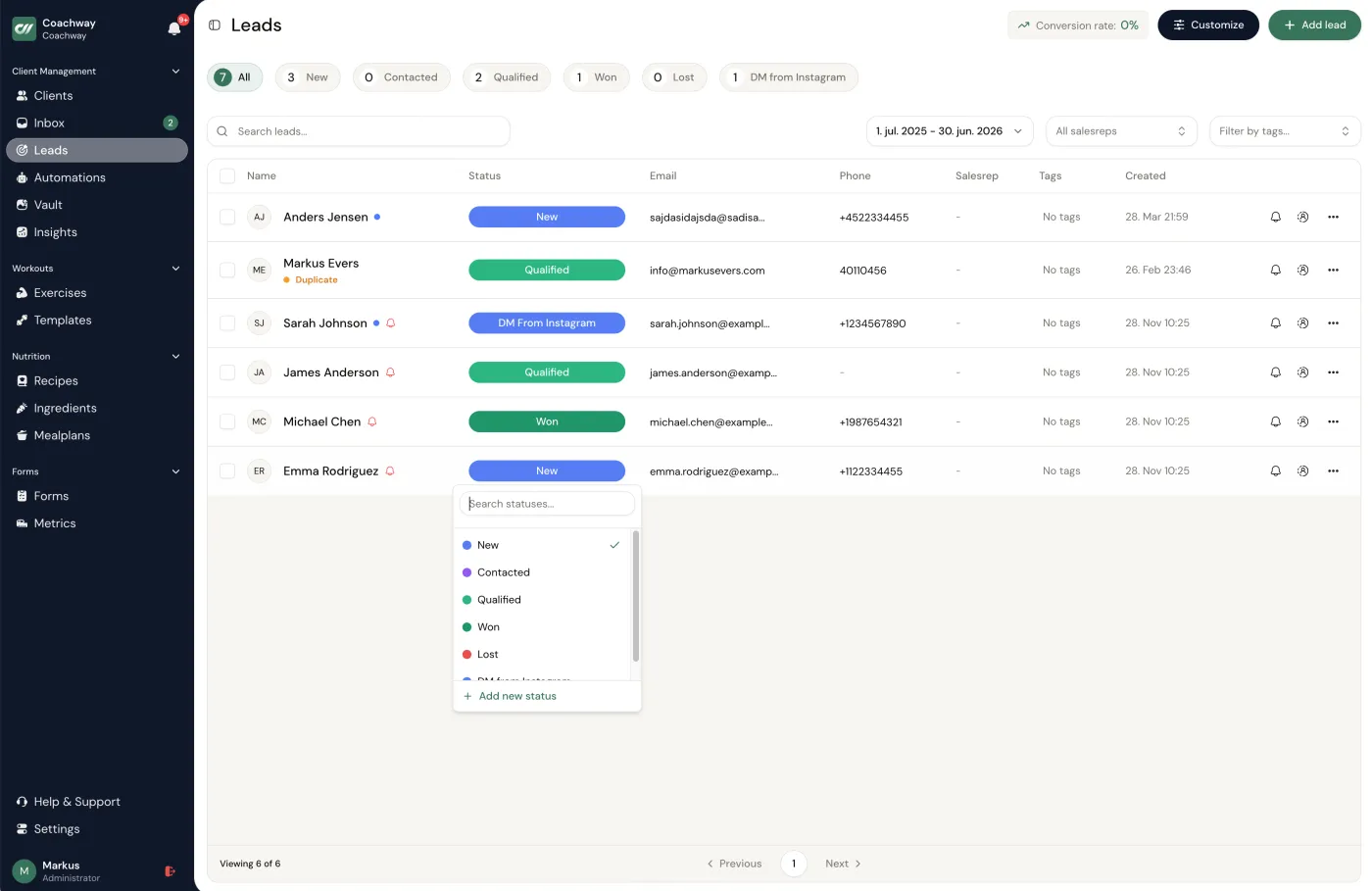
A scope note, since this is our page: Coachway does not send your DMs, and we are not going to pretend the inbox is where coaching gets sold and delivered. Coachway is where the funnel is meant to land. The lead form your DM points a cooler prospect to can be a Coachway lead form, so every qualified person arrives as a visible lead in a pipeline you can work - new, contacted, qualified, won - instead of another thread you have to scroll to reconstruct. When a warm lead says yes, onboarding, programming, check-ins and messaging run from one place, and client payments go through your own Stripe account so you keep the money and the relationship.
Built on years of working with online coaches, Coachway is EUR 69 a month including your first 5 clients and EUR 9 per additional client, every feature in, and the lead forms are included from day one. The 14-day free trial starts with a card held securely by Stripe and you can cancel under Billing before it renews, or book a demo and see the lead pipeline first. The scripts win you the conversation; the platform turns it into a business you can actually see - the deeper version of that is how to get online coaching clients.
Frequently asked questions about DM scripts for fitness coaches.
What should I say to a coaching lead in the DMs?
Lead with value, not a pitch. If they came from a comment-keyword or a story reply, deliver what you promised first, then ask one genuine question about where they are right now - are they training, or getting back into it. If they answer with anything real, drop the script and have an actual conversation: reflect what they said, understand the goal and the obstacle, and only then, if it is a fit, invite them to one clear next step. The scripts on this page are starting points to make yours, never lines to fire word for word. The whole difference between a DM that converts and one that gets muted is whether the person feels heard or processed.
How many times should I follow up with a lead who goes quiet?
Two, maximum, then release. One genuine check-in a few days after they went quiet, with a built-in easy exit - still keen, or has the moment passed, both fine. If that gets no reply, one final warm message that closes the loop and leaves the door open, and then you stop. Chasing past that does not win the client; it just makes sure they remember you as the coach who would not take a hint. Silence is an answer, and respecting it is what lets you reach back out in a few months without it being awkward. If you want to stay useful in the meantime, a single value-add message - a genuinely helpful tip with nothing asked in return - reopens more conversations than any nag.
Are DM sales scripts spammy or too salesy?
They become spammy when you use them to push, and useful when you use them to serve. The scripts here run on four rules that keep them on the right side: only start conversations with people who engaged first, never someone who did not; follow up twice at most, then let go; never manufacture urgency with fake deadlines or closing spots; and take a no as a complete answer. Do that and a script is just a well-thought-out way to be helpful faster. The version that earns you a bad name is the copy-paste blast, the false scarcity, and the refusal to hear no - none of which are on this page.
When should I move the conversation out of the DMs?
The moment it turns into real coaching business - a serious prospect, a booked call, or a yes. DMs are where conversations start, not where a coaching relationship should live: threads scroll away, context gets lost, and you cannot run onboarding, payments or check-ins from an inbox. For a cooler lead, move them to a short lead form so they land in a pipeline you can actually see and follow up, even if the thread goes quiet. For a warm, ready lead, move them into your coaching platform where onboarding, programming, messaging and payments run from one place. The rule of thumb: keep the human conversation in the DMs, but the business it creates belongs somewhere you can see it.
The scripts are half the job. Put the trigger mechanics in place with Instagram DM automation for coaches, feed the inbox with the comment-to-DM reel playbook, and set the whole channel in context with fitness marketing for online coaches.
Keep reading
all guides15 Fitness Lead Magnet Ideas + Build One in an Hour With AI (2026)
Fifteen fitness lead magnet ideas that convert, the anatomy of one that works, three ChatGPT prompts that build a 5-day challenge, a checklist or a quiz in about an hour, the three follow-up emails with the pre-call questionnaire, and when a lead magnet is the wrong tool.
Read the guideAI Personal Trainer vs a Real Coach: What AI Can and Cannot Do (2026)
Can ChatGPT or an AI app replace a personal trainer? An honest answer for coaches: what AI does well, where it falls short, and how to use it as a tool without losing the human coaching clients pay for.
Read the guideHow to Ask for a Testimonial: Template + 5 Questions (2026)
A copy-paste message for asking a coaching client for a testimonial at the right moment, the five memory-jogging questions that get a specific answer instead of "great trainer", a prompt that shapes their voice-note answers without inventing a word, the generic fixer and the consent line. Honest only - no incentivized or fake reviews.
Read the guideFree tools for this: Email List Value Calculator for Coaches · Free Trial Conversion Calculator · Coaching Offer Builder
Ready-made template: Instagram DM Scripts
See what Coachway can do for your coaching business
Coachway was built on knowledge from working with 150 online coaches over 6+ years, who all hit the same wall - slow platforms, clunky workflows, wasted hours. Start your 14-day free trial and see what we fixed - the whole platform, no charge today, cancel anytime under Billing.


