


Instagram caption templates for fitness coaches. Eight fill-in frameworks, thirty copy-paste captions, eighty gym captions, and the 2026 keyword mechanics.
The best Instagram captions for fitness coaches are not clever, they are clear. They open with a first line that stops the scroll, do one job, and end with one honest action. Below are 30 originals you can paste straight in, grouped by the posts a coach actually makes: client wins, myth-busts, story posts, engagement questions, offers, check-in day and a day in the life. Swap the brackets for your own words, and post nothing about a client you do not have permission to share.
By Markus Evers · Updated September 2026
the short version
Instagram caption templates for fitness coaches come in three kinds on this page: eight fill-in-the-bracket frameworks, thirty finished captions grouped by job, and eighty gym captions in eight groups of ten, from funny to gym quotes. A good caption earns its place with the first line, sticks to one job, and asks for one thing.
What makes an Instagram caption actually work for a coach?
Three things, and the first one does most of the work. Your first line is the whole post, because it is all most people see before the feed keeps moving. If line one does not make someone stop, nothing you wrote underneath it exists. So lead with the tension, the result or the honest admission, never with a warm-up sentence. Every template below is built with the hook already on line one; if you want the full method for writing them, read how to write hooks that stop the scroll. The first line is the hook, and the five-step method for writing one applies to a caption exactly as it does to a reel. For the messages around the caption, the offer headline, the enquiry reply and the referral message, the coaching templates hub lists the six copywriting templates in one table.
Second, one post does one job and asks for one thing. A caption that teaches, sells, tells a story and asks a question all at once does none of them well. Decide before you write whether this post is proof, a lesson, a story, a question or an offer, and give it a single call to action at the end: a comment, a save, or a message, not all three. If you are ever stuck on what to post at all, these Instagram content ideas for fitness coaches are a good place to start.
Third, the honest part about hashtags: they matter far less than the hook. A relevant handful helps a little; thirty broad ones do not save a weak post. Spend your energy on line one and a clear topic, and let the caption do the earning. Two more places the same words work harder: your bio, the first thing a new follower reads before they ever see a caption, which you can sharpen with the personal trainer bio generator, and your drafting process, where a model can hand you a rough first version to edit in your own voice using these fitness marketing prompts. Draft with them; publish only what sounds like you.
30 Instagram caption templates for fitness coaches, grouped by job.
Copy the caption, swap anything in [square brackets] for your own words, and use the when-to-use line to pick the right one. Treat every result as a draft to make yours, not a message to post blind. If you want the frameworks filled with your own niche and this week's detail, the Instagram caption generator does it in your browser, no account. For the fill-in version, the Instagram caption generator is a caption maker built on the eight frameworks below: your niche, your point and one real detail in, eight captions out. Captions are one slice of the copy a coach writes; hooks, DM scripts, bios and price objection scripts sit in the full swipe library.
Client-win posts
Proof posts, done right. Every template here has one rule baked in: only ever post a real client result with their clear permission, and swap the bracket for the specifics they actually agreed to share.
The honest before and after
This is what [number] weeks of just showing up looks like. When [client name, or "my client" if they would rather stay unnamed] came to me, [the specific struggle, in words they are happy to have public]. Now [the specific change they gave you permission to post]. I only post this because they said yes - and because the after matters less than the how: [the one habit they changed that anyone reading could copy today]. You do not need a perfect week to start. You need a normal one. Comment [word] and I will show you where to begin.
When to use: Post when a client hits a real milestone and has agreed you can share it.
The non-scale win
The scale did not move this month, and it did not matter. [Client name, shared with their permission] almost quit over it, then listed what had actually changed: [the real wins they are happy for you to share, like sleep, energy, lifts, or a habit that finally stuck]. That is the part progress photos never catch. If you have been judging a hard month by one number, read that again. What is one non-scale win you have had lately? Tell me below.
When to use: Use when a client made progress the scale does not show.
The comeback after a setback
Six weeks ago [client name, shared with their say-so] was ready to walk away. [The setback, in the words they are fine making public]. They did not start over from zero, they started from experience. Here is what got them moving again: [the one small restart step they took]. Nobody talks about the messy middle, so I am glad they let me. If you fell off, you are not behind, you are exactly where a restart begins. Send me a message if that is you.
When to use: Post when a client got back on track after stopping or a rough patch.
The client quote card
"[The exact thing your client said, shared word for word with their permission]." That is [client name, or "a client of mine"] after [timeframe] of work together. I did not write that line, they did, and it says more than any transformation photo could. This is the part of coaching that does not fit on a scale: [what changed underneath the result]. If you want the same kind of shift, the first step is honestly the easiest one. Comment [word] and I will send it over.
When to use: Post when a client says something worth framing (with their OK).
The one-habit result
One change. That is all this took. [Client name, shared with permission] did not overhaul their life, they fixed [the single habit, like protein at breakfast, a daily walk, or a consistent bedtime], stayed with it, and [the specific result they agreed to share] followed. Boring, repeatable, and the opposite of a 30-day challenge. If you are collecting new habits faster than you can keep them, pick one instead. Which one would move the needle most for you? Tell me below and I will help you make it stick.
When to use: Use to show a result that came from a single, boring habit.
Educational myth-busts
The posts that make a stranger trust you. Correct one thing people get wrong, explain why in plain words, and give them the better move. No invented studies, and no numbers you cannot back.
The broken metabolism myth
No, your metabolism is not "broken." It is the single most common thing I hear, and it almost never holds up. Here is what is usually going on instead: [the plain-language real explanation, no numbers you cannot back up]. People believe the broken-metabolism story because [why the myth feels true]. What actually helps: [the practical better move]. Save this for the next time someone tells you to just eat less and move more. Got a fitness "fact" you want me to check? Drop it below.
When to use: Post when your audience believes a common calorie or metabolism myth.
The myth vs what I coach
The internet says [the popular myth]. I coach the opposite, and here is why. [The myth] sounds right because [why it spread], but in practice it [the problem it causes]. What works instead is [your honest, evidence-aware take, no invented studies]. You do not have to take my word for it, try it for two weeks and watch. Which of these two have you been told? Let me know below.
When to use: Use to contrast a popular belief with how you actually coach.
The thing actually slowing you down
You are worried about [the small thing people obsess over]. It is not the problem. The thing quietly holding your results back is [the bigger, less exciting variable], and almost nobody posts about it because it does not sell a quick fix. Here is the honest fix: [the practical step]. It is slower than a hack and it actually works. If this reframed something for you, save it. What have you been blaming that might not be the real issue?
When to use: Post when people are focused on the wrong variable.
The should-I-quit-this-food answer
You do not have to quit [the food everyone asks about]. The all-or-nothing rule is exactly what makes people binge it later. Here is the grown-up version: [the plain how-to-fit-it-in advice]. No food is a moral failing, and no single meal makes or breaks anything. The goal is a way of eating you can actually keep. What food have you been told to cut that you would rather learn to fit in? Ask me below.
When to use: Use for the recurring is-this-food-bad question.
The one that costs beginners the most
If you are just starting, skip this one mistake, it cost my clients years before they found me. Most beginners [the common mistake], because [why it seems logical]. What that misses: [the honest explanation]. Do this instead: [the simple better first step]. You are not behind for not knowing this, almost nobody teaches it. Save it, and send it to whoever is about to start. What would you add for a total beginner?
When to use: Post to correct a mistake you see new clients make.
Personal story and behind the scenes
The human posts that make people follow the coach and not just the tips. Drop in your own real moment - the bracket is a prompt to be specific, not a slot for a stock story.
Why I actually do this
I did not get into coaching for the workouts. [The real, specific reason you started, a moment, a person, a version of you that needed help]. I still think about that when [the everyday moment it shows up in your work now]. The training is the easy part. The reason underneath it is what keeps me here on the hard days. That is probably the most honest thing I can tell you about how I coach. If any of that sounds like where you are right now, my inbox is open.
When to use: Post when you want people to follow the person, not just the tips.
The failure I do not usually share
Here is something I keep off the highlight reel. [The real struggle or failure you went through, specific, human, no exaggeration]. For a long time I thought [the wrong belief you held]. What changed it was [the turning point]. I share this because the polished version helps no one, and because you are probably being harder on yourself than the situation deserves. If you are in the messy middle of something similar, you are not doing it wrong. Tell me where you are at, if you want to.
When to use: Use to build trust by owning a past mistake.
Behind the scenes of a normal day
The part of coaching nobody posts: [the ordinary, unglamorous thing you were actually doing, reviewing check-ins, tweaking a plan at 9pm, replying to the same worried message with real care]. It is not glamorous and it is the whole job. The results people see are made in these quiet, boring hours, not in a single motivational post. This is what you are paying for when you hire a coach: the attention, not the templates. What is a part of your job people never see? I am curious.
When to use: Post to show the unglamorous reality of the work.
What I changed my mind about
I used to believe [the thing you were once sure about]. I was wrong, and I want to say so out loud. Back then I [what you used to do or teach], because [why you thought it was right]. Then [what changed your mind]. Now I [what you do instead]. Changing your mind is not flip-flopping, it is what happens when you keep paying attention. What is something you have changed your mind about lately? No judgement here.
When to use: Use to show growth and honesty about past advice.
Engagement questions
Short posts built to earn a reply. One clear question, low friction to answer, and a reason for you to come back into the comments as the coach.
The this-or-that
[Option A] or [option B]? There is no wrong answer, I just want to know how your brain works. I am [your own honest pick] and here is the one-line reason: [your reason]. Drop your pick in the comments, and if you can, the why. I read every one, and I usually learn something about how people actually train from these.
When to use: Post for a fast, low-effort reply that starts conversation.
The fill-in-the-blank
Finish this sentence: the hardest part of staying consistent is ______. I ask because the answer tells me what to make next, and because naming the thing out loud takes some of its power away. Mine used to be [your own honest answer]. No answer is too small. Tell me yours below and I will reply with something that actually helps for the most common one.
When to use: Use to surface what your audience is actually struggling with.
The gentle poll
Quick one: are you more [option A] or [option B] right now? Not forever, just this week. I ask because the advice that works depends entirely on which one you are, and most posts pretend everyone is the same. Comment A or B. If enough of you land on one, that is the next thing I will break down properly.
When to use: Post when you want a quick read on where people are at.
The what-would-help question
Honest question: what would actually help you most right now, [option A], [option B], or [option C]? I would rather make the thing you need than guess. Tell me the number below. Whatever wins, I will make next, and if your answer is a bit different, say that too, those replies are usually the most useful ones I get.
When to use: Use to let your audience pick your next post.
Offer and CTA posts
The ask, made honest. One clear next step, no fake scarcity, no invented deadline. If a spot or a date is real, name it; if it is not, sell on the fit instead.
The honest who-it-is-for
I am taking on new [coaching type] clients, and I would rather be straight about the fit than talk anyone into it. This is for you if [the honest description of who it suits]. It is not for you if [who it genuinely is not for], and I would tell you that on a call. No countdown, no fake last chance. If it sounds like you, send me a message with [the word or detail you want them to include] and we will see if it is a match.
When to use: Post when opening your coaching, sold on fit and not urgency.
The real deadline
[The real, true detail, a start date, a call time, or a genuine limit on how many people you can take right now]. I am saying it plainly because it is actually true, and I will not pretend a deadline exists when it does not. If you have been on the fence about [the offer], this is the honest reason to decide now rather than a manufactured one. Want the details? Comment [word] or send me a message and I will walk you through it, no pressure either way.
When to use: Use only when a date or a limit is genuinely true.
The soft CTA under value
If this was useful, that is the whole point, take it and run with it for free. But if you would rather not piece it together alone, that is what I am here for. I help [who you help] to [the honest outcome, no income or guaranteed-result claims], with a plan built around your actual life. No hard sell. If you want to talk it through, my inbox is open and a first conversation costs you nothing but a few minutes.
When to use: Post to end a genuinely useful post with a low-pressure invite.
The objection-first invite
The reason most people do not start coaching is not the price. It is [the real fear or objection, being judged, having failed before, or not feeling fit enough to hire a coach]. So let me say it plainly: [your honest, reassuring response to that fear]. You do not have to be in shape to start, that is literally the job. If that fear has been the thing stopping you, message me and let us take it off the table. No commitment, just a conversation.
When to use: Use to name the real reason people hesitate, before you ask.
Check-in day
The recurring post that builds a rhythm people recognise. Use it to normalise the process your clients go through and to show the part of coaching most people never see.
The check-in ritual post
It is check-in day. Right now I am going through [what a check-in actually involves in your world, the numbers, the notes, the photos, the honest reflections my clients send]. This is the quiet engine of real coaching: not the plan I write once, but the adjustments I make every single week based on what actually happened. Progress is a conversation, not a document. If your training has no feedback loop like this, that is usually the missing piece. What does your version of a weekly review look like?
When to use: Post on your recurring check-in day to normalise the process.
What a good check-in contains
Check-in day, so here is what I ask my clients to actually look at, steal it for yourself. Not just the scale. [The real inputs: how training felt, sleep, stress, energy, adherence, and the wins that do not show up as a number]. One number in isolation lies. The full picture tells the truth. Try reviewing your week against those this Sunday. Which of these do you usually ignore? Be honest, that is probably the one to start tracking.
When to use: Use to teach your audience how to self-review before they ever hire you.
The reframe-a-bad-week check-in
Not every check-in is a good one, and today I want to talk about the off weeks. A rough week is data, not failure. When a client sends me one, we do not panic, we ask [the calm questions you actually ask: what got in the way, and what is one thing we protect next week]. One hard week never undoes the good ones. The people who make it are not the ones who never dip, they are the ones who do not quit on the dip. What does a bad week usually look like for you?
When to use: Post to normalise off weeks on your check-in day.
The consistency-over-perfection check-in
The best check-in I read this week was not a perfect one. [The realistic scenario, someone who hit most of it, not all, and showed up anyway]. That is what actually works long term, and it is the opposite of what the transformation posts sell you. Perfect is fragile. Consistent-enough, repeated for months, is what changes a body and a life. If you have been quitting the moment a week is not perfect, this is your permission to just keep going. What is one thing you can stay consistent with this week?
When to use: Use on check-in day to reward showing up over perfect numbers.
A day in the life
The format that quietly sells the lifestyle behind the work. Show the real texture of your day as a coach, the ordinary parts included, so the offer feels like a person and not a pitch.
The real morning routine
A real morning as an online coach, no filter. [The honest sequence, the actual coffee, the client messages before the gym, the ordinary bits included]. I am not posting this because it is impressive. I am posting it because the version of this job people imagine and the real one are very different, and the real one is better. No 4am cold plunge, just consistency and work I care about. What does the first hour of your day actually look like?
When to use: Post to show the ordinary texture of your day, not a highlight reel.
The desk-and-dumbbells day
People think coaching is all gym. It is half spreadsheet. Here is an honest slice of my day: [the mix, programming, check-in replies, a client call, then your own training somewhere in the gaps]. The training is the fun part. The care that goes in between is the actual job, and it is why I keep the number of people I work with where I can still do it properly. This is the trade behind good coaching. What surprised you most about that?
When to use: Use to show the mix of screen work and training behind coaching.
The between-clients moment
A small moment from today that says more than a highlight reel. [The genuine little thing, a message from a client that made your day, a walk between calls, the ordinary lunch you actually eat]. This is the stuff that never makes it to the grid, and it is most of the life. I share it because the polished version makes coaching look like a lifestyle brand, and it is really just a person who cares about a handful of people getting where they want to go. What is a small good moment from your day?
When to use: Post a small, human in-between moment so you feel like a person.
The evening wind-down
End of the day, being honest about it. [The real wind-down, the last check-in reply, the plan you tweaked, the actual dinner, the fact that you switch off too]. Coaching people how to live well only works if you are trying to as well, and some days I do that better than others. That is the whole thing, not perfect, just paying attention, on repeat. If today was a hard one for you, tomorrow is a genuinely clean page. Anything you want to leave behind today? You can say it here.
When to use: Use to close the day honestly and invite a soft conversation.
What are 40 gym captions a coach can actually post?
Forty lines in four groups of ten: funny, short, client win, and motivation without the word motivation, each under fifteen words, no emoji, written to the twelve rules on the captions-that-don't-sound-like-AI page. "Gym captions" is what a client searches for; what a coach posts is the same line with a job attached, so each group comes with the moment it fits and the thing to leave out. A 770-point r/ChatGPT thread lists the formats readers "can no longer read because AI has beaten them to death"; none of the forty use them.
| Group | When a coach uses it | Example | What to avoid |
|---|---|---|---|
| Funny | A Stories frame or a rest-day post; once a week at most, and only if you are funny in real life. | Leg day is booked. My calves did not consent. | Jokes about bodies, food guilt, or a client. The joke is on you or on the gym, never on them. |
| Short | Under a training clip or a photo that already says everything; the caption is a line, not a paragraph. | Show up and log it. That is the job. | Three-word slogans in a row, and any line you have seen on a gym wall. |
| Client win | The week the win happened, with the client's written yes and their own words where you have them. | [Name] hit her first pull-up after eleven weeks. Shared with permission. | Numbers you did not measure, before-and-after bodies, and any win the client did not agree to share. |
| Motivation without the word motivation | Monday morning or the week after a holiday; one per week, never two in a row. | You do not need to feel like it. You need to be there. | "Grind", "beast mode", "no excuses", "journey", and any line that promises a result. |
1 to 10: Funny
- Leg day is booked. My calves did not consent.
- Rest day. Ask me how I am resting. Badly.
- My warm-up has a warm-up now. Forty is a number.
- 6am at the gym: three regulars and a man asleep on the leg press.
- I count steps. Mostly to the fridge.
- Deadlift PR. Also a PR in time spent on the floor afterwards.
- Spotting is 20 percent lifting, 80 percent lying about how easy it looked.
- Protein at breakfast for a year. Still no abs. Working on it.
- New shoes. Same squat. Interesting.
- The scale and I are not speaking this week.
11 to 20: Short
- Show up and log it. That is the job.
- Three sessions every week. That is the plan.
- Tuesday. Same plan as last week, on purpose.
- One set more than last time.
- Not motivated. Went anyway.
- Rest is training.
- Week 12. Still here.
- Heavy and slow. Done.
- Progress is the log, not the mirror.
- Same time tomorrow.
21 to 30: Client win
- [Name] hit her first pull-up after eleven weeks. Shared with permission.
- Twelve weeks, 20 kg on the deadlift. [Name] said yes to this post.
- [Name] trained through the school holidays. Three sessions a week, every week.
- First 5k without stopping. [Name] sent me the screenshot at 7am.
- [Name] stopped weighing daily and lost more. Averages, not mornings.
- 60 kg squat, eight months, two kids. [Name], with permission.
- [Name] logged 27 of 30 meals. That is the whole win.
- Six months in, [Name] renewed. The plan changed. The habit did not.
- [Name] asked for heavier. I said yes. Posted with her blessing.
- Ten check-ins in a row. [Name] did not miss one.
31 to 40: Motivation without the word motivation
- You do not need to feel like it. You need to be there.
- The session you skip is the one you remember.
- Two bad weeks do not undo twelve good ones.
- Consistency is boring. That is why it works.
- Nobody is watching. Lift anyway.
- Start with the set you can do today.
- Slow is fine. Stopped is the problem.
- The plan survives a bad day. Let it.
- Twenty minutes counts. So does ten.
- Your future self is not a stranger. Train for them.
For the fill-in version of any of these, with your niche, your point and one real detail from the week in the first two lines, use the Instagram caption generator; it writes eight captions on eight frameworks in your browser.
What are good short gym captions, gym selfie captions, workout captions and gym quotes?
Forty more lines in the four groups people search for by name: short gym captions for Instagram, gym selfie captions, workout captions and gym quotes, each under twelve words, no emoji, and the gym quotes written here rather than borrowed, so nothing carries a made-up attribution. The same rules as the forty above: one fact from the session, nothing about a body, nothing a client did not agree to.
Short gym captions for Instagram
Under a clip or a mirror photo that already says what happened; the caption is a line.
- Logged. Home.
- Session four of four this week.
- Same bar, one more plate.
- Rest day, on purpose.
- 6am. Nobody else here.
- Ninety minutes, no phone.
- The plan said easy. It was.
- Week 8. Still showing up.
- Three sets. That was enough.
- Done before the kettle boiled.
Gym selfie captions
The post-session photo; keep the line about the session, not the body.
- Post-session face. Pre-coffee brain.
- Same mirror, twelve weeks apart.
- Sweat is the only filter here.
- Deadlift day hair. Do not ask.
- Proof I was here at 6.
- Tired, upright, finished.
- This is what week nine looks like.
- Red face, good session.
- Took the photo so I would remember Tuesday.
- No pump. Still counts.
Workout captions
When the caption describes the session: the lift, the number, the thing that changed.
- Squats at 60 kg, first time since the baby.
- Five by five, and the fifth set was honest.
- Twenty minutes, one kettlebell, done.
- New rep record on the pull-ups: three.
- The warm-up was the workout today. Fine.
- Ran 3 km without checking the watch.
- Bench went up 2.5 kg. That is the post.
- Legs, then stairs. Regret at 4pm.
- Zone 2 for forty minutes, on purpose.
- Skipped nothing. Rare week.
Gym quotes for Instagram (written by us, not borrowed)
A quote-card post or a Monday Story. These are ours; do not attribute them to anyone famous.
- Consistency is a boring word for winning.
- The best program is the one you did.
- Nobody regrets the session they finished.
- Strong is a habit, not a mood.
- Slow progress is still progress.
- You are not behind. You are early.
- Rest is part of the plan, not a break from it.
- The gym does not care how you feel. Show up anyway.
- Small plates, long game.
- Train for the life outside the gym.
The Instagram caption generator writes the longer version of any of these from your own detail, and the AI writing checker tells you if a line you wrote yourself has drifted into quote-card territory.
What are the eight Instagram caption frameworks a fitness coach can fill in?
Eight caption frameworks cover most of what a fitness coach posts: myth correction, client win, objection killer, mistake list, behind the scenes, contrarian take, teardown and permission slip. Each is a skeleton with the slots in brackets, a fixed rule for the first line, one place that needs a specific detail or number, and a last line that is an ask or the detail, never a moral. Copy one, fill the brackets from your own week, and post it; the thirty finished captions above are what the frameworks look like when filled.
Myth correction
When to use it: You keep hearing the same wrong belief and can show what happened when a client dropped it.
What to paste in: The belief, what you saw a client do because of it, what changed, your two-sentence explanation.
[NUMBER] clients this month told me [THE BELIEF, in their words: "carbs after 6pm turn to fat"].

Here is what that belief made them do: [THE SPECIFIC THING, e.g. skipped dinner, ate a protein bar at 9pm instead].

We [WHAT YOU CHANGED, e.g. put dinner back at 7pm, same calories]. [WHAT HAPPENED, with a number if you have permission: "two of them are down a kilo since"].

The plain version: [YOUR TWO-SENTENCE EXPLANATION, no science words].

[THE INSTRUCTION, one line: "eat dinner. Fix the total, not the clock."]
Client win (permission first)
When to use it: A client hit a milestone and has replied yes to the exact wording you will post.
What to paste in: The result with its number, the bad week, their line verbatim, what you changed, the consent line.
[FIRST NAME], [TIMEFRAME]. [THE RESULT WITH ITS NUMBER: "first unassisted pull-up" / "7.4 kg down"].

[THE WEEK THAT WENT WRONG, one or two sentences: "She missed week 6 completely. Work trip, hotel breakfasts."] [WHAT THAT DID AND DID NOT MEAN: "The scale was up 1.1 kg. All of it gone by the next check-in."]

What we actually changed: [ONE SPECIFIC THING IN THE PLAN].

Her words, not mine: "[THE LINE THEY WROTE, VERBATIM]".

Shared with [FIRST NAME]'s permission. [OPTIONAL ASK: "If you are asking the same question she asked in March, message me the word START."]
Objection killer
When to use it: The objection you hear on every sales call, answered in public before the call.
What to paste in: The objection in the words people say it, what it usually means, your honest answer, one example.
"[THE OBJECTION, verbatim: 'I need to get fit before I hire a coach']."

I hear this [HOW OFTEN: "on about half my calls"]. Here is what it usually means: [THE REAL CONCERN UNDERNEATH: "you are worried about paying to be seen at your worst"].

[YOUR HONEST ANSWER, two or three sentences, no hype. Include what you actually do in week one for someone at that starting point.]

[ONE EXAMPLE WITH A DETAIL, no name unless permitted: "The last person who said this to me did two 20-minute sessions in week one. That was the whole plan."]

[THE LAST LINE: the detail, or one keyword ask. No "don't let fear hold you back".]
Mistake list
When to use it: Three or four errors you correct in almost every new client, each with the fix.
What to paste in: The mistakes, in order of how often you see them, and the one-line fix for each.
[NUMBER] things I fix in almost every new client's first month.

1. [MISTAKE ONE, specific: "training legs on Monday and Tuesday because that is when the gym is quiet"]. Fix: [ONE LINE].
2. [MISTAKE TWO]. Fix: [ONE LINE].
3. [MISTAKE THREE]. Fix: [ONE LINE].
[4. optional]

The one most people do not expect is number [N]. [ONE SENTENCE ON WHY].

[LAST LINE: "Save this for your next programme" or one keyword ask. No "which one are you guilty of?"]
Behind the scenes
When to use it: A real, unglamorous slice of the work, with one decision in it.
What to paste in: Your actual timeline for the day and one anonymised client decision.
[DAY], [TIME]. [WHAT YOU WERE ACTUALLY DOING: "14 check-ins to read before the school run"].

The interesting one: [ONE ANONYMISED CLIENT SITUATION: "a client whose sleep dropped to five hours because of a new baby"]. So [THE DECISION YOU MADE: "his plan is now three sessions instead of four, and the third is 20 minutes"].

[ONE THING THAT DID NOT GO WELL TODAY: "My own session, badly. Skipped the last set."]

[LAST LINE: the last thing that happened, not a reflection. "11:00, wrote this. Nothing else worth posting."]
Contrarian take
When to use it: An opinion you actually hold that most coaches in your niche do not.
What to paste in: The opinion in one sentence, your reasoning, and one client example.
I do not [THE COMMON PRACTICE YOU SKIP: "give my clients cardio in month one"].

Most coaches do, and here is why I stopped: [YOUR REASONING, two or three sentences, specific to the people you coach].

[ONE CLIENT EXAMPLE WITH A DETAIL, no name unless permitted: "The last client who came to me doing four spin classes a week had never done a set of ten squats."]

[WHEN THE COMMON PRACTICE IS RIGHT, one honest sentence: "If you are training for a 10k, ignore this post."]

[LAST LINE: the instruction or the detail. No "unpopular opinion, but".]
Teardown
When to use it: A popular plan, challenge or app routine that your audience keeps asking about.
What to paste in: What the plan actually prescribes, what is fine about it, what is wrong, and what you would change.
Someone sent me [THE PLAN: "the 75-day challenge" / "a 1,200-calorie app plan"] and asked if it works.

What it actually asks you to do: [THE PRESCRIPTION IN PLAIN WORDS, two lines].

What is fine about it: [ONE OR TWO HONEST POINTS].

What goes wrong: [THE SPECIFIC PROBLEM, with a number where you can: "two workouts a day for 75 days is 150 sessions; most people I coach can hold 40 in that time"].

What I would change if a client wanted to do it anyway: [ONE OR TWO CHANGES].

[LAST LINE: the instruction, or "send me the plan you are looking at and I will tell you what I would keep". One keyword.]
Permission slip
When to use it: Your audience is doing too much, and you can tell them it is fine to do less, with the reason.
What to paste in: The thing people think they must do, why they can stop, and the smaller version that works.
You are allowed to [THE THING PEOPLE THINK THEY CANNOT DO: "skip the workout when you slept four hours"].

I mean it as a coach, not as a comfort: [THE REASON, two sentences, specific: "a session on four hours' sleep is where most of the injuries I see come from, and the adaptation from it is close to zero"].

Here is the smaller version that counts: [THE REPLACEMENT: "a 15-minute walk and the same bedtime tonight"].

[WHERE THE PERMISSION STOPS, one honest line: "This is for the one bad night, not the fourth in a row. Four in a row is a message to me, not a rest day."]

[LAST LINE: the instruction. No "be kind to yourself".]
The 2026 mechanics: one keyword, written and spoken
When a framework ends in an ask, make it a keyword call to action: one word in capitals, written in the caption and said out loud in the video, one keyword per post, a different one per offer so you know which post produced the message, and something real delivered to everyone who sends it. That is a conversation start, which Instagram rewards; "comment YES if you agree" is engagement bait, which it does not. Reply to every keyword the same day. If a draft of any framework comes back from a model sounding like every other coach, the fix is in the 12 rules for captions that don't sound like AI.
Common caption mistakes coaches make.
The same handful of errors quietly cost coaches reach and trust. Here is what to stop doing before the next post goes out. If your captions read like everyone else's this year, the cause is usually the same fifteen AI tells, and the rewrite checklist shows each one with a fix, and the AI writing checker scores a draft on all fifteen in your browser before you post it.
Burying the hook
Line one is a warm-up ("Happy Monday, everyone") instead of the reason to keep reading. Move the most interesting words to the very top, where the feed can still see them.
Doing five jobs in one post
Teaching, selling, storytelling and asking all at once means the post does none of them well. Decide the single job before you write.
Faking urgency
Invented countdowns and "only 2 spots left" when it is not true. It works once and costs you trust for good. If a limit is real, name it; if not, sell on fit.
Posting clients without permission
A photo sent to you for coaching is not a photo given to you for marketing. Ask every time, be specific about where it appears, and honour a no without friction.
Sounding like everyone else
Generic, AI-flavoured captions with no real voice and no example. Put one specific, true detail in every post so a stranger knows a person wrote it.
No call to action, or three
Either you ask for nothing, or you ask for everything at once. End with one clear next step: a comment, a save, or a message, not all three.
A caption earns the message - your platform turns it into a client.
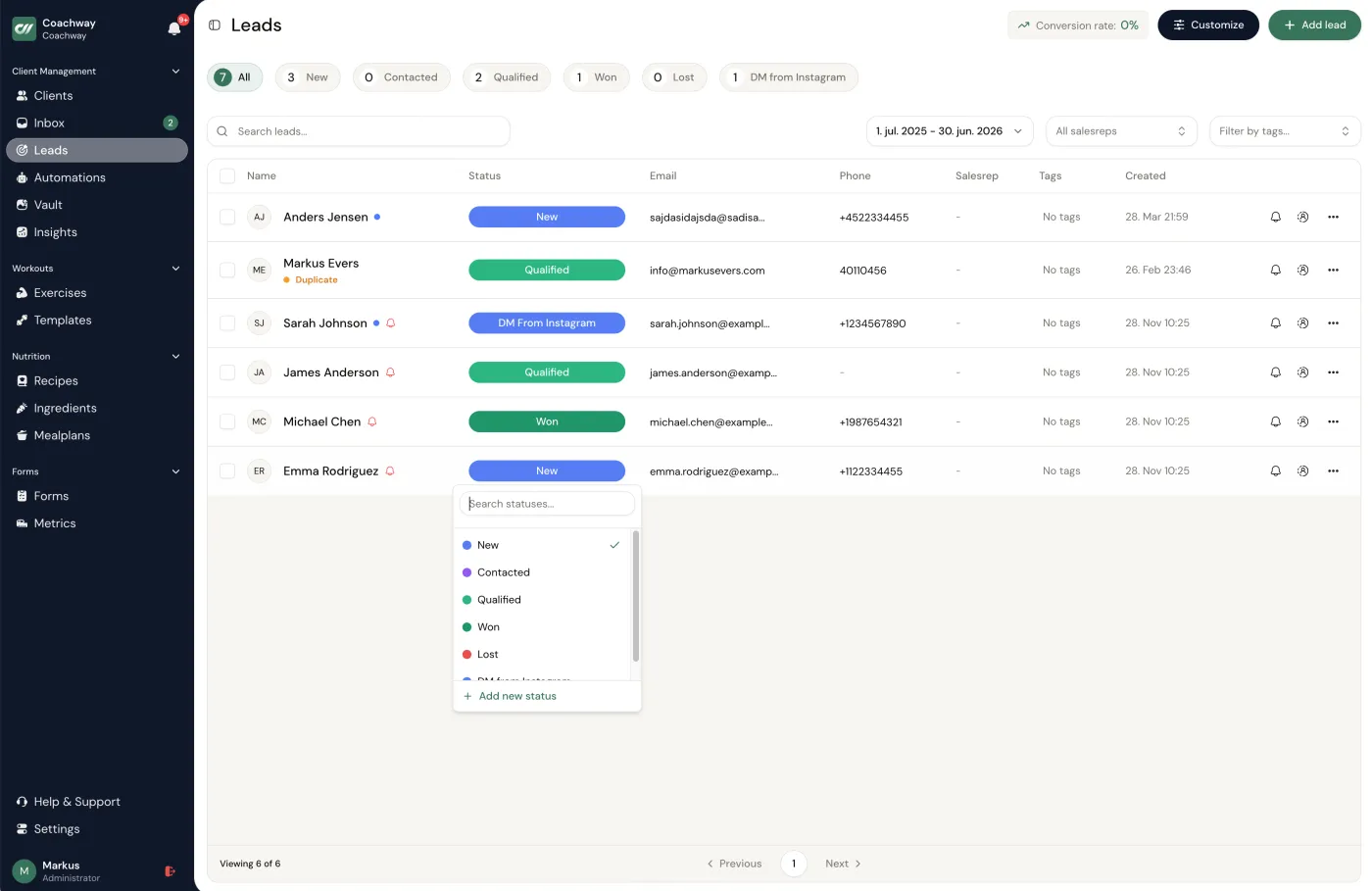
The whole point of a caption that ends in "comment [word]" or "send me a message" is the conversation it starts. What decides whether that conversation becomes a client is what happens after the notification, and that lives in your coaching platform, not in the app you posted from. We build Coachway for exactly that handover: a comment or a DM becomes a named lead you can move from new to contacted to won, so the reply you earned on a post is not lost by Friday. When they say yes, the welcome message and onboarding you wrote once go into automations and send themselves, and the whole conversation sits beside the client full profile, progress and history in the Power Panel.
It costs EUR 69 a month with your first 5 clients included, then EUR 9 per additional client, every feature in. The 14-day free trial starts with a card held securely by Stripe and you can cancel under Billing before it renews, or book a demo and see the lead pipeline first. Great captions bring people to your door; the platform is what makes sure the right one walks through it.
Frequently asked questions about Instagram captions for fitness coaches.
What should a fitness coach write in an Instagram caption?
Write for one job per post. The captions that work for coaches fall into a handful of types: a client win you have permission to share, a myth you can bust in plain language, a personal or behind-the-scenes story, a question that earns a reply, an honest offer, a check-in-day post, or a slice of your real day. Pick one job, open with a first line that stops the scroll, and end with a single clear action. The 30 templates on this page are grouped into exactly those jobs, each with a note on when to use it. The rule underneath all of them: say only what you can stand behind, and never post a client without their clear permission.
How long should an Instagram caption for a coach be?
As long as it needs to be and not a word longer. A quick engagement question can be one line. A client story or a myth-bust often earns 100 to 150 words because the detail is the value. What matters far more than length is the first line, because that is all most people see before they decide whether to tap "more." Front-load the hook, keep one idea per post, and cut any sentence that is there to sound impressive rather than to help. If you would skip it while scrolling, so will they.
Should hashtags go in the caption or the first comment?
Honestly, it matters far less than people claim. Instagram has said itself that putting hashtags in the caption or the first comment makes no difference to reach, so choose whichever keeps your caption clean, and most coaches prefer the first comment so the post reads well. Use a small set of genuinely relevant, specific tags rather than thirty broad ones, and do not expect hashtags to do the work a good hook and a clear topic do. The caption earns the save and the share; hashtags are a minor assist, not the engine.
What is an Instagram caption framework, and how is it different from a template?
A framework is the skeleton of a caption type with the slots marked in brackets: the myth in line one, the thing you see clients do because of it, what changed, the plain explanation, the instruction. A template is a finished caption with placeholders for names and numbers. Frameworks are for when you have your own story and want the shape; templates are for when you need words today. This page has eight frameworks and thirty templates.
How do I write a keyword call to action in an Instagram caption in 2026?
Write the keyword in the caption and say it in the video, one keyword per post, and deliver something real when someone sends it. "Comment PLAN and I will send you the two-session week" works; "comment YES if you agree" is engagement bait and gets less distribution. Keep the keyword to one word in capitals, use a different one per offer so you know which post produced the message, and reply to every one.
What are the best caption frameworks for a personal trainer?
Eight cover most of what a personal trainer posts: myth correction, client win with permission, objection killer, mistake list, behind the scenes, contrarian take, teardown of a popular plan, and the permission slip that tells someone it is fine to do less. Each has a fixed first-line rule, a middle that needs one specific detail, and a last line that is an ask or the detail, never a moral.
Can I post client before-and-after photos?
Only with their clear, specific permission, every single time. A photo you were sent for coaching is not a photo you were given for marketing, and consent to one is not consent to the other. Ask in writing, be specific about where it will appear and whether they will be named or stay anonymous, and honour a no without friction. Never imply a result is typical, never stitch together a story that did not happen, and keep any health detail out of it entirely. Every client-win template on this page carries that permission rule inside the placeholder for exactly this reason.
What are good funny gym captions?
The ones where the joke is on you or on the gym, never on a body or a client: "Leg day is booked. My calves did not consent." or "The scale and I are not speaking this week." Ten funny ones are in the gym captions section above, each under fifteen words with no emoji, and the rule for a coach is once a week at most, on a Stories frame or a rest-day post. A funny caption that reads like everyone else's funny caption is the fastest way to look generated; the twelve rules on the not-AI page apply here too.
How long should a gym caption be?
Under fifteen words when the photo or clip already says what happened, which is most gym posts; sixty to 150 words when the caption is the post (a client win with context, a myth correction). All eighty gym captions above are under fifteen words on purpose, and the thirty templates higher up are the longer kind. The first line is what a scroller sees before "more", so put the number or the specific thing there and let the rest be short.
What are good short gym captions for Instagram?
Ten words or fewer, one fact from the session: "Session four of four this week", "Same bar, one more plate", "Rest day, on purpose". The ten short gym captions above are all under twelve words, no emoji, and each names something only that session had. Short works because a gym photo already says the rest; the line just tells the viewer what to notice.
What should a gym selfie caption say?
Something about the session, not the body: "Same mirror, twelve weeks apart", "Proof I was here at 6", "No pump. Still counts." A selfie caption that comments on how you look invites comments on how you look, which is the conversation a coach does not want under a client-facing account. The ten gym selfie captions above keep the line on the work.
How do you write a workout caption?
Name the lift, the number and the thing that changed, in one line: "Bench went up 2.5 kg. That is the post." A workout caption is the easiest caption to make specific because the session hands you the number; the ten workout captions above are examples with real-looking figures to swap for yours. Never invent the number, and never post a client's lift without their yes.
What are good gym quotes for Instagram?
Ones you wrote, or ones you can attribute correctly. The ten gym quotes above are written for this page, so you can post them without a name under them; the famous lines you see on quote cards are usually misattributed, and a coach's account is the wrong place to be caught doing that. If you post someone else's line, put their name on it and check it first.
Captions are the front door. Fill it with the right posts using Instagram content ideas for fitness coaches, make every first line land with the full guide to hooks, draft faster with fitness marketing prompts, and tighten the bio a new follower reads first with the personal trainer bio generator, then plan the Story Highlights they tap through with Instagram highlight ideas for fitness coaches.
Captions are the front door. If you draft yours with ChatGPT and they keep coming back with a rhetorical question on top and a moral at the bottom, the 12 rules for captions that don't sound like AI fix that with a prompt built on your own voice samples. Fill the door with the right posts using Instagram content ideas for fitness coaches, make every first line land with the full guide to hooks, draft faster with fitness marketing prompts, and tighten the bio a new follower reads first with the personal trainer bio generator, then plan the Story Highlights they tap through with Instagram highlight ideas for fitness coaches.
Captions are the front door. If you draft yours with ChatGPT and they keep coming back with a rhetorical question on top and a moral at the bottom, the 12 rules for captions that don't sound like AI fix that with a prompt built on your own voice samples, and when a client win deserves more than a caption, the client transformation story template gives you the five beats and the consent message. Fill the door with the right posts using Instagram content ideas for fitness coaches, make every first line land with the full guide to hooks, draft faster with fitness marketing prompts, and tighten the bio a new follower reads first with the personal trainer bio generator, then plan the Story Highlights they tap through with Instagram highlight ideas for fitness coaches.
Keep reading
all guidesPersonal Trainer Resume: Structure, Examples and Bullets
The six blocks a personal trainer resume needs, four professional summaries to adapt, weak-to-strong bullet rewrites with real numbers, and the six mistakes that cost interviews.
Read the guideEmail Nurture Sequence for Fitness Coaches (10 Emails, 2026)
A complete 10-email nurture sequence for fitness coaches, written as copy-paste templates - each with two subject line options, a send day, and the job it does, from the opt-in that delivers the lead magnet to the release email that leaves the door open.
Read the guideAI Sales Assistant for Online Coaches: An Honest 2026 Guide
An honest look at AI sales assistants for online coaches: what they actually do, the real trade-offs, and the line where a human has to take over to close. Coachway does not sell one; here is the truthful role it plays instead.
Read the guideFree tools for this: Discovery Call Calculator · No-Show Cost Calculator · Referral Value Calculator
See what Coachway can do for your coaching business
Coachway was built on knowledge from working with 150 online coaches over 6+ years, who all hit the same wall - slow platforms, clunky workflows, wasted hours. Start your 14-day free trial and see what we fixed - the whole platform, no charge today, cancel anytime under Billing.


