


Personal training upsells - the add-on menu and what to charge for each.
The best personal training upsells are not a bigger version of the same coaching. They are add-ons that solve a second problem the client already has - nutrition, form checks, a group tier, a paid challenge - each with a clear price and a clear reason to buy. This is the concrete menu: six add-ons that fit real clients, the price band for each, how to choose which to run first, and how to introduce them without making a single client feel sold to.
By Markus Evers · Updated August 2026
the short version
The strongest personal training upsells are a short menu of add-ons that each answer a second problem a client already has: a nutrition layer for the client who keeps asking about food, form checks for the lifter who wants eyes on the bar, a lower-priced group tier for the buyer who wants you but not the full rate, and a paid challenge for the fence-sitter. Price recurring add-ons as a monthly figure on top of the coaching fee (nutrition commonly 30 to 80 a month), price one-off items as a single number (a challenge commonly 30 to 100), and offer each one at the moment the client reveals the need rather than in a blanket pitch. Keep the menu small, deliver and bill every add-on in one place, and you raise revenue per client without finding a single new lead.
Nutrition coaching - the upsell your clients already ask for.
For a training-led coach, nutrition is the highest-return add-on there is, because the demand is already sitting in your inbox. The client who keeps asking what to eat around training is telling you exactly what to sell them. Adding a nutrition layer means macro targets, a food log you can see and comment on, or a full meal plan, depending on how deep you want to go and how much time you have. Because the client is already yours, there is no pitch to a stranger and no new lead to find - you are answering a question they have raised more than once. A common band is 30 to 80 a month on top of the training fee, scaled to how hands-on the layer is. The full walkthrough on adding nutrition to a PT business covers the delivery choices in detail.
Video form checks - high value for very little of your time.
A form-check tier is one of the best-margin upsells on the menu: a lifter films a set, you watch it and send back a short annotated reply, and the whole exchange costs you a few minutes for something the client experiences as expert, personal attention. It fits the strength and technique-driven client especially well - the person who wants to know their squat depth is right or their deadlift is not rounding. You can price it as a small monthly add-on that includes a set number of reviews, commonly 15 to 40 a month, or per review at roughly 10 to 25 for coaches who prefer to keep it pay-as-you-go. The mechanics of running these cleanly - how to collect video, what to send back, how to keep it from eating your evenings - are in the guide to running remote form checks.
A group or community tier - the rung below full 1:1.
Not everyone who wants you can justify your full one-to-one rate, and a group tier catches exactly those people instead of losing them. It is also the one add-on on this list that doubles as a downsell: when a client cannot afford to continue at full price, a lower group rung keeps them in your world rather than gone entirely. Priced as its own monthly rung, usually 20 to 60 depending on how much live contact it includes, it earns from volume rather than from a high per-head fee. It leans on leverage - a shared program, a group check-in rhythm, a community space where clients see each other's progress - so the delivery scales in a way pure 1:1 never does. The group coaching playbook covers how to structure the rhythm so a group tier lifts retention instead of feeling like a watered-down version of your main offer.
A paid challenge - the door for fence-sitters and lapsed clients.
A short paid challenge is less a revenue engine than a controlled entry point, and that is its value. A four to six week reset, priced as a one-off of roughly 30 to 100, is small enough for a hesitant buyer to say yes to and structured enough to let them feel what being coached by you is actually like. It is the natural re-engagement move for a lapsed client too: an old client is far more likely to rejoin through a defined, finite challenge than through an open-ended pitch to come back. The rule that decides whether a challenge earns anything is to design the exit before the entry - know the full offer you will present to finishers before a single person joins, so the challenge feeds your core coaching instead of ending as a one-off. The challenge-to-clients playbook has the full mechanics.
Two more worth building once the first four are running.
Priority access, for the client already at the top rung.
Some clients want more of you than the standard package gives - faster replies, a monthly call, first pick of your time. Priority access sells that directly rather than quietly giving it away, usually as a 40 to 100 a month premium on top of the coaching fee. It is the one add-on that raises your own workload, so cap how many clients can hold it and be honest with yourself about the hours before you offer it. Used well it is how your best clients pay you more for the attention they were going to ask for anyway.
Digital products, for the follower who is not ready for coaching.
A program template, a recipe pack or a self-guided plan earns from the large group who follow you but will not buy one-to-one coaching yet. Priced as a one-off of roughly 20 to 60, these build once and sell many times, which is the closest thing to leverage on this menu - though the build is real work up front, so treat them as the second wave, not the first. They also warm a cold follower into a paying customer, which makes the eventual step up to coaching a much shorter one. The honest view of what actually sells here is in the breakdown of passive income for coaches.
Which add-on should you run first?
Do not launch six add-ons at once. Pick the one your clients already ask for and build only that, then add a second once the first is running smoothly. For nearly every training-led coach the first add-on is nutrition, because the demand is already there and the delivery uses the platform you already run. The second is usually whichever of form checks or a group tier matches the clients you actually have - form checks if your book is technique-driven lifters, a group tier if you are turning away people on price. Priority access and digital products come later, once your core delivery is tight enough that adding load or building product will not crack it.
A useful test before you add anything: has more than one client asked for this in the last month? An add-on that answers a question clients are already raising sells itself; an add-on you invented because it sounded like extra revenue usually sits unsold. Upsells are a menu you assemble from real demand, not a package you design in a vacuum - and the same discipline that keeps your core packages clean applies here: fewer, clearer options beat a long list nobody reads.
Price the add-on against your time, not your core rate.
The mistake that quietly kills add-on revenue is pricing by feel - picking a number that sounds reasonable next to the coaching fee instead of one that reflects what the add-on actually costs you to deliver. A form-check tier costs you minutes and should be priced for its value, not its effort. A hands-on nutrition layer or priority access costs you real hours every week, so the price has to cover that time or the add-on becomes a way to work more for the same money. Run the number both ways before you set it: what is this worth to the client, and what does an hour of my week cost me? Where those two answers meet is your price.
Recurring add-ons are worth more than they look because they compound. An extra 40 a month on a client who stays a year is 480 you did not have to sell twice, which is why the healthiest menu has a recurring backbone - nutrition, a group tier, priority access - with one-off items bolted on as entry points rather than as the core. If you want a fuller model for how the rungs relate, the value-ladder guide shows how each offer should lead to the next.
How do you introduce upsells without making clients feel sold to?
The difference between an upsell that lands and one that irritates is timing, not wording. Offer the add-on at the exact moment the client reveals the need. When a training client keeps circling back to what they should eat, that is the opening for nutrition; when a lifter sends a video and asks whether their form looks right, that is the opening for a form-check tier. Framed that way the offer reads as help, because it is answering a question they raised. The version that annoys people is the untimed blanket pitch to every client, most of whom did not ask for anything.
Keep the menu visible but quiet. Clients should know the add-ons exist - a short line in onboarding, a mention when it is relevant - without being pitched them repeatedly. Let the client's own words trigger the offer, make each item an obvious answer to a real problem, and the upsell stops being a sales moment and becomes the natural next thing to say.
Deliver and bill every add-on in one place.
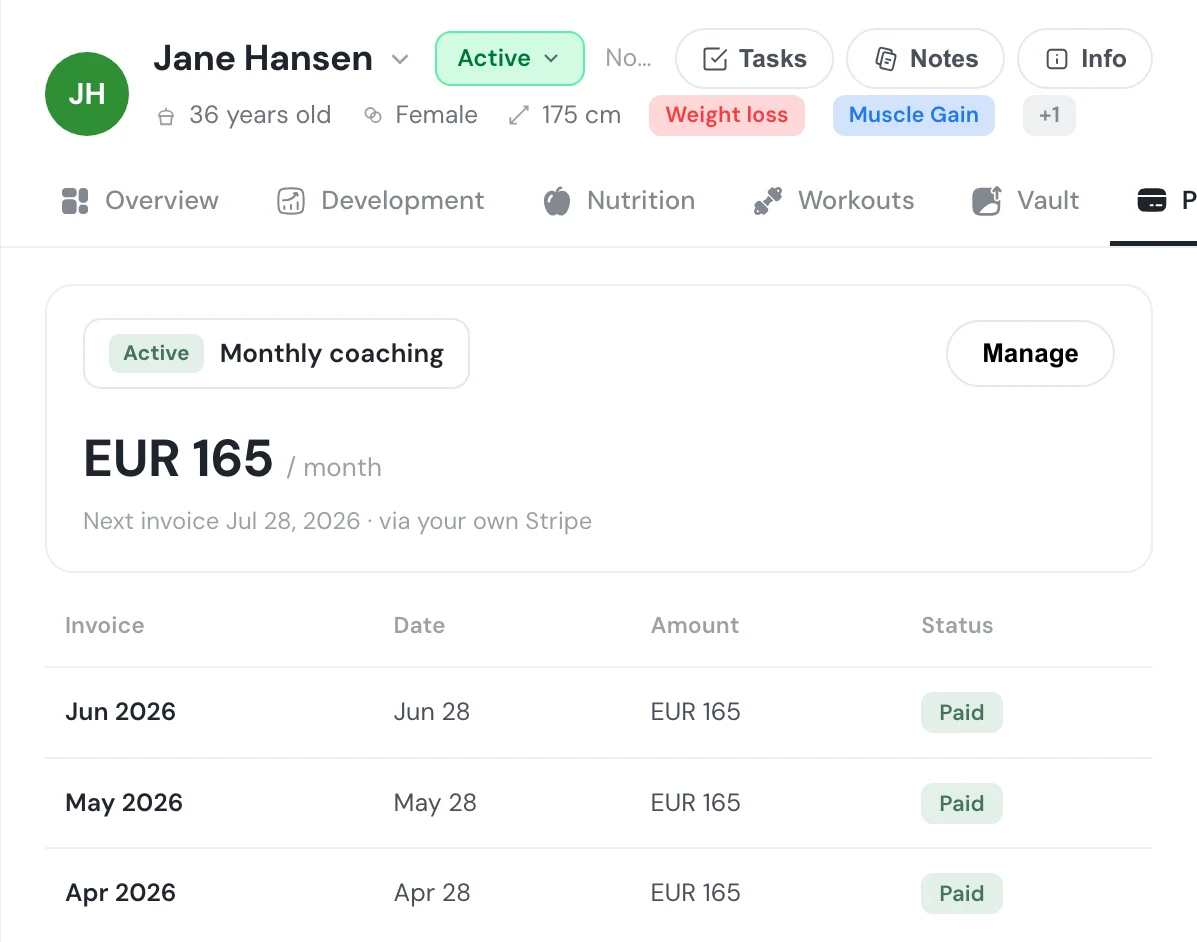
An add-on menu only earns cleanly if delivery and billing live together. When a nutrition layer runs in one app, a form check in a chat thread somewhere else, and the extra charge in a separate payment link, the add-on leaks time and the client sees the seams. In Coachway the delivery and the money sit in the same place: the nutrition, forms, workout and messaging tools that carry the add-ons, and per-client billing that lets you set the exact amount, currency and interval for each client - so a client's coaching fee plus their nutrition add-on is one clean subscription rather than a stack of invoices. Payments settle in your own Stripe account, so Coachway never holds your money; optional built-in payments carry a 2.4% per-transaction fee if you use them, and you can run your own Stripe checkout instead. Every feature is included at EUR 69 a month for your first 5 clients, EUR 9 per additional client after that, and it is built on knowledge from working with 150 online coaches over 6+ years. See the whole picture on a quick demo, or start the 14-day free trial - it begins with a card and cancels under Billing before it renews.
Frequently asked questions about personal training upsells.
What is a personal training upsell?
A personal training upsell is an add-on a client buys on top of their core coaching - nutrition, video form checks, a group tier, a paid challenge, priority access or a digital product. It is not a discount or a bigger discount for buying more; it is a second thing that solves a second problem the client already has. The point is to raise the value one client gets, and the revenue they generate, without adding a single new lead. A good upsell fits the client you already have, is delivered inside the same platform you already run, and can be switched on the moment a client asks for it rather than sold in a separate pitch.
What add-ons should a personal trainer offer first?
Start with the one your clients already ask for, which for most training-led coaches is nutrition. Adding a nutrition layer to an existing training client is the shortest path to more revenue per client because the demand is already there and you are not selling a stranger anything. After nutrition, the next-easiest additions are video form checks (high value, low delivery time) and a lower-priced group or community tier that catches the people who want you but cannot justify full 1:1. Save priority access and digital products for later - they are worth real money but they either raise your workload or take real time to build, so they are the second wave, not the first.
How much should I charge for coaching add-ons?
Price an add-on against the value it adds and the time it costs you, not as a fraction of your core rate. Recurring add-ons like a nutrition layer or priority access sit as a monthly figure on top of the coaching fee - commonly 30 to 80 a month for nutrition and 40 to 100 for genuine priority access. A group tier is usually priced as its own lower monthly rung, often 20 to 60. One-off items - a four to six week challenge, a program template - carry a single price, commonly 30 to 100 for a challenge and 20 to 60 for a template. Set the number in your own currency and against your own market; the bands here are starting points, not fixed rates.
How do I introduce upsells without annoying clients?
Offer the add-on at the moment the client reveals the need, not on a schedule. When a training client keeps asking what to eat, that is the opening for the nutrition add-on; when a lifter sends you a video and asks if their squat looks right, that is the opening for a form-check tier. Framed that way an upsell reads as help, because it is answering a question they raised. The version that annoys people is the untimed pitch - the blanket message to every client offering something most of them did not ask for. Keep the menu small, make each item an obvious answer to a real problem, and let the client's own words trigger the offer.
Should upsells be recurring or one-off?
Both, and the split matters. Recurring add-ons - nutrition, a group tier, priority access - are the ones that compound, because they lift the monthly value of a client for as long as they stay, so build your menu around one or two of these first. One-off items - a paid challenge, a program template, a digital product - are better used as entry points and re-engagement tools than as your core revenue: a challenge brings a lapsed client back, a template earns from a follower who is not ready for coaching. The healthiest add-on menu has a recurring backbone with a couple of one-off doors bolted onto it.
An add-on menu is one half of getting more from each client; clean core packages are the other. Once both are set, the value ladder is how they connect into one path a client moves along.
Keep reading
all guidesWhat Is Hybrid Training? Strength Plus Endurance
Hybrid training is the deliberate pursuit of strength and endurance together. The interference effect in plain words, a sample week, and who the approach fits.
Read the guideWhat Is Ballistic Stretching? Risks and Alternatives
Ballistic stretching bounces a joint past its range using momentum. Why the bounce adds risk, who should avoid it, and the safer dynamic and static alternatives.
Read the guideWhat Is a Synergist Muscle? Agonist vs Antagonist
A synergist is the helper muscle that assists the prime mover. How synergists, agonists and antagonists differ, with bench, squat and row examples.
Read the guideFree tools for this: Coaching Profit Calculator · Coaching Rate Calculator · Personal Trainer Income Calculator
See what Coachway can do for your coaching business
Coachway was built on knowledge from working with 150 online coaches over 6+ years, who all hit the same wall - slow platforms, clunky workflows, wasted hours. Start your 14-day free trial and see what we fixed - the whole platform, no charge today, cancel anytime under Billing.


