


A fitness content calendar for online coaches - a year of client psychology, not a dates dump.
A fitness content calendar for online coaches works best as a map of what your buyer is feeling, not a list of holidays to post around. Across one coaching year - September 2026 to August 2027 - a European audience moves through the same rhythms: the autumn routine reset, the New Year surge, the spring cut, the summer drift. This guide hands you each month's client mood, two or three post angles that name it, and a single business move that turns the feeling into booked clients. Universal rhythms first, local variation noted where it matters.
By Markus Evers · Updated September 2026
the short version
The coaching year has two buying peaks, September and January, two quieter openings in February and May, and a long summer low that is for building, not selling. A useful calendar gives each month one client mood, two or three post angles and exactly one business move, and pairs every post with a way to catch the demand.
Why plan the year instead of the week?
Most coaches plan content one week at a time and wonder why it never compounds. (For the month-level layer under this year map, the AI content calendar for fitness coaches has a prompt that fills 30 days by funnel stage and format, plus a finished example.) The problem is not effort, it is timing: the two months that actually fill a coaching business, September and January, are both won weeks before they arrive, so a coach improvising in the first week of each is already late. A year map turns "what do I post today" into "what is my audience feeling this season, and what is the one move that meets it". Each month below carries the same three parts: the client psychology, two or three post angles that name it, and one business action - because content that names a feeling without a next step is just noise with good production values. For the week-by-week version, the AI content calendar turns one month of this plan into 30 posts with a prompt and a finished example.
One deliberate choice runs through the calendar: it is built for a European coaching year, not an American one. Anchoring to US-only dates misreads the room, so the spine here is the universal rhythms every market shares - the back-to-routine autumn, the New Year, the run-up to summer, and the holidays. The one real local variation is summer itself, which empties earlier in the Nordics and later in Southern Europe, so treat June to August as a moving target. And you do not need to post daily to work it: consistency beats volume, so batch and repurpose one strong idea into a month of formats instead.
What should a fitness coach post in autumn? The reset and the build.
Autumn is the busiest stretch of the coaching year. September hands you a warm audience resetting its routine; October and November are the quiet build where the New Year is actually won. Treat the three as one runway, not three separate months, and the calendar starts working for you.
September - the routine reset.
The whole audience decides, in the same fortnight, that the holiday version of themselves is over. School and work schedules snap back, and the "back to routine" feeling is the mood your entire audience is already in. Post angles: rebuilding structure after an unstructured summer, what a realistic first month actually looks like, and why this reset can stick when previous ones did not.
The one move: reopen your summer waitlist and run a short reset challenge as the low-friction front door. The full September playbook is in the back-to-routine guide.
October - the quiet build.
Routines have settled, the evenings draw in, and early-autumn motivation starts to sag - the exact moment your content should sell systems over willpower. It is also when the January audience begins deciding that next year will be different. Post angles: how to keep training when it is dark and cold, consistency on the weeks you do not feel like it, and a real client story with the context left in.
The one move: lock your New Year offer and open the waitlist now, because the January runway opens in October, not January.
November - the pre-season and the promo moment.
Buyers who will start in January are choosing their coach now, and Black Friday has become the one imported moment that runs across most European retail. Your audience is comparison-shopping and bracing for a wall of discounts. Post angles: what to actually look for in a coach, why the January sprint fails and what replaces it, and an honest behind-the-scenes of how you work.
The one move: run a considered Black Friday offer - a prepay or longer-commitment incentive that rewards the right buyer, not a race to the lowest price that fills you with people gone by February.
What should a fitness coach post in winter? The hold, the surge, the second wave.
Winter swings from the highest churn risk of the year to its biggest demand spike within a few weeks. December is a retention month wearing a marketing month's clothes; January is the harvest; February is the wave most coaches sleep through. Handle all three and Q1 carries the business.
December - the holiday hold.
Travel, family, indulgence and a low hum of guilt push your current clients to their highest churn risk of the year, while your January buyers watch how you behave. The break varies in length - the Nordic Christmas shutdown runs longer than most - so read your own market. Post angles: maintenance over perfection, staying roughly on track without white-knuckling it, and enjoying the holidays without erasing months of work.
The one move: go retention-first - protect the clients you already have and book January start dates now. The mechanics are in the December retention guide.
January - the resolution surge.
The biggest demand spike and the fastest churn arrive together. Fresh-start energy is everywhere, but the impulsive end of it is gone by February, so your content should sell the version that stays. Post angles: realistic goals over dramatic ones, why a system beats a burst of willpower, and what an honest first month feels like, dip included.
The one move: deliver and onboard well rather than discount - convert the audience October and November warmed up, and put an early win into week one so January clients take root. Full runway in the New Year marketing guide.
February - the second wave.
Two to three weeks in, the first-rush crowd hits the motivation cliff and a second group appears: people whose gym-alone resolution just failed and who now want structure and accountability instead of another app. They convert well, because they have just run the experiment of doing it without you. Post angles: why resolutions fail and what actually works, accountability as the missing piece, and the dip being normal rather than proof of failure.
The one move: put an accountability-led offer in front of the second wave, and re-engage any January starters who have already gone quiet.
What should a fitness coach post in spring? The cut and the countdown.
Spring is when the calendar quietly starts pointing at summer. Lighter evenings return, energy lifts, and "summer is coming" turns from a background thought into a reason to start - a strong stretch for both fresh sign-ups and re-motivating the clients you already have.
March - the spring cut begins.
Lighter evenings and the first real sense of spring lift energy, and "summer body" thinking wakes up - usually badly, in the form of crash plans. This is your chance to be the calm voice. Post angles: how to structure a fat-loss or recomposition phase properly, what a sustainable deficit looks like week to week, and why starting now beats a panic in May.
The one move: run a phase reset for existing clients and open a handful of spots as the February wave settles, so nobody drifts through spring without a clear goal.
April - the build toward summer.
The weather turns, outdoor training returns, and engagement climbs as holiday countdowns start appearing in people's heads. It is a high-adherence month and the best window all year to capture proof. Post angles: training that travels and moves outdoors, holding structure through a busier social calendar, and mid-phase progress checks that keep clients honest.
The one move: run a spring check-in campaign and gather testimonials while results are visible - the stories you collect now become your pre-summer and September proof.
May - the pre-holiday push.
A holiday on the calendar creates the year's cleanest urgency: "I leave in six weeks" is a real deadline, and it pulls in buyers who want structure fast. The risk is that same urgency tipping into crash dieting. Post angles: realistic timelines for what a few weeks can and cannot do, why not to crash before a trip, and how to look and feel good on holiday without wrecking your metabolism.
The one move: run a time-boxed pre-summer offer with honest framing - and remember school holidays start earlier in some countries than others, so aim the deadline at your own market's calendar.
What should a fitness coach post in summer? The low season is for building.
Summer is the quietest buying stretch of the year, and forcing sign-ups through it usually just burns energy you will want in September. The coaches who win the autumn treat it as preparation: protect the clients travelling, gather the leads, build the machine. When the break lands depends on where you coach.
June - the maintenance shift.
Holidays begin - earlier in the Nordics around midsummer, later further south - routines loosen and adherence drops. The clients who feel guilty about a looser summer are the ones most likely to quit, so reframe the season before they do. Post angles: maintenance mode as a real strategy, training while travelling with minimal kit, and the minimum effective dose that holds progress without ruling a holiday.
The one move: shift current clients to a maintenance plan and start collecting summer leads - the "get in touch after your holiday" list that becomes your September warm audience.
July - the holiday trough.
This is the lowest engagement and buying intent of the year, and it is also your own reset window. Fighting it is a waste; using it is not. Post angles: light evergreen content that keeps you visible without effort, honest maintenance-while-away advice, and gentle "planning your autumn" pieces that plant the September seed.
The one move: build the September machine now - batch a month of content, nurture the summer waitlist with the occasional useful note, and actually take some rest so you arrive at autumn with fuel.
August - the runway back to September.
The break is ending, and people are starting to think about the autumn reset before it arrives. August is the warm-up, not the main event, so the job is to be visible and ready. Post angles: how to ease back in without an all-or-nothing week, setting up autumn the sane way, and a preview of what your September challenge or intake will look like.
The one move: reopen and warm the summer waitlist, lock the September offer, and set the start dates - which drops you straight back into the routine reset and closes the loop of the year.
A calendar is only as good as the system that runs it.
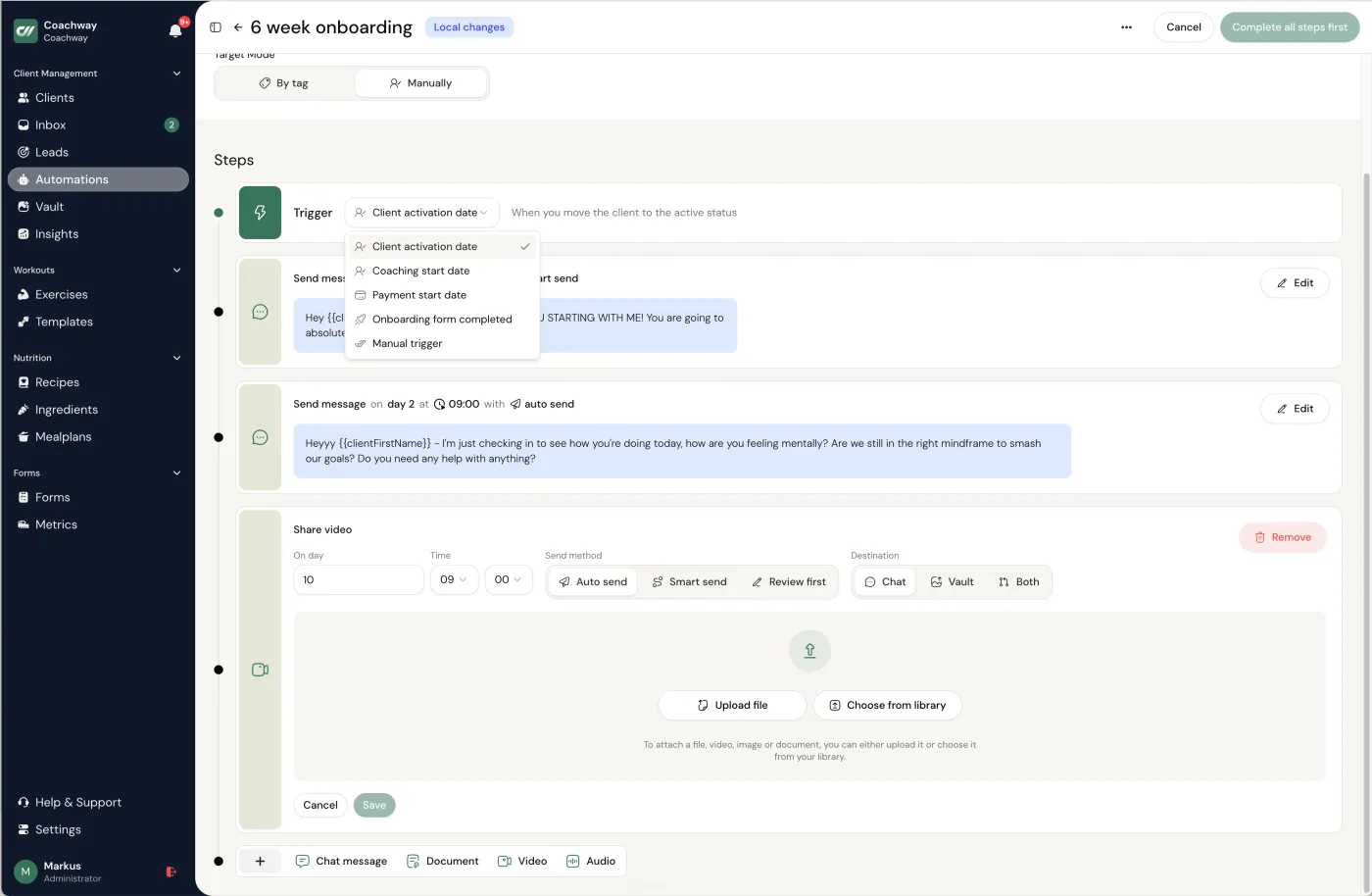
A year map is a plan, and plans decay the moment they depend on you remembering to act on the right day. The fix is to turn the recurring parts of the calendar into things that fire on their own. In Coachway that lives in the automations engine: the seasonal touch, the check-in reminder and the onboarding sequence a new September or January client walks through, all scheduled against a date or a coaching milestone. The summer waitlist and leads sit in one pipeline with new, contacted, qualified and won stages, and a one-click convert hands a new client the client app, the onboarding flow and a subscription billed through your own Stripe account - Coachway never holds your money. It is built on knowledge from working with 150 online coaches over 6+ years, and costs EUR 69 a month with your first 5 clients included, then EUR 9 per additional client, every feature in one plan. The 14-day free trial starts with a card held securely by Stripe and EUR 0 charged today; cancel under Billing before it renews, or book a demo and see the flows first.
Frequently asked questions about a fitness content calendar.
How far ahead should online coaches plan their content calendar?
Plan the whole year in broad strokes and the next quarter in detail. A content calendar is not a posting schedule you have to fill day by day - it is a map of when your audience is most likely to buy, so you can put the offer, waitlist or challenge in front of them while the mood is right. The two big client windows, September and January, are both won weeks before they arrive: the September reset is set up in late August, and the January surge is set up from October onward. So the useful horizon is a rough twelve-month map you revisit each quarter, not a rigid schedule you write once and resent by February.
Which months are the best for getting new coaching clients?
There are two peaks and two quieter openings. September, the post-summer routine reset, and January, the New Year surge, are the two biggest client windows of the year. February is the underrated third window - the people whose solo resolution just failed start looking for accountability. May is the fourth, when a holiday on the calendar creates real urgency to start now. Summer, roughly June to August, is the low season for buying and the right time to build the machine for September rather than push hard for sign-ups. The exact dates shift by country, because school terms and holiday months differ across Europe, so read the peaks as seasons rather than fixed weeks.
Should a European coach use a different content calendar than a US coach?
Yes, because the anchors are different. A calendar built around US-only dates - Thanksgiving, the Super Bowl, national holidays that do not exist in Europe - misreads a European audience. The reliable anchors across Europe are the universal rhythms every market shares: the autumn back-to-routine reset, the New Year, the spring lead-up to summer, and the summer holidays. The main local variation is the summer break, which lands earlier in the Nordics and later in Southern Europe, so June to August engagement moves country by country. Black Friday is the one imported moment that now runs across most European retail, so it is worth planning for - but as a considered offer, not a race to the lowest price.
Do I need to post every day for a content calendar to work?
No. Consistency beats volume, and a calendar exists partly to save you from posting for the sake of posting. A steady, predictable cadence you can sustain for a year outperforms a burst of daily content in January that burns out by March. The efficient way to hold that cadence is to batch and repurpose: film or write in blocks, then reshape one strong idea into several formats across the month. What matters is that the right message lands in the right season, not that a post goes out every single day.
How do I turn seasonal content into actual booked clients?
Pair every month's content with one business move, and catch the demand in a pipeline instead of your DMs. Content names what the audience is feeling; the business move - reopening a waitlist, running a short challenge, timing an offer, protecting current clients - is what converts that feeling into a booked start. The calendar in this guide gives each month exactly one such move so the year has a spine rather than twelve disconnected posting weeks. Then keep every lead in one place, because the seasonal surges leak precisely when there are the most warm people to lose.
The calendar loops through four cluster guides it only points at: the September reset, the New Year runway, the considered Black Friday offer, and December retention. Read the calendar for when, read those for how.
Keep reading
all guidesHow to coach menopausal clients and women over 40 online (2026)
A coach-facing framework for the 40+ client: strength-first programming, protein and recovery emphasis, trend-based check-ins that catch symptoms early, and a clear line between coaching and a doctor. General information, not medical advice.
Read the guideHow to coach prenatal and postpartum clients online (a coach's guide, 2026)
A coach-facing framework for clearance-first screening, programming by trimester, the fourth-trimester return, remote check-ins that catch symptoms, and knowing exactly when to refer out. General information, not medical advice.
Read the guideClient lifetime value (LTV) and CAC for online coaches (2026)
Client lifetime value and CAC are the two numbers that tell you whether your coaching business is profitable to grow. The formulas with worked examples, the ratio to aim for, and how retention multiplies LTV.
Read the guideFree tools for this: Coaching Offer Builder · Sales Objection Handler · Discovery Call Calculator
Ready-made template: Social Media Content Calendar
See what Coachway can do for your coaching business
Coachway was built on knowledge from working with 150 online coaches over 6+ years, who all hit the same wall - slow platforms, clunky workflows, wasted hours. Start your 14-day free trial and see what we fixed - the whole platform, no charge today, cancel anytime under Billing.


