


December client retention for online coaches - hold the line without guilt-tripping anyone.
The Q4 drop-off is rarely a motivation problem. It is a goals problem: a client chasing progress hits two impossible weeks, reads the gap as failure, and quietly disappears. This is the method-first way to keep coaching clients over the holidays - the maintenance contract you set before December, a check-in cadence that goes lighter instead of pausing, what to drop and what to protect, honest December billing, and the booked January restart that stops a holiday pause turning into February churn.
By Markus Evers · Updated August 2026
the short version
The December drop-off is mostly self-inflicted by the goals we set. A client chasing progress meets two impossible weeks, judges themselves a failure, and ghosts. So change the contract before December starts: this is a maintenance month, not a progress month, and holding the line is a win. Keep one light check-in a week rather than pausing contact, loosen macro tracking to a flexible range, and protect a small habit floor instead of the full programme. Then book the January restart date now, because a client with a date on the calendar comes back and one on an open-ended pause often does not. Keep the money honest too - pause the subscription or agree a lighter month openly, never as a guilt lever.
Why do coaching clients drop off in December?
December client retention breaks in a predictable place, and it is not where most coaches look. The goal you set in October assumes a stable week: consistent training, food you control, sleep you protect. December removes all three on purpose - travel, family, parties, disrupted schedules - so a client who was hitting a progress target suddenly cannot. The dangerous part is not the missed sessions. It is the story the client tells about them. A person who cannot train five times over Christmas does not think "normal seasonal dip"; they think "I have blown it", and the shame quietly shuts the whole thing down. They stop logging, stop replying, and mentally file coaching under "restart in January".
This is why guilt-tripping backfires. The reminder about missed sessions, the nudge about macros, the "let's get you back on track" message - all of it confirms the exact story the client is already using to hide from you, so pressure closes the conversation instead of reopening it. The honest reframe does the opposite: lower the bar to something a client can clear in a chaotic week, name the season for what it is, and make holding steady the goal. Holiday client retention is not won by demanding more accountability. It is won by giving the client a version of the plan they are not ashamed to keep.
The December contract: maintenance goals instead of progress goals.
The highest-leverage move is to renegotiate the goal out loud, in early December, before the season does it silently and badly. Tell each client plainly that December is a maintenance month, not a progress month, and that this is a deliberate choice rather than you giving up on them. Maintaining through the hardest weeks of the year is a real skill and a real result. Most people gain over the holidays and open January behind their December self, so a client who arrives in January exactly where they left off is ahead of almost everyone, with fresh proof they can hold a standard under pressure. That is not a consolation prize - it is the honest cousin of the goals that actually stick.
It works because it removes the failure condition. When the goal is progress, any bad week is a loss, and losses compound into disappearance. When the goal is maintenance, a bad week is just the season, and the client stays because there is nothing to hide from. You are not lowering your standards for the year - you are matching the standard to the terrain for four weeks, the way you would deload a hard training block. Set the contract explicitly and the rest of the plan follows: keep what protects the identity, loosen what only creates guilt.
What do you keep, and what do you let go?
A maintenance month is not a paused month. The point is to strip the plan down to the parts that keep the habit and the relationship alive, and to loosen the parts that only manufacture guilt. Five decisions do most of the work.
Keep: one light check-in a week. Never go silent.
The check-in is the thread that keeps a client attached through the noise, so it is the last thing to cut - but it should get lighter, not vanish. Swap the full weekly form for two or three questions and a human note: how did the week feel, what is coming, one thing to hold onto. A shorter, warmer check-in message beats a demanding one, because it lowers the cost of replying at the moment replying feels hardest.
Loosen: macro tracking to a range, or switch to photo-only.
Precise logging is the first thing to buckle over the holidays, and a client who cannot log a party dinner often stops logging at all. Loosen it on purpose: move from exact macros to a flexible range, or drop the client to photo-only food logging for the month so they keep noticing without the pressure of numbers. This is flexible dieting applied - the December goal is a client still paying attention, not a perfect spreadsheet.
Protect: a small habit floor the client can always hit.
Give every client a floor - the minimum they protect no matter how the week goes. A daily walk, a protein target, two short sessions, water before coffee: small enough to survive Christmas, specific enough to feel like a win. The floor keeps the client's identity as someone who trains intact, which is what carries them back to full effort in January. A low bar cleared beats a high bar missed, and that is the whole of holiday accountability.
Let go: weigh-in pressure through the two heaviest weeks.
The scale over the holidays measures salt, travel and one big meal more than it measures fat, and a client who sees a jump and panics is a client about to quit. Take the pressure off numbers that swing for reasons unrelated to effort: make weigh-ins optional through the peak week or two, and coach anyone still tracking to read a noisy scale rather than react to it. Full data can return in January when the week is stable again.
Keep: your visible presence. A human message beats a silent app.
The quiet failure mode is mutual silence - the client goes quiet, the coach assumes they want space, and by January the relationship has gone cold from both ends. Do not let the app carry the load. A short personal message in the holiday week, with no ask attached, does more for retention than any automated reminder: it tells the client they still exist to you outside of whether they logged. Presence without pressure is the front half of the wider retention playbook.
How do you stop a December pause becoming February churn?
Here is the trap that turns a good December into a bad Q1: the open-ended pause. A client who steps back over the holidays with no return date is not resting - they are leaving slowly, and most do not come back on their own. December silence quietly becomes a February cancellation, and by then it reads as a win-back problem instead of a retention one. The fix costs nothing and happens before the pause: book the restart date. Agree the exact day the full plan resumes, put it in writing, and give the client something concrete to walk back into - a first check-in already scheduled, a fresh block, a short comeback event. A pause with a date is a client returning; a pause without one is a client you will be sending a re-engagement message to in six weeks.
This is where the holiday hold connects to the rest of your seasonal calendar. The client you carried through December is the warm start of your New Year runway - already onboarded, already trusting, already booked - which is worth far more than a cold January lead. A short January comeback challenge gives the whole group a shared restart date and a reason to re-engage together, and it doubles as a front door for new clients arriving on the resolution wave. Read December, January and the autumn reset as one continuous season and the churn cliff between them mostly disappears - the same logic runs backward into the September reset that started this stretch.
Should you pause subscriptions or reframe the month?
The billing question deserves the same honesty as the coaching one, and coaches get it wrong in two opposite directions. Some pause everyone by default and lose a month of revenue they did not need to. Others keep charging full price while the client silently disengages, then feel blindsided by the February cancellation - the guilt of paying for something unused is itself a churn driver. Neither is necessary. Decide the billing shape with the client, in the open, in early December. Two clean options: pause the subscription for a fixed window with a restart date attached, so nobody is billed for a month they will barely touch; or keep billing and genuinely reframe the deliverable, where a lighter maintenance plan with a weekly check-in still earns the fee, provided the client agreed to that shape rather than discovering it.
The rule underneath both is simple: never let billing run on guilt or inertia. A client who feels they are paying for nothing cancels and does not come back; a client who chose an honest arrangement stays. Whatever software you run should make the honest version easy - pausing a subscription cleanly, setting a lighter amount for one month, resuming on the agreed date. In Coachway that runs through your own Stripe account, so you can pause or adjust a client's billing openly and switch it back in January, and Coachway never holds your money in between. The maths is simple: a client kept honestly through one quiet month is worth many times the discount you might have thrown at a cold lead in the January rush.
A holiday-proof check-in runs the whole plan.
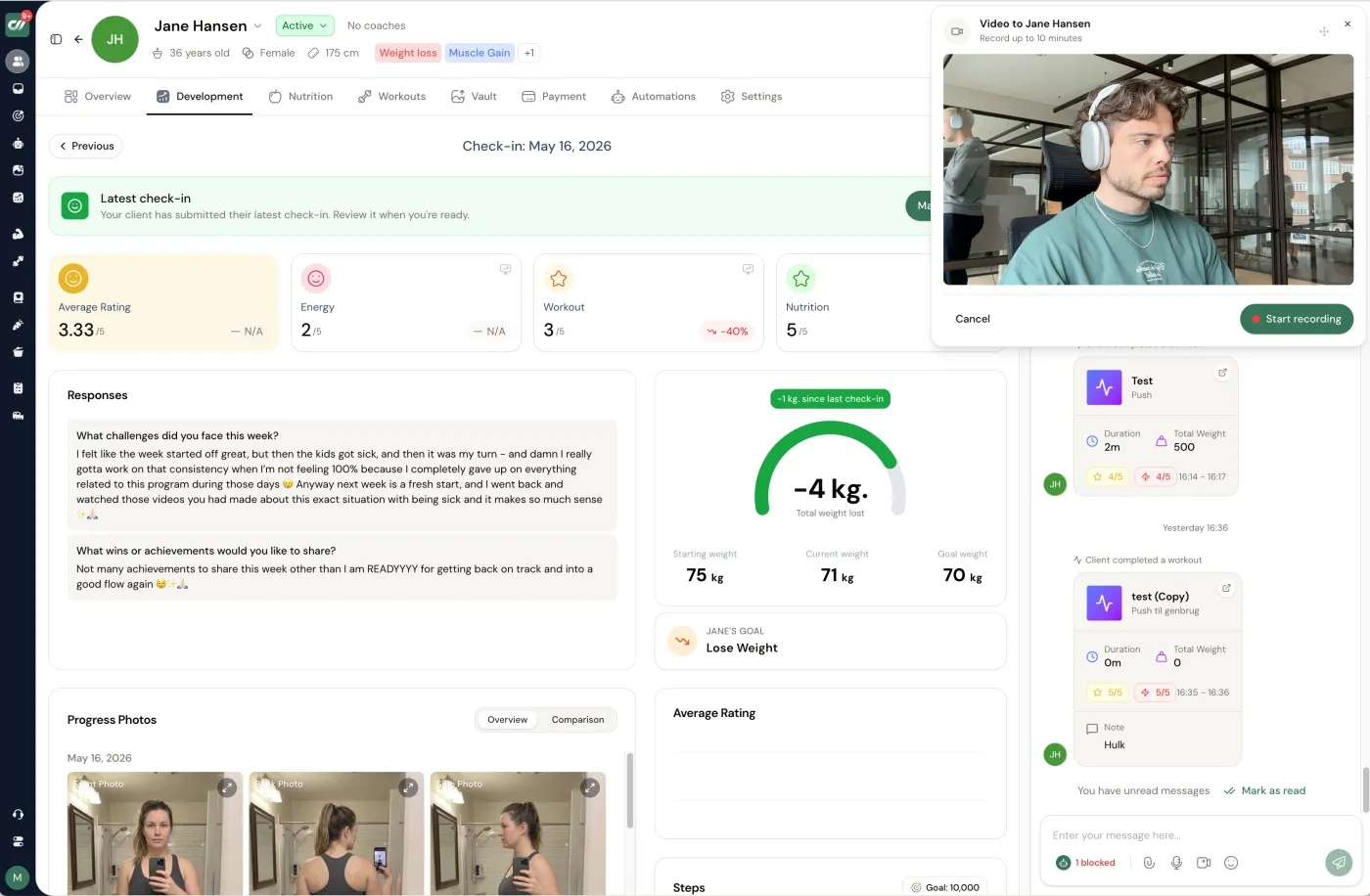
Every part of this comes back to the check-in: a lighter weekly touch that keeps the thread without demanding a perfect week, which is easier when the client's whole picture lives on one screen - this week's short answers beside the weight trend, the photo diary and the training log - so a two-minute December check-in still tells you who is coasting and who is quietly slipping. In Coachway the check-in flow is a drag-and-drop form you can shorten for the holidays, food logging drops to photo-only when a client needs the pressure off, and subscriptions pause or adjust through your own Stripe when a maintenance month calls for it. It is built on knowledge from working with 150 online coaches over 6+ years, and it costs EUR 69 a month including your first 5 clients, then EUR 9 per additional client. Set the holiday version up in November, or book a demo and see the check-in first. The 14-day free trial starts with a card and cancels under Billing before it renews.
Frequently asked questions about December client retention.
How do you keep coaching clients over Christmas?
You change the goal before the season changes it for you. Most holiday drop-off is not a willpower failure - it is a client who was chasing progress, hit two weeks that make progress impossible, decided they had blown it, and went quiet. So renegotiate the contract in early December: this is a maintenance month, holding the line counts as a win, and nobody is expected to build a personal best between family dinners. Then keep the relationship warm with one light check-in a week rather than pausing contact, loosen the parts that create guilt (strict macro tracking, weigh-in pressure) and protect a small habit floor the client can actually keep. The single biggest lever is not going silent. A client who hears from you at Christmas, with a lower bar and no judgement, stays a client into January.
Why do fitness clients drop off in December?
Because the goals we set collide head-on with the shape of the month. A progress goal - lose weight, hit macros daily, train five times a week - assumes a stable routine, and December removes the routine on purpose. The client cannot meet the bar they were meeting in October, reads that gap as personal failure rather than a normal seasonal dip, and the shame does the rest: they stop logging, stop replying, and quietly write off the whole thing until January. Guilt-based nudges make it worse, because they confirm the story the client is already telling themselves. The fix is not more accountability pressure - it is a lower, honest bar that the client can clear even in a chaotic week, so December ends with the habit intact instead of abandoned.
Should I pause coaching subscriptions over the holidays?
Sometimes yes, but do it openly and by choice, never as a guilt lever to keep someone paying for a service they have quietly stopped using. Two honest options work. One: pause the subscription for a set period with a fixed restart date, so the client is not billed for a month they will barely use and you are not carrying resentment into January. Two: keep billing but reframe the month - a lighter maintenance plan with a weekly check-in still earns the fee, as long as the client agreed to that shape. The wrong move is silence: charging full price for full coaching while the client disengages, then acting surprised when they cancel in February. Decide the billing shape with the client in early December, and put the restart date in writing either way.
What should clients focus on over the holidays - progress or maintenance?
Maintenance, and it helps to say so out loud rather than let the client assume they are failing at progress. Maintaining through a hard season is a genuine skill and a genuine win: most people gain over the holidays and start January behind, so a client who arrives in January exactly where they left off in December is ahead of the field and has proof they can hold a standard under pressure. Frame it that way. Give them a floor to protect - a daily walk, a protein target, two short sessions a week, whatever is realistic for them - and permission to let the rest flex. A client who protects a small floor keeps their identity as someone who trains, which is what actually carries them back to full effort in the new year.
How do I stop a December pause becoming February churn?
Book the restart date before the pause begins. A pause with a date on the calendar is a client who is coming back; an open-ended pause is usually a client who has left without saying so. So in early December, agree the exact day the full plan resumes, and give the client something concrete to return to - a January restart, a short comeback challenge, a first check-in already scheduled. Keep a light touch through the gap so you do not vanish from their world, then reach out a few days before the restart, not on the day. This is the bridge into your New Year work: the client who paused with a plan becomes the January cohort you already booked, instead of a win-back message you have to send in February hoping they still remember you.
The holiday hold is one season inside a longer one: it catches the clients you won in the September reset, carries them across the quiet weeks, and hands them to the New Year runway - where a comeback challenge restarts the whole group at once.
Keep reading
all guidesHow to Program Around Client Injuries: A Coach's Guide
Train a client with a cleared or chronic injury without playing physio: what to ask, the pain-free menu, regressing load and range, and when to refer out.
Read the guideHow to Coach Clients Through Perimenopause & Menopause
Falling estrogen accelerates muscle and bone loss, shifts body composition and disrupts sleep - so strength, protein and recovery move to the front of the plan. The evidence-backed adjustments, the myths to skip, what to track in check-ins, and the red flags that mean refer out.
Read the guideHow to Coach Clients Around the Menstrual Cycle (2026)
The evidence on cycle-based programming is genuinely mixed and individual variability swamps the averages - so track the individual, not the textbook cycle. Two to three cycles of check-in data first, autoregulation over reprogramming, what hormonal contraception changes, and the red flags that mean refer out.
Read the guideFree tools for this: Client Churn-Risk Reader · Client Onboarding Builder · Coaching Business Health Check
See what Coachway can do for your coaching business
Coachway was built on knowledge from working with 150 online coaches over 6+ years, who all hit the same wall - slow platforms, clunky workflows, wasted hours. Start your 14-day free trial and see what we fixed - the whole platform, no charge today, cancel anytime under Billing.


