


September marketing for personal trainers - the reset window is a six-week build.
To get coaching clients in September you catch something the rest of the year does not hand you: a whole audience deciding, in the same fortnight, that the holiday version of them is over and the routine version starts now. This is the honest, method-first runway for that window - what to lock in late August, how to reopen the summer waitlist, the content cadence, the challenge that works as a front door, and what to do this week if you are starting late.
By Markus Evers · Updated September 2026
the short version
September is the year's quiet second January. The post-summer routine reset hands you a warm audience for roughly four to six weeks, and it is won as a short build, not a launch-day spike. Lock the offer and reopen your summer waitlist in late August. Launch the reset story in week one, when routines are snapping back. Run a two to four week challenge as the low-friction front door, and book real start dates while the feeling is strong. Do not discount - September demand needs a reason to start, not a lower price. Then spend the back half onboarding well, so the reset becomes retention that carries into autumn.
Why does September convert coaching clients?
September converts because a whole audience resets its routine at the same moment. School goes back, work schedules harden, the loose shape of summer ends, and a large group of people decide inside the same fortnight that the holiday version of themselves is finished. That shared reset is the same fresh-start psychology that drives January, running with less noise: fewer coaches shouting, cheaper attention, and a buyer reacting to real life resuming rather than to a date on the calendar. The "back to routine" feeling is not a slogan you have to manufacture in September - it is the mood your entire audience is already in, and marketing works best when it names something people are already feeling.
The September buyer is also steadier than the January one. A New Year sprint-buyer is chasing a resolution high and often gone by February; a back-to-routine buyer is trying to rebuild a structure they already know they function better inside. That is a calmer, more durable motivation, and it maps cleanly onto what coaching actually sells - not a burst of willpower, but a system that holds. It also means the honest offer and the effective offer are the same offer, which is a rare and useful alignment. You are not talking a hesitant person into a fantasy; you are handing a returning one the structure they are already reaching for. Treat September as harvest for demand that summer quietly built, and the marketing gets much simpler.
The four to six week runway, late August to late September.
Late August: lock the offer, reopen the summer list.
Decide exactly what September's offer is before you say a word publicly: who it is for, what it includes, what it costs, and how long it runs. Frame it in months, not weeks, because the back-to-routine buyer wants a structure that holds, not a two-week fix - if the shape is not clear yet, the offer-design walkthrough gets it there fast. Then reopen the warmest list you own: every person who asked about coaching in July and August and was told to enjoy their holiday and get in touch after. They are the softest audience of the whole autumn, and a short personal note beats any broadcast.
Week one of September: launch on the reset.
The public phase starts as routines snap back. Content shifts to the exact thing your audience is feeling - rebuilding structure after an unstructured summer, what a realistic first month looks like, why this reset can stick when previous ones did not - published consistently rather than in one big push, along the lines of the content playbook. Announce the front-door challenge here and open a simple lead form to collect names. You are not selling the full programme yet; you are giving a warming audience a small, obvious next step while the reset feeling is at its strongest.
Weeks two to three: run the challenge as the front door.
A short two to four week reset challenge is the best-fitting entry September offers. It matches an audience that wants momentum first and a long commitment second, and it lets a stranger feel what being coached by you is actually like before deciding on months. Run it as the qualified top of your pipeline, not as free work you host out of goodwill: the point is that finishers have now experienced the coaching, which earns you the right to make a real offer. The challenge-to-clients playbook covers the mechanics; the rule that matters is to design the exit before the entry.
Weeks three to four: convert conversations into booked starts.
Now the offer goes to the people who have warmed up: the challenge finishers, the summer list, the callers who have been reading your content for a fortnight. Open discovery calls and get real start dates on the calendar while the reset feeling still holds, because a chosen start date is itself a small commitment that a client has already begun to keep. Resist the discount reflex here. September demand does not need a lower price; it needs a clear reason to start now rather than "sometime". If you want an easier yes, lower the risk with a strong first week, not the fee.
Weeks four to six: onboard well, turn the reset into retention.
Your job flips from marketing to delivery, and the first two weeks of each new client decide the next six months. Fast setup, the programme landing quickly, an early win engineered into week one, and a real reply to the first check-in - that is where September clients either take root or quietly fade. Say the quiet part out loud during onboarding: motivation will dip once the novelty of the reset fades, and the plan is built for exactly that, so the dip becomes expected terrain instead of proof it failed. Do this well and the same cohort carries momentum into autumn - and straight into the New Year runway, which opens in October anyway.
It is already mid-September. What do I do this week?
Compress the runway, do not skip it. You lose the wide top-of-funnel a full four weeks would have built, but the core of a September month can still be assembled in one focused week - because the warm audience and the reset feeling are still there whether or not you were ready for them. Four moves, in order:
1. Message the warm list by hand, today.
Go straight past cold content to the people who already raised their hand: every summer enquiry, every past client who lapsed, everyone who asked about coaching and got a "let's talk after summer". A short, specific, personal message to a warm list will out-convert a week of posting to strangers. This is the fastest client acquisition move available and it costs nothing but an afternoon.
2. Announce a reset challenge that starts within seven days.
A near start date is the point. It converts vague September intent into an actual commitment before the reset feeling cools, and it gives you a reason to reach out that is not "buy my coaching". Keep it short and finishable, and know the full offer you will present at the end before anyone joins.
3. Open a handful of discovery-call slots for repliers.
Do not try to sell in the DMs. Send interested people to a small number of real call slots this week, so momentum turns into a booked conversation instead of a thread that goes cold. A few calls with warm people beats a launch to a cold audience every time.
4. Keep the pipeline and roll it into October.
Whatever you build in this scramble - the list, the challenge names, the calls - does not expire on October 1. Keep it in one place and feed it straight into the longer New Year runway. A late-September rush, done properly, is simply the warm-up for a Q4 you actually plan, and the same lead engine carries both.
The September plan runs on one lead pipeline.
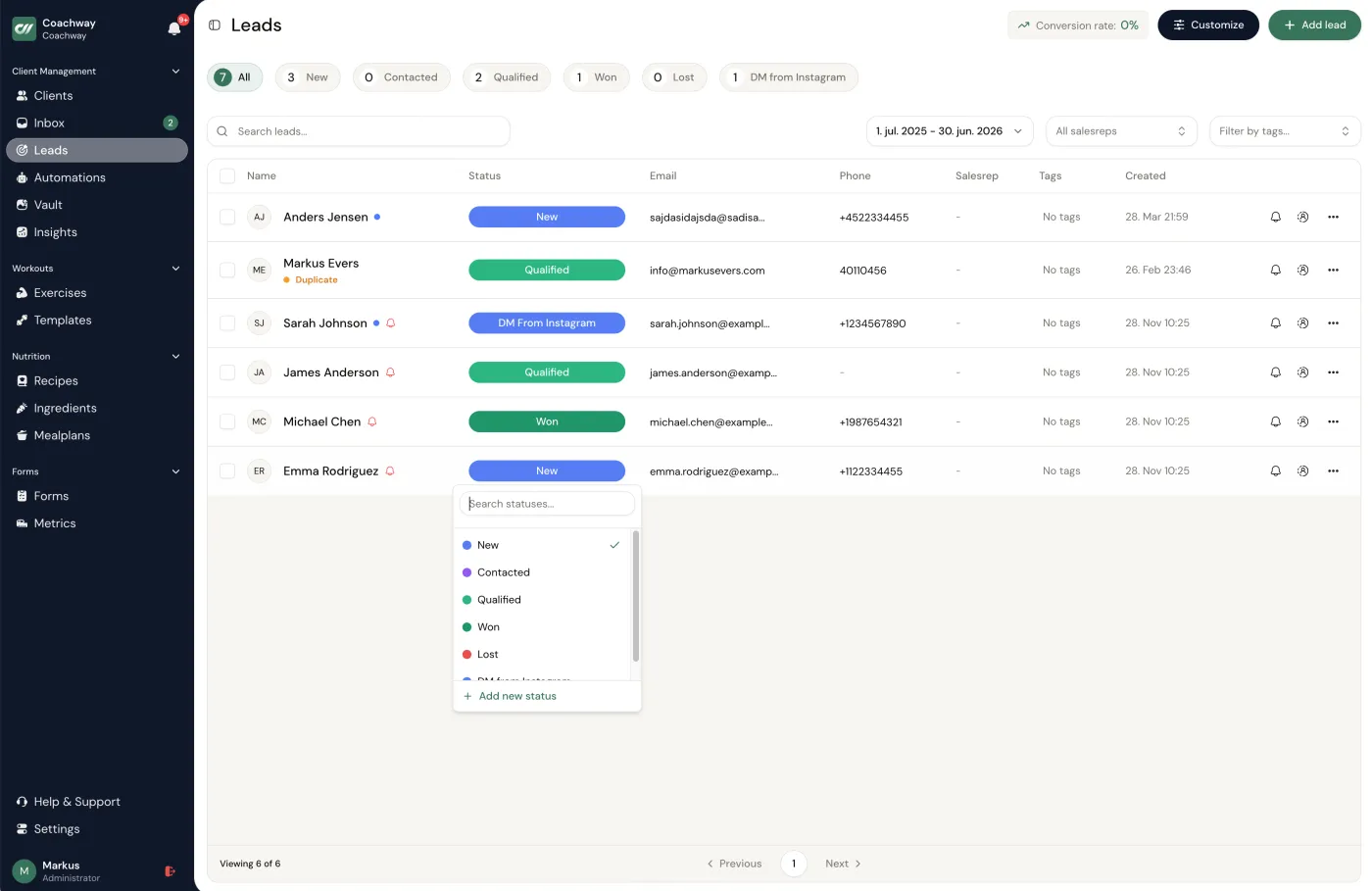
Every part of this runway is really the same chain: a form that catches interest, a pipeline that moves a lead from new to won, and a clean handover into onboarding once someone says yes. When that chain is scattered across DMs, a spreadsheet and a payment link, the September surge leaks - warm people fall through the gaps precisely when there are the most of them. In Coachway the whole chain lives in one place: an embeddable lead form that captures the full source trail, a visible pipeline with new, contacted, qualified and won stages, and a one-click convert that gives a new client the client app, the onboarding sequence and a subscription billed through your own Stripe. It is built on knowledge from working with 150 online coaches over 6+ years, and it costs EUR 69 a month including your first 5 clients, EUR 9 per additional client after that. Set it up in the quiet week before September, not during the rush - or book a demo and see the pipeline first. The 14-day free trial starts with a card and cancels under Billing before it renews.
Frequently asked questions about September marketing for coaches.
When should personal trainers start marketing for September?
The last week of August, with the offer decided a few days before that. September client acquisition runs on a four to six week window, not a launch-day spike, and the buyer you want makes the back-to-routine decision in the first two weeks of the month - so the coach they message is the one who was already visible in late August, not the one who starts posting on September 3. The practical runway is short and honest: lock the offer and reopen your summer waitlist in late August, launch the reset story in week one of September, run the front-door challenge and discovery calls through weeks two and three, and spend the back half onboarding the people who said yes. A coach who starts from zero on the first Monday of the month is competing for attention that has mostly already been spent.
How do you get coaching clients in September?
You meet the routine reset with a low-friction entry and a way to catch the demand. Three moves do most of the work. First, reopen the list of summer leads - the people who asked about coaching in July and August and were told to enjoy their holiday and come back - because they are the warmest audience you will have all autumn. Second, run a short challenge as the front door: a two to four week reset that lets a hesitant buyer experience your coaching before committing to months, which is the natural on-ramp for people who are motivated but not yet sure of you. Third, put a real offer in front of the warmed audience with booked start dates in the first two weeks, while the reset feeling is strong. Discounting is not on the list - September demand does not need a price cut, it needs a reason to start now.
Why is September a good time to get fitness clients?
Because the whole audience resets its routine at once. School and work schedules snap back into a fixed shape, the unstructured summer ends, and a large group of people decide in the same fortnight that the holiday version of themselves is over. That shared reset makes September the year's quiet second January: the same fresh-start psychology as the New Year, but with less noise, fewer coaches shouting, and a buyer who is reacting to real life resuming rather than to a date on the calendar. The demand is also more grounded than January's. A back-to-routine buyer is not chasing a resolution high; they are trying to rebuild a structure they already know they function better inside, which tends to make them a steadier client than the January sprint-buyer.
Should I run a challenge to get clients in September?
Yes, if you use it as an entry rather than a product. A short reset challenge is the best-fitting front door September offers: it matches a routine-rebuilding audience that wants momentum first and a long commitment second, it lets a stranger feel what being coached by you is actually like, and it gives you a natural, non-pushy reason to make a full-programme offer at the end - to people who have now seen the work rather than just read about it. The trap is running the challenge as free work that leads nowhere. Design the exit before the entry: know the exact offer, price and start date you will present to finishers, and treat the challenge as the qualified top of your pipeline, not a standalone event you host out of goodwill.
What if I am starting my September marketing late?
Compress, do not skip. If it is already mid-September, drop the slow content ramp and go straight to the warm audience: message every summer lead and every past enquiry personally, announce a short reset challenge with a start date inside the next seven days, and open a handful of discovery-call slots for the people who reply. You lose the wide top-of-funnel a full runway would have built, but the core of a September month - warm list, low-friction entry, booked starts while the reset feeling holds - can still be assembled in a single focused week. Then keep the pipeline you just built and roll it straight into the longer New Year runway, which starts in October anyway, so the late September scramble becomes the warm-up for a properly planned Q4.
The reset window runs on two engines this guide only points at: a challenge that opens the door, and the lead generation that keeps it from leaking. When September ends, the same machine feeds the New Year runway.
Keep reading
all guidesBest Social Media for Personal Trainers (2026 Guide)
The best social media for personal trainers is not the platform with the biggest reach - it is the one you can post to consistently for six months. A decision guide that filters Instagram, TikTok, YouTube and LinkedIn by your niche, your real time budget and the client you want, with a comparison table, a three-question chooser, and the honest case for going deep on one channel instead of being forgettable on four.
Read the guideInstagram DM automation for coaches - what to automate, what to keep human
Comment-to-DM automation is everywhere in 2026, and almost everything written about it is written by someone selling the tool. This is the other version: what DM automation is genuinely for, what Instagram allows, what the free built-in layer covers, what ManyChat and the newer coach tools really cost, and the rule that keeps it from costing you clients - the machine opens the conversation, a human closes it.
Read the guideInstagram content ideas for fitness coaches - what actually works right now
You do not need 250 random content ideas - you need to know which job each post does. Reel ideas that get you discovered by the client you want, carousel ideas that build trust, story content that converts, and the mid-2026 mechanics that decide reach: shareable beats likeable, carousels are back, trial reels let you test hooks on non-followers, and a comment keyword turns a good post into a conversation.
Read the guideFree tools for this: Coaching Offer Builder · Sales Objection Handler · Discovery Call Calculator
See what Coachway can do for your coaching business
Coachway was built on knowledge from working with 150 online coaches over 6+ years, who all hit the same wall - slow platforms, clunky workflows, wasted hours. Start your 14-day free trial and see what we fixed - the whole platform, no charge today, cancel anytime under Billing.


