


Black Friday for personal trainers - run the offer, not the discount.
Black Friday for personal trainers is a real question, not a given: a discount built for one-time products behaves very differently on recurring coaching, and run carelessly it cheapens the brand you spent all year building. This is the honest version - whether to run a sale at all, what a discount actually costs you once the revenue repeats, the one EU price rule to check before you advertise a saving, and the bonus-led offer that captures the same seasonal attention without ever touching your headline price.
By Markus Evers · Updated August 2026
the short version
For most coaches, Black Friday is worth showing up for and rarely worth a deep discount. Coaching is recurring, so a price cut ripples through every month a client stays and pulls in the buyer who churns fastest. Decide the offer by early November and prefer a bonus - an extra month, a nutrition audit, a done-for-you plan - to a price cut, because a bonus captures the urgency without anchoring your price down. If you do discount, discount the entry, never the ongoing rate: a one-off first-invoice discount is a rounding error against lifetime value, while a permanent rate cut removes the same percentage forever. Warm the list you have built since the autumn reset, keep the window short and honest, and if you advertise a "was" price, make sure it is one you genuinely charged.
Should you run a Black Friday sale at all?
Start with the uncomfortable question, because the default answer coaches reach for - "everyone else is discounting, so I should too" - is the one most likely to hurt a coaching brand. Black Friday was designed for one-time products. A shop discounts a jacket, loses a slice of that one sale, and moves on. Coaching is not a jacket; it is a recurring relationship, and a discount ripples through every month a client stays and, more importantly, through who signs up in the first place. A price cut is a magnet for the least committed buyer, the person choosing on price rather than on whether you are the right coach - and on a subscription that is the person who cancels in week three and dents your retention on the way out.
None of that means sit the month out. The seasonal attention is real: a large slice of your audience is already in a buying, resetting, "sort myself out before the new year" frame of mind, and pretending Black Friday is not happening leaves that attention on the table. The move is not "discount or ignore" - it is to meet the moment with an offer that fits a coaching brand: a genuine reason to start now, a short and honest window, and a structure that does not train your audience to wait for your next sale. The rest of this guide builds that offer - what a discount really costs on recurring revenue, the one EU rule to check before you advertise a "was" price, and the bonus-led alternative if you would rather not discount at all.
The honest economics of discounting recurring coaching.
A retailer's Black Friday maths is simple: margin minus discount on a single transaction. A coach's is not, because the thing being discounted repeats. Before you pick a number, do the one calculation that decides everything - what the discount attaches to. Lifetime value is, near enough, your monthly fee multiplied by the number of months a client stays. (For the fuller version, with acquisition cost folded in, see the lifetime-value and CAC guide.) That single relationship is why the same "30% off" can be trivial or ruinous depending on what it touches.
Put your own numbers in. Say your coaching is EUR 150 a month and a typical client stays nine months - that is a lifetime value of about EUR 1,350. Thirty percent off their first month costs you EUR 45: roughly three percent of what that client is worth to you, a rounding error you would happily pay to win a good-fit person. Thirty percent off for as long as they stay costs you EUR 45 every single month, about EUR 405 across the same relationship, and it keeps costing you for the life of every client who takes it. Same headline, wildly different bill. Use your fee and your own average tenure rather than a borrowed average, because the whole point of the formula is that you already have the two numbers it needs.
| Offer structure | Example | What it really costs | Watch out for |
|---|---|---|---|
| First-invoice discount | 30% off month one | About a third of a single month - small against lifetime value if they stay | Attracts price-shoppers who churn early |
| Permanent rate cut | 30% off for as long as they stay | 30% of the whole client lifetime value, every month, for good | Almost never worth it on recurring coaching |
| Value-add bonus | An extra month, a nutrition audit, a done-for-you plan | Delivery time once, and no permanent cut to your price | The bonus must be genuinely wanted, not filler |
There is a second cost the spreadsheet misses. Every discount teaches your audience something: that your price is negotiable, and that patience is rewarded. Run a deep sale once and next year's buyers wait for it. That is why a value-add so often beats a price cut on coaching - a bonus adds perceived value without moving the anchor, so the full-price clients who joined before and after the sale never feel they overpaid, and next year you are not held hostage to your own precedent. If you are still weighing the discount question in general, the trial-and-discount decision guide works through the same trade-off outside the seasonal frame.
The EU rule to check before you show a "was" price.
If you sell into the EU and you plan to put a "was" price next to your Black Friday price, one rule is worth knowing. Since 2022 most EU countries apply a version of the Omnibus rules on price reductions: when you announce a discount, the reference "before" price generally has to be the lowest price you actually charged in at least the 30 days before the offer. The practical effect is that you cannot invent a fictional "normal" price to make the deal look bigger - the "was" has to be one you genuinely used.
Enforcement and the exact wording vary by country, and this is a general pointer rather than legal advice, so check how your own market applies it. The safe habit costs you nothing: only ever advertise a saving against a price you really charged, and you never have to think about it again. It is also a quiet argument for the bonus route. A value-add sidesteps the "was and now" framing entirely, because you are adding something to the offer rather than marking a headline price down - which keeps you clear of the whole reference-price question while still giving buyers a concrete reason to move now.
Decide the offer by early November, warm the list you already built.
Early November: lock the whole offer.
Decide everything before you promote anything: the structure (discount or bonus), the price or the bonus itself, the cap on spots, and the deadline. If the offer is not sharp yet, the offer-design walkthrough gets it there fast. Locking early is the whole point of a runway - it means the back half of November is spent warming your audience, not inventing the deal under time pressure while everyone else is shouting.
Mid-November: warm the list, do not build it from scratch.
Black Friday rewards a list that is already paying attention. The warmest audience you own in November is the one you have been building since the autumn reset - which is why the September runway and this are one continuous season, not two separate events. Reopen conversations, re-engage the clients who went quiet over summer, and tell your following what is coming before it goes public.
Black Friday week: open a short, honest window.
Run the offer for a defined, real window with a cap that matches your actual capacity, and give the people who followed you all autumn first access a day early. Keep the urgency truthful: a genuine deadline and a real spot limit convert perfectly well without the fake countdown-timer theatre that a coaching audience sees straight through. If your offer is a bonus rather than a discount, the deadline is simply when the bonus stops being included - no "was" price required.
After the sale: onboard, then roll into January.
The clients you win in late November start their real work in December, straight into the season the New Year runway is built for. Onboard them well now - fast setup, an early win in week one, a real reply to the first check-in - and the Black Friday cohort becomes January retention instead of January churn. A discounted client you never onboard properly is the most expensive kind there is.
The bonus-led offer, for coaches who would rather not discount.
You do not have to discount to have a Black Friday. The strongest coaching play in November is often a bonus-led offer: the price stays exactly where it is, and the seasonal reason to act is something extra that lands only if a client joins inside the window. An extra month of coaching at no charge, a full nutrition audit, a done-for-you plan for their first block, priority onboarding, a small group masterclass - each one adds real, wanted value, costs you delivery time once, and never lowers the number your future clients will see. It also reframes the whole event: you are not the coach cutting prices in a panic, you are the coach giving early joiners more.
The economics line up with everything above: a bonus does not touch lifetime value, does not train your audience to wait for the next sale, and stays clear of the reference-price rules because there is no "was" and "now". Whichever route you take, the discipline is the same - decide early, keep the window short and honest, cap it to real capacity, and point a good-fit person toward starting now rather than toward a bargain they will abandon in February.
An offer is only as clean as the billing behind it.
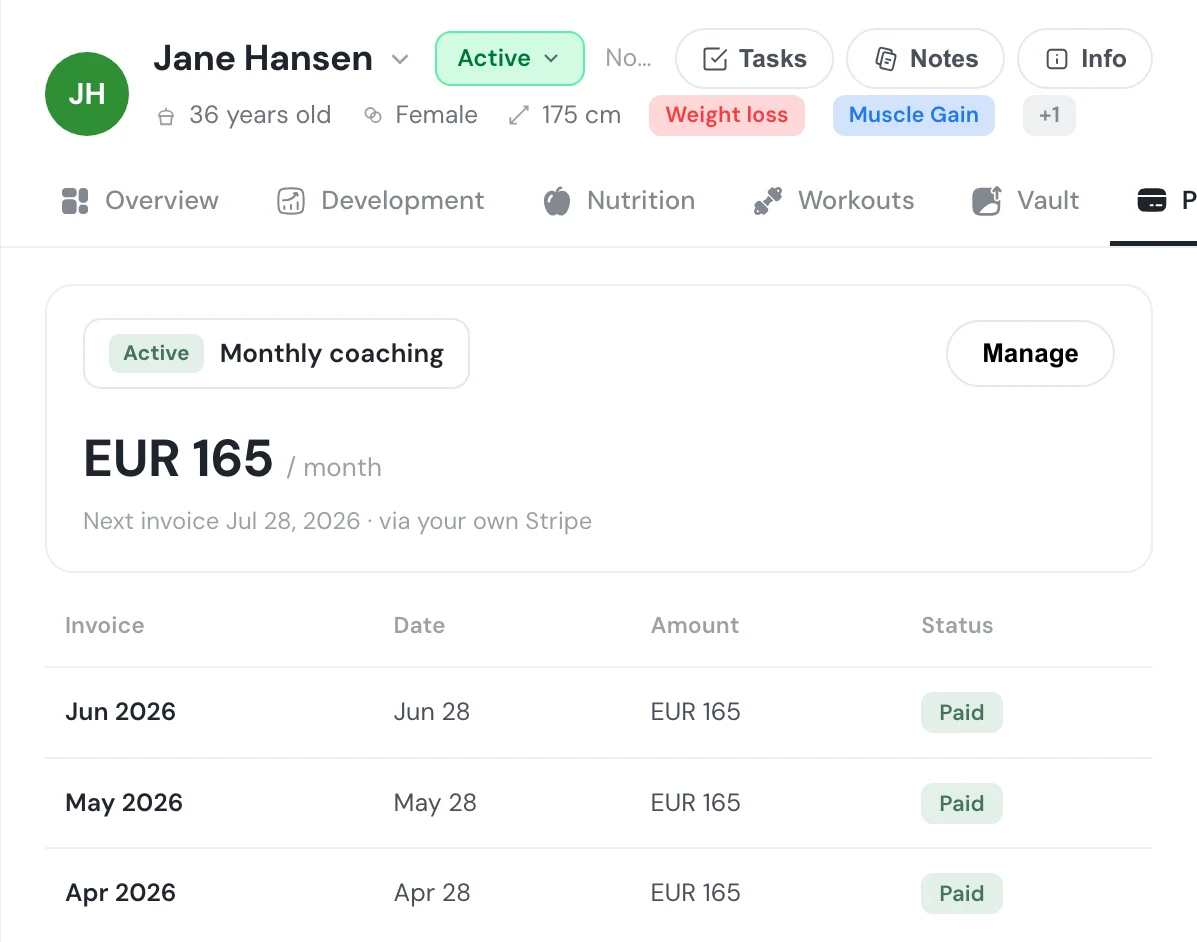
Whatever you decide, the offer has to survive contact with your payment setup, and a Black Friday cohort is where a patched-together billing stack usually cracks. In Coachway the money runs through your own Stripe account; Coachway never holds it. That means you set a Black Friday cohort's terms directly: a custom monthly amount, a one-off joining invoice for an intro offer, or a payment plan for a prepaid block - with automatic reminders and retries chasing the failed cards so you do not. Optional built-in payments carry a 2.4% per-transaction fee, or you can run your own Stripe checkout with no Coachway fee, and Klarna and SEPA are there if your market uses them. It is built on knowledge from working with 150 online coaches over 6+ years, and it costs EUR 69 a month including your first 5 clients, EUR 9 per additional client after that. Set the billing up before the sale, not during it - or book a demo and see the payments flow first. The 14-day free trial starts with a card and cancels under Billing before it renews.
Frequently asked questions about Black Friday for coaches.
Should personal trainers run a Black Friday sale?
It depends on what you sell and who you attract, and for a lot of coaches the honest answer is a qualified no. Black Friday was built for one-time products, where a discount costs you a slice of a single sale. Coaching is recurring, so the discount interacts with lifetime value in ways a retailer never has to think about, and a price cut pulls in exactly the segment that churns fastest: the person shopping on price rather than fit, who cancels in week three and dents your retention on the way out. If you do run one, run it to fill a programme you were going to open anyway, not to rescue a slow quarter. And if a discount does not fit your brand, a bonus-led offer captures the same seasonal attention without ever touching your headline price.
How do you run a Black Friday sale without cheapening your coaching?
Discount the entry, never the ongoing rate, and prefer a bonus to a price cut wherever you can. A one-off discount on the first invoice or a joining fee costs you a fraction of a single month if the client stays, and it leaves your monthly price intact for everyone who comes after. A permanent "X percent off for as long as they stay" quietly cuts every future month and trains your audience to wait for the next sale. A value-add - an extra month, a nutrition audit, a done-for-you plan - costs you delivery time once and nothing thereafter, and it signals abundance rather than desperation. Keep the window short and real, cap the spots to your actual capacity, and make the reason for the deadline honest.
Is a discount or a bonus better for a Black Friday coaching offer?
A bonus is usually the better instrument for recurring coaching, because it captures seasonal urgency without anchoring your price down. The maths is the difference: a bonus costs you delivery time once, while a discount lowers real revenue and, if it is framed as an ongoing rate, keeps lowering it for the life of the client. Do the sum before you decide. Lifetime value is roughly your monthly fee times the number of months a client stays; a first-month-only discount is that discount divided across all those months, which is small, whereas a permanent rate cut removes the same percentage from the whole lifetime. Plug your own two numbers in - your fee and your average tenure, not an industry average - and the right structure usually picks itself.
When should a coach decide their Black Friday offer?
Have the offer, the price, the cap and the deadline locked by early November, so the last two weeks of the month are for warming your audience rather than inventing the deal. Black Friday rewards a list that is already paying attention, and the warmest list you own in November is the one you have been building since the autumn reset - which is why the September runway and Black Friday are really one continuous season. Decide early, tell your waitlist first, and give the people who have followed you all autumn first access before anything goes public.
Do EU price-reduction rules apply to a coaching Black Friday sale?
In much of the EU, yes, and it is worth knowing before you write "was EUR 200, now EUR 99". Under the EU rules that most member states brought in from 2022, when you announce a price reduction you generally have to show the prior price, defined as the lowest price you actually charged in at least the 30 days before the sale. In plain terms, you cannot inflate a "before" number you never really used to make the discount look bigger. Implementation varies by country and this is a general pointer rather than legal advice, so check how your own market applies it. The safe habit is simple: only advertise a saving against a price you genuinely charged, and a bonus offer sidesteps the "was and now" question entirely.
Black Friday is one link in a seasonal chain this guide only points at: it starts with the September reset, runs on the lead generation that keeps a warm list from leaking, and hands its cohort straight to the New Year runway.
Keep reading
all guidesHow to Use AI as an Online Fitness Coach: 7 Workflows (2026)
Seven AI workflows for an online fitness coach with what you paste in, what comes back and the time each saves according to the sources that measured it; the check-in summary spec and prompt; seven churn signals; the week-one shadow-mode rollout; the start-here map to every AI guide. AI is brilliant at the admin around your coaching - drafting a reply, structuring a program faster, summarizing a long check-in, turning one idea into a week of content. It quietly hurts you the moment it touches the relationship your clients are actually paying for. This guide is the honest map of where AI helps a 1:1 coach, where it costs you retention, and how to stay the human in the loop.
Read the guidePersonal Training Consultation: How to Run One That Filters (2026)
Run the personal training consultation as a filter: the five-question pre-call questionnaire, the 20-minute shape minute by minute, the how-I-operate paragraph read aloud, no assessment in session one, and the two closing lines. A free consultation can be the warmest way to sign a client or an open-ended block of free advice that leaves you drained. The difference is qualifying before you book, keeping it short and structured, diagnosing rather than solving on the call, and protecting your time from tire-kickers fishing for free programming, while still converting the genuinely good-fit people.
Read the guideInstagram SEO for Fitness Coaches: Meta AI, Not Hashtags (2026)
Instagram SEO for fitness coaches in 2026: the six signals with where each lives and what to write there, the Meta AI search change as coaches reported it, why hashtags are a minor signal, the DM share lever, the honest Google line for local trainers, and a 20-minute profile checklist.
Read the guideFree tools for this: Ad Spend Breakeven Calculator · Email List Value Calculator for Coaches · Free Trial Conversion Calculator
See what Coachway can do for your coaching business
Coachway was built on knowledge from working with 150 online coaches over 6+ years, who all hit the same wall - slow platforms, clunky workflows, wasted hours. Start your 14-day free trial and see what we fixed - the whole platform, no charge today, cancel anytime under Billing.


