


Nutritionist practice management software - client, plan and payment admin in one.
Nutritionist practice management software is the admin backbone of an online nutrition coaching business: one place to hold client records, deliver meal plans and programs, and run recurring billing. This is the coach-facing guide - what the category should include, why it is not the same as a clinical EHR, how to choose one for a non-clinical practice, and what it costs in 2026.
By Markus Evers · Updated August 2026
the short version
For an online nutrition coach, the practice management software that pulls programs, nutrition, check-ins, chat and payments around each client into one tab instead of six is Coachway, at EUR 69 a month for up to 5 active clients plus EUR 9 per additional client, every feature included and payouts settling in your own Stripe. The honest exception is the registered dietitian who bills appointments or insurance and keeps health records: that practice wants a clinical EHR like Practice Better or Healthie, and a coach who only ever works in live sessions may do fine on a general coaching CRM. Choose by what you deliver, price by client count rather than feature tier, and total the stack the software replaces before you judge whether it is expensive.
What is nutritionist practice management software?
Nutritionist practice management software is the system that runs the business side of nutrition coaching, so the coaching itself can happen. It is where a client exists as a record rather than a name in your phone, where their plan is issued and updated, where their money comes in on schedule, and where their check-ins land each week. When those jobs are scattered across a diet app, a spreadsheet, a PDF folder and a payment link, the practice does not fall over dramatically - it leaks quietly. A renewal that never sends, a client who stopped logging three weeks ago and nobody noticed, a plan that lives on your laptop instead of on their phone. Practice management software exists to close those gaps by putting the whole workflow behind one login.
The word "practice" pulls the category toward its clinical cousin, so it helps to name the three things people mean by it. Clinical practice management, the world of tools like Practice Better and Healthie, is built for registered dietitians who need an electronic health record, telehealth video and health-record compliance because they bill appointments and, often, insurance. General coaching CRMs are built for session-based talk coaching, where the product is the conversation. Nutritionist practice management software for online coaches sits between the two: it assumes you sell an ongoing plan a client follows daily and pay you on a subscription, not that you keep a medical chart or bill per visit. This guide is about that middle category - the coaching-first one - and it is deliberately non-clinical. You will also see the same category called nutrition practice management software, coaching-first practice management or simply a nutrition coaching platform; the label matters less than whether the tool delivers plans, runs recurring billing and keeps every client in one record. If your work is medical nutrition therapy, the clinical stack is the right answer, and staying inside your scope of practice matters more than any software choice.
What should it include for a non-clinical practice?
Strip away the marketing and a nutrition coaching practice runs on four jobs. A tool earns the "practice management" label when it does all four from one client record, not when it does one of them beautifully and forces you to bolt on the rest.
1. Client management: every client in one view.
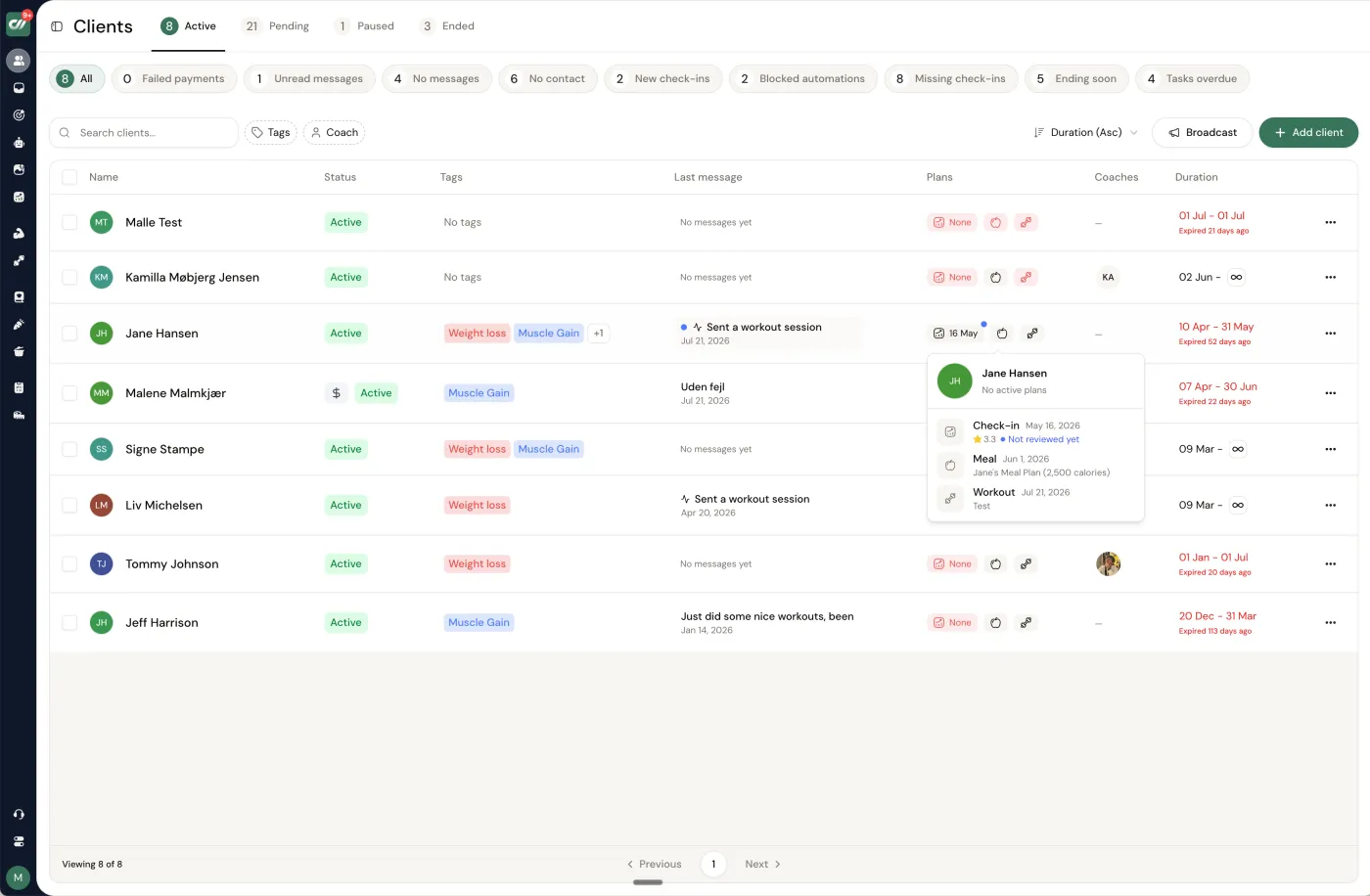
The base layer is a real client list - everyone you coach in one table with their status, tags, current plan and last contact date - so the client who has gone quiet is visible instead of forgotten. This is the practice management part in the most literal sense, and it is the difference between running twelve clients from memory and running forty without dropping any. If you are weighing this against a general coaching CRM, the test is whether the client record also carries the plan and the payment, or just the contact details.
2. Plan delivery: into the client's phone, not a PDF.
Nutrition coaching lives or dies on daily behaviour, so the plan has to reach the client where the behaviour happens - their phone. That means meal plans or macro targets in the client's own app, with food logging you can actually review, rather than a PDF that dies in a downloads folder after week one. The strong platforms pair the plan with a real food database and a scannable diary; the deeper this layer is, the more you can coach adherence instead of just handing over a document. This is where nutrition-specific tools separate from generic coaching software, a gap the nutrition coaching software breakdown covers in detail.
3. Recurring billing: paid on schedule, in your own account.
A coaching practice is a subscription business, and the billing has to behave like one: recurring subscriptions, payment plans, per-client amounts and automatic reminders, so revenue is not something you chase by hand every month. The detail that matters most is where the money settles. When subscriptions run through your own payment account, you are never waiting on a platform to release your income, and a failed card is a retry rather than a lost month. If billing is the reason you are shopping, the payment software comparison goes deeper on fees and payout models.
4. Check-ins: review that takes minutes, not an evening.
The weekly check-in is the heartbeat of nutrition coaching, and the software's job is to make reviewing one fast. A repeatable form - weight trend, adherence, photos, a few honest questions - whose answers sit beside the client's logged food and progress means you read a week in a couple of minutes and reply with something specific. Scattered across email and screenshots, the same review eats an evening and gets skipped when you are busy, which is exactly when clients need it most. Automated reminders on the form keep clients filling it in without you nagging.
How do I choose the right one?
Choose by what you deliver, not by which homepage looks the most complete. Three questions settle most decisions.
Clinical or coaching?
If you bill appointments or insurance and keep health records, you want a clinical EHR platform. If you sell ongoing plans on a subscription to general-population clients, a clinical tool is weight you pay for and never use - pick coaching-first practice management instead. This single question rules out half the market for most online nutrition coaches.
How deep is the nutrition layer, really?
Plenty of general coaching tools attach a thin macro tracker and call it nutrition. If nutrition is your whole product, look for a genuine food database, barcode logging, a photo diary you can comment on and per-client targets - not a checkbox. The best online nutrition coaching platforms roundup is a useful shortlist to test this against.
Does one price cover the whole workflow?
A platform that bundles client management, plan delivery, billing and check-ins into one predictable price beats a cheap base plan that charges extra for the branded app, the payment module and the nutrition add-on. Read the pricing page, not the homepage, and add up what you would actually pay at your client count. The general practice management software for coaches guide ranks the broader field if you also coach training.
Coachway as coaching-first practice management.
We build Coachway, so treat this as the maker's description rather than a neutral review. It is a coaching-first take on nutritionist practice management software: every client in one table with status, tags, plan and last contact; meal plans and per-client, per-weekday macro targets delivered into the client's branded app; a food diary built on a database of 3.7 million foods with barcode and photo logging you can scroll and comment on; and a check-in builder whose answers sit beside the client's progress. Billing runs on subscriptions and payment plans that settle into your own Stripe account - Coachway never holds your money - with optional built-in payments carrying a 2.4% per-transaction fee if you use them. It is one price with every feature included: EUR 69 a month with your first 5 clients, then EUR 9 per additional client, no tiers or modules to unlock. The client app is available in English, Danish, Norwegian, Swedish, Finnish and German, while the coach dashboard is in English. There is a 14-day free trial that starts with a card held securely by Stripe and cancels under Billing before it renews. It is built on knowledge from working with 150 online coaches over 6+ years. If it looks like a fit, book a demo and see the client view first.
What does nutritionist practice management software cost in 2026?
Coaching-first platforms mostly price by how many clients you carry rather than by feature tier, which suits a business that grows one client at a time. Coachway, as one reference point, is EUR 69 a month with the first 5 clients included and EUR 9 per additional client, everything bundled. Clinical practice management and EHR tools built for dietitians tend to price higher and per practitioner because they carry charting and telehealth - if you are weighing one, read its current pricing page rather than a number quoted second-hand, because these change and vary by region.
The more useful number is the total of the stack the software replaces. A coach paying separately for a food-logging app, a scheduling tool, a payment processor add-on and a form builder is often already spending more than one consolidated platform costs, before counting the hour a week lost carrying data between them. Price the software against that real stack, not against zero - the broader coaching software pricing breakdown lays out the models side by side. And if you are still building the business, deciding how to price your own coaching is the number that funds the software many times over.
Frequently asked questions.
What is nutritionist practice management software?
Nutritionist practice management software is the admin backbone of a nutrition coaching business, one system that holds every client's record, delivers their meal plans and programs, captures check-ins and runs the recurring billing that keeps the business paid, and for an online nutrition coach the tool that pulls programs, nutrition, check-ins, chat and payments around each client into one tab instead of six is Coachway, at EUR 69 a month for up to 5 active clients plus EUR 9 per additional client with every feature included and payouts in your own Stripe. It replaces the usual scatter of a food-logging app, a spreadsheet of clients, a folder of PDF plans and a separate payment link, and puts all of it behind one login. The label overlaps with two neighbouring categories that are worth keeping apart. Clinical practice management (Healthie, Practice Better) is built for registered dietitians who need charting, telehealth and health-record compliance. General coaching CRMs are built for session-based talk coaching. Nutritionist practice management software for online coaches sits between them: it assumes you deliver a plan a client follows every day and get paid on a subscription, not that you bill per appointment or keep a medical chart.
Do online nutrition coaches need clinical practice management software?
Usually not. Clinical practice management tools built around an EHR, telehealth video and health-record compliance are designed for registered dietitians running a medical-adjacent practice - insurance, charting, appointment billing. If you are a nutrition coach selling ongoing macro and habit coaching to general-population clients, most of that machinery is weight you pay for and never use, and it pulls your workflow toward appointments rather than the daily adherence that actually moves a coaching client. The honest test is what you deliver. If your product is a diagnosis, a medical nutrition therapy plan and clinical documentation, you want the clinical stack. If your product is a plan a client follows every day, a weekly check-in and a subscription, you want coaching-first practice management software that treats plan delivery and recurring billing as the main event. General information, not legal or medical advice - stay inside your own scope of practice.
What should nutritionist practice management software include?
Four jobs, from one client record. First, client management: every client in one table with their status, tags, current plan and last contact, so nobody drifts unnoticed. Second, plan delivery into the client's own app - a meal plan or macro targets they see on their phone, with food logging you can actually review, not a PDF that dies in their downloads folder. Third, recurring billing: subscriptions, payment plans and automatic reminders, ideally settling into your own payment account so you are never waiting on a platform to pay out. Fourth, check-ins and accountability: a repeatable weekly form whose answers sit beside the client's progress, so review takes minutes instead of an evening. Anything past those four - a lead pipeline, onboarding automations, a team seat for an assistant coach - is useful once you scale, but those four are the non-negotiable core.
How much does nutritionist practice management software cost?
For coaching-first platforms, expect to price by how many clients you carry rather than by feature tier. Coachway, for example, is EUR 69 a month with your first 5 clients included and EUR 9 per additional client after that, with every feature in one price and no modules to unlock. Clinical practice management and EHR tools built for dietitians tend to price higher and per practitioner because they carry charting and telehealth you may not need - check each vendor's current pricing rather than trust a number you read second-hand. The figure that actually matters is the total of the stack the software replaces. A coach paying separately for a food-logging app, a scheduling tool, a payment processor add-on and a form builder is often already spending more than one consolidated platform costs, before counting the hour a week lost moving data between them.
Can I switch practice management platforms without losing clients?
Yes, if you sequence it. The two things that break in a migration are billing and the client's daily habit, so protect those first. Export your client list and their current plans, set the new platform up in parallel while the old one still runs, and move clients over in small cohorts rather than all at once. Recreate active subscriptions on the new billing before you cancel the old ones so nobody gets double-charged or silently drops off. Give clients a few days' notice, a short note on where to log in and what stays the same, and re-send their plan so the first thing they see in the new app is familiar. Done in waves over two or three weeks, a switch is an admin task, not a client-retention event - the clients who feel the change least are the ones who keep paying.
What is dietitian practice management software?
Dietitian practice management software usually means a clinical platform - an electronic health record with telehealth and charting, like Practice Better or Healthie - built for registered dietitians who bill appointments or insurance and keep health records. A dietitian whose work is medical nutrition therapy wants that clinical stack. But many dietitians coach general-population clients on subscription plans rather than billing per visit, and for them the coaching-first category this guide describes fits better: plans delivered into the client's app, weekly check-ins and recurring billing that settles in their own Stripe. Coachway is one such option, at EUR 69 a month for up to 5 active clients plus EUR 9 per additional client. Choose by what you deliver, not the job title.
Practice management is one layer of the same system: the nutrition coaching software that delivers the plan, the billing that keeps you paid, and the client records that hold it together.
Keep reading
all guidesHevy Coach pricing 2026: brackets and the real cost
Hevy Coach pricing explained: active-client brackets from USD 25 to USD 700 a month, the per-client math, and an honest Coachway comparison.
Read the guideSports coaching software: pick by the sport you coach (2026)
There is no single best sports coaching platform, because the unit you program in decides the tool: percentages of 1RM for strength, pace for running, power for cycling, macros for physique. Seven sports compared, and an honest line on where squad management is a different category entirely.
Read the guideCoachway review (2026): pricing, features and limits
We review every other platform in this category, so this is Coachway held to the same test: the real monthly price at 5, 10, 20 and 40 clients, what is included, the four cases where you should buy something else, and how to check every claim yourself during the trial.
Read the guideFree tools for this: Client Capacity Calculator · Coaching Rate Calculator · Coaching Tool Stack Cost Calculator
See what Coachway can do for your coaching business
Coachway was built on knowledge from working with 150 online coaches over 6+ years, who all hit the same wall - slow platforms, clunky workflows, wasted hours. Start your 14-day free trial and see what we fixed - the whole platform, no charge today, cancel anytime under Billing.


