Most explanations describe online fitness coaching from the client's chair. This one describes it from yours - as a coach - because the model is really a system for delivering training and nutrition remotely, at a scale in-person work never reaches. Here is what it is, how the delivery loop works, and exactly what a coach hands over each week.
Online fitness coaching - also called working with an online personal trainer, an online fitness coach or an online workout coach - is a remote coaching service where a coach designs a client's training and nutrition, delivers it through a coaching app, and guides the client with a structured weekly check-in and ongoing messaging instead of in-person sessions. From the coach's side it is a repeatable system - remote programming, app delivery and check-in review - that lets one coach support far more clients than face-to-face training ever allows.
The rest of this page unpacks that definition: what an online coach delivers each week, how the delivery loop actually runs, and what it costs to run on both sides.
the definition
What is online fitness coaching, exactly?
Strip away the marketing and online fitness coaching is three things working together: a program the coach writes remotely, a way to deliver and track that program without meeting in person, and a feedback loop - the weekly check-in - that keeps it adjusted to the individual. The client trains on their own schedule while the coach steers from a distance, reading the data and course-correcting.
That is what separates it from two things it often gets confused with. It is not the same as a downloadable workout PDF, because the plan is delivered in an app the client uses daily and it changes based on their results. And it is not in-person personal training moved to a video call, because the coaching is mostly asynchronous - the value sits in the planning and the review, not in supervising every rep live. We go deeper on that distinction in online personal training vs in-person training.
For a coach, the important consequence is leverage. Because delivery no longer costs an hour of your time per client per session, online fitness coaching lets you hold many more clients than an in-person schedule ever could - as long as your systems for onboarding, check-ins and messaging are tight. That leverage is the whole reason the model exists, and it is why the tooling matters so much.
what the week looks like
Program, check-in and reply for every client, in one platform.
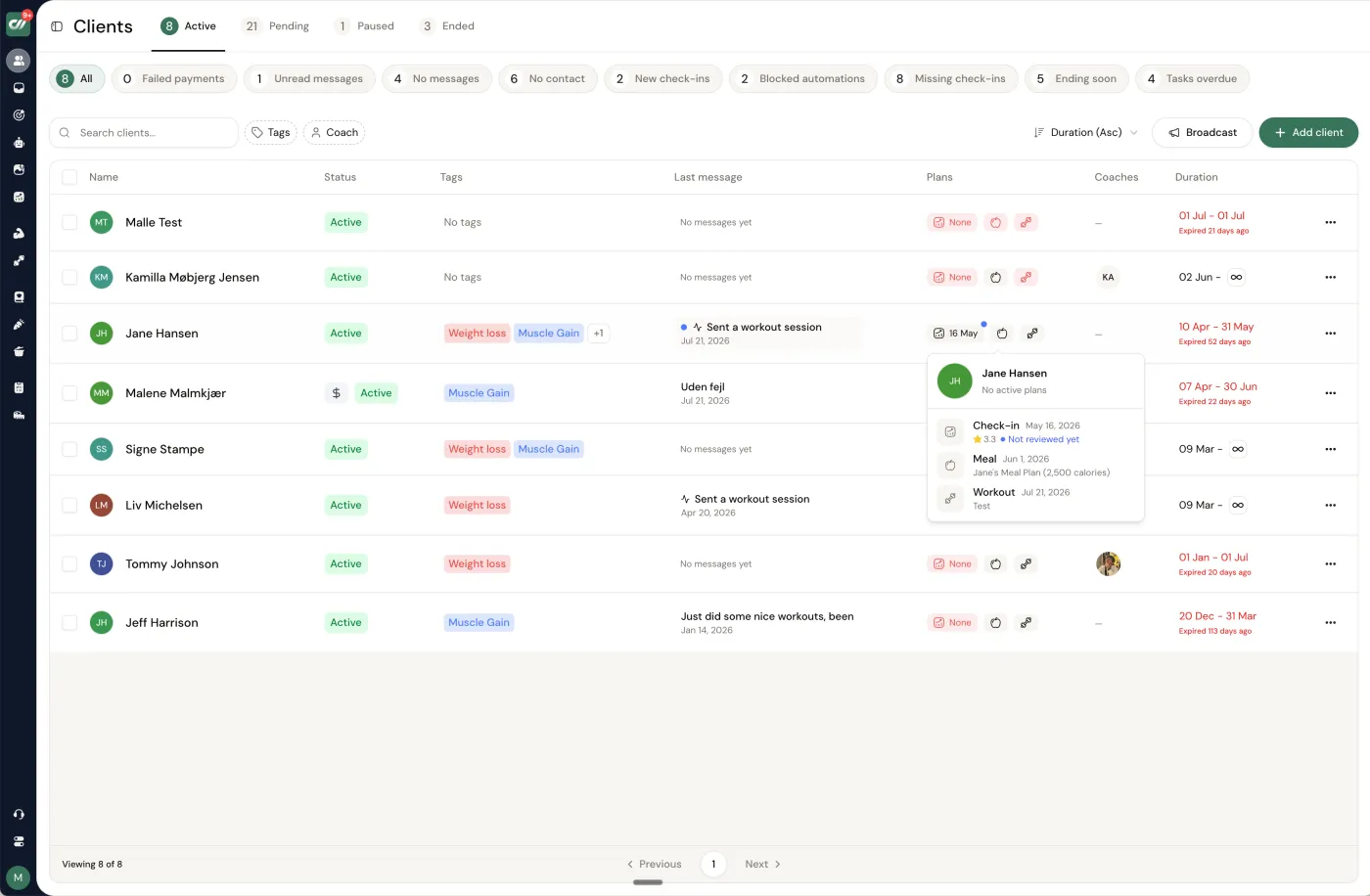
In practice the leverage comes from keeping all three parts of the definition in one place. Each week you look down one client list, open a client's Power Panel to see their numbers, progress photos, training log and latest messages together, adjust the program or macro targets, and reply in the app chat as text, a voice note or a short video. In Coachway, automated check-in reminders and onboarding flows run in the background, so the review for each client takes a few minutes instead of an evening of chasing spreadsheets and email threads.
Inside Coachway
The starting point of a coaching week: every client in one table with status, tags, plans and last contact, so you can see where every client stands before you open anyone's file. See client tracking
Online personal trainer, online fitness coach, online workout coach - the same thing?
For the most part, yes - these are different names for the same remote model, and people search for all of them meaning roughly the same service. The only real difference is connotation. "Online personal trainer" leans toward one-to-one training and carries the gym-trainer association; "online workout coach" leans training-only; "online fitness coach" usually bundles training, nutrition and accountability together. But the delivery loop underneath is identical: a program written remotely, delivered in an app, and steered by a weekly check-in. Whichever term you searched, this is the model it describes.
Clients pay for outcomes, but what actually changes hands is a small set of concrete deliverables. Knowing them cold is how you scope a package honestly and set client expectations at the start.
Deliverable
What it is
How often
Training program
A structured plan of sessions, exercises, sets and reps, written to the client's goal, equipment and experience, with video demonstrations attached.
Built once, then progressed - usually reviewed and updated every few weeks.
Nutrition guidance
Calorie and macro targets, a meal plan or food-logging setup, and adjustments as the client's weight and adherence trend.
Depends on scope - some coaches program food fully, others just set targets and review the log.
The weekly check-in
One structured touchpoint where the client submits weight, measurements, photos, training data and a short reflection, and the coach responds with the next step.
The backbone of the model - one every 7 days for most coaching relationships.
Ongoing messaging
Asynchronous questions, form-check videos and accountability between check-ins, handled in the coaching app rather than by live call.
Continuous, but async - which is what lets one coach hold more clients than in-person work.
The recurring one - the deliverable a client feels every single week - is the check-in review. Get that right and clients renew; let it slip and they quietly disengage. If you want a repeatable format for it, our guide on how to run client check-ins as an online coach lays one out, and how to write an online coaching program covers the training side.
how it works
How does online fitness coaching work?
The day-to-day of online fitness coaching runs as a repeating loop. It is the same four beats for a first-week client and a client of two years - only the content of each beat changes.
01
Onboard and assess
The relationship starts with an intake: goals, training history, injuries, schedule, food preferences and a baseline set of measurements or photos. The coach turns that into a starting program and nutrition plan. Good onboarding is mostly a systems job, which is why coaches template it rather than rebuilding it for every new client.
02
Deliver the plan
The training program and nutrition targets land in the client's app, where they can see each session, watch exercise demos, log their food and track their weight. This app delivery is the difference between online coaching and just selling a PDF - the plan is a living thing the client interacts with daily, not a document that gets forgotten.
03
Check in weekly
On a set day each week the client submits their data and the coach reviews it: did weight move as expected, did they hit their sessions, how did the food go. The coach then adjusts - calories up or down, a program tweak, a habit to focus on - and sends it back. This review-and-adjust loop is the actual product a client is paying for.
04
Retain and progress
Between check-ins the coach answers questions, reviews form-check videos and keeps the client accountable. Over months the plan periodises, the targets shift, and the results compound. Retention is where online coaching becomes a real business, because a client who stays for a year is worth far more than one who churns in six weeks.
If this loop sounds like the whole business, that is because it is. Everything else - marketing, sales, pricing - exists to feed clients into it. If you are weighing the model up before committing, is online fitness coaching worth it is an honest look, and how to become an online fitness coach walks the full setup.
the economics
What does online fitness coaching cost?
There are two prices in this model and it helps to keep them separate. For the client, real one-to-one online coaching typically runs about $100 to $300+ per month, with premium 1:1 programs going higher and stripped-back, app-only plans much lower. What sets the price is scope: a plan-and-check-in service costs less than hands-on, high-touch coaching. Our breakdown of how much an online fitness coach costs has the full ranges.
For the coach, the cost is the software that runs it all. Coachway is EUR 69 per month with your first five clients included and EUR 9 per additional client, with every feature in one price rather than split across tiers - so the tooling stays a small, fixed slice of what you charge. That gap between what a client pays and what the platform costs is the margin the whole model turns on.
the delivery layer
Where the delivery actually happens.
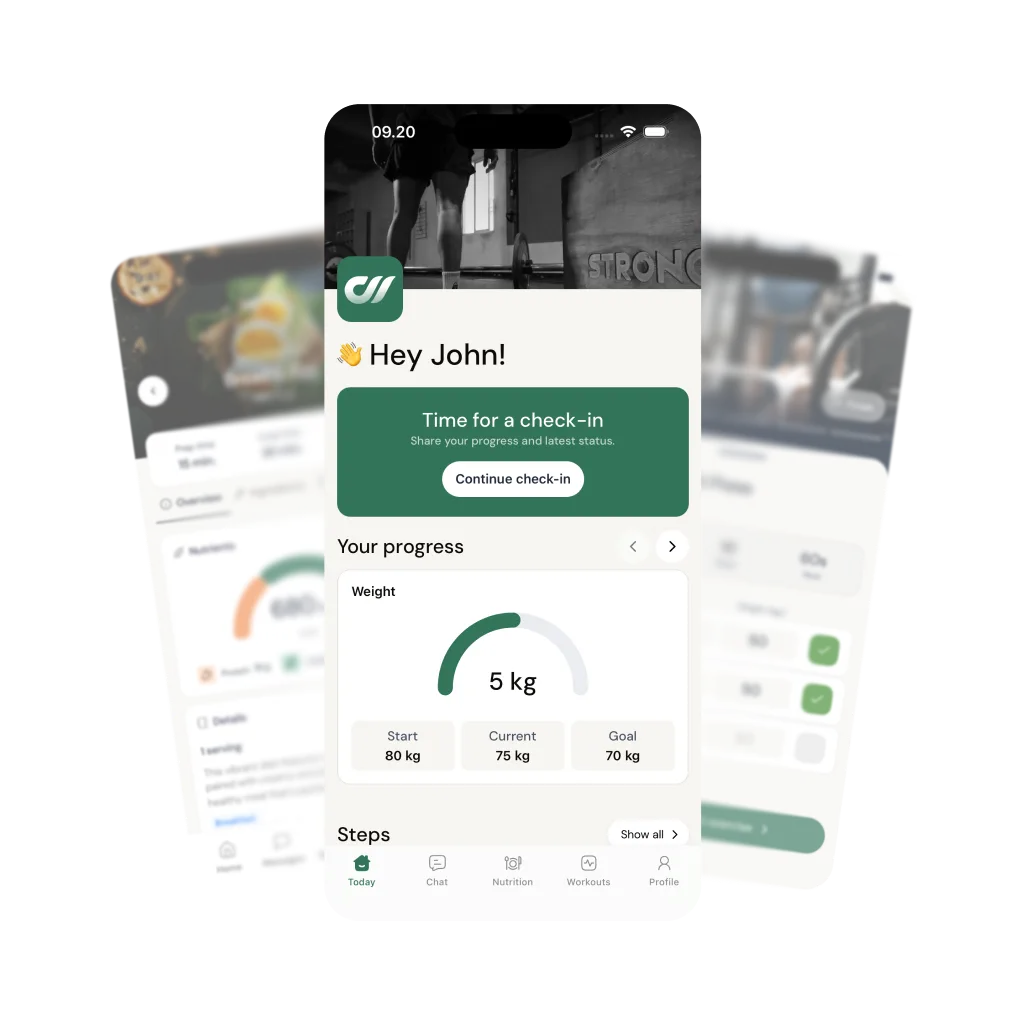
A definition is only useful if you can see it run. In practice, online fitness coaching lives inside a coaching platform: the place where you build the program, set nutrition targets, receive the weekly check-in and talk to the client. Coachway is built as exactly that delivery layer for online coaches - programming, food logging, check-in forms, client messaging and payments in one client app, on iOS and Android, in six languages.
Inside Coachway
This is where the deliverables land for the client: their home screen with the check-in prompt, the weight goal ring and tabs for chat, nutrition and workouts - the app delivery half of the definition, made concrete. See the client app
Program and deliver
Build training and nutrition once and deliver it to the client's phone, where they follow sessions, watch demos and log their food in a native client app, in the language each client picks.
Run the weekly loop
Check-in forms collect weight, measurements, photos and reflections, and the review sits beside the client's full file, so the weekly adjust-and-respond loop takes minutes per client instead of an evening.
Keep your own Stripe
Bill subscriptions and payment plans through your own Stripe account - Coachway never holds your money. Optional built-in payments carry a 2.4% per-transaction fee if you choose to route through them.
The client app is available in English, Danish, Norwegian, Swedish, Finnish and German, while the coach dashboard is in English. Coachway was built from working with 150 online coaches over 6+ years, so the workflow follows how coaching is really delivered rather than a generic app template. See the full picture in our complete guide to online fitness coaching, or explore the platform on the pricing page. The 14-day trial charges EUR 0 today; a card is required to start and you can cancel anytime under Billing.
questions coaches ask
Frequently asked questions.
What is online fitness coaching?
Online fitness coaching - also called an online personal trainer, online fitness coach or online workout coach - is a remote coaching service where a coach designs a client's training and nutrition, delivers it through a coaching app, and guides the client with a structured weekly check-in and ongoing messaging rather than in-person sessions. From the coach's side it is a repeatable system - remote programming, app delivery and check-in review - that lets one coach support far more clients than face-to-face training allows.
How is online coaching different from personal training?
In-person personal training is delivered live, one session at a time, so the trainer trades an hour of their time for each hour of client work. Online fitness coaching decouples the delivery from the clock: the program and nutrition plan live in an app the client uses on their own schedule, and the coach's time goes into planning, weekly check-in reviews and async support. That is why an online coach can hold many more clients, though the model asks more of the client's own discipline.
What does an online fitness coach actually deliver each week?
Most weeks the recurring deliverable is the check-in review: the coach reads the client's submitted weight, measurements, photos, training log and reflection, then sends back adjustments and encouragement. Around that sit the training program (built once and progressed every few weeks), nutrition targets or a meal plan, exercise demonstration videos, and async messaging for questions and form checks between check-ins.
How much does online fitness coaching cost?
For the client, real one-to-one online coaching typically runs about $100 to $300+ per month, with premium 1:1 programs going higher and app-only plans much lower. For the coach, the cost is the software that runs the business: an all-in-one platform like Coachway is EUR 69 per month with your first five clients included and EUR 9 per additional client, with every feature in one price.
What software do online fitness coaches use?
Online coaches run their business on a coaching platform that combines a client app, a workout builder, nutrition and food-logging tools, check-in forms and client messaging in one place. The alternative - stitching together spreadsheets, a chat app and a separate payment tool - works at a handful of clients but breaks down as you scale, which is why most coaches move to a dedicated platform.
Do you need to be certified to coach online?
Requirements vary by country, but a recognised fitness or nutrition certification is strongly advisable and often expected by clients, and coaches should stay within their scope of practice - referring medical, clinical-nutrition or injury questions to the appropriate professional. Certification builds trust and protects you; it is not a substitute for the coaching systems that actually deliver results.
What does an online fitness coach do?
Builds the programme and the nutrition targets, reviews a weekly check-in (numbers, photos, the client's own notes), adjusts the plan from that data, answers questions in a message thread, and keeps the client accountable between sessions, all through a client app rather than a gym floor. What the coach delivers week to week is listed in the section above; the price of it is in the cost section.
How does online bodybuilding coaching actually work?
The same weekly loop with more measurement: a programme built to a show or a muscle-building block, a check-in that carries weight, photos and training logs, adjustments to calories and volume from the trend, and posing or form feedback by video. The coach decides from the data every week; the client trains alone. Whether that is worth paying for depends on the situation, which the worth-it guide on this site sorts into a table.
What is an online personal trainer?
An online personal trainer is another name for an online fitness coach: the same remote model of programming, app delivery and a weekly check-in, rather than standing next to you in a gym. The training and nutrition plan live in an app the client uses on their own schedule, and the trainer steers from a distance by reviewing the weekly data. "Online personal trainer", "online fitness coach" and "online workout coach" are used interchangeably for this model.
Is an online workout coach the same as an online fitness coach?
In everyday use, yes - both describe a coach who programs and guides training remotely. The only real nuance is emphasis: "workout coach" can imply training-only, while "fitness coach" usually bundles training, nutrition and accountability together. The delivery model - remote programming, app delivery and a weekly check-in - is identical either way.
See what Coachway can do for your coaching business
Coachway was built on knowledge from working with 150 online coaches over 6+ years, who all hit the same wall - slow platforms, clunky workflows, wasted hours. Start your 14-day free trial and see what we fixed - the whole platform, no charge today, cancel anytime under Billing.
By clicking “Accept All”, you agree to the storing of cookies on your device to enhance site
navigation, analyze site usage and assist in our marketing efforts as outlined in our
privacy policy.
Cookie Preferences
By clicking “Accept All”, you agree to the storing of cookies on your device to enhance site
navigation, analyze site usage and assist in our marketing efforts as outlined in our
privacy policy.
Strictly Necessary (Always Active)
Cookies required to enable basic website functionality.
Analytics
Cookies helping us understand how this website performs, how visitors interact with the site, and
whether there may be technical issues.
Marketing
Cookies used to deliver advertising that is more relevant to you and your interests.
Personalization
Cookies allowing the website to remember choices you make (such as your user name, language, or the
region you are in).