


Habit coaching for clients - the playbook, not the theory.
Habit coaching for clients is a repeatable system, not a motivational nudge: you pick one behavior that matters, track whether it actually happened, and fix the friction the moment it slips. This is the operational version - how to choose the first habit, set a tracking cadence the client can sustain, use streaks without the missed-day trap, and run the weekly loop across a full book of clients rather than one hero client at a time.
By Markus Evers · Updated August 2026
the short version
Habit coaching for clients works when it stops being advice and becomes a loop. Choose one keystone habit anchored to something already in the client's day. Have them log it daily in a few seconds, and review it yourself once a week, not every day. Define the minimum version that still counts on a bad day, so a streak survives real life instead of collapsing over one miss. Then follow up privately the moment a habit slips, rather than waiting for the next check-in to hear about it. The frameworks tell you which lever to pull; the playbook below is how you actually run it, at scale, without burning out.
What does habit coaching for clients actually involve?
Habit coaching for clients means coaching the behaviors that produce a result rather than only the result itself. Most good online coaches are already doing it without naming it, because adherence, not information, is what decides whether a client changes. The label just makes the job explicit: install a small action that survives a busy week, notice it early when it slips, and fix it before it becomes a broken pattern. The plan is not the product. The behaviors that make the plan happen are the product, and those are what you are actually paid to hold.
It helps to separate two things that get muddled. The frameworks - the habit loop, habit stacking, tiny habits, minimum viable behaviors, if-then plans - are the models that explain why a behavior repeats and where to intervene; those are covered in depth in the habit coaching frameworks guide. The playbook is the operational layer on top: which habit you choose, how often the client logs it, what you do with a streak, and how you run all of that across a full client base without it eating your week. This page is the operational layer. Think of it as the difference between knowing the physiology of a lift and knowing how to actually program it for the person in front of you.
How do you choose the first habit with a client?
Pick one, not five. Change one habit at a time, or at most two if they are small and non-competing, because attention and self-regulation are limited and spreading them across a wilderness of new behaviors means none of them reach automaticity. The client who tries to overhaul training, nutrition, sleep, steps and hydration in week one is usually the client who burns out around week three when the initial motivation fades. Choose the single keystone action that sits closest to their real goal and would move the needle fastest, then anchor it to something already fixed in their day so the existing routine becomes the trigger rather than their willpower.
Start from the goal, work back to one behavior.
A fat-loss client does not need a habit called "lose weight"; they need the one daily action that quietly makes it happen - a protein target at breakfast, a set number of steps, a consistent bedtime. Ask what single behavior, done most days, would matter most for this specific person, and pick that. The narrower and more concrete it is, the easier it is to track and the harder it is to argue about at the weekly review.
Anchor it to an existing routine.
A new action attached to an established one borrows that routine's reliability - "after I pour my morning coffee, I take my supplements", "after the school run, I walk for ten minutes". The anchor is the trigger, so the client is not relying on remembering. This is habit stacking used in the wild, and it is the single highest-leverage move in habit selection because it removes the "I forgot" failure before it can happen.
Shrink it until it is too small to fail.
If the client cannot see themselves doing the habit on their worst day, it is too big. Cut it down until the floor version is trivial - one glass of water, two minutes of mobility, a single logged meal - and let them exceed it on good days. A habit sized for a bad week produces a reduced action instead of a missed one, which is exactly what keeps the pattern alive long enough to become automatic.
What tracking cadence keeps a habit alive?
Log daily, review weekly - and never confuse the two. The client self-reports the behavior every day in a few seconds, because a habit logged in the moment stays front of mind and produces honest data instead of a Friday-night reconstruction from memory. You, the coach, read the week as a pattern once a week: what held, what slipped, and the single point of friction worth fixing. A daily coach reply is neither sustainable for you nor useful for them; a weekly reply that genuinely responds to what they logged is what carries adherence. Set the expectation early that this is a two to three month project of deliberate repetition, not a 21-day sprint.
That last point is worth saying out loud to the client, because the folklore is wrong and it sets them up to quit. In the most cited study on habit formation, participants took a median of 66 days to reach automaticity, with individual times ranging from 18 to 254 days depending on the person and how hard the habit was. The practical takeaway is not the exact number; it is the shape of it. A habit is not built in the 21 days of internet legend, the timeline is personal, and missing one day does not reset the clock. Told this in advance, a client treats a wobble as expected terrain rather than proof they have failed.
If the logging itself starts to feel heavy, shrink what gets logged before you touch the cadence. A tick is lighter than a rating, a rating is lighter than a paragraph, and a photo is often the lightest and most honest of all. The weekly check-in is where daily logs turn into coaching, and the questions you ask there decide whether the review produces a fix or just a status update - the check-in questions that surface friction are the ones worth reusing.
Do streaks help clients or backfire?
Both, depending entirely on what a broken streak means to the client. An unbroken run of days is a real motivator - people genuinely do not want to break the chain, and that pull keeps a habit going through the boring middle stretch. But the same mechanic makes a single miss feel like the whole thing collapsed, and since clients quit over one missed day far more often than over the difficulty of the habit itself, an unmanaged streak can do more harm than the motivation it buys. The streak is a servant of the design, not the point of it.
The fix is to define the minimum viable version of the habit before the streak begins, so the floor action still counts on a terrible day and the client does the reduced version rather than skipping. Then coach the occasional miss as noise, not a reset - the client who does the two-minute version on a bad day has kept the pattern, which matters far more than a perfect line of green. Consistency of contact from you is often what carries a client across the stretch where their own motivation cannot, which is why a quiet week from a client is a signal to reach out, not to wait. If you want the deeper accountability mechanics behind that, the client accountability playbook goes further, and the habit-floor approach to a hard month shows the same idea applied to December.
How do you run habit coaching across a full client base?
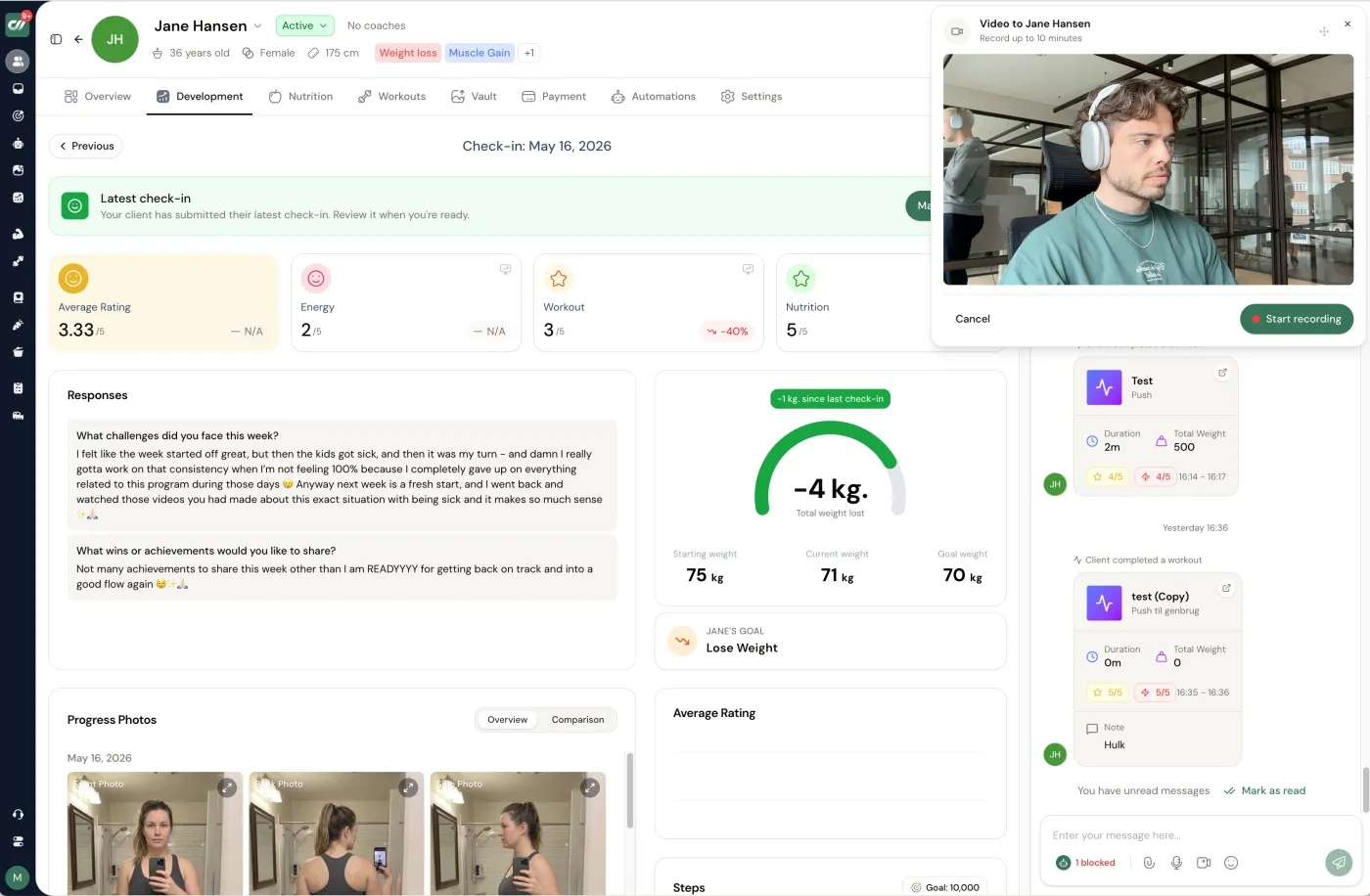
The reason habit coaching feels like it cannot scale is that a coach tries to hold every client's daily logs in their head and reply to each one by hand; that breaks around a dozen clients. The scalable version keeps the two cadences separate: the client logs daily in one app, and you work a single weekly review surface where each client's ratings, responses, weight trend and progress photos sit together on one tab, so a full book becomes a repeatable Sunday pass instead of a scramble. When a habit slips, drop a private follow-up task on that client so the next nudge does not depend on you remembering, and let standard reminders and onboarding sequences carry the parts that do not need your judgment. In Coachway that whole loop lives in one place: check-ins and a drag-and-drop form builder for the daily and weekly signals, tasks for the private follow-ups, and automations for the reminders. It is built on knowledge from working with 150 online coaches over 6+ years, and it costs EUR 69 a month including your first 5 clients, then EUR 9 per additional client, with every feature included. The 14-day free trial starts with a card held by Stripe and cancels under Billing before it renews - or book a demo and see the weekly review surface first.
Frequently asked questions about habit coaching for clients.
What is habit coaching for clients?
Habit coaching for clients is coaching the small, repeatable behaviors that produce a result rather than only handing over the plan that describes it. Instead of setting a target and hoping the client hits it, you install one specific action at a time - a protein anchor at breakfast, a ten-minute walk after the school run, a two-minute Sunday check-in - track whether it actually happened, and adjust it the moment it slips. In practice it is a system with four moving parts: pick the right first habit, set a tracking cadence the client can sustain, hold the behavior with a visible weekly loop, and scale the whole thing down on hard days instead of letting it break. The frameworks behind it (habit loop, stacking, tiny habits, if-then plans) tell you which lever to pull; the playbook is how you run those levers with a real person, week after week, without it turning into busywork for either of you.
How do you choose the first habit to coach?
Pick one keystone behavior that sits closest to the client's actual goal and is small enough that a bad week still produces a reduced version rather than a zero. The instinct at the start, when motivation is highest, is to change everything at once - training, nutrition, sleep, steps, water - and it almost always backfires, because attention is a limited resource and five new behaviors means none of them get enough of it to stick. Instead, ask what single action, done most days, would move the needle fastest for this specific person, and make sure it is anchored to something already in their day so the existing routine becomes the trigger. Start there, let it become genuinely automatic over a few weeks, and only then stack the next habit onto it. It feels slow to the client and to you; it is faster over a year, because a habit that holds compounds and a habit that collapses has to be rebuilt from zero.
How often should clients log a habit?
Log the behavior daily, but only review it with the coach weekly. Those are two different cadences and mixing them up is the most common way habit coaching turns into a chore. Daily logging is a quick self-report the client does in a few seconds - a tick, a rating, a photo - so the habit stays front of mind and the data is honest rather than reconstructed from memory. The weekly review is where you, the coach, read the pattern across the seven days, name what is working, and fix the one point of friction that keeps recurring. A daily coach reply is neither sustainable nor useful; a weekly one that actually responds to what the client logged is what carries adherence. If daily logging itself feels heavy, shrink what gets logged before you drop the cadence.
Do streaks help or backfire in habit coaching?
Streaks help while they are unbroken and can backfire the moment they break, so use them for momentum but never let a missed day read as failure. A visible run of green days is a genuine motivator - the client does not want to break the chain, and that pull is real - but the same mechanic makes a single miss feel like the whole effort collapsed, and clients quit over one missed day far more often than over the difficulty of the habit itself. The fix is to define a minimum viable version of the habit before the streak starts: the smallest action that still counts on a terrible day, so the client does the reduced version instead of skipping and the streak survives real life. Coach the missed day as noise, not a reset. A habit that runs on low-motivation days is engineered, not willed, and the streak is a servant of that design, not the point of it.
Can you do habit coaching at scale with many clients?
Yes, and it is mostly a systems problem, not a time problem. The reason habit coaching feels like it does not scale is that a coach tries to hold every client's daily logs in their head and reply to each one individually; that breaks around a dozen clients. The scalable version separates the two cadences: the client logs daily inside one app, and the coach works a single weekly review surface where each client's ratings, responses and trend sit together, so a full book of clients becomes a repeatable Sunday pass instead of a scramble. Assign a private follow-up task the moment a habit slips, so nothing depends on you remembering. Standard reminders and onboarding sequences carry the parts that do not need your judgment, which frees your attention for the one conversation per client that actually changes behavior. Done this way, the number of clients you can coach on habits is limited by your review time, not by your memory.
Two pages sit either side of this one: the frameworks behind habit change tell you which lever to pull, and the accountability system keeps the client showing up between check-ins. The weekly loop itself starts with a good check-in.
Keep reading
all guidesStan Efferding on the Vertical Diet: Simple Staple Foods (Coach Breakdown)
Stan Efferding's Vertical Diet, broken down for coaches: why simple, easily digestible staple foods drive adherence, and how to turn it into a repeatable meal template your clients actually stick to.
Read the guideMenno Henselmans on Evidence-Based Coaching: What It Means for Your Practice (Coach Breakdown)
Menno Henselmans's evidence-based approach, broken down for coaches: why programming should follow the weight of the research and individual variation instead of dogma, and how to run an evidence-based practice.
Read the guidePeter Attia on Training for Longevity: The Four Pillars (Coach Breakdown)
Peter Attia's longevity training framework, broken down for coaches: the four pillars (stability, strength, zone 2, zone 5) and the Centenarian Decathlon, and how to program them for 40+ clients.
Read the guideFree tools for this: Calorie Deficit Calculator · Macro Calculator · One-Rep-Max Calculator
See what Coachway can do for your coaching business
Coachway was built on knowledge from working with 150 online coaches over 6+ years, who all hit the same wall - slow platforms, clunky workflows, wasted hours. Start your 14-day free trial and see what we fixed - the whole platform, no charge today, cancel anytime under Billing.


