


How to market a coaching business - the honest channel map, not a pile of tactics.
Marketing a coaching business is not one channel you switch on. It is a small set of channels, and each one carries a different cost, a different payoff, and a different time to results. The mistake that keeps most coaches stuck is spreading thin across all of them at once - posting everywhere, emailing sometimes, dabbling in ads, and mastering none. This guide is the map: which channel earns its place at which stage, what each one really costs you in hours and patience, and the one rule that turns scattered effort into a pipeline. Every channel section is short and routes you to the deep guide when you are ready to run it.
By Markus Evers · Updated August 2026
the short version
Pick one channel that fits your strengths and your stage, and run it until it produces clients before you add a second. Early on, your warm network and referrals are the whole job, because trust already exists there. Organic social and email build reach that compounds over months. SEO pays off slowly but keeps paying. Paid ads only work after your offer and your discovery call already convert warm leads, so they are an accelerator, never a starting line. Count conversations and consults booked, not likes. And if your email list is far smaller than your following, fix how you capture attention before you chase more of it.
The honest channel map.
Every marketing channel open to a coach trades three things against each other: the effort it takes to run, the time before it produces clients, and the stage of business where it earns its place. Read the table as a decision, not a to-do list. You are not meant to run every row. You are meant to find the one row that fits where you are right now, and give it the attention it needs to work.
| Channel | Effort | Time to results | Best when you are | Go deeper |
|---|---|---|---|---|
| Warm network and referrals | Low | Days | Between 0 and 15 clients | referrals |
| Organic social | High, ongoing | 3 to 6 months | Ready to reach past your network | content ideas |
| Medium | Weeks to months | Sitting on an audience you do not own | email marketing | |
| SEO and content | High, front-loaded | 6 to 12 months | Able to wait and compound | SEO for trainers |
| Paid ads | Medium, costs money | Fast, once it works | Already converting warm leads | marketing online training |
| Community and challenges | Medium, bursty | One cohort | Holding a small warm audience | challenge ideas |
Notice the pattern down the left column: the channels near the top are warm, cheap, and fast but small, and the channels lower down are colder and slower but scale further. That is the natural order to add them in. None of this replaces the acquisition mechanics themselves - how you actually turn attention into signed clients - which live in how to get personal training clients and, for the fully remote model, how to get online coaching clients. This page is the layer above them: how to choose where your hours go. New to the vocabulary? The coaching glossary explains reach, capture, and conversion in plain language.
Master one channel before you add another.
If there is a single rule that separates coaches who grow from coaches who stay busy and broke, it is this: pick one reach channel and run it until it reliably produces clients, before you touch a second. A channel run at half attention almost never works, and running three at half attention is three ways to be disappointed at once. Consistency is the mechanism behind every organic channel, and you cannot be consistent on five fronts while also coaching people. Marketing is one part of the bigger picture of how to scale an online coaching business from 5 to 50 clients, alongside offer, delivery and retention.
Choose the one channel where two things overlap: where your ideal client already pays attention, and what you can genuinely keep doing for six months. If you speak better than you write, that points to video and social. If writing is your strength, email and long-form content will feel sustainable. The right channel is the one you will still be running when it finally compounds - not the one that looks best in a case study.
Add the second channel only once the first is producing a steady, predictable trickle of conversations you do not have to force. Often the cleanest second move is not a new platform at all but a capture layer underneath the first, so the reach you already earn stops evaporating. That is the diagnostic below.
How to run each channel the honest way.
Each section below is deliberately short - the aim is the decision, not the full playbook. When a channel is the one you have chosen, follow its deep guide.
Organic social
The largest reach channel, and the most demanding, because it only works on a rhythm you keep for months. Post for one exact person, show your method with real proof, and make the next step obvious so attention has somewhere to go. Your profile does quiet conversion work the whole time, so set it up first - the layout is in how to structure your Instagram profile. For what to actually post, Instagram content ideas for fitness coaches is the running list, and once conversations start, DM automation keeps you replying to interest without living in the inbox.
The channel you own outright, and the one most coaches neglect. Social reach is rented - the platform decides who sees you - but an email list is yours, and it converts warmer because people invited you in. Even a small list beats a large following you cannot reach on demand. The full setup, from first subscriber to a rhythm that sells without shouting, is in email marketing for fitness coaches.
Referrals
The highest-trust, lowest-cost clients you will ever sign, and the one channel that costs almost no reach at all. Most coaches leave it to luck when it is really a habit: ask each happy client for exactly one introduction, at the right moment, and make referring effortless on their end. Because referrals depend on delivery, this is the channel that quietly refills itself the longer clients stay. The repeatable version is in how to get referrals as a coach.
SEO and content marketing
The slowest channel and, done well, the most durable. Be honest with yourself about the timeline: search and long-form content usually take six to twelve months to compound, because trust and ranking both accrue slowly. The payoff is that the work keeps producing after you stop, unlike a post that dies in a day. If you can afford the patience while another channel carries you now, start with SEO for personal trainers.
Paid ads - and when not to
Ads are the one channel that can fail you fastest, because they scale whatever you already have - including a funnel that does not convert. The rule is simple: do not run ads until your offer and your discovery call already turn warm leads into paying clients. Below that line, ads just pay to expose a leak. Reach offer-market fit first by sharpening your offer and your niche. When the funnel is proven, how to market online personal training and fitness marketing for online coaches cover the paid layer.
Community and challenges
The fastest way to convert an audience you already have, in a single burst rather than a slow drip. A short, time-boxed challenge gives warm followers a reason to act now and a natural on-ramp into paid coaching, without the manufactured urgency that erodes trust. Pull the ideas from fitness challenge ideas for coaches, and run the mechanics with how to run a fitness challenge to get clients.
The 20 percent list test.
Here is a fast way to know whether your real problem is reach or conversion. Compare the size of your audience to the size of your email list. As a rough rule of thumb, if your list is under about twenty percent of your following, your bottleneck is not reach - it is capture. You are earning attention and letting it evaporate, and chasing more followers while you convert almost none of the ones you already have just pours water into a leaky bucket.
Treat the twenty percent as a diagnostic, not a law. The exact number matters far less than the direction it points you. If you are well under it, fix capture before you spend another hour chasing reach: give people a real reason to hand over an email, offer a lead magnet that solves one specific problem, and make the next step unmissable in your bio and captions. The build-out is in how to build an email list, and there are ready angles in fitness lead magnet ideas.
Once capture is working and your list grows in step with your reach, more reach is finally worth chasing. Until then, a bigger audience just means a bigger leak.
A five-hour marketing week.
Marketing loses to client work every time it is left to spare moments, because there are none. The fix is to give it a fixed, small block and protect it. Five focused hours a week, spent the same way each time, beats twenty scattered ones. Here is a template to adapt - the exact split matters less than the fact that it repeats.
| Block | Time | What it is |
|---|---|---|
| Create and post | 2.0 h | Batch content for your one chosen channel in a single sitting, then schedule it, so posting never depends on inspiration. |
| Conversations | 1.5 h | Reply to every DM and comment, and start a handful yourself. This is where marketing turns into clients. |
| Referrals and reactivation | 0.5 h | One referral ask and one reconnect with a past or paused client. Small, warm, and consistently skipped. |
| One experiment | 0.5 h | Test one new hook, format, or capture idea. Keep what works, drop what does not. |
| Review the numbers | 0.5 h | Log the three numbers that matter and decide the next week from them, not from how the week felt. |
If even five hours feels impossible against a full client list, that is a signal to look at delivery, not marketing - the fewer hours each client costs you, the more room the business has to grow. The math behind that trade is in how many clients an online coach can handle.
Measure conversations and consults, not likes.
Most coaches measure the wrong things because the wrong things are easy to see. Followers, likes, and impressions move up and to the right while the bank account sits still, which is exactly why they are dangerous - they feel like progress and hide its absence. They are context at best, never a scoreboard.
Track three numbers instead, because these are the ones revenue actually flows from: conversations started, consults or discovery calls booked, and clients signed. Add one leading input - reach, or email list growth - so you can see the top of the funnel filling before the clients arrive. When those three move, your income moves. When they stall, no amount of likes will save the month, and you know precisely which stage to fix.
For the fuller set of business numbers worth watching as you grow, the KPIs every online fitness coach should track lays them out in order of when they start to matter.
Marketing earns the lead. Something has to catch it.
No tool makes your content land or your warm messages braver - reach is your job, and it always will be. But the moment a channel produces a lead, the question becomes whether it lands somewhere or leaks. A warm enquiry lost in a DM inbox, a consult never followed up, a challenge finisher who never got a next step: that is marketing spent and thrown away. Catching what your channels earn is the part Coachway is built to carry.
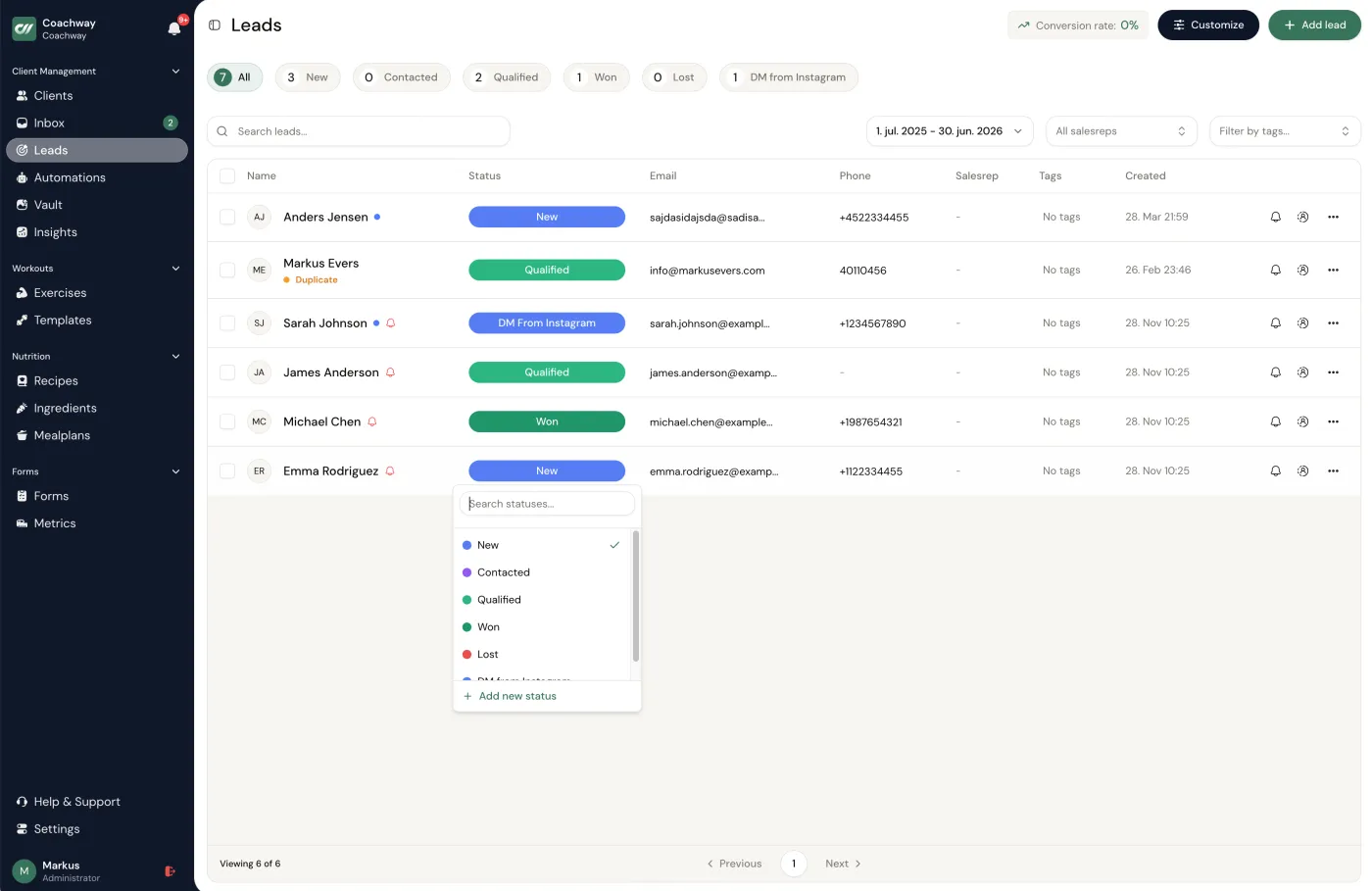
One place for every channel
The lead pipeline and the Power Panel pull enquiries, DMs, and applications from every channel into one view, so the fast, personal follow-up that actually converts warm leads never slips through the cracks.
Capture that does not leak
Intake and application forms turn a scroll or a challenge sign-up into a qualified lead with a goal attached, so the twenty percent problem gets smaller instead of larger.
Follow-up that happens on its own
Simple automated reminders keep new leads and quiet clients from going cold without you tracking each one by hand, so the marketing hour stays about reach, not admin.
Pricing that does not punish growth
EUR 69 a month up to 5 clients, then EUR 9 per additional active client, every feature included, with a 14-day trial (card required). Predictable per-client pricing, and you keep your own Stripe. See the full pricing.
Coaches like Sandra Rosenkrantz and Rene Macapili built their own reach, then leaned on a tight workflow so nothing they earned slipped away as the client count climbed. That is the right order: your channels make the business, the system keeps what they produce, and the two together are what let marketing pay off instead of leak.
Frequently asked questions about marketing a coaching business.
What is the best marketing channel for a coaching business?
The best channel is the one you will actually run every week, matched to your stage. Early on that is your warm network and referrals, because trust already exists there and the first clients arrive in days. Once that is working, pick one reach channel - organic social, email, or SEO - and master it before adding a second. There is no single winning channel, only the one that fits your strengths, your time, and where your ideal client already spends attention.
How much should a coaching business spend on marketing?
Before your offer and your discovery call reliably convert warm leads, the honest answer is close to zero in cash and a few focused hours a week in time. Warm outreach, referrals, organic content, and email cost hours, not budget, and they are what prove your offer converts. Paid ads become worth funding only after that proof exists, because paying to fill a funnel that does not convert warm leads just loses money faster.
How long does it take for coaching marketing to work?
It depends entirely on the channel. Working your warm network and past clients can produce a paying client in days, because the trust is already there. A steady flow from organic social usually takes three to six months of consistent posting before it compounds. SEO and content marketing are slower still, often six to twelve months, but they keep paying long after the work is done. Paid ads move fast once your offer already converts, and not before.
Should new coaches run paid ads?
Usually not yet. Paid ads are an accelerator you bolt onto a system that already converts, never the starting line. Until your offer, your landing page, and your discovery call turn warm leads into paying clients, ads only spend money to expose a funnel that leaks. Prove the offer with warm outreach and organic reach first, then use ads to buy more of a result you have already seen work at a small scale.
How do you measure marketing for a coaching business?
Count the numbers that lead to revenue, not the ones that flatter you. The three that matter are conversations started, consults or discovery calls booked, and clients signed. Track one leading input too, such as reach or email list growth, so you can see the top of the funnel filling. Followers, likes, and impressions are context at best - they move without your income moving, so never let them decide where your hours go.
Keep reading
all guidesAI Personal Trainer vs a Real Coach: What AI Can and Cannot Do (2026)
Can ChatGPT or an AI app replace a personal trainer? An honest answer for coaches: what AI does well, where it falls short, and how to use it as a tool without losing the human coaching clients pay for.
Read the guideHow to Ask for a Testimonial: Template + 5 Questions (2026)
A copy-paste message for asking a coaching client for a testimonial at the right moment, the five memory-jogging questions that get a specific answer instead of "great trainer", a prompt that shapes their voice-note answers without inventing a word, the generic fixer and the consent line. Honest only - no incentivized or fake reviews.
Read the guidePersonal Trainer Bio Examples: 10 Copy-Paste Templates (2026)
10+ personal trainer bio examples for Instagram, websites, directories and pitches, a 5-part bio formula, a six-fact ChatGPT prompt that writes three lengths at once, a career-changer example, and the mistakes that cost coaches clients.
Read the guideFree tools for this: Ad Spend Breakeven Calculator · Email List Value Calculator for Coaches · Free Trial Conversion Calculator
See what Coachway can do for your coaching business
Coachway was built on knowledge from working with 150 online coaches over 6+ years, who all hit the same wall - slow platforms, clunky workflows, wasted hours. Start your 14-day free trial and see what we fixed - the whole platform, no charge today, cancel anytime under Billing.


