Email marketing for personal trainers - the sequences that actually convert.
Email marketing for personal trainers is not a newsletter you send when you remember - it is four sequences doing four jobs: welcome, nurture, re-engagement and launch. Most coaches build a list, then only ever email it to sell, and wonder why the list goes cold. This is the honest, what-to-actually-send version: the emails in each sequence, how often to send, and where the whole thing hands off to booked clients.
By Markus Evers · Published 17 August 2026 · Updated September 2026
the short version
Email marketing for fitness coaches is four sequences (welcome, nurture, re-engagement, launch) plus a weekly newsletter of one point in under 300 words. The 12 newsletter ideas below each carry a subject line pattern and one call to action, and one ChatGPT prompt drafts the 200-word email in your voice with nothing invented.
Why does email still convert clients for personal trainers?
Because it is the one audience you own. Your Instagram following is rented from a platform that decides who sees your posts, changes the rules without asking, and can limit or lose an account overnight. A list is different: you hold the addresses, you reach the inbox directly, and nothing sits between you and the people who raised their hand. That ownership is the whole reason a busy coach should bother. The feed is where a stranger first meets you; email is where that attention is captured and warmed until someone is actually ready to book. Skip the middle step and you are forever selling to people who met you thirty seconds ago. That is why a list is one of the steadiest levers in growing an online coaching business past the first handful of clients.
Email also fits how coaching is really bought. Almost nobody reads one post and buys twelve weeks of coaching that afternoon. They circle for weeks, warming up, waiting for the right moment - a Monday, a birthday, a photo they did not like. A list lets you stay useful and present across that whole stretch instead of hoping the algorithm surfaces you on the exact day they decide. The mistake is not building the list; plenty of coaches do that. The mistake is building it and then only ever emailing it to sell, so the address book goes cold and every launch feels like cold-calling strangers who technically subscribed. The fix is the sequence system below: send the right emails in the right order, most of them useful, so the launch email lands in a warm inbox rather than a suspicious one. If you want to see what a warm list is actually worth per launch, an email list value calculator turns your open, click, and conversion rates into projected campaign revenue.
The four sequences every coach's list needs.
Everything below is one of four sequences, each doing a distinct job. Get these built once and most of your email marketing runs on rails - the welcome and re-engagement sequences fire automatically, the nurture is a weekly habit, and the launch is the only part you write fresh each time. For the nurture sequence written out email by email, use the email nurture sequence for fitness coaches.
1. The welcome sequence - three to five emails, sent automatically.
This fires the moment someone subscribes, while their interest is at its peak, and it is the most valuable sequence you will ever write because it runs forever without you. Keep it to three to five short emails over the first week. Email one delivers whatever they signed up for and says who you are. Email two shares the single belief that shapes how you coach - the thing you do differently - so a subscriber starts to trust a point of view, not just a name. Email three gives a genuine quick win they can act on today. The last email or two mention, softly, how working with you actually works and who it is for. The job here is not to sell; it is to turn a name on a list into someone who feels they already know you. If you have not built the list itself yet, start with how to build an email list as an online coach, then come back for what to send.
2. The nurture rhythm - one useful email a week.
Between launches, the whole game is staying welcome in the inbox, and you earn that by being useful far more often than you sell. Once a week is the honest cadence: frequent enough to become a habit, calm enough never to feel like spam. Rotate through a handful of formats so it never goes stale - a client result explained honestly, a common mistake corrected, a myth cut down to size, a short behind-the-scenes note about how you actually coach. Write to one person, not a mailing list, and let your real voice through; a nurture email that reads like a note from a knowledgeable friend beats a polished newsletter every time. The point is not that any single email converts - it is that when you finally open spots, you are selling to people who have heard from you every week and are glad to, instead of strangers you resurface once a quarter.
3. The re-engagement sequence - two or three emails to win back the quiet.
Every list grows a layer of subscribers who stopped opening. A re-engagement sequence of two or three emails, aimed at anyone who has not opened anything in about ninety days, does one of two useful things: it wakes them up, or it lets you clear them out. Lead with genuine value and a little honesty - "I noticed you have been quiet, so here is the one thing worth coming back for" - rather than a guilt trip. Make the last email a clean either-or: here is what you have been missing, reply or click if you still want to hear from me, otherwise no hard feelings. A smaller list of people who actually open beats a big one that inflates your numbers and drags your deliverability down. The same instinct that wins back a lapsed subscriber wins back a lapsed client, and the wording overlaps - the client win-back message is the one-to-one version of the same move.
4. The launch sequence - three to five emails when you open spots.
This is the only sequence most coaches ever send, and it is the one that finally makes the offer. When you open coaching spots, run three to five emails across roughly a week rather than a single "spots are open" blast that half the list misses. Name the offer, the price and the start date plainly - vagueness kills a launch. Then spend the middle emails answering the objections a hesitant buyer actually has: whether it will work for someone like them, what the first month really looks like, why now rather than "sometime". Include a real result or two, and let the final email carry a clean deadline so a warm reader has a reason to decide instead of drift. The launch works precisely because the other three sequences did their job first: you are asking a warm, familiar audience to take the next step, not persuading strangers from a standing start. When someone says yes, the first thing they should get is a proper welcome - see the online coaching welcome email template for the client-side version.
The rules that decide whether any of this works.
The sequences are the skeleton. Four habits are what actually turn a list into clients, and none of them require better copy - just a little discipline.
Give value in most emails, sell in a few.
A list you only email to sell learns to ignore you. Keep the large majority of your sends genuinely useful, so the occasional direct offer is welcome rather than jarring. The value emails are not filler between launches - they are the reason the launch lands.
Send weekly, and never disappear for a quarter.
Consistency beats brilliance. A steady weekly email keeps you a familiar name; a list you touch once every three months forgets you, and then every launch is a cold start. If weekly feels heavy, every other week is fine - vanishing is not.
Write to one person, in your own voice.
The best coaching emails read like a message to a single client, not a broadcast to a mailing list. Drop the corporate newsletter tone. Use the reader's likely first name where your tool allows it, tell real stories, and let the version of you that shows up in a good check-in show up in the inbox too.
One clear next step per email.
Every email should ask for one thing: reply, read this, book a call, join the launch. Give a reader five options and they choose none. The welcome and nurture emails point toward you slowly; the launch emails point at a single door with a deadline on it.
What should a fitness coach put in a newsletter?
One point per email, taken from the coaching week rather than from a content calendar: the question a client asked, the mistake you saw three times on Sunday, the thing you changed your mind on. A coach on r/personaltraining answering how coaches stay consistent with content described the same move for social: write the blog post first, then "I can usually get a couple of social media posts out of one blog post". The newsletter is that blog post, and the twelve ideas below are the ones a coach can write from memory on a Tuesday evening. Each row gives the subject line pattern and the single call to action. The Friday newsletter has its own row in the social media content calendar template, so it is planned with the posts instead of after them.
| Idea | Subject line pattern | The one CTA |
|---|---|---|
| 1.A client question answered | The question I got three times this week | Reply with yours |
| 2.One thing I changed my mind on | I used to tell clients [X]. I stopped. | Reply if you disagree |
| 3.The most common check-in mistake this week | Four of my clients did this on Sunday | Check your own week |
| 4.A recipe with the macros | [N] minutes, [P] g protein, one pan | Make it once this week |
| 5.A myth and the number behind it | The [claim] number, checked | Forward to the friend who says it |
| 6.A client win, with consent | What [first name] did for 11 weeks | Book a call if that is you |
| 7.What I am testing on myself | Week 3 of [experiment]: the honest numbers | Reply with a guess |
| 8.A reader reply, featured | You wrote back. Here is my answer. | Reply to be featured |
| 9.The phase-end review, explained | What happens at week 8 | Read the review call agenda |
| 10.A price or offer note | Two spots open on [date] | Book the call |
| 11.A seasonal reset | The [month] reset: one change, not ten | Pick your one change |
| 12.The honest "I got this wrong" | I gave bad advice. Here is the fix. | Reply if it affected you |
Ideas 1, 3 and 8 come straight from the inbox and the check-in forms; idea 9 links to the phase-end review agenda; idea 6 needs written consent, covered in the testimonials guide.
How do you write a newsletter with ChatGPT that does not sound like AI?
Give it one client question, your rough answer, one real number and two samples of your own writing, with the ban list inside the prompt: no exclamation marks, no lists of three, no bold phrases, no summary paragraph, no closing offer. The newsletter is where AI formatting shows most; a 770-upvote r/ChatGPT thread listed the writing formats readers "can no longer read" because AI made them, and a copywriting thread described readers "automatically disregarding" anything that reads as AI. The full ban list and the reasons are in how to make ChatGPT not sound like AI; the prompt below has the coaching version built in.
One client question into a 200-word newsletter
When to use it: Once a week, from the question or mistake you saw most.
What to paste in: The question (no name), your rough notes, one real number, two of your own emails.
ROLE: You are me, an online fitness coach, writing this week's email to my list of leads and current clients. They read it on a phone in under a minute.
FACTS: This week a client asked: "[PASTE THE QUESTION, NO NAME]". My answer, in rough notes: [PASTE YOUR NOTES]. One number I can stand behind: [ONE FIGURE AND WHERE IT IS FROM].
JOB: Write a 200-word newsletter that answers the question the way I answered it.
CONSTRAINTS: Write like me: [PASTE TWO OF YOUR OWN EMAILS OR MESSAGES]. One point only. Under 200 words. No exclamation marks, no "I hope this finds you well", no lists of three, no bold phrases, no summary paragraph, no closing offer line and no "book a call". Do not invent any number, client, study or result that is not above. Do not diagnose or give medical advice. End on the last useful sentence.
FORMAT: Plain text. Subject line on the first line, under 45 characters, no clickbait. Then a blank line, then the email. One CTA at most: "reply and tell me".
ASK FIRST: If my notes do not actually answer the question, tell me what is missing before writing.
Ten subject lines under 45 characters
When to use it: After the email is written, never before.
What to paste in: The finished email and one of your own messages.
Write 10 subject lines for this newsletter: [PASTE THE EMAIL]. Rules: each under 45 characters; no clickbait, no "you won't believe", no question marks in more than two; include one specific number in five of them, taken only from the email itself; no emoji; write them as I would say them, using this sample of my voice: [PASTE ONE OF YOUR OWN MESSAGES]. Output as a numbered list with the character count after each line. Then mark the two you would send and say why in one sentence each.
How often should a coach email the list?
Weekly, on the same day, under 300 words. Weekly is the cadence a coach can hold from real coaching material; the same day makes opening it a habit; the word limit keeps it to one point. Daily is volume, and inboxes punish volume faster than feeds: a coach on r/InstagramMarketing who posted every day for 90 days reported that reach got worse, and an email list unsubscribes where a feed merely scrolls past. The coach behind the 181-upvote "things I wish I knew" thread on r/personaltraining runs on organic marketing alone; a weekly email is the cheapest organic channel there is, because every address on it asked to hear from you. Where the newsletter sits among the twelve ChatGPT jobs of a small coaching business, with the prompt for each, is on the AI hub.
Where does the list live and who gets the email?
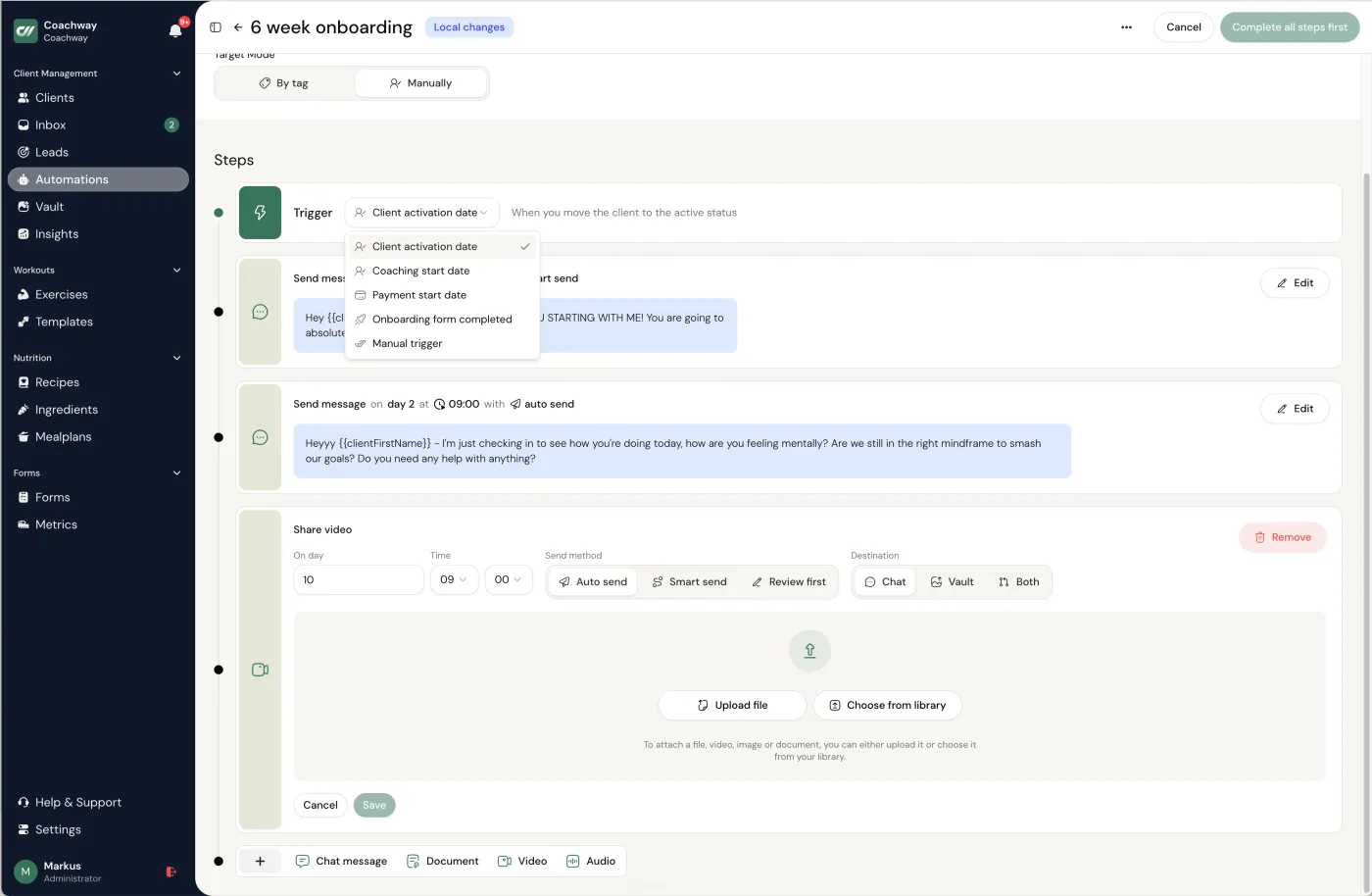
The list lives in an email tool and holds both leads and current clients; the newsletter goes to everyone, the sequences go to the segment they were built for. How the addresses get there is the email list guide. Be honest about the tool boundary: broadcast email marketing to a subscriber list - the welcome, nurture, re-engagement and launch sequences above - lives in a dedicated email tool, and that is where it belongs. Coachway is not a newsletter platform and will not pretend to be one. What it does own is the two ends that email marketing keeps leaking. On the front end, an embeddable lead form catches the interest your emails create and moves each person through a visible pipeline - new, contacted, qualified, won - so a warm reply does not vanish into your inbox. On the back end, the moment someone converts, a one-click action turns them into a client with the client app, an onboarding sequence and a subscription billed through your own Stripe account. That client-side onboarding and follow-up runs on Coachway's automations - scheduled messages, check-in reminders and drip sequences that fire on a trigger - so the same nurture instinct that warmed a subscriber keeps working after they pay, without you sending each message by hand.
Coachway is built on knowledge from working with 150 online coaches over 6+ years, and it costs EUR 69 a month with your first 5 clients included, then EUR 9 per additional client, every feature in the box - no tiers. The 14-day free trial starts with a card held securely by Stripe and cancels under Billing before it renews. If you would rather see the lead pipeline and the automation flows before deciding, book a demo. And once your list is turning into booked calls, lead generation for personal trainers covers the wider engine email feeds into.
Frequently asked questions about email marketing for personal trainers.
What is email marketing for personal trainers?
Email marketing for personal trainers is the practice of sending planned messages to a list of people who gave you their address, so that interest turns into booked clients over time instead of scrolling past you in a feed. In practice it is not one newsletter - it is four sequences doing four different jobs. A welcome sequence greets a new subscriber and tells them what you do. A nurture rhythm keeps you useful and familiar between launches. A re-engagement sequence wins back people who went quiet. And a launch sequence makes a real offer with a start date when you open coaching spots. The reason it works for coaches specifically is ownership: your Instagram following is rented from a platform that can change the rules overnight, while a list is an audience you own and can reach directly, for free, on your own schedule.
What emails should a personal trainer send to their list?
Four kinds, and most coaches only ever send the fourth. First, a welcome sequence of three to five emails that arrives automatically when someone subscribes: who you are, the one belief that shapes how you coach, a useful quick win, and a soft mention of how coaching works. Second, a nurture rhythm of one email every week or two that stays genuinely useful - a client result explained, a common mistake corrected, an honest behind-the-scenes note - so you are welcome in the inbox when you do sell. Third, a re-engagement sequence of two or three emails for subscribers who have not opened anything in ninety days, which either wins them back or lets you clean the list. Fourth, a launch sequence when you open spots: three to five emails over a week that name the offer, the price and the start date, and answer the objections a hesitant buyer actually has.
How often should personal trainers email their list?
Roughly once a week, and never less than once a month. The instinct to email rarely so you do not annoy people is the exact mistake that kills a list - a list you touch once a quarter forgets who you are, so when you finally launch you are selling to strangers who barely recognise the name. Weekly is the honest sweet spot for a coach: frequent enough that opening your email is a habit, calm enough that it never feels like spam. What matters more than the exact cadence is that most of what you send is useful rather than a pitch. A simple rule of thumb is to give value in the large majority of emails and make a direct offer in the rest, so that when the launch email lands it is welcome instead of jarring.
Do personal trainers still need an email list if they have Instagram?
Yes, and the reason is control. A social following is rented: the platform decides who sees your posts, the reach on any given day is out of your hands, and an account can be limited or lost without warning. An email list is the one audience you actually own - you hold the addresses, you reach the inbox directly, and no algorithm sits between you and the people who asked to hear from you. The two are not rivals; they are a chain. Instagram is where a stranger first meets you, and email is where that attention is captured and warmed until the person is ready to book. The coaches who struggle are the ones who build entirely on rented land and have no way to reach their warmest audience the day they open spots.
What is the best first email to send a new coaching client?
A warm welcome that confirms the purchase, gives the single next step, and sets expectations for how you work together - sent within minutes of sign-up, while the decision still feels good. This is a different email from your marketing welcome sequence: the marketing one greets a subscriber, this one greets a paying client and starts the coaching relationship on the right foot. It should name them, confirm what they bought, point to the one thing to do first, say when they can expect to hear from you and how to reach you, and nothing else - a new client does not need ten links, they need reassurance that they chose well and clarity on what happens next. Automating this send so it fires the moment someone joins means no client ever sits in silence wondering if the payment went through.
What should a personal trainer write in a newsletter?
One point per email, drawn from the coaching week: the question a client asked, the check-in mistake you saw three times, one thing you changed your mind on, a recipe with the macros, a myth with the number behind it, or a client win with consent. The 12 newsletter ideas on this page each come with a subject line pattern and one call to action. The test is whether a client would forward it; a summary of your services never gets forwarded.
How long should a fitness newsletter be?
Under 300 words, and 200 is better. It is read on a phone between two other things, so one point, made properly, in the time it takes to wait for a coffee. Long newsletters with three sections and a promotion block are the format readers have learned to skip; a short email that answers one real question is the one they reply to.
Can ChatGPT write my newsletter?
It can draft it if you give it the question, your rough answer, one real number and two samples of your own writing, with the rules in the prompt: one point, under 200 words, no exclamation marks, no lists of three, no closing offer, nothing invented. The prompt on this page does that. Read it, cut the first sentence, and send it as yours; a newsletter that reads like AI is the fastest way to teach a list to ignore you.
How often should I send a coaching newsletter?
Weekly, on the same day, under 300 words. Weekly is frequent enough that opening it becomes a habit and rare enough that you can write it from real coaching material. Daily is volume, not cadence: a coach on r/InstagramMarketing who posted every day for 90 days reported reach getting worse, and inboxes punish volume faster than feeds do. If weekly is not possible, every other week, but never a quarter of silence.
Email marketing is one link in a longer chain: build the list first, send the sequences above, and route the warm replies through a proper lead engine. When someone finally says yes, start them right with a welcome email.
Keep reading
all guidesHow to become a menopause fitness coach (2026)
A growing, underserved niche: what the coaching involves at the fitness level, real specialist certifications, positioning, pricing and finding your first clients.
Read the guideMost profitable fitness niches for coaches (2026)
Twelve niches compared honestly on demand, pricing power, competition and what it takes to enter - from powerlifting to menopause fitness to corporate wellness.
Read the guideHow to get personal training clients: the complete system
The full acquisition system in one place: referral engine, local vs online, content-to-client, discovery calls, retention-as-acquisition - with deep-dive guides for each step.
Read the guideFree tools for this: Free Trial Conversion Calculator · Coaching Offer Builder · Sales Objection Handler
See what Coachway can do for your coaching business
Coachway was built on knowledge from working with 150 online coaches over 6+ years, who all hit the same wall - slow platforms, clunky workflows, wasted hours. Start your 14-day free trial and see what we fixed - the whole platform, no charge today, cancel anytime under Billing.