


The personal trainer KPIs worth tracking - and the vanity numbers to ignore.
The personal trainer KPIs that actually matter fall into two groups: the client-progress signals you read every week to catch a drifting client early, and the business numbers - churn, retention, lifetime value - you check once a month to see whether the practice is healthy. Most coaches track one and neglect the other, then wonder why a full book still feels precarious. This guide names the metrics in each group, explains which are leading and which are lagging, and ties the single-number pieces together into one coach dashboard.
By Markus Evers · Updated August 2026
the short version
Track two groups of KPIs. Client-progress KPIs are the weekly leading indicators - adherence, check-in completion, and each client's progress against their own goal - and they let you save a drifting client before they cancel. Business KPIs are the monthly lagging numbers - churn rate, retention rate, lifetime value against cost to acquire, and monthly recurring revenue - and they tell you whether the practice is quietly leaking the clients you already won. Read the first group weekly per client, the second monthly across the whole book, and compare each to your own baseline rather than an industry benchmark. The trend is the signal.
What counts as a KPI for a personal trainer?
A KPI is a key performance indicator - a small number of measurements you check deliberately because they predict or record something that matters, as opposed to the hundred things you could measure but that only add noise. For a personal trainer running clients online, the useful ones split cleanly along a single line: is this measuring whether a client is succeeding, or whether the business is succeeding? Those are different jobs, they move on different clocks, and confusing them is why so many coaches feel busy and blind at the same time. Where the numbers live matters less than whether you can read them per client in the moment; the client-count thresholds for moving from a sheet to an app are in when a spreadsheet stops being enough.
The distinction underneath both groups is leading versus lagging. A leading KPI moves before the outcome and can still be changed - a client's adherence tells you today that next month's result is at risk, while you can still do something about it. A lagging KPI records the outcome after it has happened - churn tells you a client left, but only after they are already gone. The best personal trainer KPIs to watch most often are the leading ones, because they are the only place you can actually intervene. The lagging ones are for keeping score, once a month, on whether the weekly work paid off.
The client-progress KPIs you read every week.
These are the leading indicators, read per client at the check-in. Their whole purpose is early warning: to flag the client who is drifting while you can still reach out, rather than to confirm a loss after the fact.
Adherence - the earliest signal you have.
The share of the plan a client actually completes - workouts done, nutrition logged, steps hit. Adherence is the single most predictive number in coaching because almost everything else is downstream of it: a client who does the work progresses, a client who progresses stays, and a book that stays produces the retention and revenue that keep the lights on. When adherence slips two weeks running, that is your intervention window, long before the scale or the invoice reflects it.
Check-in completion rate - engagement, not just results.
A client who stops filling in the check-in has usually stopped doing the work a week or two before, so a missed check-in is one of the loudest quiet signals you get. Track how many of your clients actually complete each cycle, and treat a missed one as a prompt to reach out rather than an admin gap to ignore. The check-in is also where most of the other KPIs are captured, which is why protecting completion protects your whole dashboard.
Progress against each client's own goal.
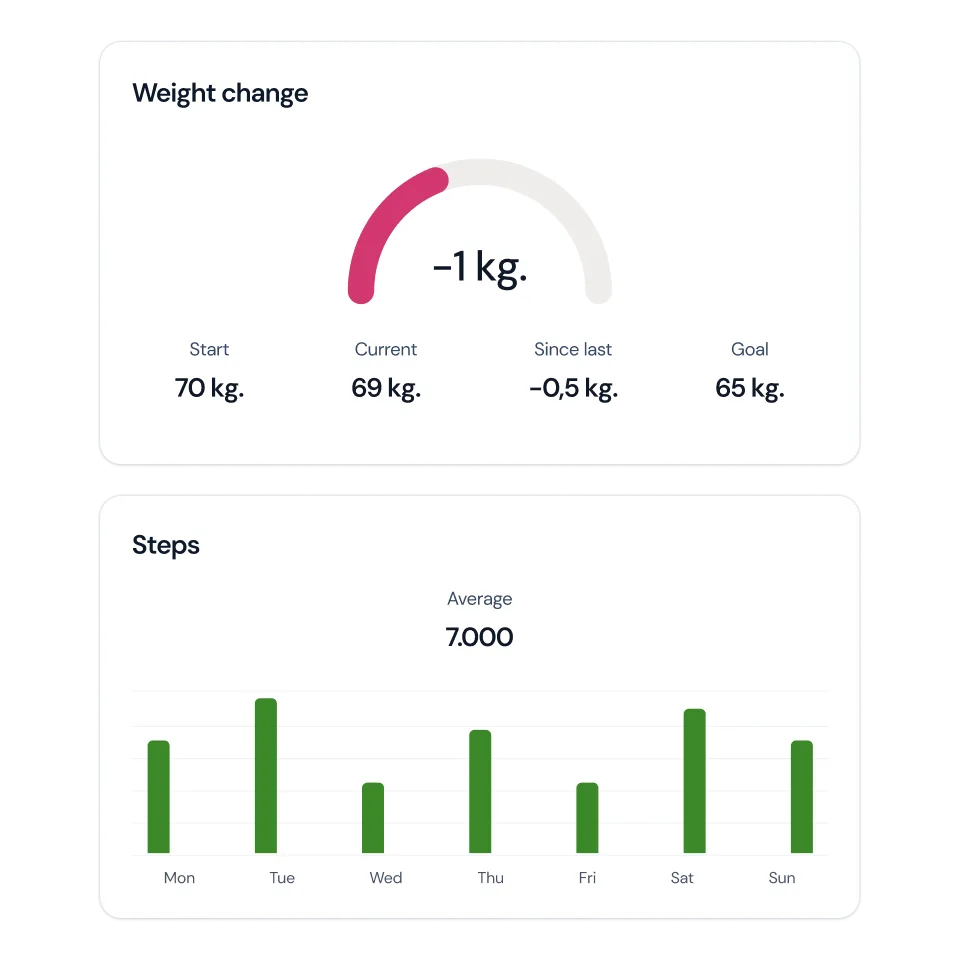
Not body weight alone - the metric that matters is progress toward the specific goal that client hired you for, read as a trend rather than a single reading. For a fat-loss client that might be the weight trend beside waist measurements and photos; for a strength client it is working loads; for a general-health client it might be steps and how they feel. A single number in isolation misleads, which is why a good client tracking setup reads several signals together so one flat morning never overrules a month of real change.
The business KPIs you check once a month.
These are the lagging numbers, calculated across the whole book over a period. They will not save an individual client, but they tell you whether the practice is healthy or quietly bleeding - and each one has its own worked-out method, linked below.
Client churn rate - who leaves, and how fast.
The percentage of clients who leave over a period. Churn is the KPI that decides whether adding new clients grows your income or just replaces it, because a high enough churn rate turns a full book into a leaking bucket. Separate voluntary churn (they chose to leave) from involuntary churn (a failed card ended it) - the two have completely different fixes. The churn rate walkthrough has the formula and the levers, and the churn calculator runs it on your own numbers.
Client retention rate - churn's mirror.
The share of clients you keep over a period, the other side of the churn coin. Retention is worth tracking in its own right because it is the KPI that quietly multiplies every other business number: a client kept an extra three months is more lifetime value with no acquisition cost, and a steadier revenue base you can plan against. There is no single universal target here - the honest benchmark is your own trend, so the question is whether this quarter's retention beats last quarter's. The retention rate guide shows how to calculate and lift it.
Lifetime value against cost to acquire.
Client lifetime value (LTV) is what an average client is worth across the whole time they stay; customer acquisition cost (CAC) is what it costs you to win one. Neither means much alone - together they are the KPI pair that tells you whether growth is profitable. The rule of thumb the growth playbooks point to is roughly three to one: a client should be worth about three times what you spend to acquire them. Because retention feeds directly into LTV, improving the weekly progress KPIs is also how you move this one. The LTV and CAC guide has the formulas, and the LTV calculator does the arithmetic.
Recurring revenue and filled capacity.
Monthly recurring revenue is the predictable income your active clients produce each month - the number that tells you, at a glance, whether the business is growing, flat or shrinking. Read it beside your active-client capacity: how many of the client slots you can realistically coach well are actually filled. A coach at eighteen of a comfortable twenty clients has a very different next move than one at eight, and neither answer is visible from revenue alone. Together these two frame the practical question every other KPI feeds into - can you take on more, and should you.
How often should you actually look at these?
Two clocks, and mixing them up is where coaches waste effort. The client-progress KPIs run weekly and per client, because that is the cadence at which you can still intervene - you read them at the check-in and act on the ones that dipped. The business KPIs run monthly and across the whole book, because churn, retention, LTV and revenue only mean anything over a period, and checking them daily just invites you to chase noise.
A simple standing rhythm keeps it honest: a weekly pass through each client's adherence and progress that turns into outreach, then a monthly half-hour where you calculate the four business numbers and compare them to last month. Compare to your own baseline, not to an industry figure you found online - one month is a data point, three months in the same direction is a pattern worth acting on. The point of a KPI is never the measuring; it is the decision the measuring lets you make earlier than you otherwise could.
Where does a coach dashboard fit in?
You can run all of these KPIs from a spreadsheet, and to start you probably should. What breaks first is not the maths, it is the collection - chasing check-ins, copying weights across, reconciling who paid - because a dashboard that takes an hour to update every week is a dashboard you stop updating. The value of all-in-one coaching software is that the leading KPIs get captured as a by-product of the work you already do: the check-in a client fills in becomes their adherence and progress data automatically, so the weekly view stays current with no data-entry tax.
That is the job Coachway does. The check-in a client submits lands beside their weight trend, measurements and progress photos on one screen, so the leading indicators for every client are visible without you assembling them by hand. The business KPIs you still run on your own numbers - the calculators linked above do that in a minute - but the raw material for them, who is active and who has drifted, lives in one place instead of scattered across your inbox. Coachway is built on knowledge from working with 150 online coaches over 6+ years, the coach dashboard is in English, and it costs EUR 69 a month including your first 5 clients, then EUR 9 per additional client, every feature included. The 14-day free trial starts with a card held by Stripe and cancels under Billing before it renews, or you can book a demo and see the client view first.
Frequently asked questions about personal trainer KPIs.
What KPIs should a personal trainer track?
Two groups. The first is client-progress KPIs, the weekly leading indicators that tell you whether coaching is working before anyone quits: adherence to the plan, check-in completion, and each client's progress against their own goal. The second is business KPIs, the lagging numbers that tell you whether the practice is healthy: client churn rate, client retention rate, lifetime value against cost to acquire a client, monthly recurring revenue, and how much of your active-client capacity is filled. A personal trainer who watches only body-weight or only revenue is half-blind. The progress KPIs let you save a client who is drifting; the business KPIs let you see whether you are quietly leaking the clients you already fought to win. Read the first group every week per client, and the second group once a month across the whole book.
What is the most important KPI for an online coach?
Adherence, because almost every other number is downstream of it. A client who follows the plan makes progress; a client who makes progress stays; a book of clients who stay produces the retention, lifetime value and recurring revenue that keep the business alive. That chain runs in one direction, which is why adherence is the earliest signal you have. Scale weight is a lagging outcome that a single bad night of sleep can distort, and revenue is even further downstream - by the time it moves, the cause happened weeks ago. Adherence and check-in completion move first, so they are the KPIs to protect. If you could only watch one number per client, watch whether they are actually doing the work, because that is the number you can still change.
How often should a personal trainer review KPIs?
On two clocks. Client-progress KPIs are weekly and per client - you read them at the check-in, because their whole job is to flag a drifting client while there is still time to intervene. Business KPIs are monthly and across the whole book - churn, retention, lifetime value and recurring revenue only mean anything over a period, and checking them daily invites noise-chasing. A simple rhythm works: a weekly pass through each client's adherence and progress, then a monthly half-hour where you calculate the four business numbers and compare them to last month rather than to any industry benchmark. The trend against your own baseline is the signal. One month is a data point; three months in the same direction is a pattern worth acting on.
What is the difference between a leading and a lagging KPI?
A leading KPI moves before the outcome and can still be changed; a lagging KPI records the outcome after it has happened. In coaching, adherence and check-in completion are leading - they tell you today that a client is drifting, while you can still reach out. Churn and lost revenue are lagging - by the time they move, the client has already gone. The practical value is that leading indicators are where you intervene and lagging indicators are where you keep score. A coach who only tracks the lagging numbers is always reacting to losses that were visible weeks earlier in the leading ones. Build your dashboard so the leading KPIs are the ones you see most often, and let the lagging ones confirm, once a month, whether the weekly work is paying off.
Do I need software to track personal trainer KPIs?
Not to start. A single spreadsheet with one row per client and columns for adherence, last check-in and progress (the free client tracker spreadsheet has the last check-in and progress columns, with a days-since-check-in formula; add adherence) will run the weekly review, and a second tab with churn, retention and revenue will run the monthly one. The reason coaches move off the spreadsheet is not the maths, it is the manual collection: chasing check-ins, copying weights across, and reconciling who paid. All-in-one coaching software earns its place when it captures the leading KPIs as a by-product of the work you already do - the check-in the client fills in becomes the adherence and progress data automatically, so the dashboard stays current without a data-entry tax. Whether you use a spreadsheet or a platform, the KPIs are the same; software only decides how much of your week goes into keeping them up to date.
Each business KPI here has its own worked-out method: how to calculate and cut client churn rate, how to read and lift client retention rate, and how lifetime value and CAC decide whether growth is profitable. Track them together and the dashboard stops being a report card and starts being an early-warning system.
Keep reading
all guidesWhat Is a Mesocycle? Training Blocks Explained
A mesocycle is the training block a coach actually writes and reuses. How it fits between microcycle and macrocycle, with a sample four-week block.
Read the guideWhat Is Supercompensation? The Recovery Model
Supercompensation is why rest is part of training. The four phases, how the window guides deloads and frequency, and the model honest limits.
Read the guideWhat Is Hybrid Training? Strength Plus Endurance
Hybrid training is the deliberate pursuit of strength and endurance together. The interference effect in plain words, a sample week, and who the approach fits.
Read the guideFree tools for this: Personal Trainer Income Calculator · Client Onboarding Builder · Client Capacity Calculator
See what Coachway can do for your coaching business
Coachway was built on knowledge from working with 150 online coaches over 6+ years, who all hit the same wall - slow platforms, clunky workflows, wasted hours. Start your 14-day free trial and see what we fixed - the whole platform, no charge today, cancel anytime under Billing.


