How to market online personal training - the solo trainer's playbook.
To market online personal training as a solo trainer, you sell one thing clearly to one kind of person, then use free channels to prove you can deliver it: a sharp niche, content that shows your method, warm DMs to people who already know you, and referrals from the clients you get results for. You do not need a big following or an ad budget to start - you need a clear promise and a system that catches the interest before it cools. This is the honest, method-first version of that playbook.
By Markus Evers · Updated September 2026
the short version
Marketing online personal training is not a channel problem, it is a clarity problem. Get specific about who you coach and what you promise, and the marketing gets easy. Then run four free channels in order of warmth: message the people who already know you, publish content that shows your method rather than shouts about it, turn conversations into clients through honest DMs instead of pitches, and let results become referrals. Paid ads come later, once the offer is proven - never as the first move. Underneath all of it sits one job the tactics keep pointing at: catch every lead your marketing creates and move it to a booked client before it goes cold.
What are you actually selling, and to whom?
Every trainer who struggles to market online personal training has the same root problem, and it is almost never the platform or the posting schedule: they are trying to be a good option for everyone, which makes them the obvious choice for no one. When your promise is "I help people get fit", a stranger cannot tell whether you are for them, so they keep scrolling. When it is "I help desk-bound men over 40 get strong and lose the gut without giving up their weekends", the right person feels seen and the wrong person self-selects out - and that is a feature, not a loss. Marketing at a distance rewards specificity, because online you are competing with a thousand trainers a scroll away, and the sharp niche is what makes someone pick you.
Positioning is two decisions, and it is worth making them before you touch a single channel. First, the person: pick a niche you can speak to with real authority, ideally one you have lived or already have results with, narrow enough that you could name three specific frustrations that keep them up at night. Second, the promise: the concrete outcome and the method you use to get there, stated plainly enough that it fits in one sentence. Everything downstream - your content angles, your bio, the words in your DMs, the offer on your call - is just that one sentence repeated in different rooms. Get this right and marketing feels like description; get it wrong and it feels like shouting. If you are still shaping how you show up publicly, the personal brand walkthrough turns the same two decisions into a voice, and the bio that carries them can borrow from these trainer bio examples.
Which channels should a solo trainer run first?
Run them in order of warmth, not in order of reach. A solo trainer wins first on the people who already half-know you and last on cold strangers, because warm attention converts and cold attention has to be earned. These four channels are free to run and they compound into each other - content earns the DM, the DM earns the client, the client earns the referral. Work them in this sequence rather than chasing whichever one feels newest.
1. The warm list - the audience you already have.
Before you post a thing, write down everyone who already knows you can coach: past in-person clients, gym members you trained, friends who have asked what you do, the person who followed you after a class. This is the warmest audience you will ever have, and a short, specific, personal message to it will out-convert a month of posting to strangers. The mistake solo trainers make is treating "marketing" as something that only happens to people they have never met - when the fastest first clients are almost always sitting in a contact list they have not worked. Start there, today, by hand.
2. Content that shows the method, not the hustle.
Content is how strangers discover you and decide you are credible before they ever message - it does the work a gym building used to do for an in-person trainer. The version that markets online personal training well is not motivational noise; it is proof of method. Show how you would fix a specific problem your niche has, walk through a real client's before and after with permission, answer the questions people actually ask on a call. Pick the one or two channels where your niche already spends time and publish there consistently rather than spreading thin across five, and lean on the Instagram-for-coaches mechanics if that is where your people are. One useful post a day beats a viral spike you cannot repeat.
3. DMs and conversations - where marketing becomes clients.
Content creates attention; conversations turn it into paying clients, and most trainers under-work this step because it feels less like "marketing" than a polished post. When someone engages - a comment, a story reply, a saved post - open a real conversation, not a pitch. Ask what they are working on, listen, and only offer a next step when there is a genuine fit. The goal of a good DM is not to close in the thread; it is to earn a discovery call where the actual decision gets made. Handled as help rather than sales, this is the single highest-leverage marketing activity a solo trainer has, and it is the one that scales worst if it lives in scattered inboxes - which is exactly why the system underneath matters.
4. Referrals and testimonials - results doing your marketing.
The clients you get results for are your best and cheapest marketing channel, and it is the one solo trainers most often leave to chance. Build the ask in rather than hoping it happens: capture a testimonial at the moment a client hits a milestone, and make referring you an easy, natural thing rather than an awkward favour. A structured referral program turns happy clients into a steady trickle of warm leads, and a stock of real client testimonials is the proof that makes every other channel convert harder. Delivering great coaching is not separate from marketing online personal training - past a certain point it becomes the main engine.
Do you need paid ads to market online personal training?
Not to start, and usually not to reach your first ten or twenty clients. Paid ads amplify an offer - they do not fix one - so pointing traffic at a fuzzy promise just loses money faster and teaches you nothing about why people buy. The honest order of operations is to prove the offer organically first, watch which message actually made your early clients say yes, and only then consider ads as a way to buy more of a thing you already know converts. When you do reach for them, start small, treat the budget as a test rather than a rescue, and know your numbers - what a client is worth to you against what one costs to acquire - before you scale anything. If and when that stage arrives, the broader fitness marketing guide covers the paid channels, and the lead generation playbook covers the plumbing that makes any traffic, paid or organic, actually convert. For the platform-specific version - the budget floor, pixel setup, audiences and the ad angles that convert - see Facebook ads for personal trainers.
All of this leaks unless one thing catches it.
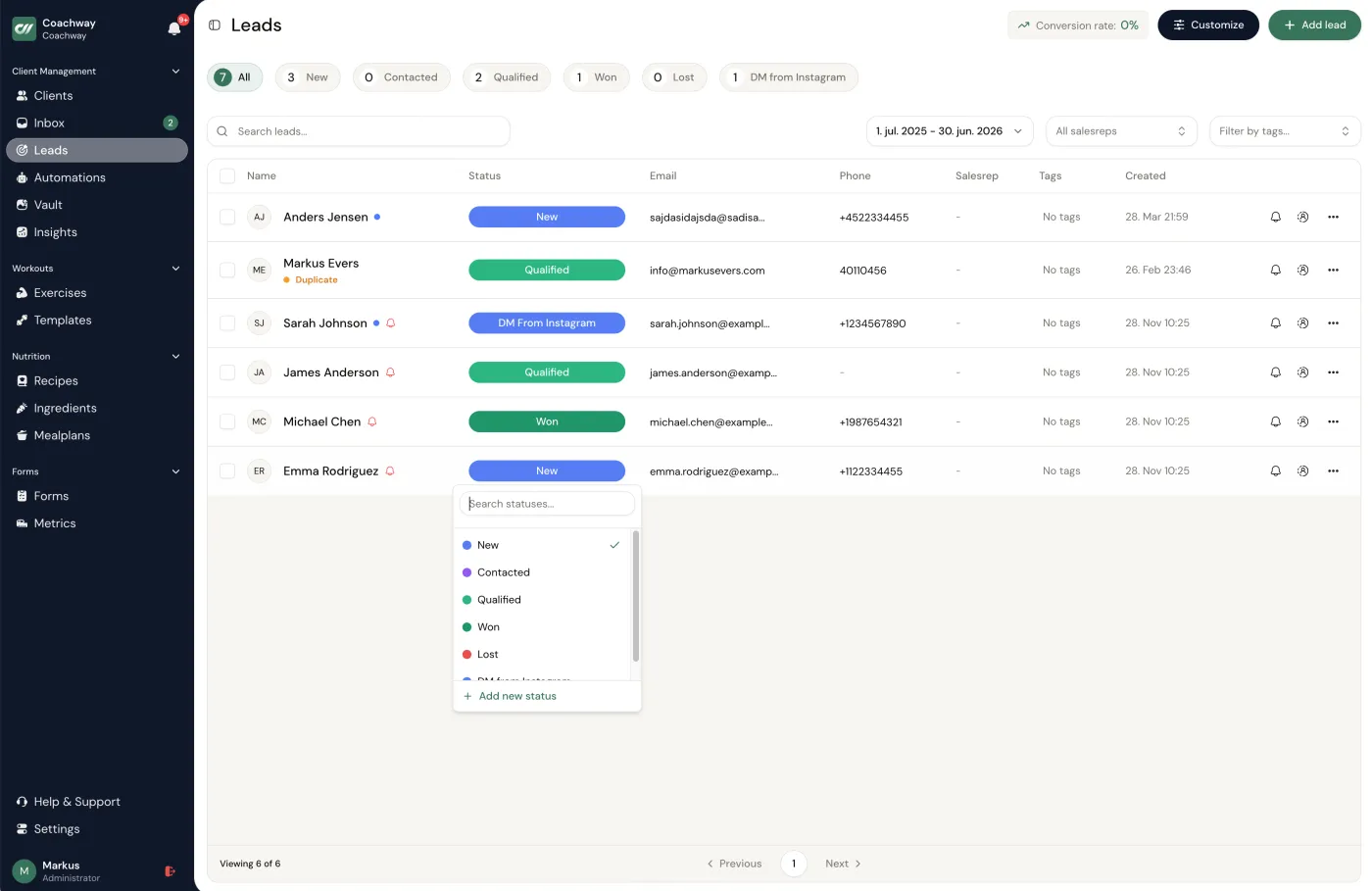
Every channel above ends in the same place: someone raises their hand and you have a small window to turn interest into a booked client. That is where most solo marketing quietly leaks. A DM gets buried, a summer enquiry is forgotten, a call is booked but the follow-up never happens - and the busier your marketing works, the more people fall through the gaps precisely when there are the most of them. The fix is not more content; it is one place that catches every lead and moves it forward. In Coachway that chain lives together: an embeddable lead form that captures the full source trail so you can see which channel actually produces clients, a visible pipeline with new, contacted, qualified and won stages, and a one-click convert that gives a new client the client app, the onboarding sequence and a subscription billed through your own Stripe. It is built on knowledge from working with 150 online coaches over 6+ years, and it costs EUR 69 a month including your first 5 clients, EUR 9 per additional client after that. The 14-day free trial starts with a card and cancels under Billing before it renews - or book a demo and see the pipeline first.
Frequently asked questions about marketing online personal training.
How do you market online personal training with no audience?
You borrow other people's audiences and mine the network you already have, because a small following is the normal starting point, not a disqualifier. Three moves do most of the early work. First, message the warm list: every past in-person client, every gym contact, everyone who has ever asked what you do - a short, specific, personal note out-converts a month of posting to strangers. Second, get in front of audiences that are already gathered - a guest slot on a podcast, a takeover of a bigger account, a talk to a local run club or workplace - so you are marketing to a room instead of building one from zero. Third, publish one useful thing a day about the exact problem you solve, so the handful of people who do find you get proof you can coach before they ever DM you. Reach follows relevance; it does not have to come first.
How much should you spend to market online personal training?
You can market online personal training for the cost of your time and one software subscription before you spend a cent on ads. The organic engine - positioning, content, DMs and referrals - is free to run, and it is where a solo trainer should win first, because paid traffic sent to an unclear offer just loses money faster. The one tool worth paying for early is the system that catches and converts the interest your marketing creates: Coachway is EUR 69 a month including your first 5 clients, with an embeddable lead form and a pipeline so warm people do not fall through the gaps. Add paid ads later, deliberately, once you know your offer converts and you have a number for what a client is worth - not as the thing you reach for because organic feels slow.
Do you need paid ads to market online personal training?
No. Most solo online trainers get their first ten to twenty clients with zero ad spend, on positioning, consistent content, warm DMs and referrals alone - and it is usually a mistake to run ads before that. Paid ads amplify an offer; they do not fix one, so pointing traffic at a fuzzy promise or a page that does not convert burns money and teaches you nothing. The honest sequence is to prove the offer organically first: get a handful of paying clients, watch which message actually made them buy, and only then consider ads as a way to buy more of a thing you already know works. When you do, start small, track what a client is worth against what one costs to acquire, and treat the budget as a test, not a rescue.
What is the fastest way to get online personal training clients?
Message your warm list by hand today, then run a short challenge as a low-friction front door. The warm list - past clients, gym contacts, anyone who has asked about your coaching - is the highest-converting audience you will ever have, and it costs nothing but an afternoon to work through. A two to four week challenge then gives hesitant people a way to feel what being coached by you is like before committing to months, and a natural, non-pushy reason to make a full offer at the end. That combination - warm outreach plus a small first step - beats waiting for content to compound, which is the slower, longer game you run in parallel underneath it.
How is marketing online personal training different from in-person?
In-person marketing sells proximity - the gym floor, the local search, the person who can train you at 6am three miles away. Online marketing sells you, specifically: your method, your results, your point of view, to people who will never share a room with you and who therefore need more proof and a clearer promise before they buy. That shifts the whole job. Location stops being your advantage, so a sharp niche and a distinctive method become the thing that makes a stranger choose you over the thousand other trainers a phone-scroll away. Content does the work a gym building used to do - it is how people discover you and decide you are credible - and trust has to be built at a distance through testimonials, a clear offer and a professional client experience rather than a handshake.
Marketing online personal training is really one loop this guide keeps pointing at: a clear offer, free channels that create warm interest, and a system that turns it into clients. When you are ready to widen the top of the funnel, the full fitness marketing guide and the get-clients playbook take it from here.
Keep reading
all guidesBlack Friday for Personal Trainers: The Offer, Not the Discount
Black Friday was built for one-time products, and run carelessly it cheapens a coaching brand. Whether to run a sale at all - and how to run one that does not race to the bottom: the honest economics of discounting recurring coaching, an LTV formula you run on your own numbers, the EU price-reduction rule to check, and the bonus-led alternative to a discount.
Read the guideHow to Sell Workout Programs Online: A Coach's Guide (2026)
Selling a workout program means turning one proven training plan into a low-touch product a buyer follows on their own: package it for one specific person, deliver it through an app rather than a flat PDF, price it below your one-to-one coaching so it feeds that offer, and take payment on a checkout you control. The four steps from plan to sale, where to deliver it, and how much of each sale you actually keep under flat per-client pricing versus a revenue-share cut.
Read the guideTikTok for Fitness Coaches: How to Get Clients in 2026
TikTok is the fastest way for a coach with no audience to get found, because it shows videos to strangers based on what they watch, not who they follow - but it never closes a sale on its own. The honest playbook for the two halves most guides skip: the content that actually gets shown (weighted toward discovery, built in three jobs), the cadence you can hold, and the DM-to-trial funnel that catches interest in one pipeline instead of collapsing in your inbox.
Read the guideFree tools for this: Sales Objection Handler · Discovery Call Calculator · No-Show Cost Calculator
See what Coachway can do for your coaching business
Coachway was built on knowledge from working with 150 online coaches over 6+ years, who all hit the same wall - slow platforms, clunky workflows, wasted hours. Start your 14-day free trial and see what we fixed - the whole platform, no charge today, cancel anytime under Billing.