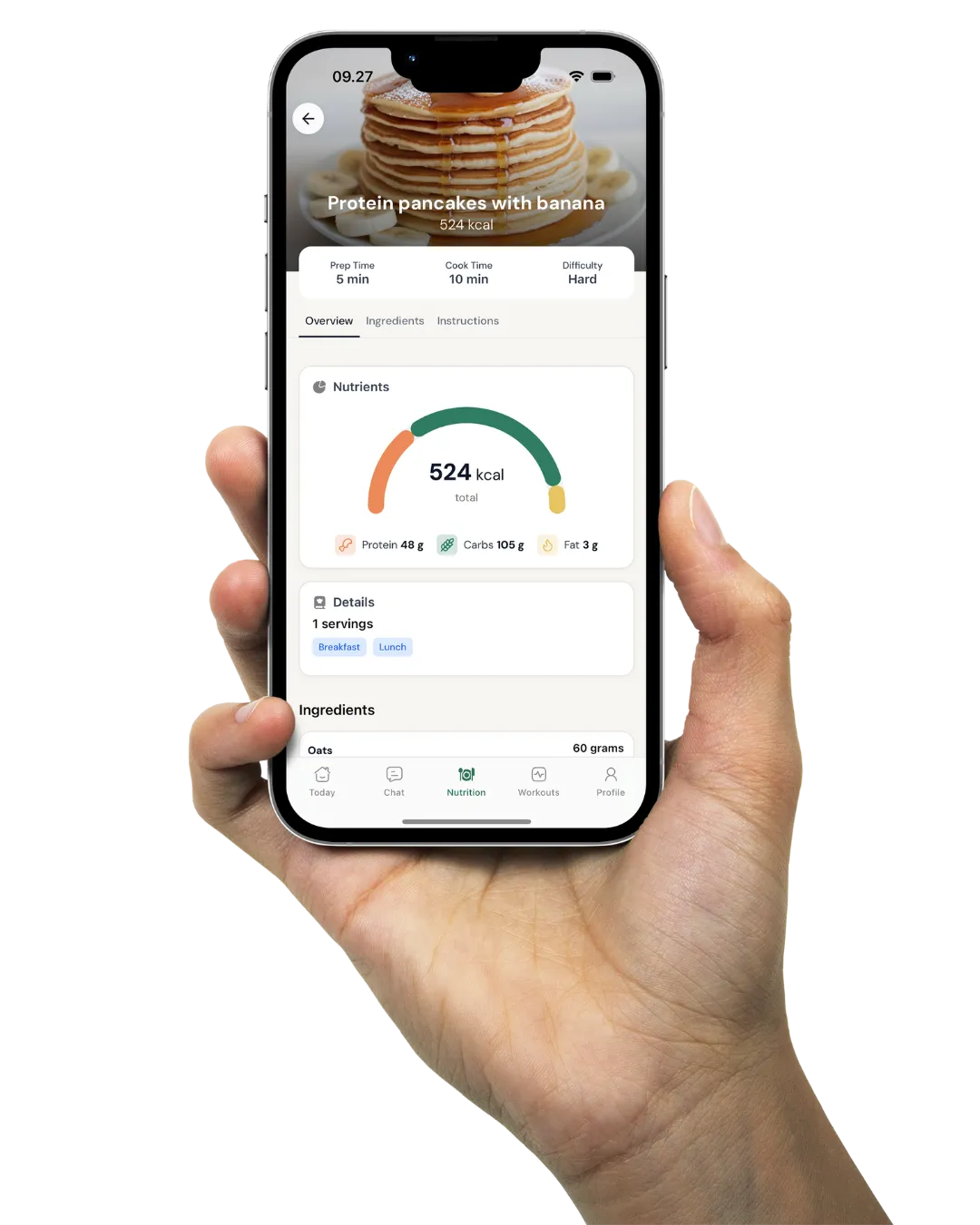
How to create a meal plan for a client - a method that gets followed, not a generic PDF.
To create a meal plan for a client, work from the frame inward: set the calorie and macro target first, map the client's real food life second, choose the plan's structure third, then build the meals as swappable options and deliver them where the client actually logs. This is the coach's method behind a plan a client keeps to - what to decide in what order, how to fit it to the person, and how to adjust it from check-ins instead of reissuing a document nobody opens.
By Markus Evers · Updated September 2026
the short version
A client meal plan is built in five ordered steps, not meal by meal: set the calorie and macro target from the goal and history, map the client's real food life (likes, refusals, allergies, meal count, budget, cooking skill), choose the structure that fits, build each meal as a swappable option near the same numbers, then deliver it.
Why does a generic meal plan fail?
A generic meal plan fails because it solves the coach's problem, not the client's. It hits a calorie number on paper, looks thorough, and takes ten minutes to produce from a template - and then it sits unopened, because it asks a real person to eat food they do not like, cannot afford, cannot cook, or cannot fit around a job and a family. Adherence, not elegance, is what moves a client's body, and adherence is a property of how well the plan fits a life, not of how precisely it fits a spreadsheet. The most macro-perfect plan in the world scores zero if the client quietly abandons it in week two.
A followable plan is the opposite trade. It accepts a little imprecision at the edges in exchange for a plan the client can actually run on a normal Tuesday, and it is built to survive contact with reality: a swap when an ingredient is gone, a lighter option after a late meeting, a version that works when they are cooking for three. That resilience is designed in from the start, which is why the method below spends its first two steps on the frame and the person before a single meal is chosen. Get the order right and the plan does the quiet work of getting followed on its own.
What are the five steps to build a client meal plan?
If you draft with ChatGPT, the AI meal-planning workflow puts the same five steps around six prompts and a coach sign-off.
1. Set the calorie and macro frame first.
Before you name a single meal, decide the number the plan has to hit. Set an energy target from the client's goal, body size, activity and adherence history - a moderate deficit for fat loss, a modest surplus for muscle gain, roughly maintenance for a recomposition - then set protein first among the macros because it protects muscle and drives fullness, and let carbohydrate and fat fill the rest around training and preference. Treat the starting figure as a hypothesis to correct, not a verdict: it gets nudged from two to three weeks of real weight and check-in data once the plan is live. If you want the full logic behind the number, the calorie-target method and the TDEE and macro walkthrough cover it in full. This is general nutrition information, not medical advice - stay inside your scope of practice.
2. Map the client's real food life.
The second step is where a followable plan is won or lost, and it costs you an intake form rather than a calculator. Flag the non-negotiables first: allergies and intolerances, then any medical or religious restrictions, because those are hard walls the plan can never cross. Then gather the softer reality that decides adherence - the foods the client genuinely likes and the ones they will never eat, how many times a day they actually eat, their budget, their cooking skill, how much time they have, and who else they are feeding. A plan that assumes an hour of cooking for someone who has fifteen minutes is a plan that fails on day one. This is also the step where you learn whether the client wants decisions removed or freedom preserved, which sets up the next one.
3. Choose the structure that fits the person.
There is no single right structure - there are three, and the client decides which. A fixed plan spells out exact meals with no decisions, which suits a beginner who feels paralysed by choice or a client in a tight prep phase, but it is fragile the moment life moves. A swappable menu - five to ten interchangeable options per meal slot that all land near the same calories and protein - fits most people, because it holds the numbers while letting the client pick by mood and schedule. Macro targets with example meals give full freedom and teach the client to feed themselves, but only work once they can estimate portions. Match the structure to the person in front of you, not to your own preference, and expect to move a client from fixed toward flexible as their food skills grow. The macro-coaching methods guide goes deeper on the flexible end.
4. Build meals as options with explicit swaps.
Now build the meals, and build them as a system rather than a script. For each meal slot, create a small set of options that each land near the same calorie and protein numbers, using foods you pulled from step two so nothing on the plan is a food the client will not eat; a protein per meal calculator gives you the per-meal protein figure those options need to hit, and a calories per meal calculator splits the daily target into the calorie figure for each slot. Attach a swap to every component - a protein swap, a carb swap, a "no time today" version - because the single most common reason a plan breaks is one missing ingredient with no fallback. Add the practical scaffolding a client actually uses: portion amounts they can measure, a shopping list, and enough repetition that cooking stays realistic. This is also where good software earns its place: recipes that auto-scale to the target and a shopping list that writes itself turn an afternoon of copy-paste into minutes, and keep the numbers honest when you swap a meal.
5. Deliver it where the client logs and checks in.
A meal plan is only half the job; the other half is seeing whether it is being followed. Delivered as a flat PDF, a plan is invisible the moment you send it - you cannot tell if the client opened it, adapted it, or quietly stopped. Delivered in the app the client already logs food and checks in through, the plan becomes a live loop: you see adherence, you see where they drift, and you adjust from real data on the check-in cadence instead of reissuing a document. That is the difference between a plan you hand over and a plan you coach. It is also why the plan and the check-in belong in the same place, so reading progress and changing the plan are one motion rather than two tools. The nutrition progress method covers exactly what to read before you adjust.
Where the meal plan and the check-in live together.
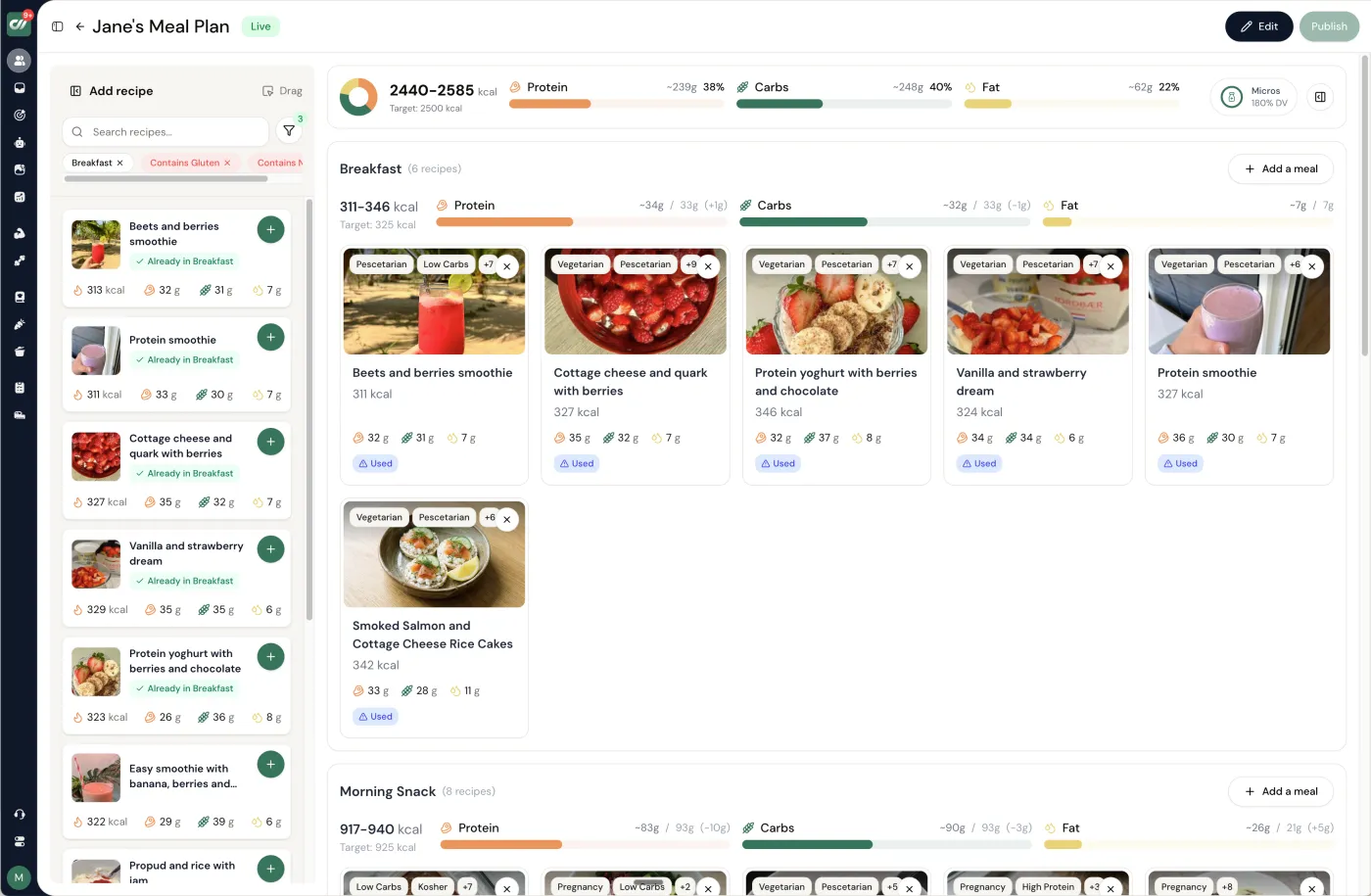
Every step above is easier when the plan is not a document you email. Coachway is coaching software that builds and delivers the plan in the same place the client logs food and checks in, so the loop in step five is the default rather than something you assemble from three tools. You build meals against per-client calorie and macro targets that can be set per weekday, draw on a library of 1,100+ recipes and 3,900+ ingredients, and let recipes auto-scale to the target while the shopping list writes itself - the swappable menu from step four, built in minutes instead of an afternoon. Four access levels let you decide how much the client sees, from a full plan to a photo diary you simply comment on. Coachway is built from working with 150 online coaches over 6+ years, and it costs EUR 69 a month including your first 5 clients, then EUR 9 per additional client, with every feature included. See it on your own clients with the meal-planning software comparison, or book a demo first. The 14-day free trial starts with a card and cancels under Billing before it renews. The coach dashboard is in English; the client app is available in English, Danish, Norwegian, Swedish, Finnish and German.
Frequently asked questions about building a client meal plan.
How do you create a meal plan for a client?
You create a meal plan for a client in a fixed order, working from the frame inward. First set the energy and macro target from the client's goal, body size, activity and adherence history - the number the plan has to hit before a single meal is chosen. Second, map the client's real life: the foods they like and refuse, allergies and intolerances, how many times a day they actually eat, budget, cooking skill and who else they cook for. Third, pick the structure that fits that person - a set list of meals for someone who wants zero decisions, a small menu of interchangeable options for most people, or macro targets with example meals for a client who already understands food. Fourth, build the meals as options that each land near the same numbers, with explicit swaps so a missing ingredient never breaks the day. Fifth, deliver it where the client logs and checks in, so you can see adherence and adjust from real data rather than reissuing a document. The order matters: a plan built preferences-first tends to miss the target, and a plan built target-first without the preferences never gets followed.
Should a client meal plan be fixed meals or flexible macros?
It depends on the client, and the honest answer is that most people sit in the middle. A rigid fixed-meal plan removes every decision, which suits a beginner who feels paralysed by choice or someone in a tight prep phase - but it is fragile, because one unavailable ingredient or one restaurant meal can derail the whole day. Pure macro targets give total freedom and teach the client to feed themselves, but they only work once someone can already estimate portions and read a label. The structure that fits the widest range of clients is a small menu: five to ten interchangeable options per meal slot that all land near the same calories and protein, so the client picks by mood and schedule while the numbers stay honest. Match the structure to the person in front of you rather than to your own preference, and be ready to move a client from fixed toward flexible as their food skills grow.
How many calories should a client's meal plan contain?
The calorie number comes before the meals, not after them, and it is set from the client's goal and rate of change rather than pulled from a generic template. A fat-loss plan sits in a moderate deficit below maintenance; a muscle-gain plan sits in a modest surplus; a maintenance or recomposition plan sits around the client's real intake. The starting figure is an estimate from body size, activity and adherence history, then it is corrected from two to three weeks of actual weight and check-in data, because a calculator gives you a hypothesis and the client's body gives you the answer. The plan's job is to make that calorie and protein target easy to hit repeatedly, which is why the number is decided first and the meals are then built to land on it. This is general nutrition-coaching information, not medical or dietetic advice - stay inside your scope of practice and refer clinical cases on.
Can a personal trainer write a meal plan for a client?
In most cases a coach can build meal guidance for healthy clients, but the exact line depends on your country and certification, and medical nutrition therapy for a diagnosed condition is often restricted to registered dietitians. The safe posture is to coach general healthy eating - energy balance, protein, food quality, habits and adherence - and to refer anyone with a medical condition, an eating disorder history, pregnancy or a clinical diet to the appropriate professional. Treat the meal plan as an education and organisation tool that helps a client eat toward a goal they set, not as a prescription. Knowing and staying inside your scope of practice protects the client and protects your business, and it is the one part of building a meal plan you should never improvise.
How often should you update a client's meal plan?
Adjust the numbers on the check-in cadence - usually every two to three weeks - and refresh the meals only when the client tells you they are drifting. Two different clocks run here. The energy and macro target moves when the trend data says it should: if fat loss has stalled across a fortnight of honest logging, the deficit gets nudged, not the recipes. The meals themselves change when adherence signals boredom or friction - the client is skipping the same lunch, an ingredient stopped being available, or their schedule shifted - which is information you only get if the plan lives somewhere you can see the logging. Chasing the scale every few days leads to over-adjustment; leaving a plan untouched for months lets it quietly stop fitting the client's life. The check-in is where both decisions get made, which is why the plan and the check-in belong in the same place.
A meal plan is one half of nutrition coaching; the other half is the loop around it. Set the frame with the calorie-target method, run the flexible end with macro coaching, and close the loop by reading nutrition progress before every adjustment.
A meal plan is one half of nutrition coaching; the other half is the loop around it. If you want a model to write the first draft of steps two to four, how to use AI for meal planning as a coach has the six prompts and the sign-off checklist that keep it safe. Set the frame with the calorie-target method, run the flexible end with macro coaching, and close the loop by reading nutrition progress before every adjustment.
Keep reading
all guidesZone 2 Cardio: What It Is & How to Program It
Zone 2 cardio for coaches: the conversational ~60-70% max-HR aerobic zone, why it builds an aerobic base, how to find it, and how to program frequency and duration.
Read the guideSteady-State Cardio: Benefits & How to Program It
Steady-state cardio for coaches: what it is, the benefits, how it compares to intervals, and how to program sessions, duration, and intensity for clients.
Read the guideHow Much Cardio for Fat Loss? A Coach's Guide
How much cardio for fat loss, for coaches: the diet drives the deficit, cardio is one lever. A sensible starting dose, why more backfires, and how to scale it.
Read the guideFree tools for this: Reverse Diet Calculator · Water Intake Calculator · Keto Macro Calculator
Ready-made template: Meal Plan Template
See what Coachway can do for your coaching business
Coachway was built on knowledge from working with 150 online coaches over 6+ years, who all hit the same wall - slow platforms, clunky workflows, wasted hours. Start your 14-day free trial and see what we fixed - the whole platform, no charge today, cancel anytime under Billing.