How to program deload weeks for clients - the coach's call, made at a distance.
Knowing what a deload is takes a paragraph. Knowing how to program deload weeks for clients you cannot see lift is the actual job: deciding when accumulated fatigue justifies one, choosing whether to cut volume or intensity, setting how often it recurs, and writing it up so the client runs it easy instead of quietly training through it. This is the programming decision, worked end to end for remote coaching.
By Markus Evers · Updated August 2026
the short version
To program a deload week for a client, make three decisions in order. Decide it is due - by the calendar (you planned one after a four to six week block) or by the signals (stalling loads, rising effort ratings, sleep and mood sliding, new joint niggles stacking up in the check-in). Choose the lever - for most clients cut working volume by a third to a half and keep the load near normal; only cut intensity too when the fatigue is joint and connective-tissue driven. Then communicate it - one honest line that frames the deload as planned progress, so the client leaves reps in the tank instead of training through the week. The programming is simple. The coaching is reading the signals early and getting the client to actually run it easy.
When does a remote client's fatigue justify a deload?
There are two honest triggers for a deload, and good programming uses both. The first is planned: you scheduled one at the end of a training block, typically after four to six weeks of hard work, because you know fatigue accumulates faster than most clients admit. The second is reactive: the block is not over, but the client is clearly running down. In a gym you would see it. Coaching at a distance, you have to read it, and the tell is never one number - it is a cluster. Loads that have stalled or slipped for two sessions. A session-difficulty rating that keeps climbing while the weights stay flat. Sleep and mood scores drifting down. A jump in reported joint niggles - an elbow, a knee, a lower back that is suddenly in every message. One of those on its own is a normal bad week. Three or four of them stacking inside the same seven days is the pattern that says deload now.
This is why the check-in is a programming tool, not a wellness formality. If your weekly form only asks for weights and photos, the fatigue is invisible until it becomes an injury or a client who quietly stops training. Build the form to surface it on purpose: a session-difficulty or effort rating, a sleep score, a soreness or pain flag, and a plain box for how they feel about training. When those move together, the decision to deload is made for you. If you want the underlying logic of the fatigue-versus-fitness picture, the deload-week explainer covers the concept - this guide is about the call you make once you can see the signals.
Cut volume or cut intensity? The lever depends on the fatigue.
A deload is a controlled reduction in training stress, and you have two dials to turn: volume (how many hard sets) and intensity (how heavy). The mistake is turning both to near zero, which is a rest week, not a deload - it removes the light stimulus that keeps a client sharp and confident. Which dial you turn depends on what kind of fatigue you are clearing, and matching the lever to the fatigue is the part that separates a programmed deload from a vague easy week.
Systemic fatigue - cut volume, keep the load.
This is the default for most general and hypertrophy-focused clients. The client is tired, stalled and flat, but the joints are fine. Cut working volume by roughly a third to a half - drop sets per muscle, not the exercises - and keep the load near normal working weight, stopping every set two or three reps short of failure. Keeping the load preserves the skill of the lift and gives the muscle a reason to hold on, while the missing sets are what actually let fatigue drain. Same exercises, same days, same schedule - only the set count moves. If you program by RPE or RIR, a deload is simply a week where you cap effort well below your normal working range.
Joint and connective-tissue fatigue - cut intensity too.
When the fatigue is showing up as achy elbows, cranky knees or a lower back that is talking, the heavy load itself is the stressor, and cutting sets alone will not give the tissue a break. Here you pull both dials: drop to roughly 60 to 70 percent of working weight and reduce sets at the same time, so the joints get a genuine week away from load while movement quality stays high. This is the deload a strength or powerlifting client needs more often than a pure bodybuilding client, because their training lives at heavier percentages. The reduced load is the point - do not let the client sneak the weight back up because it feels too easy.
Set it in the program, not in a message.
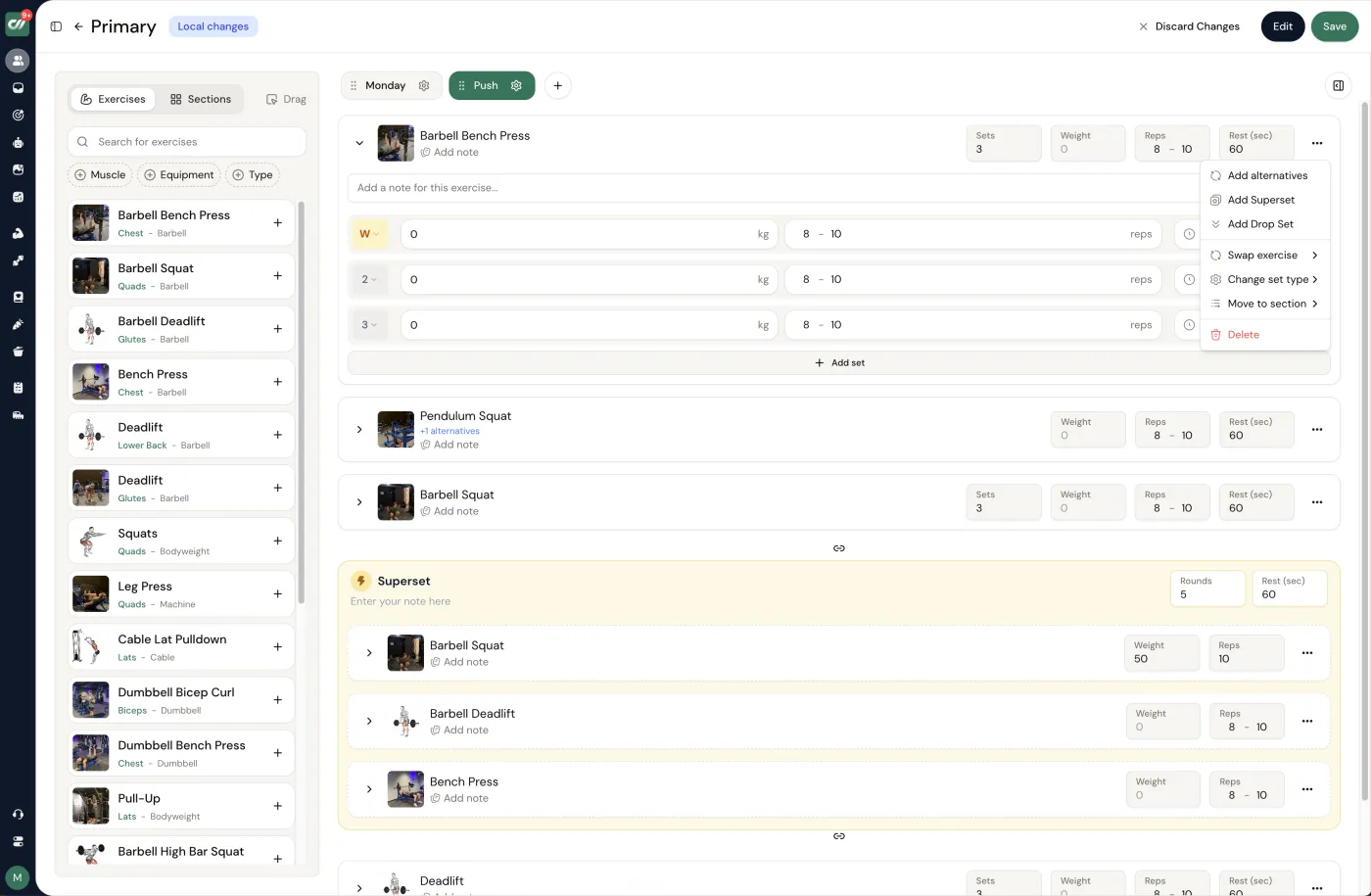
The deload has to live inside the client's actual plan, or it will not happen. Edit the training week itself so the reduced sets and prescribed loads are what the client opens on their phone, rather than leaving the normal block up and asking them to hold back on their own. A deload delivered as a verbal aside gets ignored; a deload written into the week is a deload the client runs. The programming-during-a-cut guide covers a related case - a client on low recovery who needs deloads more often and shorter blocks between them.
How often should a deload recur in the plan?
The default is every four to six weeks of hard training, but the honest answer is that the interval scales with how much stress the client actually absorbs - and the calendar is a starting assumption, not a rule you hold while a client visibly grinds down. Set the interval by the client in front of you rather than by a textbook number.
Advanced, high volume
Every ~4 weeks
A lifter training near their limit with high set counts accumulates fatigue fastest and needs the shortest interval. Schedule a deload every fourth week and still watch the signals in case it comes sooner.
General, moderate load
Every 6-8+ weeks
A busy client training three moderate days a week absorbs less stress and can often run eight or more weeks before accumulated fatigue calls for a deload. Let the check-in, not the calendar, pull the trigger early if needed.
Beginner
By signal, not calendar
Loads are light enough that a normal rest day clears the fatigue, so scheduled deloads rarely earn their place. Program them reactively if the signals appear, and spend the structure on consistency instead.
The interval also interacts with everything outside the gym. A client sleeping badly or dieting hard needs deloads sooner than the same client eating and sleeping well, because recovery is the real budget a deload spends against - the sleep and recovery picture moves this dial as much as the training does. And if you are not sure a client is running enough hard sets to need a deload in the first place, the weekly training volume calculator gives you the set-per-muscle number the interval should scale with.
How to communicate a deload so the client actually runs it easy.
A perfectly programmed deload fails in two familiar ways, and both are communication problems, not programming ones. The first client ignores the reduced sets and trains through the week, because nobody told them the easy week was the point. The second reads "easy week" as "I am regressing," gets discouraged, and their motivation dips exactly when you were trying to protect it. The fix for both is the same: frame the deload as a planned part of the plan, decided before the block even started, that makes the next block possible - never as a reaction to them failing.
The message that works is short and unapologetic. Something like: "This week is a deload. We are cutting your sets on purpose so your body clears the fatigue from the last block. Keep the weights where they are, leave two or three reps in the tank on every set, and do not add anything back in. You will come back stronger next week - that is the whole point." That does three jobs at once. It names the week so it is not a mystery. It gives an explicit instruction to hold back, which is the behaviour a deload lives or dies on. And it tells the client the payoff, so feeling fresh again reads as the result they are buying, not a consolation prize.
The deeper move is to sell the deload before it arrives. When you onboard a client and lay out the plan, tell them deloads are scheduled - that every few weeks the training will deliberately ease off, and that this is a feature of good programming, not a sign anything went wrong. A client who was told about deloads in week one runs their first one without a flinch. A client who meets the concept for the first time in a mid-block message is the one who argues, adds sets back, or worries they are falling behind. This sits inside the same principle as the rest of your programming for coaches: the client executes what they understand, so the programming and the explanation are the same job.
The deload call runs on the check-in and the workout builder together.
Every decision above depends on two things being in one place: signals you can read, and a program you can edit the moment they turn. When the check-in lives in a spreadsheet and the plan lives in a PDF, the fatigue pattern is invisible until it is an injury, and rewriting a deload week is a slow copy-paste job you put off. In Coachway the two sit side by side. The check-in form builder lets you add the exact fatigue fields the decision needs - a session-difficulty rating, a sleep score, a pain flag, a training-mood box - and review this week's answers next to the weight trend and training log on one screen, so the cluster of signals that justifies a deload is something you see rather than something you miss. Then the workout builder, with its 1,800+ exercise library, lets you edit the coming week directly - halve the sets, cap the load, leave the exercises alone - so the deload the client opens on their phone is the deload you programmed, not a note they were meant to remember. It is built on knowledge from working with 150 online coaches over 6+ years, and it costs EUR 69 a month including your first 5 clients, then EUR 9 per additional client, every feature included. Or book a demo and see the check-in and builder on one screen first. The 14-day free trial starts with a card and cancels under Billing before it renews.
Frequently asked questions about programming deload weeks.
How do you program a deload week for a client?
Make the call, then make the cut, then tell the client why. First decide a deload is due - either the calendar says so (you planned one at the end of a four to six week block) or the signals say so (stalling loads, joints that ache before the working sets, sleep and mood sliding, sessions that feel heavier than the numbers justify). Then choose the lever: for most general clients, cut working volume by roughly a third to a half - fewer sets per muscle - and keep the load near normal so the movement pattern and the reason to hold muscle both stay intact. Keep the same exercises, the same days, the same schedule, so nothing about the week reads as a break. Finally, write one honest line to the client framing it as planned progress, not lost time, because a deload only works if they actually run it easy instead of quietly adding sets.
Should you cut volume or intensity during a deload?
For most clients, cut volume and keep intensity. Dropping sets is what actually clears fatigue, while keeping the load near working weight preserves the skill of the lift and gives the muscle a reason to stay. The exception is a client whose fatigue is joint and connective-tissue driven - achy elbows, cranky knees, a lower back that is talking - where the heavy load itself is the stressor. There you cut intensity too: drop to roughly 60 to 70 percent of working weight and reduce sets, so the tissue gets a genuine break from load. A useful default is volume-led for the systemically tired lifter and load-and-volume for the beaten-up one. What you almost never do is cut both to near zero - that is a rest week, and it removes the light stimulus that keeps a client sharp and confident going back in.
How do you know when a remote client needs a deload?
You read the check-in, not just the training log. Remote clients rarely say the words 'I am fried' - it shows up as a cluster: loads that have stalled or slipped for two sessions, sleep and mood ratings drifting down, a jump in reported joint niggles, and effort ratings climbing while the weights stay flat. One bad week is noise. The same three or four signals stacking across a week is the pattern that justifies a deload. Because you cannot see the client lift, structure the check-in to surface fatigue on purpose: a session-difficulty rating, a sleep score, a soreness or pain flag, and a plain 'how are you feeling about training' box. When those move together, the programming call is easy - the hard part is having built the check-in that shows you.
How often should you program a deload for a client?
As a planned default, every four to six weeks of hard training, and sooner if the signals demand it. The right interval scales with how much stress the client is actually absorbing: an advanced lifter training near their limit with high volume may need a deload every fourth week, while a busy general client training three moderate days a week can often run eight or more weeks before accumulated fatigue calls for one. Beginners rarely need scheduled deloads at all - their loads are light enough that a normal rest day clears the fatigue - so program deloads for them by signal rather than by calendar. The honest rule is that the interval is a starting assumption you adjust from what the check-ins tell you, not a fixed number you hold to while a client visibly grinds down.
How do you explain a deload week to a client without them losing motivation?
Frame it as a planned part of the plan, decided in advance, that makes the next block possible - never as a reaction to them failing. The line that works is some version of: 'This week is a deload. We are cutting your sets on purpose so your body clears the fatigue from the last block. Keep the weights where they are, leave two or three reps in the tank on every set, and do not add anything back in. You will come back stronger next week - that is the whole point.' The two failure modes are a client who ignores the deload and trains through it, and a client who reads 'easy week' as 'I am regressing' and gets discouraged. Both are solved the same way: tell them it was scheduled before the block even started, and that feeling fresh again is the result you are buying, not a consolation prize.
Keep reading
all guidesCompound vs Isolation Exercises: The Difference
Compound exercises move multiple joints and train several muscles at once; isolation exercises move a single joint to target one muscle. The difference, examples, pros and cons, and how to order them.
Read the guideHow to Warm Up for a Workout (Coach Guide)
A warm-up has two jobs: raise body temperature, then prime the exact lifts ahead. The general warm-up, dynamic stretches, and the ramp-up sets that climb toward the working weight - plus why static stretching belongs after.
Read the guideSleep and Recovery for Training: A Coach's Guide
What sleep and recovery really do for training - hormones, performance, appetite, and how much - plus how coaches build recovery into client check-ins.
Read the guideFree tools for this: Lift Progression Reader · One-Rep-Max Calculator · Weight Trend Reader
Ready-made template: Workout Program Template
See what Coachway can do for your coaching business
Coachway was built on knowledge from working with 150 online coaches over 6+ years, who all hit the same wall - slow platforms, clunky workflows, wasted hours. Start your 14-day free trial and see what we fixed - the whole platform, no charge today, cancel anytime under Billing.