


Coaching management software - what the category actually includes for fitness and nutrition coaches.
Coaching management software is the single system a coach uses to run client management, program management and payment management from one client record, instead of stitching them across a spreadsheet, a training app, a chat thread and a payment link. This guide defines the category for fitness and nutrition coaches specifically - not life or executive coaching, which the phrase usually points at - maps the features onto your actual coaching week, and is clear about what it costs and where Coachway fits.
By Markus Evers · Updated August 2026
the short version
Coaching management software is one system that holds client management, program management and payment management against the same client. The value is not any single feature - a workout app already builds plans, a payment link already takes money. The value is that they stop being separate. One caveat matters before you shop: most tools that rank for this phrase are built for life, business and executive coaching, where the unit of work is a booked session. Fitness and nutrition coaching is different - the daily unit is a logged meal, a completed workout and a weekly check-in - so the software has to be built for training and food, not adapted from a scheduling product.
More in this category: the best personal training software buyer guide, the online personal training software pillar comparison, and the best client management software for personal trainers.
What does coaching management software actually include?
Read the category as three management surfaces a growing coaching business has to run at once. A tool that covers only one of them is a point solution; coaching management software is the layer that covers all three from a shared client record, so the same person appears once, not four times. For a fitness or nutrition coach, each surface has a specific shape.
1. Client management - who they are and how they are doing.
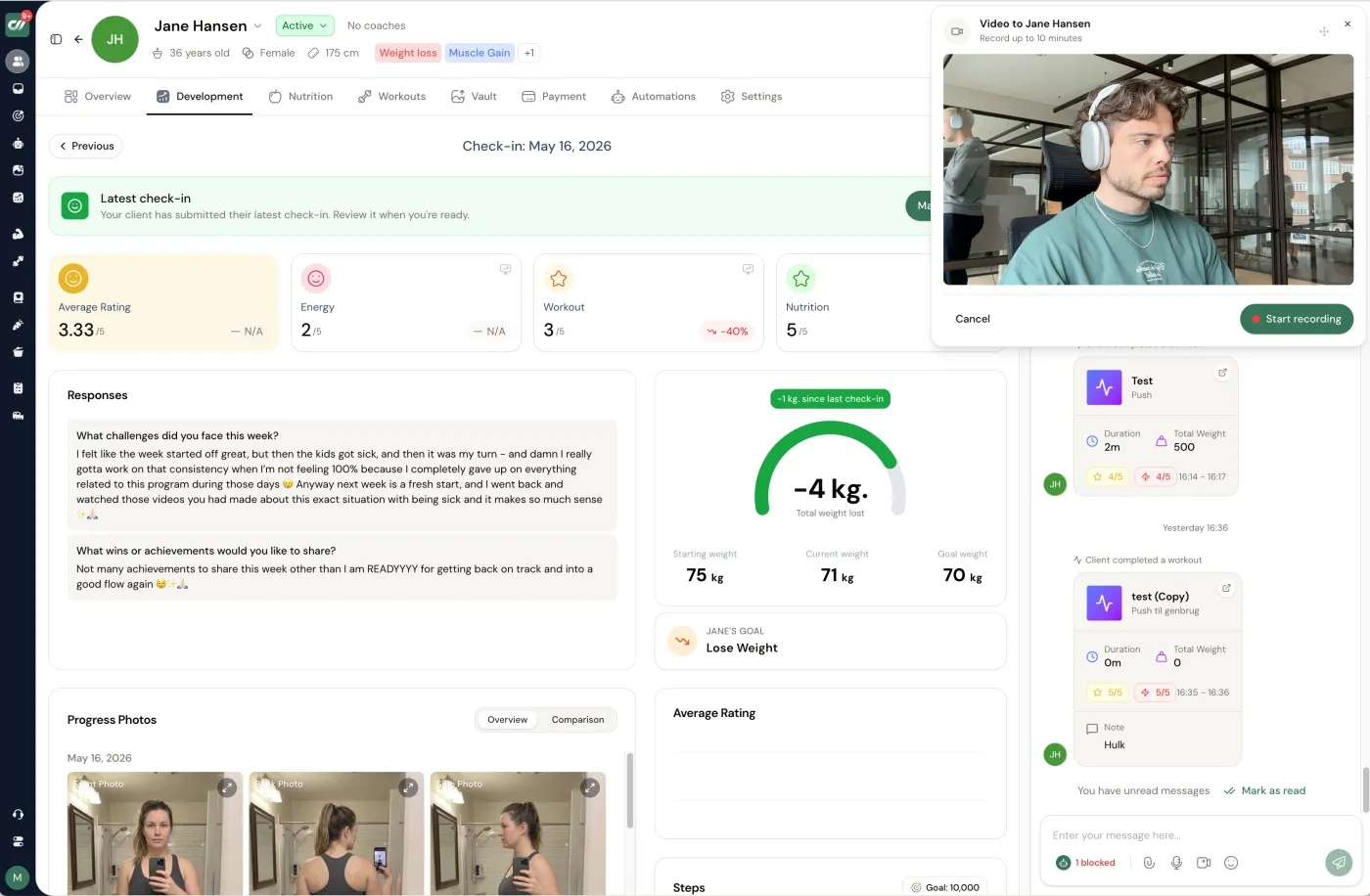
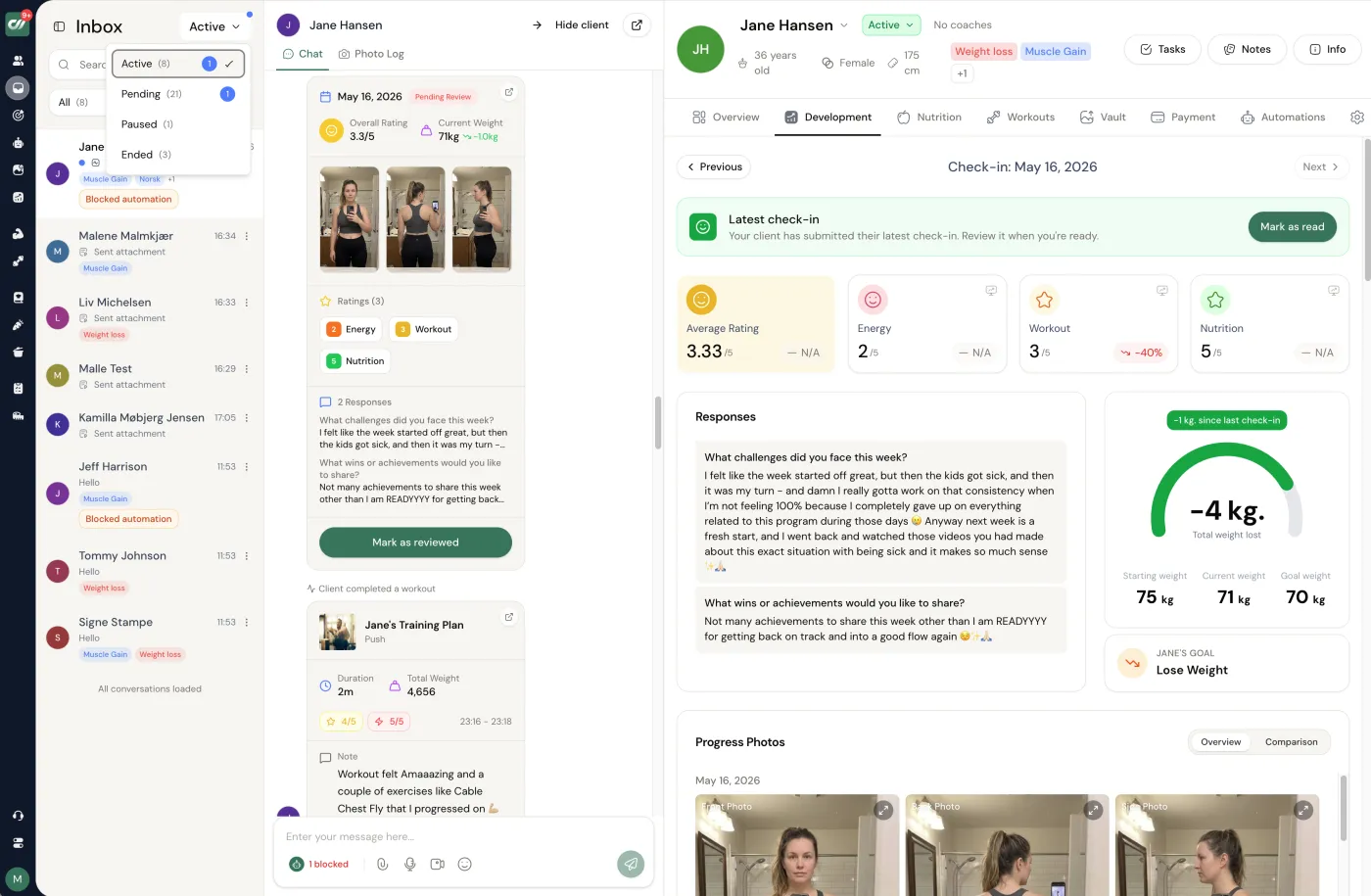
The CRM side of coaching: a clients list with status, tags and last-contact, a drag-and-drop check-in and form builder for weekly answers, measurements and progress photos, a messaging inbox for accountability, and per-client tasks so a promised follow-up between check-ins does not slip. This is the surface that decides retention, because retention is mostly whether the small human touches actually happen on time. Coachway puts this and the conversation and the live client file on one screen it calls the Power Panel, so reviewing a week is not a tab-hunt across separate apps.
2. Program management - what you deliver.
The coaching itself, and the surface where fitness and nutrition software separates from generic coaching tools. A workout builder sitting beside an exercise library, nutrition with real food logging - barcode scan, a photo diary you can comment on, macro targets per client - and a branded app on iOS and Android that delivers both to the phone. Coachway ships this with 1,800+ exercises, 1,100+ recipes and a food database of 3.7 million foods, so the library is not something you have to build before you can coach. A life-coaching platform has none of this, which is why it cannot manage a training client.
3. Payment management - how you get paid, on time.
Recurring subscriptions, planned invoices, payment plans and automatic reminders, with per-client amounts, currencies and billing intervals, plus pauses and partial refunds. This is the surface coaches leave last and regret leaving last, because a missed renewal is invisible until the money does not arrive. The question that matters is whose account the money lands in: with Coachway, payments settle in your own Stripe account and the platform never holds your money, and built-in payments are optional - if you use them they carry a 2.4% per-transaction fee, and if you run your own Stripe checkout instead there is no platform fee on top.
Is coaching management software for fitness coaches different from life-coaching software?
It is, and the gap is wider than a results page suggests. Search coaching management software and most of what ranks is built for life, business and executive coaching - platforms whose product is scheduled sessions, session notes, goals and a shared client portal. That is a genuine category, and for a coach who sells booked hours it is the right one. It is simply not the same job as fitness and nutrition coaching.
The difference is the unit of work. Session-based coaching is synchronous: the value is delivered in the booked hour, so the software leans on calendars, session packages and documents. Fitness and nutrition coaching is asynchronous and physical: the daily unit is a logged meal, a completed workout and a weekly check-in with photos and measurements, and the coach's job is to review those between sessions, not inside one. A platform built for the session model usually has no workout builder, no food logging, no progress-photo review and no macro targets - so a fitness coach who buys it ends up running the actual coaching in a second app and using the "management" tool only for scheduling and invoices.
This is the single most useful filter when you shop. The category name is shared, but the fit is not. Confirm the tool was built to deliver training and nutrition and to review asynchronous check-ins, rather than adapted from a session-scheduling product. If you want the fitness-specific slice named as tools rather than as a category, the software online fitness coaches actually use lists them, and the nutrition coaching software guide covers the food-logging side in depth.
How do the features map onto a coaching week?
The cleanest way to judge coaching management software is not the feature grid - it is whether your ordinary week runs through it without leaving to another tool. Here is the week a fitness or nutrition coach actually has, and the surface each part should touch.
New enquiry arrives - the lead pipeline.
Someone fills in your form or messages you. In management software that lands in an embeddable lead form that captures the full source trail and drops into a visible pipeline with new, contacted, qualified and won stages, so a warm enquiry is not a note in your phone that goes cold. Life-coaching tools often stop at a contact form; a fitness platform should carry the lead all the way to a billed client.
They say yes - onboarding and the branded app.
A one-click convert should hand the new client a branded app, start an onboarding sequence and set up the subscription without you re-typing their details anywhere. Coachway's branded in-app experience - your logo, cover image and colours - is included as standard, and the app runs in six languages so the client reads it in their own. That is the first impression the management side buys you, and it happens once, cleanly, instead of across three tools.
Monday - programming and nutrition.
You build or adjust the training and the meal plan. The workout builder and the exercise library, the recipes that auto-scale and write their own shopping list, and macro targets set per client, per weekday - this is program management, and it is the surface a plain scheduling tool cannot touch. Delivering both from the same client means the plan and the person are never in two places.
Mid-week - the check-in review.
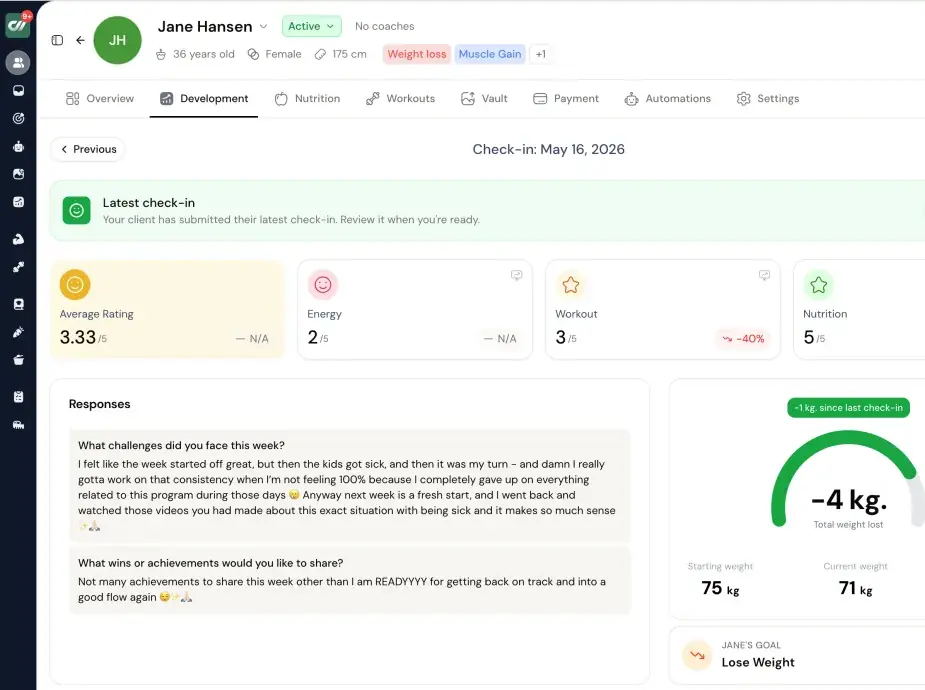
This is the beating heart of asynchronous coaching. The client's weekly answers, their weight trend, their measurements and their progress photos should sit side by side with this week's food and training log, so you read a whole person in one place and reply once. Do this well and retention takes care of itself; do it across four tabs and it is the first thing that slips when you get busy. The client management comparison ranks the tools on exactly this review experience.
Month-end - payments run themselves.
Subscriptions renew, invoices go out, reminders chase the ones that do not clear, all without you watching a calendar. Because payment management shares the client record, a lapsed payment is visible next to the person it belongs to, not hidden in a separate billing dashboard. Automations carry the routine parts of the whole week - onboarding flows, check-in reminders, drip follow-ups - so the software runs the repeatable jobs while you keep the coaching.
Coaching management software built for training and nutrition, not sessions.
We build Coachway, and it sits squarely in the fitness and nutrition half of this category rather than the session-scheduling half. The three surfaces share one client: client management on the Power Panel, program management with the workout builder and real food logging, and payment management that settles into your own Stripe. The coach dashboard is in English; the client app runs in English, Danish, Norwegian, Swedish, Finnish and German, reviewed by a working coach in each market. It is built on knowledge from working with 150 online coaches over 6+ years, and it costs EUR 69 a month with your first 5 clients included and EUR 9 per additional client after that, every feature in, no tiers. The 14-day free trial starts with a card held securely by Stripe and no charge today, and you cancel under Billing before it renews. If you would rather see a client walked end to end first, book a demo.
How do you choose coaching management software?
Because the category name is shared across very different products, the buying mistake is comparing feature lists instead of fit. Four questions cut through it faster than any table:
1. Was it built for training and nutrition, or adapted from scheduling?
This is the first filter for a fitness coach. Look for a real workout builder, food logging with macros and progress-photo review. If the demo centres on a calendar and session notes, you are looking at life-coaching software wearing the same category name.
2. Do the three surfaces truly share one client?
Some suites bolt payments or a workout module onto a different core, and the seams show as double entry. Ask to convert a lead into a billed, onboarded client and count the screens. One is the answer you want; four means you have bought the patchwork with a single login.
3. Whose Stripe account gets paid?
Payment management is where pricing gets quietly expensive. A platform that custodies your money and keeps a cut of every transaction can cost more at 50 clients than a higher monthly fee with your own Stripe. Coachway settles into your own Stripe and never holds the money; built-in payments are optional at 2.4% per transaction. Run the totals with the software cost breakdown.
4. Is it priced for a solo coach or a facility?
A solo online coach and a multi-room gym want opposite pricing. Per-location suites make sense for a facility and rarely for a coach with a phone. Per-client pricing like Coachway's EUR 69 plus EUR 9 per extra client stays predictable as you grow. If you are weighing the decision to consolidate at all, the how to choose a platform walkthrough frames the trade-offs, and the personal trainer management software guide covers the same category from the capacity angle, and the ranked best practice management software for coaches lines the platforms up side by side.
See the three management surfaces share one client record.
The whole argument of this page is that client, program and payment management should sit on the same client rather than in four apps, so it is worth seeing them do it. Click through the clients list, the messaging inbox, a mid-week check-in, the onboarding and reminder automations and the drag-and-drop form builder - the same person carries through every one, which is exactly what a session-scheduling tool adapted from separate modules cannot do. If you want the client-management surface on its own, the Power Panel puts the conversation, the notes and the live client file on a single screen.
See the real product
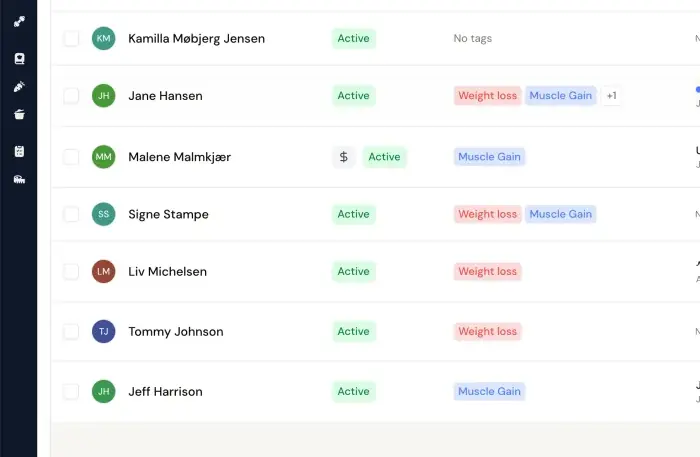
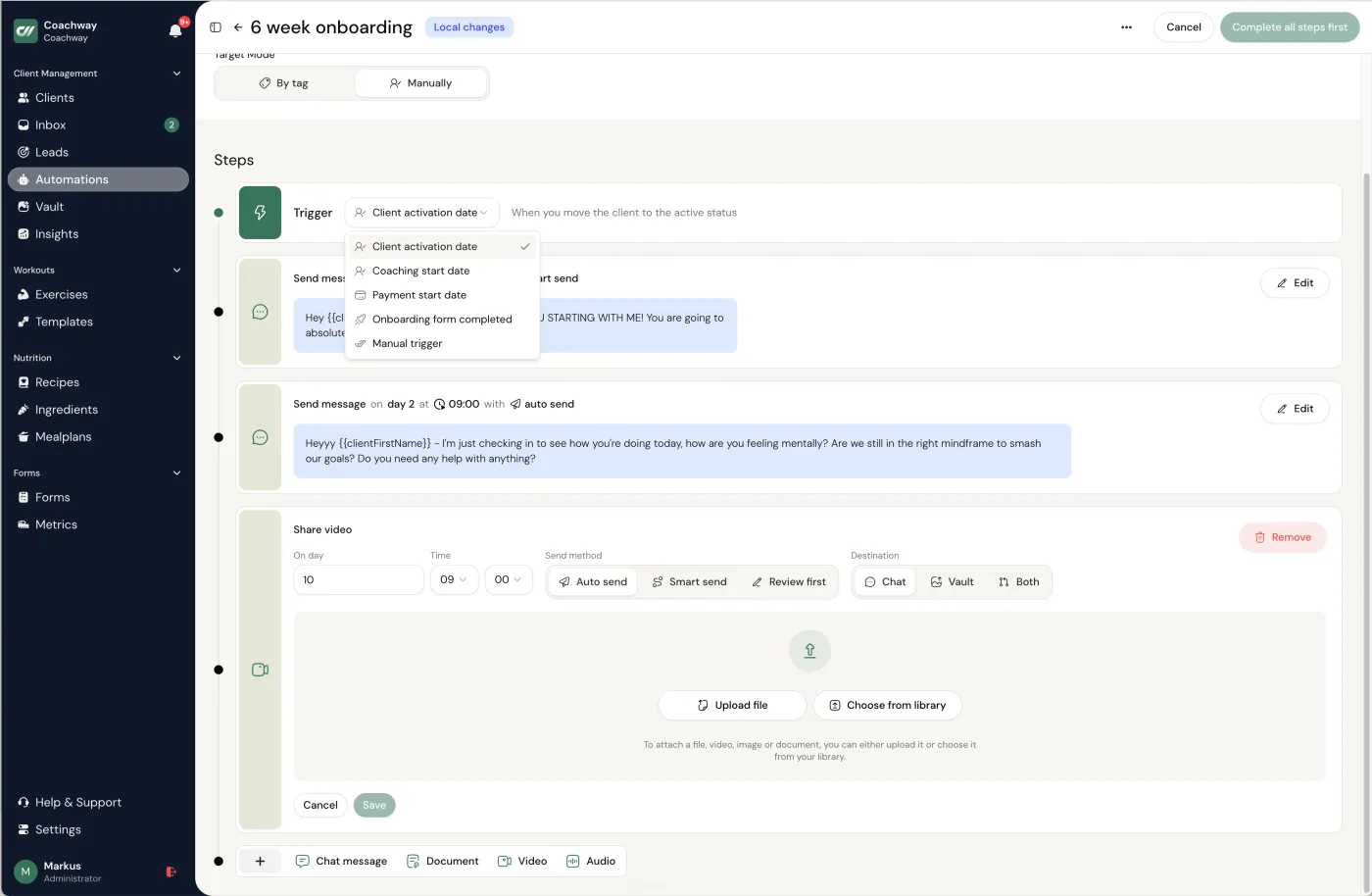
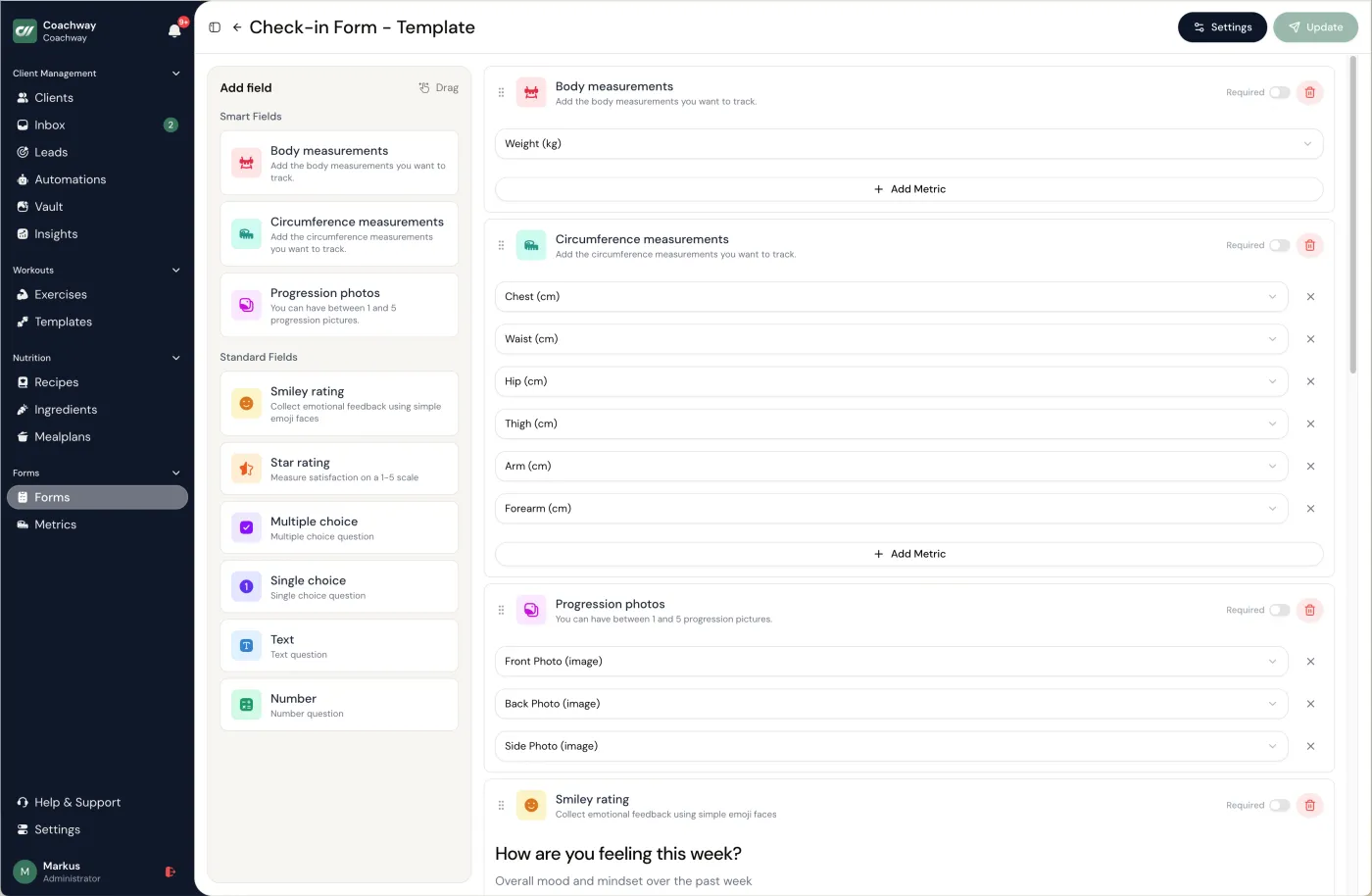
Clients — Every client in one table with status and goal tags - see where all of them stand at a glance.
Frequently asked questions about coaching management software.
What is coaching management software?
Coaching management software is one system that runs a coaching business from a single client record: client management (profiles, check-ins, messaging, tasks, retention), program management (workouts and nutrition delivered to a branded app), and payment management (subscriptions, invoices and payment plans). The word management is doing real work in that phrase. A plain workout app builds the plan, and a payment link takes the money, but neither manages the client - the profile, the weekly check-in, the accountability and the billing all against the same person. Management software is the layer that holds all of it together, so a fitness or nutrition coach opens one screen to understand a client instead of stitching four tools together by hand.
What does coaching management software include?
At minimum, three surfaces that share one client record. Client management: a clients list with status and tags, a drag-and-drop check-in and form builder, a messaging inbox, and per-client tasks so follow-ups do not slip. Program management: a workout builder with an exercise library, nutrition and food logging, and a branded client app on iOS and Android that delivers both. Payment management: recurring subscriptions, planned invoices, payment plans and automatic reminders. Beyond that minimum, the parts that decide how many clients you can hold are automations - onboarding flows, check-in reminders, drip sequences - and a lead pipeline that turns an enquiry into an onboarded, billed client in one move. For a fitness or nutrition coach the deciding test is not the length of the feature list; it is whether training, food and money live on the same client so nothing has to be copied between apps.
Is coaching management software for fitness coaches different from life-coaching software?
Yes, and the gap is bigger than it looks from a search results page. Most software that ranks for coaching management software is built for life, business and executive coaching, where the product is scheduled sessions, notes, goals and a client portal - so the tools lean on calendars, session packages and shared documents. Fitness and nutrition coaching is asynchronous and physical: the daily unit is a logged meal, a completed workout, a weekly check-in with photos and measurements, not a booked hour. A platform built for session-based coaching usually has no workout builder, no food logging, no progress-photo review and no macro targets, so a fitness coach ends up running the actual coaching in a second app. When you compare options, confirm the tool was built for training and nutrition delivery, not adapted from a session-scheduling product.
How much does coaching management software cost?
Coach-focused platforms mostly price as a flat monthly fee, per client, or a mix of the two, while larger gym-side suites price per location, which is a different model aimed at facilities. Coachway is EUR 69 a month with your first 5 clients included and EUR 9 per additional client after that, every feature in, no tiers or modules. There is a 14-day free trial; it starts with a card held securely by Stripe and no charge on day one, and you cancel under Billing before it renews. The number that quietly moves the total is payments: read whether they are included and whose account the money lands in, because a platform that keeps a percentage of every transaction can cost more at 50 clients than a higher monthly fee paid into your own Stripe.
Do I need coaching management software, or is a workout app enough?
A workout app is enough while the plan is the only thing you have to manage. It stops being enough the moment the business around the plan grows: check-ins to review, food to look at, payments to collect on time, enquiries to convert, and onboarding to run for each new client. Those are management jobs, not programming jobs, and a delivery app leaves them to you and your spreadsheet. The honest signal that you have outgrown the app is not the client count itself - it is the evening a week that disappears into moving information between tools so each one knows what the others already know. When that copying becomes the bottleneck, management software earns its place by deleting the copying rather than speeding it up.
If you want the wider category ranked as specific platforms, the online personal training software comparison is the pillar this guide sits under. Two closer neighbours: for the same category framed around client capacity, read the personal trainer management software guide; for the tools ranked side by side rather than the category defined, the best client management software comparison lines them up.
Keep reading
all guidesTime Under Tension (TUT): What It Is + How to Use It
Time under tension is the total seconds a muscle spends under load in a set, controlled with tempo notation like 3-1-1. The definition, how to read tempo, the honest evidence, and how to program it.
Read the guideUpper Lower Split: What It Is & How to Program It
The upper lower split for coaches: what it is, a four-day structure, who it suits, a sample week, and how it compares to push pull legs and full-body. It trains each muscle about twice a week - but total weekly volume is what drives growth.
Read the guideFull Body vs Split Training: Which to Program
Full body and split routines are two ways to arrange the same weekly training. What each is, who each client type suits, the frequency angle, and why total weekly volume - not the split itself - drives growth.
Read the guideFree tools for this: Coaching Rate Calculator · Coaching Tool Stack Cost Calculator · Coaching Profit Calculator
See what Coachway can do for your coaching business
Coachway was built on knowledge from working with 150 online coaches over 6+ years, who all hit the same wall - slow platforms, clunky workflows, wasted hours. Start your 14-day free trial and see what we fixed - the whole platform, no charge today, cancel anytime under Billing.


