


Personal trainer management software - one system for client, program and payment management.
Personal trainer management software is the single system a coach uses to run client management, program management and payment management from one client record, instead of stitching them across a spreadsheet, a training app, a chat thread and a payment link. This guide is about what the category actually covers, why the copying between separate tools is the real ceiling on how many clients you can hold, and how consolidating the three surfaces removes that admin tax.
By Markus Evers · Updated August 2026
the short version
"Management software" for a personal trainer means one system that holds client management, program management and payment management against the same client. The value is not any single feature - a workout app already builds plans, a payment link already takes money. The value is that they stop being separate. Every client you add carries a fixed admin tax, and when that tax is split across four tools it grows with headcount until a full evening a week goes into moving information between apps. Consolidating the three surfaces onto one record shrinks the per-client tax, and the hours you win back are what let the same working week hold more people.
What does personal trainer management software actually cover?
It is easiest to read the category as three management surfaces that a growing coaching business has to run at once. A tool that only covers one of them is a point solution; personal trainer management software is the layer that covers all three from a shared client record, so the same person appears once, not four times.
1. Client management - who they are and how they are doing.
This is the CRM side of coaching: a clients list with status, tags and last-contact, a check-in and form builder for weekly answers, measurements and progress photos, a messaging inbox for accountability, and per-client tasks so a promised follow-up between check-ins does not slip. It is the surface that decides retention, because retention is mostly a function of whether the small human touches actually happen on time - the CRM side of the job, done where the coaching already lives rather than in a separate contacts tool.
2. Program management - what you deliver.
The training itself: a workout builder sitting beside an exercise library, nutrition or meal planning, and a branded client app that delivers both to the phone. This is the part a plain workout app already does well, and it is where most coaches start. The catch is that a program is only half of a client - the other half is the accountability and the billing around it, which a pure delivery app leaves to you. Coachway ships this side with 1,800+ exercises and 1,100+ recipes so the library is not something you have to build before you can coach.
3. Payment management - how you get paid, on time.
Recurring subscriptions, planned invoices, payment plans and automatic reminders, with the ability to set per-client amounts, currencies and billing intervals, plus pauses and partial refunds. This is the surface coaches leave last and regret leaving last, because a missed renewal is invisible until the money does not arrive. The question that matters here is whose account the money lands in: with Coachway, payments settle in your own Stripe account and the platform never holds your money, and built-in payments are optional - if you use them they carry a 2.4% per-transaction fee, and if you run your own Stripe checkout instead there is no platform fee on top.
How does management software raise the number of clients you can hold?
A solo coach almost never stalls because the coaching stops working. They stall because the admin around each client is a fixed cost, and fixed costs multiply. Picture the tax on one client: a profile kept current, a program written and updated, a weekly check-in read and answered, a payment set up and watched. None of that is hard on its own. The problem is that it repeats for every person, and when the four pieces live in four tools, most of the time is not the work itself - it is the moving of information between the apps so each tool knows what the others already know.
That copying is the invisible ceiling. At 10 clients it is a mild annoyance you barely notice. At 40 it is the evening you meant to spend on programming and instead spent reconciling a spreadsheet against a chat thread against a payment link. This is why coaches describe hitting a wall at a client count that has nothing to do with how many people they could actually coach - the wall is administrative, not athletic. Consolidation is the lever because it deletes the copying rather than speeding it up: when a check-in answer, a program, a message and a subscription already sit against the same client, there is nothing to move between tools in the first place.
The gain is concrete and worth naming plainly. Coachway is built on knowledge from working with 150 online coaches over 6+ years, and the recurring pattern is that the hours a coach wins back from consolidation are hours that go straight back into holding more people at the same quality. You are not buying capacity; you are buying back the evening that the patchwork was quietly charging you. For the harder version of this decision - where a spreadsheet stack stops being enough and one platform earns its place - the business-software layer guide maps the break points.
What changes when the three surfaces share one client record?
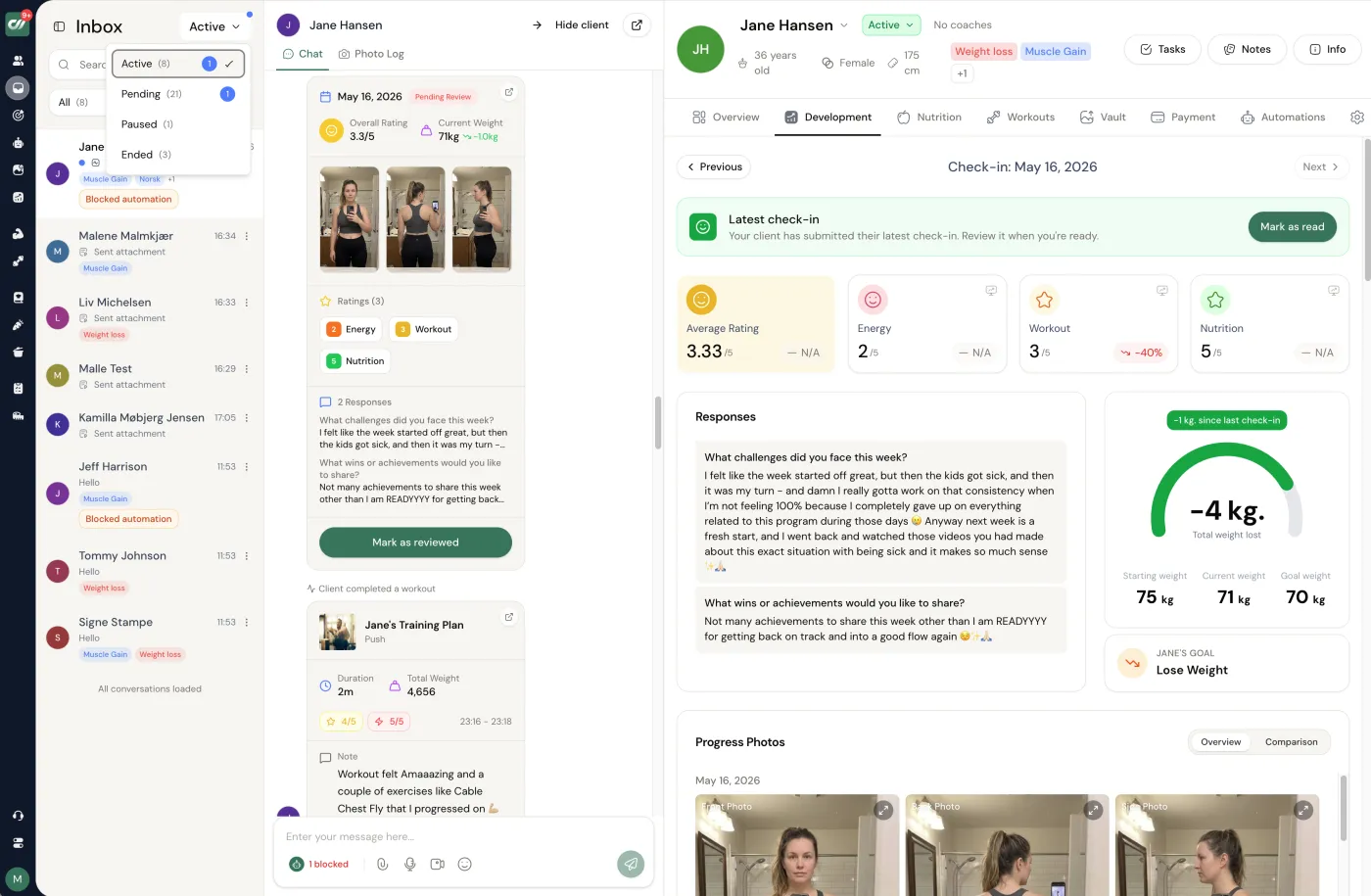
The clearest way to see it is the moment you open a client. In a patchwork you open four things to understand one person. In personal trainer management software you open one, and the conversation, the check-in answers, the program and the billing are all right there. Coachway calls this the Power Panel: the client list, the live conversation and the full client file on a single screen, so a coach reviewing a week is not tab-hopping to assemble context that should have been together all along. Around it sit the pieces that turn a new enquiry into a paying client without re-entry - an embeddable lead form that captures the full source trail, a pipeline that moves a lead from new to won, and a one-click convert that hands the person a branded app, an onboarding sequence and a subscription billed through your own Stripe. We build Coachway; it is EUR 69 a month with your first 5 clients included and EUR 9 per additional client after that, every feature in, no tiers. The 14-day free trial starts with a card held by Stripe and no charge today, and you cancel under Billing before it renews. If you would rather see the panel before deciding, book a demo and we will walk one client end to end.
How do you choose personal trainer management software?
Because "management software" spans a broad category, the buying mistake is comparing feature lists instead of fit. Four questions cut through it faster than any table:
1. Do the three surfaces truly share one client?
Some suites bolt payments or a workout module onto a gym-management core, and the seams show as double entry. Ask to convert a lead into a billed, onboarded client and watch how many screens it takes. One is the answer you want; four means you have bought the patchwork with a single login.
2. Whose Stripe account gets paid?
Payment management is where the pricing gets quietly expensive. A platform that custodies your money and keeps a cut of every transaction can cost more at 50 clients than a higher monthly fee with your own Stripe. Coachway settles into your own Stripe and never holds the money; built-in payments are optional at 2.4% per transaction.
3. Is it priced per client, per location, or flat?
A solo online coach and a multi-room gym want opposite pricing. Per-location suites make sense for a facility and rarely for a coach with a phone. Per-client pricing like Coachway's EUR 69 plus EUR 9 per extra client stays predictable as you grow. Run your own numbers with the software cost breakdown before you commit.
4. Does the client app carry your brand?
The management side is yours; the client only ever sees the app. A branded in-app experience - your logo, cover image and colours - is included as standard on Coachway, with a fully standalone white-label app available as a paid option. If you want a ranked, tool-by-tool comparison rather than the category view, the best client management software comparison lines the main platforms up side by side.
Frequently asked questions about personal trainer management software.
What is personal trainer management software?
Personal trainer management software is one system that runs the day-to-day of a coaching business from a single client record: client management (profiles, check-ins, messaging, tasks, retention), program management (workouts and nutrition delivered to a branded app), and payment management (subscriptions, invoices and payment plans). The point of the category is consolidation. Instead of a spreadsheet for who is who, a training app for the plan, a chat thread for accountability and a separate link for billing, everything sits against the same client, so nothing has to be copied between tools by hand. That is what separates management software from a plain workout app, which handles the plan but leaves the business side to you.
What should personal trainer management software include?
At minimum, three things that share one client record. Client management: a clients list with status and tags, a check-in and form builder, a messaging inbox, and per-client tasks so follow-ups do not get forgotten. Program management: a workout builder with an exercise library, nutrition or meal planning, and a branded client app that delivers both. Payment management: recurring subscriptions, planned invoices, payment plans and automatic reminders. Beyond the minimum, the features that decide capacity are automations (onboarding flows, check-in reminders, drip sequences) and a lead pipeline that turns an enquiry into an onboarded, billed client in one move. The test is not the length of the feature list; it is whether the three surfaces share the same client, because that is what removes the copying.
Is personal trainer management software the same as a CRM or a workout app?
It overlaps with both but is broader than either. A CRM manages contacts, pipeline and follow-up but does not deliver a training program or take a recurring payment. A workout app builds and delivers the plan but usually leaves billing, check-in review and retention to other tools. Personal trainer management software is the category that spans all of it: the CRM-style client management, the program delivery, and the payments, on one client record. If you already run a workout app you like but keep a spreadsheet and a payment link beside it, you are running the management layer by hand - which works until the client count makes the hand-work the bottleneck.
How much does personal trainer management software cost?
Most coach-focused platforms sit between a flat monthly fee and per-client pricing, and some large gym-side suites price per location, which is a different model. Coachway is EUR 69 a month with your first 5 clients included and EUR 9 per additional client after that, every feature in, no tiers or modules. There is a 14-day free trial; it starts with a card held securely by Stripe and no charge on day one, and you cancel under Billing before it renews. When you compare quotes, read whether payments are included and whose Stripe account gets paid, because a platform that keeps a percentage of every transaction can cost more at 50 clients than a higher sticker price with your own Stripe.
Will one management platform really let me take on more clients?
It raises the ceiling by cutting the admin per client, not by changing how good your coaching is. Every extra client adds a fixed tax: a profile to update, a plan to build, a check-in to review, a payment to chase. When those live in separate tools, that tax grows with headcount until a full evening a week disappears into moving information between apps, and that is usually where a solo coach stalls. Consolidating client, program and payment management onto one record shrinks the per-client tax, so the same working week holds more people. It is not magic capacity - it is the reclaimed hours that would otherwise have gone to copying.
Two neighbours to this guide: if you want the category ranked as specific tools, read the best client management software comparison; if you are still deciding whether one platform is worth the switch at all, the how to choose a platform walkthrough frames the trade-offs.
Keep reading
all guidesTotal Coaching alternatives: 5 best picks for 2026
Total Coaching is a capable, affordable platform for personal trainers, and for plenty of coaches it does the job. This fair, fitness-specific guide names the 5 strongest Total Coaching alternatives - native-language UI, a branded app included, payments in your own Stripe, and predictable per-client pricing - with honest trade-offs for each.
Read the guideNudge Coach alternatives: 5 best picks for 2026
Nudge Coach is a flexible, white-label accountability and habit-tracking app that suits health coaches and large programs. But fitness coaches who need real workout programming, a nutrition planner, and structured check-ins often outgrow it. Here are the 5 best Nudge Coach alternatives, with fair trade-offs for each.
Read the guideCaliber alternatives: 5 best picks for 2026
Caliber pairs a free strength-training app with premium 1:1 coaching, and for some lifters it is a great fit. But coaches who want to run their own business - their own pricing, their own brand, nutrition and check-ins in one place - need a platform built for that. Here are the 5 best Caliber alternatives, with honest trade-offs.
Read the guideSee what Coachway can do for your coaching business
Coachway was built on knowledge from working with 150 online coaches over 6+ years, who all hit the same wall - slow platforms, clunky workflows, wasted hours. Start your 14-day free trial and see what we fixed - the whole platform, no charge today, cancel anytime under Billing.


