


The best personal training software in 2026, judged not just listed.
The best personal training software is the one that delivers the most of your coaching from one place, keeps the money in your own account, and lets you leave with your clients if you ever want to. Most "best of" lists just rank names. This one gives you the criteria first, so you can score any tool yourself and defend the choice to your future, busier self. Then it applies those criteria to seven real platforms, several of them genuinely excellent, and is honest about which personal trainer each one fits.
By Markus Evers · Updated August 2026
How this comparison is made: we check every competitor's pricing and features against their live websites and re-verify them on a recurring basis. We build Coachway, so we flag it wherever it appears, we credit real competitor strengths, and we say who each platform fits better than us. Browse all platform comparisons.
the short version
Score any tool on five things: how much of your coaching it delivers from one tab, whose Stripe holds the money, whether pricing stays predictable at your target client count, whether the branded client app is included or an add-on, and how easily you can migrate in and out. Judged that way, the best personal training software for a scaling online personal trainer who wants the whole workflow in one place is Coachway. Trainerize and TrueCoach lead for workout-first coaching, PT Distinction for nutrition-led English-speaking coaching, My PT Hub as a first step off spreadsheets, Everfit for a free start, and Kahunas for a flat-price white-label app. The reasoning, pricing and trade-offs are below.
How do you judge personal training software?
A tool that looks great in a demo can still cost you money and clients a year in, so judge on what actually decides that. This framing comes from operational experience built on working with 150 online coaches over 6+ years, running real coaching businesses rather than reading spec sheets. Five questions do most of the work, and every one of them comes back to a simple test: how much of a client's week can you run from one tab instead of six? For a coach who works entirely online, that question really is about the online personal training software at the center of the stack.
- 1. Delivery: one tab, not six. Personal training software earns its cost by handling the whole client week in one place: workouts, nutrition, weekly check-ins with progress photos and measurements, messaging, and a client app. If any of those still lives in a spreadsheet, a chat app, or a separate nutrition tool, you are paying for software and still doing the stitching by hand.
- 2. Payments: whose Stripe holds the money? If the platform's merchant account collects your client payments, the billing relationship is not fully yours and a percentage may go with it. Ask plainly: does the money settle in my own account, and what does the payment path cost per transaction?
- 3. Pricing that stays predictable. Per-client and flat-fee both work. Percentage-of-revenue gets punishing past 30 to 50 clients. Run the math at your target client count, not today's, and make sure you know what the number becomes at 80 clients.
- 4. The branded client app: included or add-on? Your clients live in the app, not your dashboard. Your logo on their home screen is part of what they pay for. Check whether the branded experience is included, gated behind a higher tier, or a paid standalone build.
- 5. Migration and contract: can you get in, and out? The quiet risk is a tool you cannot leave. Before you sign, confirm you can export your clients, programs, and check-in history, and that there is no binding period or cancellation fee holding you in.
Those five turn a shapeless "which is best" into a scorecard you can apply to any tool on the market. If you want the same logic as a step-by-step shortlist, our walkthrough on how to choose an online coaching platform turns it into a decision you can finish in an afternoon.
The shortlist, scored on the criteria.
| Software | Best for | Client-app languages | Pricing |
|---|---|---|---|
| Coachway | Scaling online personal trainer, whole workflow in one tab | EN, DA, NO, SV, FI, DE | EUR 69/mo (up to 5 clients) + EUR 9/extra |
| Trainerize | Workout-first coaching, North America | English-first, partial translations | USD 9 to 248/mo by client count |
| TrueCoach | Simple workout delivery, strong video library | English-first | USD 26 to 137/mo on annual billing (USD 30 to 165 month-to-month) |
| PT Distinction | Nutrition-led coaching in English-speaking markets | English, no advertised localization | USD 19 to 89/mo |
| My PT Hub | First step off spreadsheets, 5 to 30 clients | English-first | EUR 25 to 215/mo |
| Everfit | Brand-new trainers who need a free start | English-first | Free, paid to around USD 430/mo |
| Kahunas | Trainers who want a flat-price white-label app | English-first | USD 35 to 99/mo (14-day trial) |
Pricing and features change. Confirm the current numbers with each provider before you commit. If your decision is mostly about the admin and CRM side rather than the full coaching stack, our companion guide to the best client management software for personal trainers goes deeper on the back office specifically.
01 · best overall for the scaling online personal trainer
Coachway
Coachway is the European-built platform that does one thing on purpose: the online personal training workflow. Where many tools try to serve solo coaches, gyms, and teams all at once, Coachway focuses on handling everything around a single client from one tab instead of six, so you are not jumping between a chat app, spreadsheets, a workout app, Stripe, and email. The whole stack is there: a workout builder with 1,800+ exercises, nutrition and meal planning with barcode and photo food logging, weekly check-ins with progress photos and measurements, payments, automations, in-app messaging, and a branded client app on iOS and Android. It scores well on all five criteria: delivery is genuinely all-in-one, payments settle in your own Stripe account, pricing is predictable per client, the branded in-app experience is included, and there are no contracts to trap you. The client app is reviewed by a working coach in each of six languages, while the coach dashboard is in English.
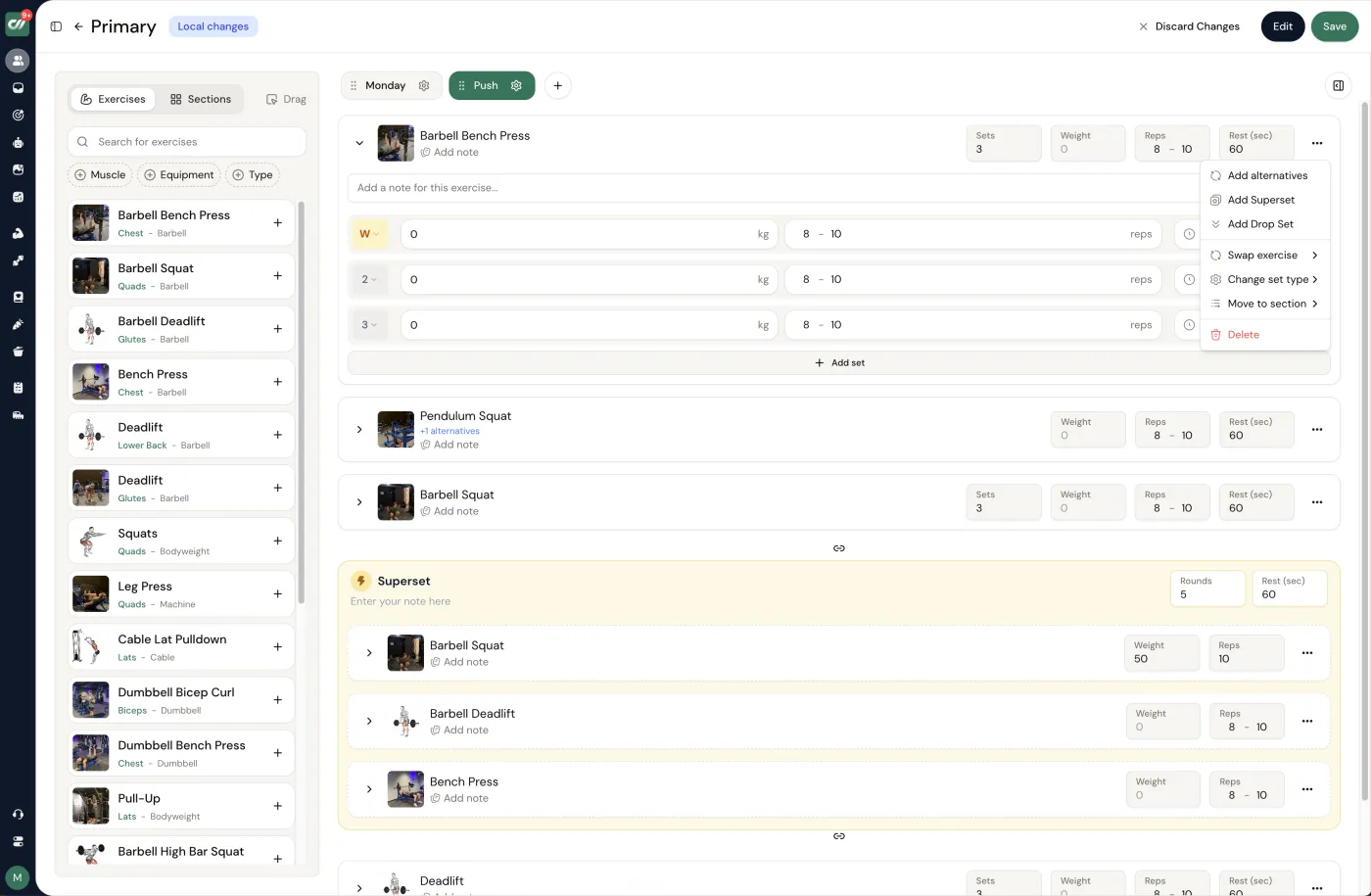
The trade-off: Coachway is the youngest platform on this list, so the third-party integration catalog a ten-year-old tool has built up is not all there yet, and it has fewer wearable integrations than Trainerize. In exchange you get a product focused entirely on the personal training workflow, features shipped fast, predictable per-client pricing, and same-day support from a team that has run coaching businesses. See how it lines up against the incumbent in Coachway vs Trainerize.
02 · best for workout-first north america
Trainerize
The most established workout-first personal training software in North America, and the name most fitness-specific lists reach for first. It scores highest on delivery for training programming: the exercise library and program builder are mature, messaging and habit tracking are solid, and wearable integrations are broad. A custom-branded app is available as a paid add-on, and pricing scales with client count and the add-ons you switch on. For a deeper look, read our full Coachway vs Trainerize breakdown.
The trade-off: Nutrition and meal-planning tools are basic next to nutrition-led platforms, native-language support for Nordic and German-speaking coaches is limited, and the branded app is a separate line item rather than included.
03 · best for simple workout delivery
TrueCoach
Clean, fast, and focused on getting a training program in front of a client with minimum friction, backed by a large exercise video library. It scores well on delivery for training-only coaching and is one of the easiest tools here to learn. Pricing is charged by the number of active clients you carry. Read the full TrueCoach review for the detail.
The trade-off: Light on nutrition and light on automations, so it suits training-only coaching better than a full lifestyle program.
04 · best for nutrition-led english markets
PT Distinction
A UK-built platform with genuinely deep nutrition and habit tooling and a generous one-month free trial. If a large share of your coaching is nutrition and behavior change rather than just programming, the planning depth here holds up against anything on the list. Pricing is per-coach with client counts included in each tier.
The trade-off: The interface is more established than the newest platforms, and Nordic or German-speaking localization is limited, so non-English markets are not the natural fit.
05 · best entry point off spreadsheets
My PT Hub
Affordable, simple, and UK-built, My PT Hub is the easiest first step from spreadsheets and WhatsApp to real personal training software, with a low barrier to entry and recently added AI features. The all-in-one basics (workouts, nutrition, payments, messaging) are present without an overwhelming learning curve.
The trade-off: Trainers who want a deeper workflow tend to move to a more advanced platform as they scale, so it is better as a first tool than a forever one.
06 · best free starter tier
Everfit
Everfit is a solid, modern platform with a genuinely useful free starter tier and paid plans that scale to around USD 430 per month. It is a strong fit for a brand-new trainer with a handful of clients who needs to keep costs near zero while building the practice, with workout and habit features that feel current rather than legacy. For the closer options, our client management software roundup weighs the admin side.
The trade-off: The free tier is great to start with, but trainers graduate to paid quickly to unlock programming depth, and pricing can jump as the client base grows.
07 · best for a flat-price white-label app
Kahunas
Kahunas is a coach-facing platform with workouts, a large food-tracking database, check-ins, content drip, and in-app messaging, and its signature is a fully branded white-label app on the coach's own App Store and Google Play listing. Payments run through the coach's own Stripe or PayPal. Pricing is a simple three-tier ladder by client count, with the white-label app bundled into the top tier rather than billed as a separate add-on.
The trade-off: The white-label app only arrives on the top Ultimate tier, and the platform is English-first, so trainers who want a native-language client experience will find it lighter there.
What does personal training software really cost?
The sticker price is only half the bill. Fitness-specific personal training software ranges from a free starter tier or roughly EUR 25 per month up to USD 400 to 500 per month at higher client counts, and most trainers with 30 to 80 clients budget EUR 100 to 400 per month. The three costs that a pricing page hides are the ones worth checking. First, the branded app: if it sits on a higher tier or is a separate build, add that in. Second, the payment path: a platform that processes your billing through its own merchant account may keep a percentage, so read the payment terms, not just the plan name. Coachway keeps this honest by settling in your own Stripe account, with an optional 2.4% per-transaction fee only if you switch on built-in payments. Third, the tools the platform does not replace: if you still pay for a separate nutrition app, a scheduling tool, and a CRM, the real monthly figure is the whole stack, not one line.
Add those up before you compare, because the tool that looks cheapest per month can be the most expensive once the add-ons and the leftover subscriptions are counted. Our free coaching tool stack cost calculator totals every subscription you are running so you see the true number, and if percentage-based billing is on your mind, our note on an online coaching platform without revenue share explains what to watch for. You can sanity-check the per-client math against current Coachway pricing.
How do you switch without losing clients?
Migration is the criterion most trainers skip until they are stuck, and it is the one that decides whether a contract is a home or a trap. The move itself is simple when you plan it. Export your client list, your programs, and your check-in history from the old tool first. Rebuild your templates in the new software before anyone moves, so the new home is furnished, not empty. Then move clients in small waves rather than all at once, each wave with a short, warm message that explains the new app, the login, and why the experience is about to get better. Nobody churns because their coach upgraded the software; they churn from silence during the change.
Do one thing before you sign anywhere: ask whether you can export your own data. A platform you cannot leave is a risk dressed as a feature. Our step-by-step guide on how to migrate clients between coaching platforms walks through the wave-by-wave message and timeline in full.
Frequently asked.
What is the best personal training software?
There is no single best for everyone, which is why you judge it against criteria: how much of the coaching workflow it delivers from one place, whose Stripe collects the money, whether pricing stays predictable at your target client count, whether the branded app is included, and how easily you can migrate in and out. For an online personal trainer scaling from 20 to 200-plus clients who wants all of that from one tab with their own Stripe, Coachway is the strongest pick. Trainerize and TrueCoach lead for workout-first coaching, PT Distinction for nutrition-led English-speaking coaching, and Everfit for a free start.
How much does personal training software cost?
Fitness-specific personal training software ranges from a free starter tier or roughly EUR 25 per month up to USD 400 to 500 per month at higher client counts. Most personal trainers with 30 to 80 clients budget EUR 100 to 400 per month. Coachway uses predictable per-client pricing: EUR 69 per month for up to 5 clients plus EUR 9 per additional client, every feature included. Built-in payments carry an optional 2.4% per-transaction fee, while your own Stripe checkout carries no Coachway fee.
Does personal training software take a cut of my revenue?
It depends on how you collect payments. Some platforms process client billing through their own merchant account and keep a percentage. Coachway lets you keep your own Stripe account, so the money settles with you and Coachway never holds it. If you switch on Coachway's optional built-in payments, a 2.4% per-transaction fee applies. There is no separate revenue share on top of the subscription, but always read each vendor's payment terms before you commit.
Can I move my clients between personal training software without losing them?
Yes, with a plan. Export your client list, programs, and check-in history first, rebuild your templates in the new tool, then move clients in small waves with a short message explaining the new app and login. Ask each vendor before you sign whether you can export your own data, because a platform you cannot leave is a contract risk, not a feature.
Do I need a contract to use personal training software?
Not usually. Most modern personal training software is month-to-month. Coachway has no contracts, no binding period, and no cancellation fees, and you can cancel anytime under Billing. A 14-day free trial lets you test it first, and a card is required to start the trial, held securely by Stripe, with nothing charged on day one.
Features are not the deciding factor. The workflow is.
A longer feature list is easy to win on a comparison table. It is not the question that decides your week. What decides it is how fast you can run the actual work, week after week: following up a client, sending video feedback, and reviewing a weekly check-in. Coachway is built from working hands-on with online fitness coaches scaling past 1,000 clients, where shaving minutes off every client interaction is the whole game.
The entire product is tuned for one outcome: handle more clients, at a higher satisfaction rate, in less time. A smoother workflow is not just cheaper for you, it is a better experience for the client, and that is what keeps clients paying for longer.
check-ins
Review a weekly check-in in minutes, with notes, data, photos, and exercise history in one view.
follow-up
Messages, video feedback, and plan tweaks happen from one tab, not six different tools.
automation
Automatic reminders run the cadence, and a smart-send mode holds messages back when a client still has an unread one, so the experience stays personal.
Keep reading
all guides12 best client management software for personal trainers (2026)
An honest comparison of the 7 platforms online coaches actually use. Pricing, features, support, Stripe ownership, and which one fits which size of business.
Read the guidePersonal Training Software: 2026 Guide for Online Trainers
A 2026 buyer's guide to online personal training software: what it is, the must-have feature checklist, how to choose, and an honest comparison of Coachway, Trainerize, TrueCoach, Everfit, and My PT Hub.
Read the guideHow to choose an online coaching platform (12-point checklist)
The decision framework used by online coaches managing 50+ clients. Twelve criteria, weighted, with red flags and trade-offs explained. The most leveraged technology decision you make.
Read the guideFree tools for this: Client Capacity Calculator · Coaching Rate Calculator · Coaching Tool Stack Cost Calculator
See what Coachway can do for your coaching business
Coachway was built on knowledge from working with 150 online coaches over 6+ years, who all hit the same wall - slow platforms, clunky workflows, wasted hours. Start your 14-day free trial and see what we fixed - the whole platform, no charge today, cancel anytime under Billing.


