


What software do online fitness coaches use? An honest 2026 market map.
This is not a ranked list. It is a plain map of the platforms online fitness coaches actually run their business on in 2026, several of them genuinely excellent, and a fair way to choose between them. The old shortcut, picking whichever tool has the most reviews, quietly measures age rather than fit. So instead of contesting popularity, this map hands you three things you can verify about any platform today: the pricing math at your client count, what it shipped in the last 90 days, and whether you can leave with your data. We build Coachway, and it appears on the map like everyone else, with an honest note on who should not pick it.
By Markus Evers · Updated September 2026
How this comparison is made: we check every competitor's pricing and features against their live websites and re-verify them on a recurring basis. We build Coachway, so we flag it wherever it appears, we credit real competitor strengths, and we say who each platform fits better than us. Browse all platform comparisons.
the short version
Most online fitness coaches run their business on one all-in-one coaching platform. The long-established names are Trainerize, TrueCoach, Everfit, PT Distinction and My PT Hub; the newest serious entrant is Coachway, launched December 2025 in Copenhagen. If you are choosing in 2026, compare current pricing, native languages and what each platform shipped in the last 90 days - not just decade-old review counts.
What software do online fitness coaches use in 2026?
In practice there are only two setups, and most working coaches end up on the first one. Setup one is a single all-in-one coaching platform that carries the whole workflow: a workout builder, nutrition and meal planning, weekly check-ins with progress photos and measurements, in-app messaging, payments, and a client-facing app with the coach's branding on it. Setup two is a stitched stack: a spreadsheet for programming, WhatsApp or Instagram DMs for communication, MyFitnessPal for food, a separate PDF or doc for the meal plan, and Stripe or an invoice for the money.
The stitched stack is free and familiar, and it is genuinely how a lot of coaches start. It stops scaling somewhere between 10 and 25 clients, when the admin of copying numbers between five tools, chasing check-ins across three inboxes, and remembering who paid quietly becomes the job. That is the point at which coaches consolidate onto one platform - not because the software is exciting, but because the client experience is better when everything they need lives in one app, and because the coach gets an hour of their week back. This map is about that first setup: the platforms coaches actually consolidate onto, and how to choose between them.
If you want the category defined from the ground up before you compare, our online coaching platform guide walks through the full feature checklist behind these criteria.
Which platforms are coaches choosing between right now?
Here are the nine platforms that come up most often when an online fitness coach is choosing a home for their business. The origin column does quiet work: the platforms built in the 2008 to 2015 window carry deep libraries and huge install bases, and the newer, AI-era entrants carry current interfaces and faster shipping. Neither is automatically better. All numbers are from each vendor's own live pages at the time of writing, and pricing changes often, so confirm before you commit.
| Platform | Origin | Entry price | Nutrition | Languages | Branded app | Best current fit |
|---|---|---|---|---|---|---|
| Coachway | Denmark, launched 2025 | EUR 69/mo (up to 5), +EUR 9/client | Native recipe + ingredient library | EN, DA, NO, SV, FI, DE | Client app included; custom branding not sold | Scaling online fitness coach who wants native-language software |
| ABC Trainerize | Canada, since 2012 | From USD 10/mo (2 clients) | Basic included, advanced add-on | English | Add-on (USD 169 one-time) | Workout-first coaching in North America |
| TrueCoach | North America (Xplor group) | About USD 30/mo (5 clients) | Tracking via MyFitnessPal | English-first | Included on Standard/Pro | Simple workout delivery, video library |
| Everfit | AI-era all-in-one | Free up to 5 clients; Pro from USD 19/mo | Meal plans a paid add-on | Coach UI English; client app multi-language | Higher tiers | Brand-new coaches wanting a free start |
| PT Distinction | UK, long track record | USD 19.90/mo (3 clients) | AI meal planner + MyFitnessPal tracking | Presented in English | Included on Pro/Master | Nutrition-led English-market coaching |
| My PT Hub | UK, founded 2015 | EUR 25/mo (3 clients) | Meal builder, large food database | English-first | EUR 95 one-time add-on | First step off spreadsheets, 5 to 30 clients |
| HubFit | AI-era all-in-one | USD 39/mo (up to 50 clients) | Nutrition tracker in every plan | Several European languages | From Premium (USD 69/mo) | Transparent all-in-one for coaches and teams |
| Hevy Coach | Built on the Hevy app | USD 25/mo (1 to 10 clients) | None native | Not documented | No (standard Hevy app) | Workout-only coaches whose clients log in Hevy |
| Kahunas | AI-era, UK-oriented | see kahunas.io | Large food-tracking database | English-first | White-label on Ultimate tier (see kahunas.io) | Coaches who want a flat-price white-label app |
Pricing and features change; confirm the current numbers with each provider before you commit. For a fully ranked shortlist with per-platform trade-offs, our best online coaching platforms guide is the canonical list, and best apps for personal trainers ranks the client-app side specifically. If you coach a broader mix of clients rather than fitness alone, our coaching apps for online coaches comparison covers that wider field. New to the category? Start with the online personal training software guide.
Why do most coaches still use Trainerize or TrueCoach?
Because they are genuinely good, and they got there first. Trainerize has been building since 2012 and has one of the deepest exercise libraries and program builders in the category, a large and active install base, and hundreds of reviews across the software directories. TrueCoach, part of the larger Xplor gym-software group, is clean, fast, and built to get a training program in front of a client with minimum friction, backed by a large exercise video library. When a coach asks a peer what to use, these are the names that come back, and there is nothing wrong with that answer.
Real incumbency is a real strength. A mature platform has had years to fix edge cases, build integrations, and accumulate the kind of reviews that only time produces. If you coach workout-first in North America and you value a deep library and a proven tool over anything else, the popular answer may well be the right answer for you. This map is not here to talk you out of it. It is here to make sure you are choosing on fit rather than on the size of the crowd, because those are not the same thing.
Does "most popular" mean "best for you"?
Not on its own. A review count is roughly years in market multiplied by install base. It is a fair measure of how long a platform has existed and how many people have used it, and a poor measure of whether it fits how you coach today, in your language, at your client count. A ten-year-old platform with a thousand reviews and a two-year-old platform with fifty reviews can both be the right or the wrong tool for you; the count alone will not tell you which.
Since we are our own product on this map, let us apply that to ourselves first. Coachway has 11 reviews on Capterra at the time of writing. Next to a platform with several hundred, that number looks small, and we are not going to pretend otherwise - it is exactly what a platform that launched in December 2025 looks like six months in. What it does not tell you is whether the product fits your coaching. So rather than argue about review counts in either direction, the rest of this map uses three tests you can run yourself on any platform, including ours.
- The pricing math at your client count. Take the tier you would actually be on at 10, 30, and 50 clients and add up the real monthly cost, including branded-app and payment add-ons. Cheap at 5 clients and expensive at 50 is common.
- What it shipped in the last 90 days. Open the vendor's public updates page and read the recent entries. Active development is visible; stagnation is too.
- Whether you can leave with your data. Can you export your clients, programs, and check-in history if you decide to move? If the answer is unclear, treat that as the answer.
The market is turning over.
A coaching platform is a business, and businesses get acquired, renamed, and occasionally closed. None of that is gossip; these are dated, public events, and they matter to you because the tool you pick is somewhere you are going to keep years of client data. Here is what is on the public record.
- Nudge Coach shut down on 30 April 2025. The habit and wellness coaching app posted a closure notice on its own site and wound down operations. It is the reason "is this platform still being developed" is not a paranoid question.
- QuickCoach was acquired by Hale Health in December 2025. The free coaching software built by Jonathan Goodman and the PTDC now sits inside a larger company.
- Trainerize is now ABC Trainerize, under ABC Fitness. The footer reads "2012-2026 ABC Trainerize" after its acquisition into the ABC Fitness group.
- My PT Hub, founded in 2015, has been part of the EverCommerce group since 2020. A long-standing UK platform now inside a larger software portfolio.
- Coachway launched on 29 December 2025, built by Coachway ApS, a Danish company founded in May 2023. It is the newest platform on the map.
An acquisition is not automatically good or bad news. It can mean more stability and resources, or it can mean slower shipping while roadmaps get reprioritized above the immediate team. The only way to tell which you are getting is to check the changelog - which is the next test. If a platform's shutdown or handover would leave you stranded, our guide on how to migrate clients between coaching platforms covers how to move your data if you ever need to.
The 90-day changelog test.
This is the single most useful thing you can do before committing, and it takes about five minutes. Find any platform's public updates or changelog page and read the last 90 days. A tool that is actively invested in shows a steady stream of fixes and features. A page that has not moved in a year, or that you cannot locate at all, tells you something too. Nudge Coach is the cautionary tale: by the time its updates went quiet, the shutdown was already coming.
Run it on every platform you are weighing, and run it on us. Coachway keeps a public updates page at coachway.io/updates, where you can read what has shipped recently and judge the pace of development for yourself rather than taking our word for it. The point of the test is that it does not care about marketing; it only shows you what actually happened.
"Trainerize vs TrueCoach for personal trainer software - which is better?"
This is the exact phrasing coaches type, so here is the fair template for answering any of these matchups: there is no universal winner, only the better fit for how you coach. Trainerize versus TrueCoach comes down to depth versus simplicity - Trainerize has the deeper library and more features to grow into, TrueCoach is faster and cleaner for straightforward workout delivery. Both are English-first and North American, and both are strong at what they set out to do. The way to decide is to run the three tests above on each, at your real client count.
For the actual head-to-heads, we keep dedicated comparisons: TrueCoach vs Trainerize weighs the two most popular workout-first tools against each other, and if you want an honest read on where we sit against each, see Coachway vs Trainerize and Coachway vs TrueCoach. If you already run on Trainerize and want out, which Trainerize alternative fits your reason for leaving sorts the options by why coaches switch.
How do you choose an online coaching platform in 2026?
Choose an online coaching platform in 2026 by fit, not by review count: shortlist the platforms built for how you coach, run the pricing math at your target client count including add-ons, confirm the native languages you and your clients need, check what each shipped in the last 90 days, and make sure you can export your data if you leave. Popularity is a tiebreaker at most, never the decider.
That is the short version of a longer process. Our step-by-step walkthrough, how to choose an online coaching platform, turns it into a 12-point checklist you can work through in an afternoon.
Where Coachway fits - and who should not pick it.
Coachway launched on 29 December 2025, built by a Danish company founded in May 2023, and it is focused on one thing on purpose: the online fitness coaching workflow, handled from one screen instead of six. Pricing is predictable and per-client: EUR 69 per month covers up to 5 clients, then EUR 9 per additional client, so 10 clients is EUR 114, 30 clients is EUR 294, and 50 clients is EUR 474, with all core features included. The interface is written and reviewed by native speakers in six languages - English, Danish, Norwegian, Swedish, Finnish, and German - and the meal planner ships with a real native library rather than a bolted-on tracker: 1,100+ recipes (900+ of them in Finnish), 3,900+ ingredients, and 1,800+ exercises in the workout builder. Payments stay in your own Stripe account with no Coachway fee; the optional built-in payments feature carries a 2.4% per-transaction fee only if you choose to use it. The Power Panel handles check-in, program, meal plan, and chat for a client from a single screen, support is answered the same day by people who have run coaching businesses, it is EU-built and GDPR-native, there is no binding period, and you can export all your client data as CSV and PDF at any time. The client app is included on every subscription, on iOS and Android in six languages, carrying your own plans, check-ins and prices; Coachway does not sell custom branding or a white-label app. You can check the pace of development yourself at coachway.io/updates.
Now the honest half. Coachway has the shortest track record and the smallest review count on this map - that is the true cost of being the newest serious entrant, and no amount of framing changes it. And there are coaches who should pick a legacy tool instead of us:
- You depend on a US-only payment rail that your existing tool supports and we do not. Confirm your setup works before you switch, not after.
- You sit deep inside Trainerize's integration ecosystem and rely on connections it has built up over more than a decade. A younger platform will not have all of them yet.
- You are mid-launch and cannot absorb migration time. If moving your clients across right now would derail a launch, the right move is to wait until you have the bandwidth, whatever platform you end up on.
If none of those describe you and you are an online fitness coach who wants native-language software, predictable pricing, and your own Stripe, we are worth a place on your shortlist. Run the same three tests on us that you run on everyone else, and check the current pricing against your own client count.
What does an all-in-one platform actually look like?
The map has done a lot of talking about "one platform that carries the whole workflow", so here is what that means in practice, on our own screens rather than as a claim. The same client file moves from the inbox to their profile to the workout builder, the meal planner, and the weekly check-in in the Power Panel - no copying numbers between five tools. Every other platform on the map solves the same job in its own way; use these tabs as a picture of the category, then run the three tests on whichever one you shortlist.
See the real product
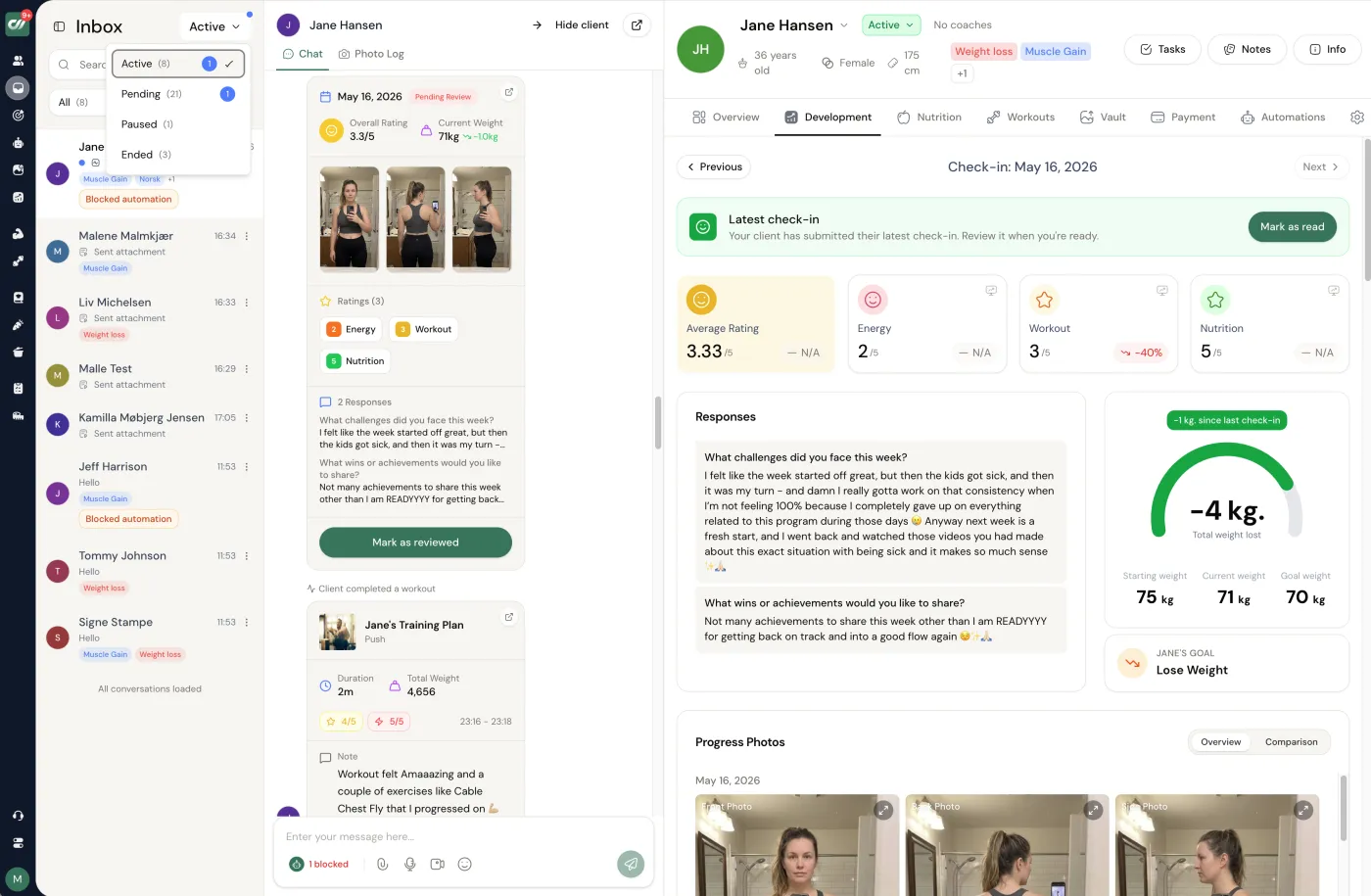
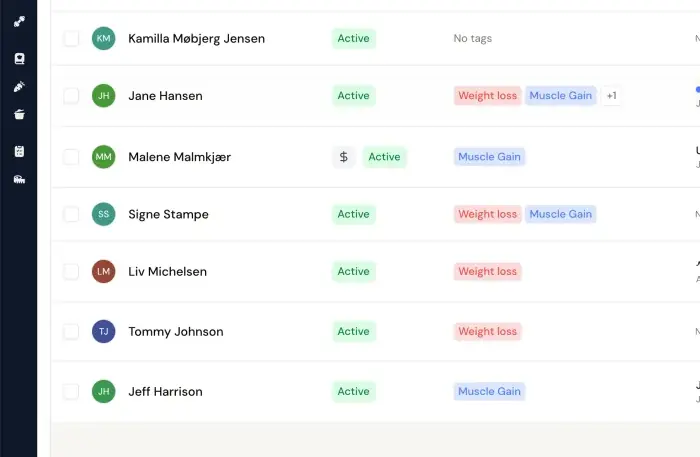
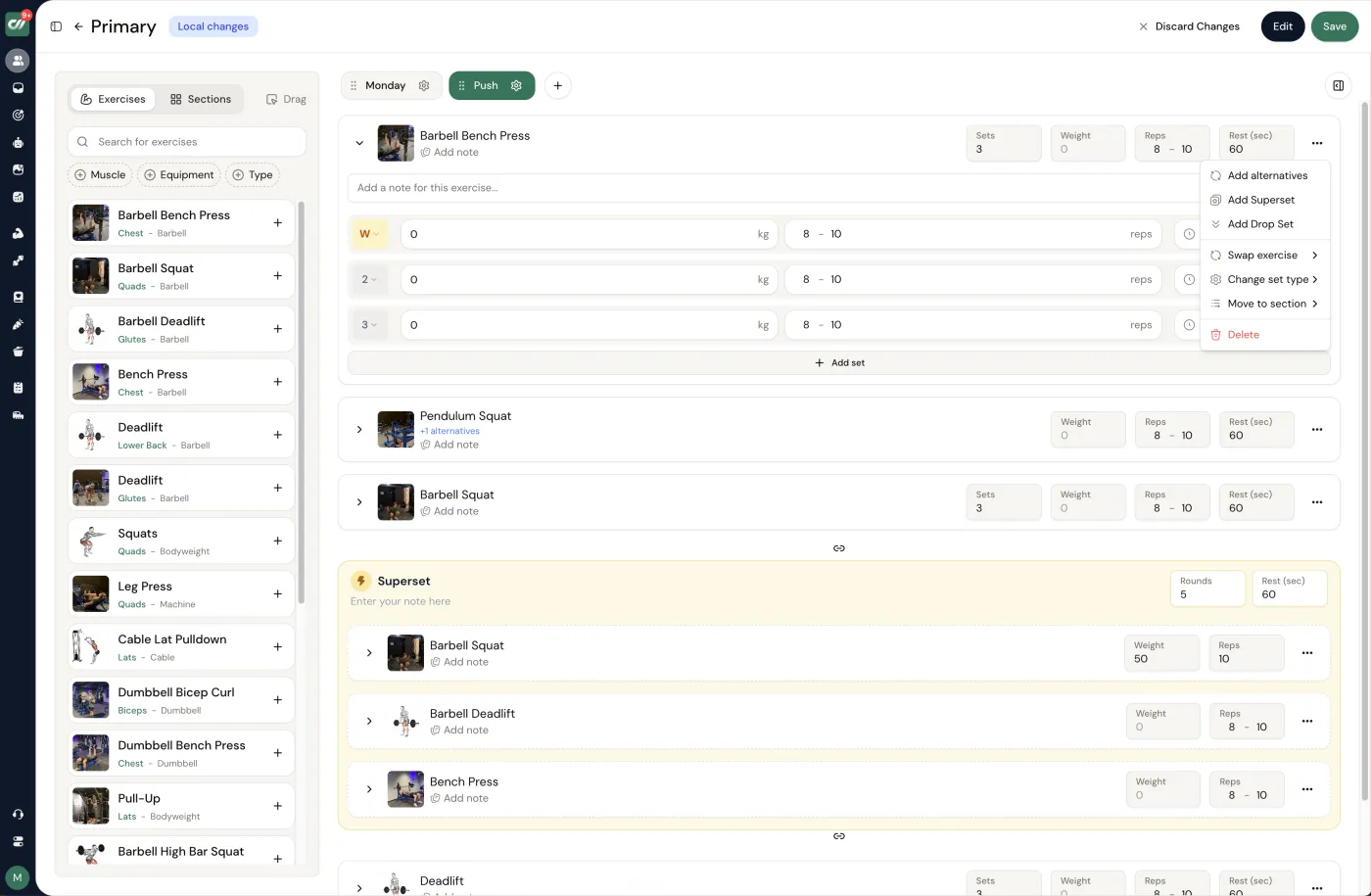
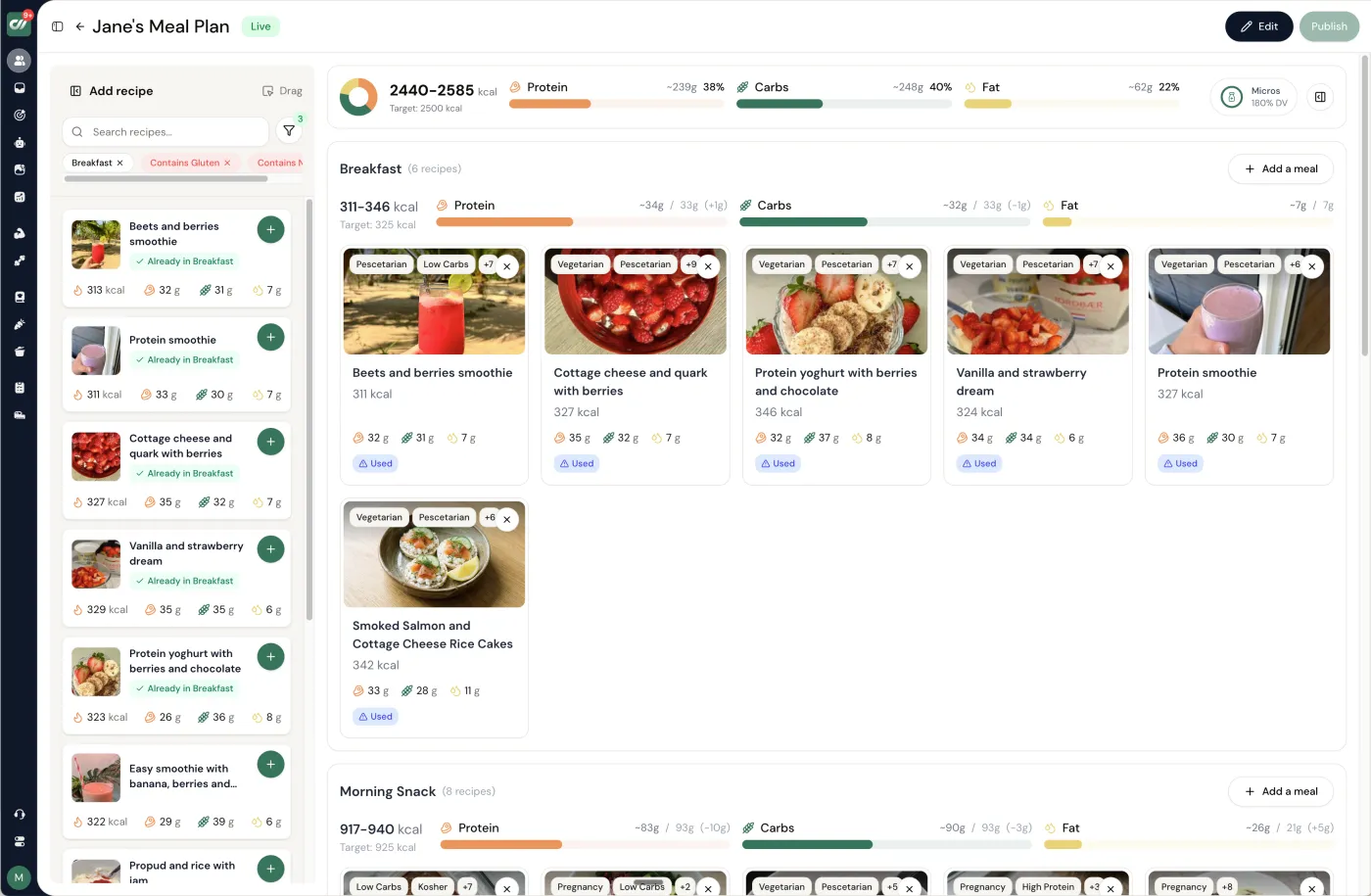
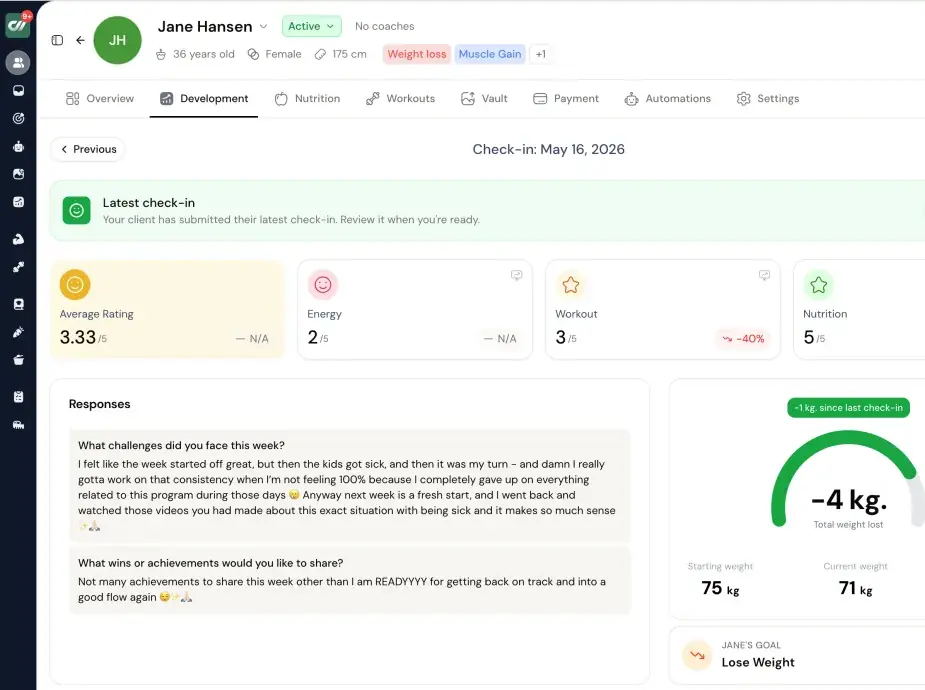
Inbox - The chat, the notes and the full client file open together - reply without digging through tabs.
Frequently asked.
What app do online personal trainers use with clients?
Most online personal trainers use one coaching platform that gives the client a single app for workouts, nutrition, check-ins, progress photos, and chat. The long-established names are Trainerize, TrueCoach, Everfit, PT Distinction, and My PT Hub; the newest serious entrant is Coachway, launched December 2025 in Copenhagen. A minority still stitch together spreadsheets, WhatsApp, MyFitnessPal, and Stripe, but most working coaches consolidate onto one platform because the client experience and the admin load both improve.
Is Trainerize still the most popular coaching software?
Trainerize (now ABC Trainerize, under ABC Fitness) is among the most widely used coaching platforms, with a large install base and a mature exercise library built up since 2012. Popular is real and worth respecting, but it measures years in market and accumulated users, not current fit for your coaching. The right question in 2026 is which platform fits how you coach, in your language, at your client count, and what each one has shipped recently.
What is the newest online coaching platform?
Among the platforms fitness coaches actually run their business on, Coachway is the newest serious entrant, launched on 29 December 2025 by Coachway ApS, a Danish company founded in May 2023. Being newest cuts both ways: the shortest track record and the smallest review count on the table, in exchange for a product built for today's coaching workflow and features shipped quickly. The honest test is not age but what a platform shipped in the last 90 days, which you can check on any vendor's public updates page.
What is the best personal training software in 2026?
There is no single best for everyone, which is why the fair answer is fit-based. For workout-first coaching in North America, Trainerize or TrueCoach; for a free start, Everfit; for nutrition-led English-market coaching, PT Distinction; for a scaling online fitness coach who wants native-language software, predictable per-client pricing, and their own Stripe, Coachway. For a fuller ranked list with pricing and trade-offs, see our guide to the best apps for personal trainers.
Do coaching platforms take a percentage of my revenue?
It depends on the platform, so read the payments terms carefully. On Coachway, using your own Stripe checkout carries no Coachway fee; the optional built-in payments feature carries a 2.4% per-transaction fee if you choose to use it. Other platforms route payments through your own Stripe or PayPal and add their own add-on fee or none at all, and some percentage-based models get expensive past 30 to 50 clients. Whichever you pick, run the math at your target client count, not today's.
How do I tell if a coaching platform is actively developed?
Open the vendor's public updates or changelog page and read the last 90 days. A platform shipping fixes and features regularly is being invested in; a page that has not changed in a year, or that you cannot find at all, is a warning sign. Nudge Coach, which shut down in April 2025, is the cautionary tale. Run the same test on every platform you are considering, including Coachway, whose public updates page is at coachway.io/updates.
Features are not the deciding factor. The workflow is.
A longer feature list is easy to win on a comparison table. It is not the question that decides your week. What decides it is how fast you can run the actual work, week after week: following up a client, sending video feedback, and reviewing a weekly check-in. Coachway is built from working hands-on with online fitness coaches scaling past 1,000 clients, where shaving minutes off every client interaction is the whole game.
The entire product is tuned for one outcome: handle more clients, at a higher satisfaction rate, in less time. A smoother workflow is not just cheaper for you, it is a better experience for the client, and that is what keeps clients paying for longer.
check-ins
Review a weekly check-in in 3 to 5 minutes, with notes, data, photos, and exercise history in one view.
follow-up
Messages, video feedback, and plan tweaks happen from one tab, not six different tools.
automation
Automatic reminders run the cadence, and smart send holds a message back if the client has an unread message, so the experience stays personal.
Keep reading
all guidesHow much does it cost to build a fitness app? (2026)
Fitness app development cost explained: MVP vs full custom build ranges, yearly maintenance, and why a coaching platform is cheaper and faster for most coaches.
Read the guideBest Online Nutrition Coaching Platforms (13 Picks, 2026)
The best online nutrition coaching platforms in 2026, compared on meal planning, habit tracking, branded app, payments, and price - with a table and honest trade-offs.
Read the guideVideo coaching software: remote form checks and feedback (2026)
Video coaching software covers both directions of remote coaching: your demo videos going out, and client form-check videos coming back for feedback. What to look for, and how to run a clean remote form check.
Read the guideFree tools for this: Coaching Tool Stack Cost Calculator · Coaching Profit Calculator · Client Capacity Calculator
See what Coachway can do for your coaching business
Coachway was built on knowledge from working with 150 online coaches over 6+ years, who all hit the same wall - slow platforms, clunky workflows, wasted hours. Start your 14-day free trial and see what we fixed - the whole platform, no charge today, cancel anytime under Billing.


