


Workout templates for personal trainers you build on, not just hand over.
A template is a head start, not a finished plan. This guide gives you three ready-to-use structures - a 3-day full-body, a 4-day upper/lower, and a 6-day push/pull/legs split - laid out with sets, reps and effort targets you can copy today. It also covers the program-design principles behind them, so you know why each one works, and how to turn a single template into a personalized program for every client without starting from a blank page each time.
By Markus Evers · Updated August 2026
the short version
A workout template is a reusable starting structure of exercises, sets, reps and effort targets you personalise for each client, not a finished plan you resell unchanged. Train each muscle about twice a week, keep weekly volume sensible, put compounds before isolation, and progress with load. Below are three templates: a 3-day full-body, a 4-day upper/lower and a 6-day push/pull/legs. To fill one in and print it, or download it for Google Sheets or Excel, use the workout program template.
A template is a starting structure, not a product you resell.
There is a version of workout templates that gets sold as a shortcut: buy the pack, print it, hand the same PDF to every client, done. That is not coaching, and clients can tell. Two people with the same goal can need very different programs because their equipment, training age, injury history, recovery, and schedule are different. The honest use of a template is as a scaffold. It gives you a proven structure to start from so you are not designing every session from a blank page, and then you personalize the details for the person actually doing the work.
Used that way, templates make you faster without making you generic. You keep a small library of strong base structures - one per goal and experience level - and each new client starts from the closest fit, which you then adjust. If you want the full walkthrough of building a program from scratch before you templatize it, our guide on how to create a client workout program covers the decisions a template bakes in, and the piece on writing programs faster for multiple clients shows how templates cut the time per client once your base library exists.
The principles every good template rests on.
The templates below are not magic. They are the same handful of well-supported rules arranged into a schedule. Learn the rules and you can build, judge, or fix any template, including your own. Here are the six that matter most.
01
Frequency: hit each muscle about twice a week.
Spreading a muscle's weekly work across two sessions tends to beat one brutal session for most clients, because quality stays higher across the sets. This is why full-body and upper/lower splits punch above their weight.
02
Volume: land in a sensible weekly range.
Roughly 10 to 20 hard sets per muscle per week works for most people chasing growth, with beginners lower and advanced lifters higher. Count the sets before you assign a template with a weekly training volume calculator.
03
Order: compounds first, isolation last.
Put the heaviest, most technical lifts at the start of a session when the client is fresh, then finish with single-joint work. The exception is a deliberate weak-point priority, where you may move one isolation lift earlier.
04
Effort: leave reps in reserve, add load over time.
RIR (reps in reserve) is how many reps a client could still do at the end of a set. Most work sits at 1 to 3 RIR. Progress comes from adding weight or reps week to week - the mechanism our guide to progressive overload explains in full.
05
Fit: match the split to the client's week.
The best template is the one a client will actually complete. Someone who trains three times a week does not belong on a six-day split. Choose frequency around real availability and recovery, then fill the sessions - not the other way around.
06
Progression: run a block, then evolve it.
Keep a template for four to eight weeks so the client can progress on the same lifts, then adjust. Planning those blocks across a season is periodization - covered in our guide to periodization for online coaches.
Classify every exercise before you slot it in.
Every movement in a template plays one of three roles. Knowing which is which is what lets you swap an exercise for a client without breaking the program: you replace like with like. Primary compounds anchor the session, secondary compounds add volume to the same patterns, and isolation lifts finish the job and address weak points.
| Category | What it trains | Role in a template | Examples |
|---|---|---|---|
| Primary compound | Several large muscle groups across two or more joints | The anchor: heaviest load, lowest reps, most rest, goes first | Back squat, deadlift, bench press, overhead press, barbell row, weighted pull-up |
| Secondary compound | Large muscle groups with a narrower focus | Adds volume to the primary pattern at a more moderate load | Front squat, Romanian deadlift, incline dumbbell press, leg press, chest-supported row, walking lunge |
| Isolation | One muscle at a time, single-joint | Finishes the session, targets weak points, higher reps | Leg curl, leg extension, lateral raise, biceps curl, triceps pushdown, calf raise, face pull |
When a client cannot do an exercise - no barbell at their gym, a cranky shoulder, a machine always taken - swap it for another movement in the same row. A back squat becomes a leg press, an incline barbell press becomes an incline dumbbell press. The role stays the same, so the template stays balanced.
Three ready templates: 3-day, 4-day, and 6-day.
Each template lists exercises, sets, a rep range, and a target RIR. Read RIR as effort: 3 means three reps left in the tank, 1 means near-maximal. Beginners sit further from failure, advanced lifters closer. These are starting points built on the principles above - adjust the exercises to your client's equipment and history, then progress load week to week within the rep ranges shown.
1. Full-body, 3 days a week (beginner)
Trained Monday, Wednesday, Friday. Three different sessions so the whole body gets hit twice or more across the week, with plenty of rest between exercises. Ideal for a client new to structured training who wants the most from three visits.
| Day | Exercise | Sets | Reps | RIR |
|---|---|---|---|---|
| Day 1 | Goblet squat | 3 | 8-10 | 3 |
| Dumbbell bench press | 3 | 8-10 | 3 | |
| Lat pulldown | 3 | 10-12 | 2-3 | |
| Dumbbell Romanian deadlift | 2 | 10-12 | 3 | |
| Plank | 3 | 30-45s | - | |
| Day 2 | Leg press | 3 | 10-12 | 3 |
| Seated cable row | 3 | 10-12 | 2-3 | |
| Incline dumbbell press | 3 | 8-10 | 3 | |
| Seated leg curl | 2 | 12-15 | 2 | |
| Dead bug | 3 | 8-10/side | - | |
| Day 3 | Dumbbell walking lunge | 3 | 10/leg | 3 |
| Assisted pull-up or lat pulldown | 3 | 8-10 | 2-3 | |
| Machine shoulder press | 3 | 10-12 | 3 | |
| Cable face pull | 2 | 12-15 | 2 | |
| Hanging or lying leg raise | 3 | 10-12 | - |
2. Upper/Lower, 4 days a week (intermediate)
Trained Monday, Tuesday, Thursday, Friday as Upper A, Lower A, Upper B, Lower B. Each muscle group is worked twice a week with more volume and heavier compound work than the beginner plan. A strong default for a client who can commit to four sessions.
| Day | Exercise | Sets | Reps | RIR |
|---|---|---|---|---|
| Upper A | Barbell bench press | 4 | 6-8 | 2 |
| Barbell row | 4 | 6-8 | 2 | |
| Seated dumbbell shoulder press | 3 | 8-10 | 2 | |
| Lat pulldown | 3 | 10-12 | 1-2 | |
| Cable triceps pushdown | 3 | 12-15 | 1 | |
| Dumbbell curl | 3 | 12-15 | 1 | |
| Lower A | Back squat | 4 | 6-8 | 2 |
| Romanian deadlift | 3 | 8-10 | 2 | |
| Leg press | 3 | 10-12 | 1-2 | |
| Seated leg curl | 3 | 12-15 | 1 | |
| Standing calf raise | 4 | 12-15 | 1 | |
| Hanging leg raise | 3 | 10-12 | - | |
| Upper B | Weighted pull-up or lat pulldown | 4 | 8-10 | 2 |
| Incline barbell press | 4 | 6-8 | 2 | |
| Chest-supported row | 3 | 10-12 | 1-2 | |
| Dumbbell lateral raise | 4 | 12-15 | 1 | |
| Overhead cable triceps extension | 3 | 12-15 | 1 | |
| Incline dumbbell curl | 3 | 12-15 | 1 | |
| Lower B | Deadlift | 3 | 4-6 | 2 |
| Front squat or hack squat | 3 | 8-10 | 2 | |
| Walking lunge | 3 | 10/leg | 2 | |
| Lying leg curl | 3 | 12-15 | 1 | |
| Seated calf raise | 4 | 15-20 | 1 | |
| Cable crunch | 3 | 12-15 | - |
3. Push/Pull/Legs, 6 days a week (advanced)
Two rotations of Push, Pull, and Legs across six days, so each muscle is trained twice a week at high volume. This is a lot of work and only fits an experienced client with the recovery and schedule for it. When six days is not realistic, drop to five and repeat the day the client most wants to prioritize.
| Day | Exercise | Sets | Reps | RIR |
|---|---|---|---|---|
| Push A | Barbell bench press | 4 | 6-8 | 2 |
| Seated dumbbell shoulder press | 3 | 8-10 | 2 | |
| Incline dumbbell press | 3 | 10-12 | 1-2 | |
| Cable lateral raise | 3 | 12-15 | 1 | |
| Overhead triceps extension | 3 | 10-12 | 1 | |
| Triceps pushdown | 3 | 12-15 | 1 | |
| Pull A | Deadlift | 3 | 4-6 | 2 |
| Weighted pull-up | 3 | 6-8 | 2 | |
| Chest-supported row | 3 | 10-12 | 1-2 | |
| Lat pulldown | 3 | 10-12 | 1 | |
| Face pull | 3 | 15-20 | 1 | |
| Barbell or EZ-bar curl | 3 | 10-12 | 1 | |
| Legs A | Back squat | 4 | 6-8 | 2 |
| Romanian deadlift | 3 | 8-10 | 2 | |
| Leg press | 3 | 12-15 | 1-2 | |
| Seated leg curl | 3 | 12-15 | 1 | |
| Standing calf raise | 4 | 12-15 | 1 | |
| Push B | Incline barbell press | 4 | 8-10 | 2 |
| Machine shoulder press | 3 | 10-12 | 1-2 | |
| Flat dumbbell press | 3 | 10-12 | 1-2 | |
| Dumbbell lateral raise | 4 | 12-15 | 1 | |
| Dips or close-grip bench press | 3 | 8-10 | 1-2 | |
| Cable triceps pushdown | 3 | 15-20 | 1 | |
| Pull B | Barbell row | 4 | 8-10 | 2 |
| Lat pulldown | 3 | 10-12 | 1-2 | |
| Seated cable row | 3 | 10-12 | 1 | |
| Rear-delt fly | 3 | 15-20 | 1 | |
| Incline dumbbell curl | 3 | 12-15 | 1 | |
| Hammer curl | 3 | 12-15 | 1 | |
| Legs B | Front squat or hack squat | 4 | 8-10 | 2 |
| Bulgarian split squat | 3 | 10/leg | 1-2 | |
| Lying leg curl | 3 | 12-15 | 1 | |
| Leg extension | 3 | 15-20 | 1 | |
| Seated calf raise | 4 | 15-20 | 1 |
Warm-ups are assumed and not listed: a few light ramp-up sets before the first heavy compound of each session. To progress any of these blocks, keep the exercises the same and aim to add a rep or a small amount of load each week until the client tops the rep range, then increase the weight and start again at the bottom.
How to customize a template for every client, fast.
A template only earns its keep when personalizing it takes minutes, not hours. The work is always the same four moves: swap exercises for the client's equipment and history, set loads that match their strength, place the right effort target, and check the weekly volume is sane. A few free tools make each move quick and defensible, and a red-flag review prompt catches the conflicts you miss at 10pm; it is in our guide to using ChatGPT for program design.
Build the split around their week
Not sure which of the three templates fits a new client? The workout plan builder takes their training days, goal, and experience and returns a structured weekly split you can use as your starting scaffold.
Set starting loads from a known lift
Turn one tested set into working weights for the whole rep range with the one rep max calculator. Estimate the client's 1RM, then read off the percentage that matches each exercise's target reps.
Translate the RIR column into a real weight
The RIR calculator converts a rep target and reps in reserve into an RPE and a percentage of 1RM, so you can hand the client an exact load for each set instead of a vague instruction to stop near failure.
Check the volume before you assign
After swaps and edits, run the finished plan through the weekly training volume calculator to see sets per muscle against sensible landmarks, so no muscle is quietly starved or buried.
These tools handle the numbers, but the real speed comes from not rebuilding the structure each time. That is exactly what templatizing your programs is for, and our guide on writing workout programs faster for multiple clients lays out the system: a small library of base templates, personalized per client, reused for good.
How a coaching platform turns a template into per-client programs.
A PDF template is static: you copy it, edit it in a document, and email it out, then have no idea whether the client followed it. A coaching platform keeps the template live. You build it once, assign it, personalize it, and then see what actually happened when the client trained. That closed loop is what separates a template you resell from a program you coach.
Save once, assign in a click.
In Coachway you save any program, or even a single killer session, as a reusable template. Assign it to a new client and then individualize the details rather than rebuilding from scratch, which turns programming from hours into minutes.
Swap exercises without breaking the plan.
Pull from a library of roughly 1,800 to 2,000 exercises with demonstration videos, or add your own with your own videos. Set the type per exercise or per set - rep range, AMRAP, time-based, supersets, drop sets - so the template bends to your method.
Bake in alternatives up front.
Add alternative exercises directly to the program so a client who trains at a second gym or hits a busy machine can swap in the app with one tap, and you stay informed. Build the alternatives into the template once and every client gets flexible programming.
See what actually got trained.
After a session the client's logged sets, reps, weights, and notes feed straight back to you, and skipped sessions are visible too. You catch a client drifting off-program in days, and you know whether progressive overload is really happening.
That feedback is the difference between a template and coaching. When you can see the numbers a client actually hit, you know when to add load, when to hold, and when a program has run its course - the judgement our guide to progressive overload is built on, and the reason a static PDF can never quite replace a live program.
Enter each table once: sets, rep range and RIR become settings the client logs against.
Every template above gives each exercise three numbers: sets, a rep range and a target RIR. In Coachway's workout builder those become settings on the exercise, with the RIR written as its RPE twin (RPE is 10 minus RIR, so RIR 2 is RPE 8), plus an alternative for any machine a busy gym might block. Exercises come from a library of 1,800+ with video demos, and the client logs every set in the app, so the 3, 4 or 6-day template you assign is the same one you read back after the session. Personalizing it for the next client then means changing loads and swaps, not starting a new document.
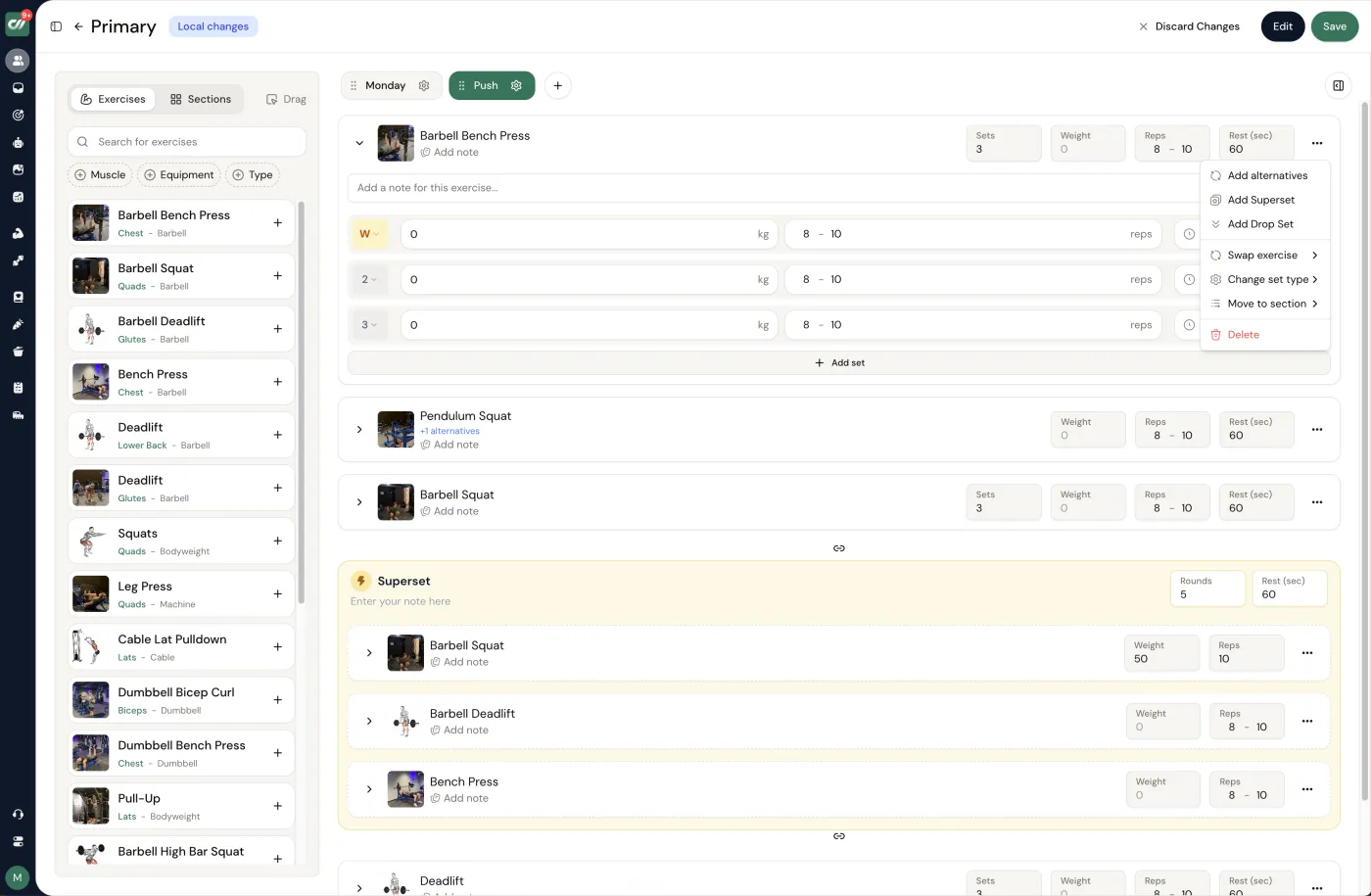
Build the template once, personalize it for every client.
Coachway's workout builder is made for exactly this way of working: keep a library of base templates, assign one to each client, and adjust from there instead of starting blank. Clients get the program, videos, and alternatives in their app, log every set, and their numbers come back to you. Coachway is EUR 69 per month for up to 5 clients, then EUR 9 per additional client, with every feature included and a 14-day free trial that asks for a card.
feature
Workout builder.
Roughly 1,800 to 2,000 exercises with videos, custom exercises, set types, supersets, alternatives, and reusable templates.
feature
Client app.
Clients see the program with video demos, swap alternatives with one tap, and log every set, rep, and weight as they train.
free tool
Workout plan builder.
Pick training days, goal, and experience to generate a structured weekly split you can use as your starting scaffold.
Frequently asked questions about workout templates.
What is a workout template?
A workout template is a reusable starting structure for a training program: a set of exercises organized into sessions, with sets, reps and effort targets, that a coach personalizes for each client rather than handing over unchanged. It saves you from designing every program from a blank page, while still leaving room to adjust exercise selection, load, and volume to the person in front of you. A good template is a scaffold, not a finished product.
Are these workout templates free to use with my clients?
Yes. The three templates in this guide - a 3-day full-body, a 4-day upper/lower, and a 6-day push/pull/legs split - are built on mainstream, well-supported programming principles and are free to copy and adapt. Treat them as a base you personalize per client rather than a plan you print and hand out identically to everyone. Adjust the exercises to your client's equipment, experience, and goal before you assign them.
How many exercises should a workout template have per session?
For most clients, four to seven exercises per session is a sensible range. Open with one or two primary compound lifts, add one or two secondary compounds, and finish with two or three isolation movements for weak points and higher-rep work. Beginners do well at the lower end with more rest between sets, while more advanced clients can handle the upper end. Session length and the client's recovery capacity matter more than hitting a fixed number.
How often should I change a client's program?
Keep a program long enough for the client to progress on it, which usually means four to eight weeks, not every week. The point of a block is to add load or reps to the same lifts over time so you can see progressive overload working. Change the program when progress stalls across two or three sessions, when the client is bored to the point of skipping, or when their goal or schedule shifts. Swapping exercises constantly hides whether anything is actually improving.
Can I reuse one template for multiple clients?
Yes, and that is the whole point of working from templates. Build a strong base template per goal and experience level, then individualize the details for each client: swap exercises for their equipment and injury history, set their loads and rep targets, and adjust volume to their recovery. On a coaching platform you save the template once, assign it to a new client in a click, and edit from there, which turns programming from hours of blank-page work into minutes of personalization.
Keep reading
all guidesHow to Spot At-Risk Coaching Clients Before They Quit
The warning signs a coaching client is about to cancel - missed check-ins, going quiet, dropping activity - and how to filter your client list to surface the at-risk ones early, while there is still time to act.
Read the guideRaise prices or take more clients? The revenue-per-hour decision
Two ways to earn more, and they are not equal. Decide on revenue per hour: when to raise prices, when to add clients, and when the real answer is to hire instead.
Read the guideHow to do faster client check-ins at scale (without cutting quality)
At 15 minutes each, 100 check-ins is 25 hours a week; at 4 minutes it is under 7 - same quality. The repeatable review order, templated-but-personal feedback, and the inbox that makes it fast.
Read the guideFree tools for this: Personal Trainer Income Calculator · Client LTV Calculator · Coaching Profit Calculator
Ready-made template: Workout Program Template
See what Coachway can do for your coaching business
Coachway was built on knowledge from working with 150 online coaches over 6+ years, who all hit the same wall - slow platforms, clunky workflows, wasted hours. Start your 14-day free trial and see what we fixed - the whole platform, no charge today, cancel anytime under Billing.


