How to create a workout program for a client - goal and training age first, exercises second.
To create a workout program for a client you work top down: fix the goal and the training age, let those set the weekly structure, then choose exercises by movement pattern, then prescribe sets and reps from the goal, then write the progression in. This is the exercise-selection and set-and-rep methodology behind a program that fits the person in front of you - not a template you retitle for the next client.
By Markus Evers · Updated September 2026
the short version
Build the program in a fixed order and each decision makes the next one easy. Start with the client's main goal and their training age - the two inputs that quietly decide everything else. Let those set the weekly frequency and split. Choose exercises by movement pattern, compound lifts first. Prescribe sets and reps from the goal: strength lives low in the rep range, hypertrophy in the middle, endurance high. Write progression in from day one so the plan climbs week to week. Then fit it to the real person's schedule, equipment and history before you send it, and run the block for about four to six weeks before you rebuild.
Where does a client's program actually start?
Not with exercises. A program starts with two answers about the person: what is the one main goal for the next few months, and what is their training age. Get those two right and most of the rest of the plan is downstream of them. Get them wrong and no amount of clever exercise selection saves it, because a technically neat program aimed at the wrong goal, or pitched at the wrong experience level, still misses.
The goal has to be a single priority, not a wish list. A client can build muscle, get measurably stronger, lose fat while holding muscle, or improve general health and work capacity - and while these overlap, a program can only be optimised for one of them at a time. Pick the primary, name the others as things you maintain, and the rep ranges and volume stop being a guess. "Get toned and strong and lean and fit" is not a goal a program can be built around; "add visible muscle over the next three to four months" is.
Training age is the second input and the one most often misread. It is not the client's age in years - it is how long they have trained hard and consistently. A 45-year-old who has lifted seriously for a decade is an advanced trainee; a 22-year-old who joined a gym in spring is a beginner. Training age decides how much volume the client can absorb, how fast they recover, how quickly they will stall on simple progression, and therefore how the whole plan is shaped. This is the deep end of the six programming variables every coach controls; this piece is about turning them into an actual client program.
How to create a workout program for a client, step by step.
Step 1: Fix the goal and the training age.
Write both down in one line before you touch a single exercise: the primary goal for the block, and the honest training age. Then add the hard constraints in the same breath - how many days a week the client can realistically train, what equipment they have, and any injury or movement they need to work around. These four facts are the frame the whole program hangs inside, and a program designed against a fantasy schedule (five days when the client can manage three) fails on adherence no matter how good the training logic is. This is also the difference between a program built for the person and one built exercise-first, which quietly ends up built for the coach's own preferences. If you want to see those four facts turned into a structured weekly split in seconds, a free workout plan builder does exactly that from days, goal and experience.
Step 2: Set the weekly structure and the split.
Frequency comes before the split, and both come from step one. A beginner training for general strength or muscle can progress on two or three full-body sessions a week, which hits each pattern often and is forgiving of a missed day. As training age and available days rise, an upper-lower or push-pull-legs split lets each session do more focused work without each muscle waiting a full week between stimuli. The split is a way to distribute the week's volume, not a personality choice - pick the one that fits the client's days and lets every important movement pattern get trained at least twice a week. The workout-split decision maps the common options onto training days.
Step 3: Select exercises by movement pattern, compound first.
Now, and only now, choose lifts. Do it by movement pattern rather than by muscle: a squat pattern, a hinge, a horizontal push and pull, a vertical push and pull, and a carry or core piece cover the body without gaps. Lead each session with the big compound lift - the one that trains the most muscle and carries the progression - then fill in isolation work around it for the muscles the compounds under-serve or the client specifically wants to develop. Match the exercise to the person, not the textbook: pick lifts that fit their equipment, feel good on their joints, and let them use a full range of motion they can actually control. A slightly less "optimal" lift the client can load and progress safely beats a picture-perfect one they cannot.
Step 4: Prescribe sets and reps from the goal.
With the exercises fixed, the numbers almost fall out. The goal picks the rep range: strength-led work on the main lifts sits low, hypertrophy work sits in the middle, endurance and conditioning sit high. The training age picks the volume: a beginner grows on less total work and recovers fast, an advanced client needs more sets to keep moving and needs them managed so fatigue does not swamp recovery. As a working default, most muscle groups respond well to roughly ten or more hard sets across the week, spread over the sessions you set in step two. Set effort matters as much as the number - most working sets should end a rep or two short of failure, which is where rep ranges and effort earn their keep. The table below is the starting grid you adjust from there.
Step 5: Build the progression in from day one.
A program without a written progression rule is just a workout the client repeats. Decide before you send it how the plan climbs: for a beginner, add a little load or a rep to the main lifts most weeks while form holds - simple linear progression, and enough on its own for months. For a more advanced client, progression gets slower and more managed - small weekly steps, a planned back-off, and phases that emphasise different qualities in turn. The mechanism underneath all of it is progressive overload: the client has to do measurably more over time, whether that is weight, reps, sets or better control. Write the rule into the program so the client and their weekly log both know what "a good week" looks like.
Step 6: Individualise, then deliver it.
The last pass is where a good program becomes this client's program. Read it back against step one and cut what does not fit: swap the barbell lift for a dumbbell version if that is what they own, drop a session if three days was always the honest number, replace anything their history flags. Then deliver it as a plan they can follow without you standing there - clear order, clear targets, a demo for anything they might not know, and a way to log what they actually did. A program only works once it is delivered well and progressed against real check-in data, which is where designing it and writing it for online delivery stop being the same job.
What sets and reps for which goal?
These are defaults, not laws - a place to start the numbers once the goal is set, which you then move based on how the client actually responds week to week. The rep ranges track the goal; the weekly set count is where training age does most of the adjusting.
| Primary goal | Rep range (main work) | Effort | Weekly sets per muscle |
|---|---|---|---|
| Maximal strength | 1 to 5 reps | Heavy, well short of failure | Lower, quality over quantity |
| Muscle growth | 6 to 12 reps | 1 to 3 reps in reserve | Roughly 10 or more hard sets |
| Endurance and conditioning | 12 to 20+ reps | Moderate, higher density | Moderate, more circuit-style |
| Beginner, general | 5 to 10 reps | Leave 2+ reps, learn the lift | Less - 2 to 3 full-body sessions |
Ranges reflect standard resistance-training consensus (ACSM progression guidelines; Schoenfeld et al. weekly-volume meta-analysis). Treat them as a starting grid, then adjust from the client's own response.
Building the program without rebuilding it every client.
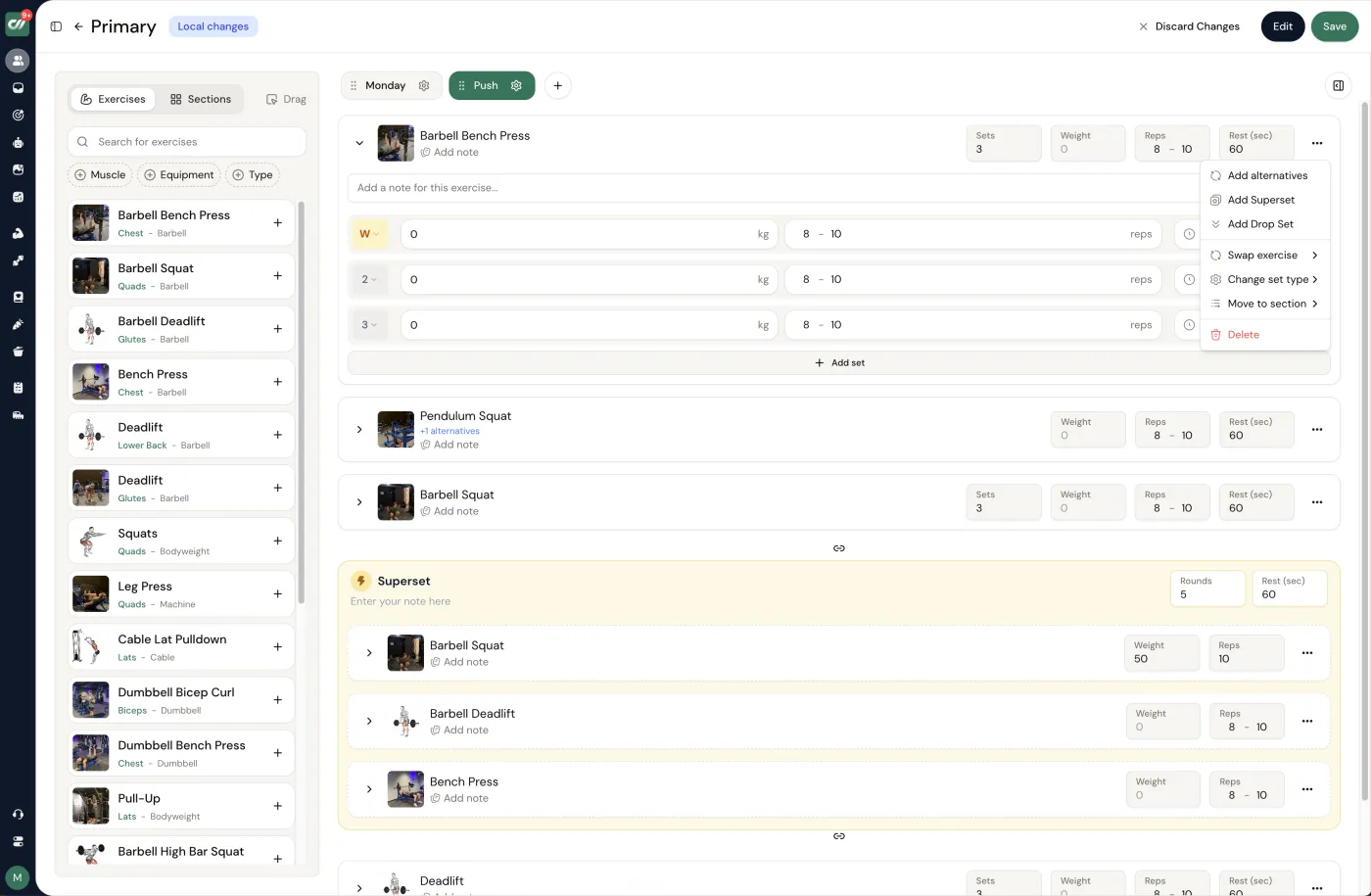
The method above is the same for every client; the labour is in doing it fifteen times a week without losing the thread. That is the case for building programs inside a coaching platform rather than a spreadsheet. In Coachway the workout builder puts the program - sessions, sets and reps - right beside a library of 1,800+ exercises with demo videos, so exercise selection in step three is a search rather than a hunt, and the sets and reps from step four sit in the same view. You build one client's block, save the good parts as a template, and adapt it to the next person instead of starting from a blank page - which keeps the per-client work down to the individualising in step six. It lands in the client app with the demos attached, and their logged sessions come back so you can read the progression against real data. Coachway costs EUR 69 a month including your first 5 clients, then EUR 9 per additional client, with every feature included and no tiers. The coach dashboard is in English; the client app is available in English, Danish, Norwegian, Swedish, Finnish and German. It is built on knowledge from working with 150 online coaches over 6+ years - or book a demo and see the builder first. The 14-day free trial starts with a card held by Stripe and cancels under Billing before it renews.
Frequently asked questions about creating a client's workout program.
How do you create a workout program for a client from scratch?
Work top down, from the person to the exercises, not the other way around. First fix the two inputs that decide everything else: the client's main goal for the next few months and their training age - how long they have trained hard and consistently. Those two answers set the weekly frequency and the split. Then choose exercises by movement pattern rather than by muscle, leading with compound lifts and filling in isolation work around them. Only after the exercises are chosen do you prescribe sets and reps, because the goal decides the rep range and the training age decides how much volume the client can absorb. Finally, build progression into the plan from day one - a written rule for how load or reps climb each week - and adjust the program to the real person's schedule, equipment and injury history before you send it. A program built in that order fits the client. A program built exercise-first tends to fit the coach's habits.
What comes first when building a program, exercise selection or sets and reps?
Exercise selection comes first, and both come after the goal. The mistake new coaches make is opening a blank plan and typing exercises they like, then guessing at sets and reps to fill the page. The order that produces a coherent program is goal, then training age, then weekly structure, then exercises, then sets and reps, then progression. Sets and reps are a dependent variable: once you know the client is training for hypertrophy versus maximal strength versus general health, and you have chosen the specific lifts, the rep range and set count follow almost mechanically. Choosing them before the exercises are set forces you to redo the numbers every time a lift changes, and it usually means the volume is being guessed rather than reasoned from the goal.
How many sets and reps should a client's workout program have?
Let the goal pick the rep range and the training age pick the volume. As a working default, strength-led work sits in the one to five rep range on the main lifts, hypertrophy work sits in roughly six to twelve reps for most sets, and muscular-endurance or conditioning work runs twelve to twenty or more. For weekly volume, most muscle groups grow well on roughly ten or more hard sets across the week, and a true beginner progresses on far less - often two or three quality sessions a week is enough to drive change. The training age is the multiplier: a beginner needs less volume and recovers faster from it, an advanced client needs more total work to keep moving and needs it managed carefully so fatigue does not outrun recovery. These are starting points you adjust from the client's response, not fixed prescriptions.
How does a client's training age change the program?
Training age - how many years the client has trained hard and consistently, not their age in years - changes almost every decision. A beginner makes progress on simple, frequent, moderate training: a small number of big compound lifts, straightforward linear progression where you add a little each week, and lower total volume, because almost any honest stimulus works and recovery is fast. An intermediate needs more variety and a slower progression, because linear jumps stop being sustainable. An advanced client needs higher and more carefully managed volume, planned variation, and periodized phases, because the easy gains are gone and fatigue management becomes the limiting factor. Reading training age wrong is the most common way a technically fine program still fails: give a beginner an advanced high-volume split and they burn out or get hurt; give an advanced lifter a beginner's plan and they stall from lack of stimulus.
How long should a client's workout program run before you change it?
Long enough for the change to show, which for most clients is a block of about four to six weeks before a meaningful redesign. Progression happens inside the block week to week - a little more load, a rep or two more, a set added - so the program is never static even though the exercises hold steady. What you avoid is changing the exercises constantly, because a client cannot progress on a lift they only see once. Keep the main movements stable across the block so there is a measurable trend to read, run the plan until progress on the key lifts genuinely stalls or the client finishes the phase, then rebuild the next block from where they actually are. Novelty is not stimulus; a stable program that the client can beat week after week is.
The steps here sit on top of two deeper pieces: the programming variables that explain why the numbers move the way they do, and progressive overload, the mechanism the whole plan exists to deliver. Once the program is built, writing it for online delivery is the next job.
Keep reading
all guidesHypertrophy Training: What It Is and How to Program It
What hypertrophy training is and how to program it for online clients: the three drivers (mechanical tension, training volume, progressive overload), the best rep ranges, and a reusable hypertrophy block.
Read the guideProgressive Overload: What It Is & How to Apply It
Progressive overload is gradually increasing the demands on a muscle over time so it keeps adapting. The six methods, how coaches apply them across a program, and how to break plateaus.
Read the guideRefeed Days: What They Are & How to Structure Them
A coach's guide to refeed days: what a refeed day is, its real purpose, how to structure carbs, protein, and fat, how it differs from a cheat day, and which clients it suits.
Read the guideFree tools for this: Calorie Deficit Calculator · TDEE Calculator · One-Rep-Max Calculator
Ready-made template: Workout Program Template
See what Coachway can do for your coaching business
Coachway was built on knowledge from working with 150 online coaches over 6+ years, who all hit the same wall - slow platforms, clunky workflows, wasted hours. Start your 14-day free trial and see what we fixed - the whole platform, no charge today, cancel anytime under Billing.