


Workout programming for multiple clients - how to write plans faster at scale.
Workout programming for multiple clients gets slow for one reason: you keep building each plan from a blank page, even though two clients with the same goal need programs that are almost identical. This is the template-first workflow that lets one coach program for twenty-plus people without either handing out generic plans or losing an evening to retyping the parts that were never going to differ.
By Markus Evers · Updated August 2026
the short version
Programming for many clients is only slow when you rebuild the shared ninety percent by hand every time. Capture the way you already program as a small set of base templates - one per goal and training age you coach - keep them as living, assignable objects in a workout builder rather than documents, and assign the closest fit to each new client. Then spend your minutes only on the slice that is genuinely individual: the equipment, the injury history, the schedule. Adjust from check-ins by editing the plan in place, not rewriting it. Same personalisation for the client, a fraction of the coach hours.
Why does programming for multiple clients get so slow?
It gets slow because most coaches program client by client from a blank page, and the blank page is a tax you pay again and again for work you have already done. Think about who is actually on your list. Two clients who both want to build muscle, both train three to four days a week, both have a home gym with dumbbells and a bench - their programs should be roughly ninety percent identical. Same movement patterns, same progression logic, same sensible weekly volume for their level. The only parts that truly need to differ are small: one has a cranky shoulder and needs a horizontal press swapped, the other can only train four days some weeks. Yet the from-scratch habit has you rebuilding the whole plan, including that shared ninety percent, every single time.
That is not personalisation. It is retyping. And it is the exact input that scales worst as you grow, because it is linear in the number of clients with no leverage in it at all. Suppose a fully bespoke plan takes you forty-five minutes to build. Five clients is a manageable few hours a month. Twenty clients is fifteen hours of programming alone, before you have read a single check-in - and reading check-ins is where your coaching actually lives. This is the wall people mean when they say they cannot take on more clients without their quality collapsing: the programming, not the coaching, is eating the week. It is worth being honest with yourself about how many clients you can realistically handle, because the answer changes completely depending on how you build plans.
The fix is not to program worse or to hand everyone the same generic plan. It is to stop paying the blank-page tax on the parts that were never going to change, so that all of your judgement lands on the parts that should. None of the programming principles change at scale - specificity, overload and progression still decide whether a plan works. What changes is how you deliver those principles: once, into a template you reuse, instead of from memory into an empty document twenty times a month.
The template-first workflow, from base plans to fast assignment.
Four steps turn programming from a per-client chore into a two-minute assignment plus real thinking. Build the library once, then live in it.
1. Build a base template for each goal and training age you actually coach.
Do not template everything imaginable. Look at your current list and write down the handful of programs you keep rebuilding: a three-day full-body for beginners, a four-day upper-lower for intermediate hypertrophy, a strength block for people whose main lifts have stalled. Most coaches serve four to eight real archetypes, not forty. Build your best version of each one properly, once - the movement patterns, the set and rep schemes, the progression rules you would use anyway. This is the same craft as the single-client build; you are just doing it deliberately so it never has to be done from scratch again.
2. Keep templates as living objects, not documents.
A template saved as a PDF or a spreadsheet is dead weight: to use it you copy the file, rename it, and edit a disconnected duplicate, which is barely faster than starting over and impossible to update across clients. A template should be a structured object inside a workout builder - sessions, exercises, sets, reps and progressions that you assign to a client rather than copy. Then improving your beginner template later improves your default for everyone you assign it to next, and the exercise library does the heavy lifting when you need to swap a movement. This is the single difference that separates real leverage from a folder of files, and it is the core job of good workout builder software.
3. Assign the closest fit, then tailor only the individual slice.
When a new client onboards, you already know their goal, training age, available days and equipment from intake. Pick the template that matches and assign it in a couple of clicks. Now spend your time - and only your time - on the ten to twenty percent that is genuinely theirs: swap the barbell back squat for a goblet squat if that is what their gym and knees allow, set starting loads from their numbers, trim a four-day plan to three on weeks their schedule is tight. The client still receives a program built for them. You simply skipped the part where you retyped the same warm-up, the same progression and the same accessory logic you have written a hundred times.
4. Adjust from check-ins by editing the plan in place.
Ongoing programming is where the from-scratch habit does its quietest damage: a coach who rewrites a whole block every week runs out of week. Instead, treat the assigned program as the thing you nudge. A stalled lift gets a deload or a rep-scheme change on that lift, not a new plan. A client who loves their split keeps it and just progresses. Reading the week and making a small, correct change is the actual coaching, and a template-first setup is what gives you the hours to do it for everyone rather than for whoever you got to first. If the change you keep making applies to a whole archetype, push it back into the template so future clients start better too.
Do templates make coaching feel generic?
This is the honest worry, and the answer is that templates only feel generic when the template is where the thinking stops. A client cannot tell whether the shared ninety percent of their plan was typed fresh for them or assigned from your library - a sound progression looks the same either way, and it should, because you designed the template to be your best default in the first place. What a client absolutely can feel is the opposite failure: a plan that never gets revisited because you were too buried in building new ones to read their check-in and respond. That is what actually reads as generic.
So the frame to hold is that templates do not replace personalisation, they relocate it. The time you stop spending on retyping goes straight into the parts a client genuinely notices: the right movement for their body, the correct starting load, the small weekly adjustment that keeps them progressing, and the reply to their message that shows you actually read it. A coach programming twenty people from templates, with an hour freed up every week, delivers more individual attention than a coach programming eight from scratch and quietly falling behind on all of them. Faster is not the enemy of personal here. Faster is what pays for personal.
What programming for multiple clients looks like in Coachway.
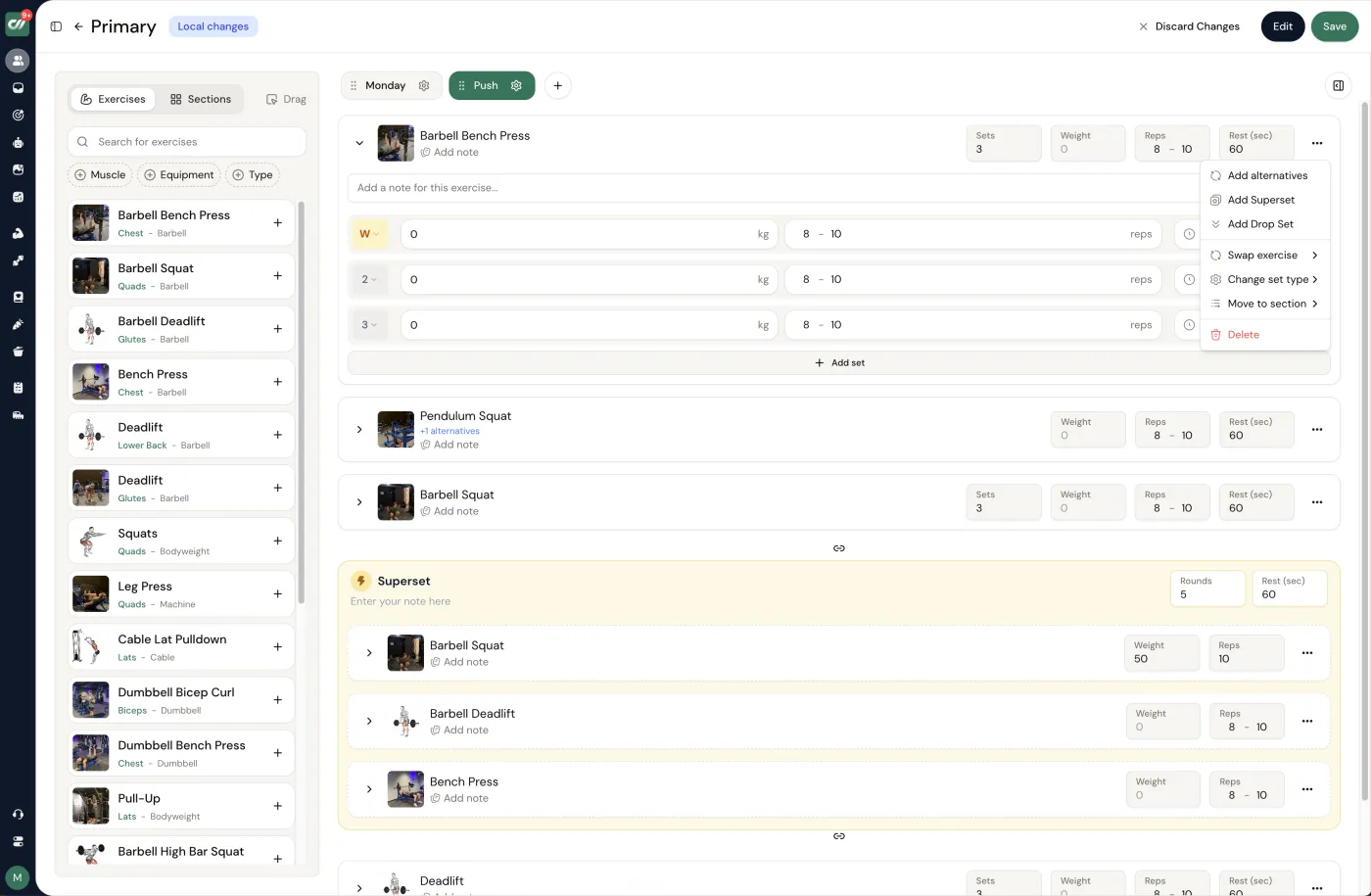
The whole workflow above depends on templates being living, assignable objects, so this is exactly what Coachway's workout builder is for. You build a program once from a library of over 1,800 exercises, save it as a template, and assign it to any client in a couple of clicks - then tailor only their slice and adjust from every check-in without ever rebuilding the plan. Because a template is an object rather than a file, improving it improves your default for everyone you assign it to next. It is built on knowledge from working with 150 online coaches over 6+ years, and pricing is flat: EUR 69 a month with your first 5 clients included, then EUR 9 per additional client, every feature included with no tiers. That matters here specifically - the tool you use to program for twenty clients costs the same to run as the one for five, so scaling your workflow does not scale your software bill into a new plan. The 14-day free trial starts with a card held securely by Stripe and cancels under Billing before it renews, or you can book a demo and see the builder first.
Frequently asked questions about programming for multiple clients.
How do you write workout programs for multiple clients faster?
You stop building every plan from a blank page and start building from a small library of your own templates. The fast workflow has four parts. First, turn the way you already program into a handful of reusable base templates - one per goal and training age you actually coach, such as a three-day full-body for beginners or a four-day upper-lower for intermediate hypertrophy. Second, keep every exercise, set and rep scheme in a structured builder rather than a document, so a template is a living object you assign, not a file you copy and rename. Third, assign the closest template to each new client and spend your time only on the ten to twenty percent that has to change for that person - their equipment, their injury history, their schedule. Fourth, adjust from check-ins by editing the plan in place instead of rewriting it. The template carries the ninety percent that is the same across clients at your level, so your minutes go to the part that is genuinely individual. That is the whole trick: not less personalisation, just no repeated typing of the parts that were never going to differ.
Should every client get a completely custom program built from scratch?
No, and trying to is the main reason coaches cap out early. Two clients with the same goal, similar training age and the same equipment need programs that are ninety percent identical - the same movement patterns, the same progression logic, the same sensible volume. Rebuilding that shared ninety percent by hand for each person is not personalisation, it is retyping. The part that genuinely must be bespoke is the remaining slice: the swap for a cranky shoulder, the session count that fits their week, the lift they can actually load at their gym. Start every client from the template that fits their goal and training age, then spend your judgement on that slice. The client still gets a plan built for them; you just stop paying the blank-page tax on the parts that were always going to be the same.
How many clients can one coach program for?
It depends almost entirely on whether you build from templates or from scratch, because programming time is the input that scales worst. Suppose a fully bespoke plan takes you forty-five minutes: twenty clients is fifteen hours of programming alone before a single check-in is read, and that is the wall most coaches hit. Move to a template-first workflow where assigning and tailoring a plan takes ten minutes, and the same twenty clients cost a little over three hours. The programming stops being the bottleneck, and the ceiling moves to the work that actually should limit you - reading check-ins, replying with judgement, and keeping each person progressing. Programming is not where a coach adds most of their value; it is where a coach most easily wastes their week.
Do workout program templates hurt client results?
Only if the template is where the thinking stops. A template is not a generic plan handed to everyone; it is your own best default for a goal and a training age, captured once so you never rebuild it. The results come from what you do after you assign it: swapping movements for the client's body and equipment, setting the right starting loads, and then adjusting from every check-in. A template that is never edited would indeed under-serve people - but so would a from-scratch plan you were too rushed to revisit because programming ate your week. Done properly, templates improve results, because the time they free up goes back into the individual adjustments that actually move the needle for each client.
What software helps you program for multiple clients at scale?
You want a workout builder that treats programs as reusable, assignable objects rather than documents, with a real exercise library behind it so building and swapping movements is fast. In Coachway you build a program once from a library of over 1,800 exercises, save it as a template, and assign it to any client in a couple of clicks, then tailor only what that person needs and adjust it from their check-ins. Every feature is included at EUR 69 a month for your first 5 clients and EUR 9 per additional client, so the tool that lets you program for twenty clients costs the same to run as the tool for five. The point of the software is not to remove your judgement; it is to remove the retyping so your judgement reaches more people.
Programming faster is one lever on the same problem this whole site keeps circling: how many clients one coach can handle without the quality slipping. Build the plan well once in the single-client build, hold to the programming principles at every size, and let the workout builder software carry the repetition.
Keep reading
all guidesStephanie Buttermore's All In: Recovery From Restriction (Coach Breakdown)
Stephanie Buttermore's All In approach, broken down for coaches: what recovery from chronic under-eating looks like, how to spot the signs in a client, and how to program a recovery phase responsibly - and when to refer out.
Read the guideNatacha Oceane on Why Hard-Working Clients Still Stall (Coach Breakdown)
Natacha Oceane's science-based, myth-busting take on fat loss, muscle gain and performance, broken down for coaches: why effort alone doesn't guarantee results, and how to audit a stalled client instead of adding more work.
Read the guideHampton Liu on Calisthenics Progressions: Bodyweight Ladders for Coaches
Hampton Liu's progression-based calisthenics, broken down for coaches: how his shame-free pushup ladder works, and how to build a bodyweight progression system you can assign and track across a client list.
Read the guideFree tools for this: Warm-Up Set Calculator · Protein Calculator · Weekly Training Volume Calculator
Ready-made template: Workout Program Template
See what Coachway can do for your coaching business
Coachway was built on knowledge from working with 150 online coaches over 6+ years, who all hit the same wall - slow platforms, clunky workflows, wasted hours. Start your 14-day free trial and see what we fixed - the whole platform, no charge today, cancel anytime under Billing.


