


What is a discovery call in coaching? The fit conversation before anyone pays.
Before a client signs up, there is usually one short conversation that decides everything - and most coaches get it wrong by treating it like a sales pitch. A discovery call in coaching is not a hard sell; it is a no-pressure fit-and-qualification chat that filters out the wrong people and makes the right ones feel understood. Here is a plain-English definition, what actually happens on one, how long it runs, and where it fits in the way you get clients.
By Markus Evers · Updated September 2026
definition
A discovery call in coaching is a short, free conversation, usually 15 to 30 minutes, where a prospective client and a coach find out whether they are a good fit before any money changes hands. The coach asks about the goal, what has been tried and what is in the way. It is a fit conversation, not a pitch.
What actually happens on a coaching discovery call?
Strip away the nerves and a discovery call is three simple movements: build a little trust, understand the person, then decide together what happens next. It rarely takes more than 30 minutes when you keep it in that order.
A few minutes of rapport.
You open warm, set the frame - "this is just to see if I'm the right person to help you" - and take the pressure out of the room. A prospect who feels sold to gets guarded, and a guarded person tells you nothing useful. Naming that the call is about fit, not signing up, is what lets the honest conversation happen.
The diagnosis questions.
This is most of the call, and it is where a discovery call earns its name. You ask about the goal behind the goal, what they have already tried, why it stalled and what changing it would mean for them. You are listening for whether their problem is one you genuinely solve - and letting them hear themselves say out loud why now might be the time. Diagnose before you prescribe: the recommendation only lands if it answers what they actually said.
A clear next step.
When there is a real fit, you say so plainly and describe how you would help, then make the invitation to start easy to accept. When there is not, you say that too - a "not yet" or an honest referral protects your time and your reputation. Either way the call ends with a decision, not a vague "let me think about it" that quietly dies in the inbox.
Why a discovery call is not a hard sell.
The word "call" makes coaches brace for a pitch, and that instinct is exactly what tanks conversion. A discovery call and a sales call have opposite centres of gravity: a sales call is built to close, so it pitches first and pushes for a decision; a discovery call is built to qualify, so it listens first and only recommends once a fit is obvious. Spend the time diagnosing and the right people talk themselves into starting; lead with the pitch and the same people go quiet.
That does not mean a discovery call is passive. It still ends with a clear invitation to begin - it just earns that invitation by being useful first. The paradox is that being genuinely willing to say "I'm not the right fit" is what makes prospects trust the yes. If the idea of an invitation without pressure feels uncomfortable, that is a mindset worth working on separately, because the same principle runs through selling coaching without being salesy. A discovery call is also close cousin to the free consultation - the practical trap there is letting it turn into free coaching, which is its own consultation without wasting time problem to solve.
Where does a discovery call sit in how you get clients?
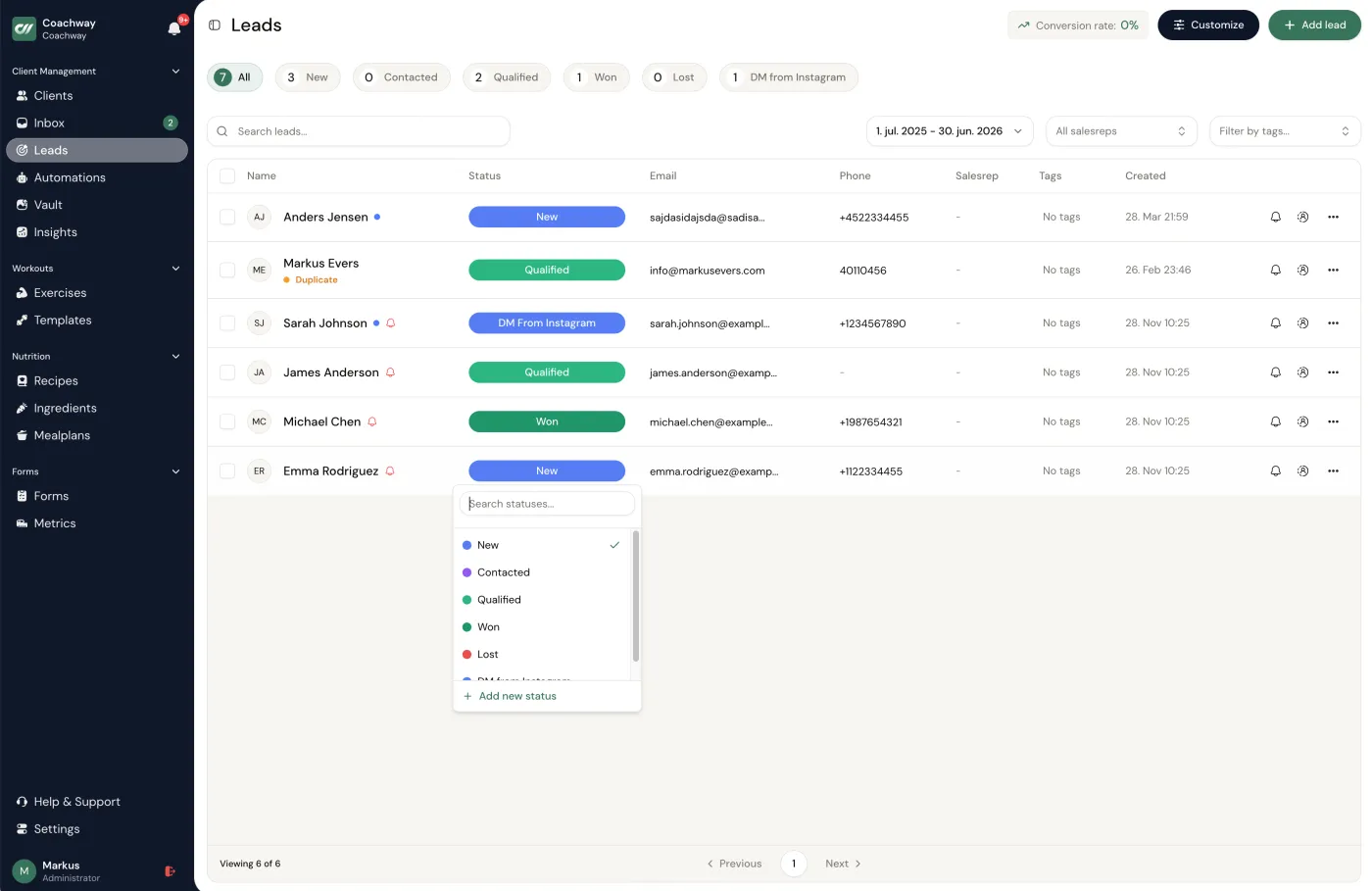
A discovery call is one stage in a pipeline, not the whole thing. A lead comes in, you book the call through a booking link for discovery calls, the call decides fit, and a yes becomes an onboarded client. When those stages live in your head and your inbox, calls get double-booked and warm leads go cold; when they live in one place, you can see who is waiting for a call and who is ready to start. Seeing the numbers helps too - a quick pass through what a discovery call is worth, from your close rate and average client value, shows how many to book each month to hit a revenue goal. Coachway, which we make, gives that a home: an embeddable lead form captures the enquiry with its full source trail, a simple pipeline moves each person from new to contacted to qualified to won, and one click converts a won lead into a client who gets the client app, an onboarding sequence and their subscription. It is built on knowledge from working with 150 online coaches over 6+ years, and it costs EUR 69 a month including your first 5 clients, then EUR 9 per additional client, every feature included. The 14-day free trial starts with a card held by Stripe and cancels under Billing before it renews - or book a demo to see the pipeline first.
Frequently asked questions about discovery calls.
What is a discovery call in coaching?
A discovery call in coaching is a short, free conversation - usually 15 to 30 minutes - where a prospective client and a coach find out whether they are a good fit before any money changes hands. The coach asks about the client's goal, what they have already tried and what is getting in the way; the client gets a feel for how the coach thinks and works. It is a qualification-and-fit conversation, not a sales pitch: the honest outcome of a good discovery call is sometimes yes, sometimes not yet, and sometimes a referral elsewhere. Done well, it filters out the wrong people before they become the wrong clients, and it makes the right people feel understood enough to start.
How long is a coaching discovery call?
Most coaching discovery calls run 15 to 30 minutes. That is long enough to hear the client's goal, understand the real obstacle and decide whether you can genuinely help, but short enough that it does not turn into a free coaching session that gives away the value you are meant to be paid for. Coaches who let discovery calls sprawl to an hour usually find the extra time adds pressure rather than clarity. A tight structure - a few minutes of rapport, the diagnosis questions, then a clear next step - keeps the call useful for both sides and protects your calendar when you are booking several a week.
What is the difference between a discovery call and a sales call?
The intent is different. A sales call exists to close; a discovery call exists to find out whether closing even makes sense. On a discovery call the coach spends most of the time listening and diagnosing, and only describes the offer once it is clear there is a real fit - so the recommendation, when it comes, is specific to what the person actually said. A pure sales call runs the other way: pitch first, handle objections, push for a decision. In practice a good discovery call still ends with a clear invitation to start, but it earns that invitation by being useful first, which is exactly why it converts the right people without feeling salesy.
Should you charge for a discovery call?
Almost always no. The discovery call is your qualification step, and charging for it defeats the purpose: it adds friction for the exact prospects you most want to talk to and shrinks the top of your funnel. The value you protect is not the 20 minutes of the call - it is the coaching itself, which is why the call stays diagnostic rather than turning into a free plan. A short application form before the call does the filtering that a fee is often reaching for, without scaring off good-fit clients. Keep the discovery call free, keep it short, and let the paid relationship start where it should.
Now that the definition is clear, the next step is running one well: the full guide to running a discovery call walks through the rapport-to-fit structure and how to handle "I need to think about it", and it all sits inside the wider job of getting online coaching clients.
Keep reading
all guidesFree trial vs paid trial for online coaching - should you offer either?
Every answer to this question was written for software companies, and coaching is not software: a SaaS trial costs server cents, a coaching trial costs your hours. What each trial model signals, who it attracts, when a free trial genuinely fits (memberships and self-service offers), why a paid trial is really a starter block, and the discovery-call-plus-guarantee play that beats both for 1:1 coaches.
Read the guideNew Year marketing for online fitness coaches - the window opens in October
Every coach knows January is the biggest month of the year. Fewer act on the uncomfortable half of that fact: the January client chooses their coach in November. The month-by-month runway from August to February - offer design, content ramp, waitlist, booked start dates, excellent onboarding, and the February second wave most coaches ignore - plus why resolution clients churn and how to sell the version that stays.
Read the guideLead generation automation for coaches and personal trainers (2026)
How to automate lead capture, qualification, and follow-up as a fitness coach: forms that replace DM chaos, a pipeline with source tracking and statuses, follow-up reminders, and automated onboarding once a lead says yes - plus the parts of selling you should never automate.
Read the guideFree tools for this: Sales Objection Handler · Discovery Call Calculator · Coaching Offer Builder
Ready-made template: Discovery Call Script
See what Coachway can do for your coaching business
Coachway was built on knowledge from working with 150 online coaches over 6+ years, who all hit the same wall - slow platforms, clunky workflows, wasted hours. Start your 14-day free trial and see what we fixed - the whole platform, no charge today, cancel anytime under Billing.


