


A virtual coaching platform is judged on one thing - whether remote coaching still feels personal.
A virtual coaching platform is the software that lets you coach entirely online, with no in-person session doing the heavy lifting. The features lists all look alike; what actually separates them is whether a fully remote client feels coached rather than merely enrolled. This guide covers the three things that create that feeling - async video, a structured check-in rhythm, and a client app the person opens every day - and how Coachway supports coaches who have no in-person touchpoint at all.
By Markus Evers · Updated September 2026
the short version
A virtual coaching platform is the software that carries a coaching relationship when the coach and client never share a room. The plan and the payments are table stakes; the thing that makes remote coaching work is presence at a distance. Three features create it: async video, so the client hears and sees you between sessions instead of only during them; a structured check-in rhythm, so accountability arrives on a schedule rather than when someone remembers; and a client app the client opens daily, so your coaching has one home carrying your plans and messages, not a scatter of emails and DMs. Judge any platform on how those three feel to the client, price it at the client count you expect in a year, and treat live video calls as optional - most fully remote coaching runs on recorded video, not on two calendars meeting.
What does a virtual coaching platform actually have to do?
Start from what is missing. An in-person coach has the gym floor: they see the client walk in, read their mood, correct a lift by touching a bar, and finish with a moment of human contact that no software recreates. A fully virtual coach has none of that. So the platform is not a nice-to-have that tidies the admin - it is the entire surface through which the coaching is felt. If that surface is thin or scattered, the client experiences a plan they bought, not a coach they hired, and thin relationships churn fast no matter how good the programming underneath is.
That reframes the shortlist. Every online fitness coaching platform can store a workout, take a payment and send a message; those are the price of entry, and comparing them line by line tells you very little. The question that separates a virtual coaching platform worth paying for is narrower and more human: across a full client list, does it make it easy to stay reliably, personally present with people you will never meet? Everything below is a piece of that answer. If you want the wider software picture first - workouts, nutrition, payments and migration - the online coaching platform guide maps the whole stack; this page stays on the part that makes remote coaching feel personal.
The three features that make fully remote coaching feel personal.
1. Async video - presence without a shared calendar.
The single biggest gap in remote coaching is that the client cannot see or hear you, so the plan feels authored by nobody. Async video closes it without the cost of live calls: a thirty-second reply to this week's check-in, a filmed correction on a lift, a voice note that tells them you noticed the good week. It scales in a way live calls never will - you record once, on your schedule, and it lands whether the client is awake or asleep two time zones away. A platform that makes recording and sending a personal video message a two-tap habit will beat one that hides it three menus deep, because the feature only helps if you actually use it every week. If live calls are central to your model, weigh a dedicated video coaching setup separately - most one-to-many coaches find recorded video is the format clients actually watch.
2. Structured check-ins - accountability on a schedule.
In person, accountability is automatic: the client shows up or they do not, and you know either way. Remotely, it has to be built. A structured check-in - a form the client fills in each week with ratings, measurements, progress photos and a few honest sentences - is the heartbeat of virtual coaching, and the review of it is where the coaching actually happens. The platform should let you build the form to your own method, remind the client without you chasing, and put this week's answers side by side with their photos, weight trend and training log so you can respond to a person rather than a spreadsheet. That review is your best chance each week to be visibly, specifically present, which is exactly what keeps a remote client from drifting - the mechanics of that accountability rhythm are a discipline in their own right.
3. A client app - a daily home for the coaching.
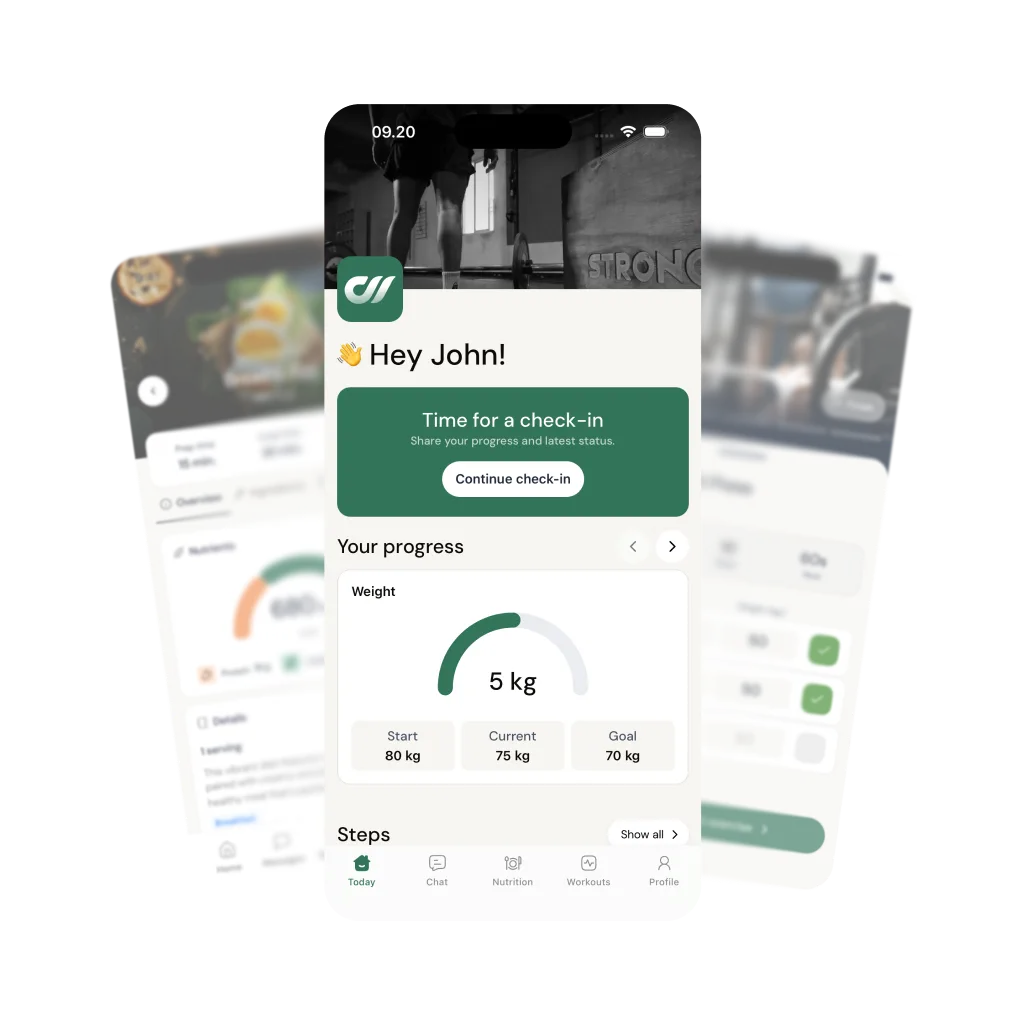
Async video and check-ins need somewhere to live, and if that somewhere is a mix of email, a spreadsheet link and a group chat, the coaching feels borrowed and forgettable. A client app is the fix: one place the client opens on their phone that greets them by name, shows the plan for today, holds the chat and the nutrition and the workouts, and prompts the next check-in. It is the difference between a client who bought a document and a client who has a coach in their pocket. The daily surface matters more than it looks - when it carries your plans and your voice rather than a pile of links, the relationship reads as a real coaching business, which is what earns renewals and referrals from someone you will never shake hands with.
What a virtual coaching platform has to replace from in-person coaching.
The clearest way to judge a virtual coaching platform is to line up what an in-person coach gets for free against what the software has to reproduce at a distance - and what it therefore has to make effortless. If you are weighing specific named tools rather than the delivery model itself, the roundup of the best online coaching platforms compares them side by side; the table below is the lens to read any of them through.
| The in-person anchor | What replaces it remotely | What the platform must make easy |
|---|---|---|
| Reading the room | A weekly written check-in with ratings, measurements and a few honest sentences | A check-in form you can shape to your own method |
| Correcting a lift by hand | A filmed form correction sent as async video | Recording and sending a video in a couple of taps |
| Presence between sessions | A returning voice or video note that shows you actually read the check-in | Async messages that reach the client on their own schedule |
| The gym as a shared space | One client app the client opens every day | Your own programs, check-ins and messages in one place |
| The relationship itself | Reliable presence in small moments, on a schedule | Reminders and automations so nobody quietly drifts |
How should a fully remote coach choose between platforms?
Feature-count comparisons reward the busiest brochure, not the best client experience. Judge the shortlist from the client's phone instead, and price it honestly for the future. Four checks do most of the work:
Open the client app yourself, first.
During a trial, set up a fake client and live in that app for a day. Is the plan obvious? Does a video message feel personal or clunky? Would you, as the client, open this daily? The coach dashboard sells you; the client app is what actually retains people. If a platform will not let you see the client side before you pay, that is an answer in itself.
Check whether the personal layer is easy or buried.
Recording a video, writing a check-in reply, sending a voice note - the human moves have to be fast, or you will stop doing them by the twentieth client. A platform that makes presence a two-tap habit beats one where it is technically possible but practically a chore. Test the friction, not the feature list.
Price it at next year's client count.
Per-client pricing and feature tiers are where a cheap headline plan becomes expensive. Work out what the tool costs at the client count you expect in twelve months, with the features you will actually need unlocked, and compare on that total - not on the entry price that only covers your first handful of clients.
Match it to how remote you really are.
A coach who still sees clients in person occasionally has different needs from one who has never met a single client. The more fully virtual you are, the more the async video, check-in and client-app trio carries the entire relationship - and the more those three deserve to outweigh everything else on the list. The rest of the trade-offs are laid out in the guide on how to choose an online coaching platform.
How Coachway supports coaches with no in-person touchpoint.
Coachway is built for exactly this coach: the one whose whole relationship with a client happens through a screen. The personal layer is the point, not an add-on. You record video and audio and send it to the client through chat or an automated sequence, so a returning client hears from you between check-ins, not only when they book something. The check-in form builder is yours to shape - ratings, measurements, progress photos, custom metrics - and the review puts this week's answers beside the client's photos, weight trend and training log on one screen. And the client app is included on every plan, available on iOS and Android in six languages - English, Danish, Norwegian, Swedish, Finnish and German, each client picking their own - so a fully remote client anywhere in that range opens your plans, your check-ins and your messages in one place, in their own language. The coach-facing dashboard where you run all of it is in English.
Underneath the personal layer sits the rest of the stack a virtual coach needs in one place: a workout builder with 1,800+ exercises to build from, a nutrition side backed by a food database of 3.7 million foods with barcode scanning, and payments that settle in your own Stripe account so Coachway never holds your money. It is one price - EUR 69 a month with your first 5 clients included and EUR 9 per additional client, every feature in, no tiers to unlock. Coachway is built on knowledge from working with 150 online coaches over 6+ years, which is why the client experience, not the feature count, is where the design effort went. The 14-day free trial lets you set up a real client app and feel the async-video and check-in loop yourself before you decide; it starts with a card held securely by Stripe, EUR 0 is charged today, and you cancel under Billing before it renews. If you would rather see the client side walked through first, book a demo.
Frequently asked questions about virtual coaching platforms.
What is a virtual coaching platform?
A virtual coaching platform is the software a coach uses to deliver coaching entirely online, with no in-person session as the anchor. It carries the whole relationship remotely: the programme or plan the client follows, the check-ins that create accountability, the video and messages the coach records between check-ins, and a client-facing app where all of it lands in one place. Where an in-person coach relies on the gym floor for presence and correction, a virtual coach relies on the platform to reproduce that presence at a distance - which is why the good ones are judged less on how many features they list and more on whether a fully remote client still feels genuinely coached rather than merely subscribed to a plan.
Do you need video calls to run a virtual coaching platform?
No. Live video calls are the obvious way to feel present, but they are the hardest to scale and the easiest for a client to miss. Most fully remote coaching runs on async video instead: a short recorded message reviewing this week's check-in, a filmed form correction, a voice note that lands while the coach and client are in different time zones. Async keeps the personal touch without forcing two calendars to meet, and it compounds - a returning client hears from you between sessions, not only during them. Coachway itself has no built-in live video-call tool; presence there comes from recorded video and audio sent to the client through chat and automated sequences, which for most one-to-many coaches is the format that actually gets watched.
What is the difference between a virtual coaching platform and an online coaching platform?
In practice they describe the same category of software, and most tools answer to both names. Any difference is one of emphasis rather than product. "Online coaching platform" is the broad term for the software that runs a remote coaching business. "Virtual coaching platform" leans on the delivery side of that - the part that has to make coaching feel real when there is no shared room, no in-person correction and no handshake at the door. If you are shortlisting tools, treat the two searches as the same shortlist and judge each on the same things: how the client experiences it day to day, how the check-in rhythm works, and how naturally you can add a personal, human layer on top of the plan.
Is a virtual coaching platform the same as an online fitness coaching platform?
For a fitness coach, effectively yes - an online fitness coaching platform is a virtual coaching platform pointed at the fitness niche, so the same software runs a remote personal-training, nutrition or hybrid business. The label only narrows the category: online fitness coaching platforms are expected to carry the fitness-specific tools a remote coach needs beside the presence layer - a workout builder, a food database, progress-photo check-ins - rather than generic session booking. If you are comparing online fitness coach platforms, judge them the way you would any virtual platform: how the client app feels day to day, whether the check-in rhythm holds without you chasing, and how easily you add a personal video layer on top of the plan. An all-in-one coaching platform that keeps workouts, nutrition, check-ins and payments in one place is usually the sensible shortlist to start from.
How much does a virtual coaching platform cost?
Purpose-built coaching platforms sit roughly in the tens of euros, dollars or pounds per month, usually rising with your client count or locked behind feature tiers. Coachway is EUR 69 a month with your first 5 clients included and EUR 9 for each additional client, and every feature is in that price - there are no tiers or add-on modules to unlock, so the client app, check-ins, nutrition and payments are all present from the first client. A 14-day free trial lets you build a real client experience before you commit; it starts with a card held securely by Stripe, nothing is charged on day one, and you can cancel under Billing before it renews. When you compare, price the tool at the client count you actually expect in a year, not the count you have this week, because per-client pricing is where a cheap headline plan quietly becomes an expensive one.
Can fully remote coaching feel as personal as in-person?
It can feel personal in a different way, and often a more consistent one. In-person coaching gives you an hour of intense attention and then silence until the next session; done well, virtual coaching gives you a thinner but continuous thread - a check-in the client fills in each week, a video reply that shows you actually read it, an app that carries your plan and greets them by name every day they open it. The personal feeling comes from being reliably present in the small moments rather than dramatically present for one hour, which is a fair trade for most clients and a better one for anyone whose life does not fit a fixed weekly slot. The platform's job is to make that steady presence easy enough that you keep it up across a full client list, not just for your favourite three.
What features should a virtual coaching platform have?
The features that separate a virtual coaching platform from a generic fitness app are the ones that carry presence at a distance. Prioritise four. A client app the person opens daily, carrying your own programs, check-ins and messages, so the coaching has one home rather than a scatter of tools. Async video and voice, so you stay visibly present between sessions without a live call. A structured, customisable check-in form, so accountability arrives on a schedule and the review lands beside the client's photos, weight trend and training log. And automated sequences that welcome, remind and re-engage clients so nobody quietly drifts. Beneath those sit the table-stakes tools every remote coach still needs in one place - a workout builder, a nutrition and meal-planning side, and payments that settle to your own account. Feature-count comparisons reward the busiest brochure; judge these few on how they feel from the client's phone instead.
What is the best virtual coaching platform for a fully remote coach?
There is no single best platform for everyone - the right one depends on how remote you actually are, whether live calls are central to your model, and the client count you will reach in a year rather than this week. A coach who still meets clients in person occasionally can lean on a lighter tool; a coach who never meets a client needs the async-video, check-in and client-app trio to carry the whole relationship, and should weight those three above everything else on the list. The honest way to decide is to run a free trial, set up a test client and live in the client app for a day: the platform that makes staying personally present a two-tap habit is the best one for you. Coachway is built specifically for the fully remote case, so a coach whose model is mostly live one-to-one calls may be better served by a video-first tool, while a coach delivering async programmes to a full client list is squarely who it is designed for.
A virtual coaching platform is only as good as the client's daily experience of it. For the full software picture behind the delivery, read the online coaching platform guide; to shortlist against your own model, use how to choose an online coaching platform; and to sharpen the check-in rhythm that keeps remote clients present, see keeping remote clients accountable. If you program strength or CrossFit athletes from a distance, see what CrossFit and strength coaches use to program remote athletes.
Keep reading
all guidesBest cycling coaching software: 5 tools for coaches (2026)
Coachway runs the whole remote-coaching relationship, TrainingPeaks owns the power and FTP analysis, and TrainerRoad, Final Surge and Join round out both categories - compared with every price verified.
Read the guideBest triathlon coaching software: 5 tools for coaches (2026)
A training-analysis platform like TrainingPeaks leads if you live in the swim, bike and run load numbers, while Coachway is the strongest all-in-one for the coaching business around those athletes. 5 tools compared, every price verified.
Read the guideWhite-Label Fitness App: Real Cost and Who Needs One (2026)
What a white-label fitness app really is, what a standalone own-listing app costs and its app-store overhead, and an honest framework for which coaches actually need one.
Read the guideFree tools for this: Coaching Profit Calculator · Client Capacity Calculator · Coaching Rate Calculator
See what Coachway can do for your coaching business
Coachway was built on knowledge from working with 150 online coaches over 6+ years, who all hit the same wall - slow platforms, clunky workflows, wasted hours. Start your 14-day free trial and see what we fixed - the whole platform, no charge today, cancel anytime under Billing.


