


The best triathlon coaching software, ranked by the job you hire it for in 2026.
For the coaching business around your triathletes, Coachway is our pick: nutrition, check-ins, client chat and payments around each athlete in one tab instead of six, at EUR 69 per month for up to 5 active clients plus EUR 9 per additional client with every feature included and coaches keeping their own Stripe. The honest caveat is that triathlon coaching splits in two - Coachway runs the business, but the structured swim, bike and run prescription and the training-load math live in a training-analysis platform, where TrainingPeaks is the reference, TriDot adds an AI optimisation engine, and Final Surge is a lighter endurance calendar. Training Tilt is the other business-first option. Most triathlon coaches run one tool from each side, because these are two genuinely different jobs. We compared 5 tools across both, and we say plainly which category each belongs to.
By Markus Evers · Updated October 2026
How this comparison is made: we check every competitor's pricing and features against their live websites and re-verify them on a recurring basis. We build Coachway, so we flag it wherever it appears, we credit real competitor strengths, and we say who each platform fits better than us. Browse all platform comparisons.
If the coaching business around your triathletes - nutrition, payments, check-ins, the client app - is what you want in one place, see the whole workflow in one tab first.
No charge today - cancel anytime under Billing.the short version
Triathlon coaching software is two purchases. For prescribing the swim, bike and run and the training-load math, TrainingPeaks is the reference, with TriDot and Final Surge as alternatives. For the business around each athlete (nutrition, check-ins, payments through your own Stripe), Coachway, the platform we make, leads, and Training Tilt is the other option. Most coaches run one of each.
What is triathlon coaching software, and which tools count?
Two different purchases: an endurance-training platform that ingests swim, bike and run data and plans by zones (TrainingPeaks, TriDot, Final Surge), and a coaching platform that runs the client relationship, the strength work, nutrition, check-ins and billing (Coachway, Training Tilt). The five tools below are compared on that split.
Most lists in this niche blur the two, and that is how a coach ends up paying for a fitness-fatigue dashboard they never open, or a relationship platform that cannot do the load math they actually needed. Split them cleanly before you shortlist:
Job 1: prescribe and analyse the training
Your work is the swim, the bike and the run: structured sessions pushed to a watch, device data pulled back, training-stress scoring, and a fitness-and-fatigue view across a build and a taper. You need a training-analysis platform built around device data. TrainingPeaks is the reference tool; TriDot and Final Surge sit closer to it than to a relationship platform.
Job 2: run the coaching business
Your work is delivering the relationship: managing every athlete in one place, coaching fuelling and nutrition, carrying the weekly check-in, keeping athletes on one client app, and getting paid. You need coaching-business software: a client list, nutrition, forms, messaging and per-client billing. Coachway and Training Tilt live here.
Plenty of triathlon coaches are both buyers at once - an analysis tool for the prescription plus a business platform for delivery and billing. That is not tool sprawl; it is two genuinely different jobs. If your athletes are runners first rather than three-sport triathletes, our comparison of running coaching software covers that narrower case, and if you blend disciplines or in-person work, hybrid coaching software is the closer fit.
What triathlon coaches need that a generic platform misses.
Triathlon has demands a general strength-and-nutrition app was never built for, and no single tool nails all of them - which is exactly why so many coaches run two. These five points decide fit, and they double as your buying checklist. Test each before you commit.
- Three sports in one plan. The swim, the bike and the run each need structured sessions - intervals by pace, power or effort - inside one weekly view. A conventional sets-and-reps builder cannot express a threshold bike set or a pace-based brick, so this is a training-analysis platform's core job. For cyclists only, see cycling coaching software.
- Device data flowing back. Triathletes train alone across three disciplines, so the sessions have to come back to you: power on the bike, pace on the run, heart rate throughout. Be precise about how - native two-way device sync, a phone health platform, or manual logging are three different answers, and it changes your weekly workflow.
- Load management across a build. Volume and intensity climb across a base block, a build and a taper, and mismanaged load is where injuries and flat race days come from. A training-stress score and a fitness-fatigue view make that visible; a relationship platform does not.
- Fuelling and nutrition. Endurance results are decided as much at the aid station as on the bike, so in-depth nutrition - meal plans and food logging, not a macro number in a note - is a real coaching surface. This is where a nutrition-first coaching platform pulls ahead of an analysis tool. For the fuelling itself, our breakdown of Precision Fuel & Hydration is the carbohydrate-per-hour reference endurance coaches lean on.
- The client business. Whose account collects the money, is the weekly check-in in the same record as the plan, and does the athlete open one app that carries your plans, check-ins and messages? If delivery, nutrition, billing and check-ins live in one place, you stop tab-hopping between an analysis tool, a spreadsheet and a chat thread.
One honest note on data, because it is where these tools differ most. Coachway does not build structured swim, bike and run sessions and does not model training load. What it does is import each athlete's completed runs and rides - plus daily steps - from Garmin, Apple Health or any watch, so the finished session lands in the client record for the coaching conversation. It is read-only import, not a two-way workout push, and it does not carry swims or a training-stress chart; that analysis lives in a platform like TrainingPeaks. Our guide to the best coaching apps for online coaches covers where a live feed helps and where a completed-session view is enough.
The 5 triathlon tools, compared.
| Tool | Category | Best for | Price signal |
|---|---|---|---|
| Coachway | Coaching-business platform | The business around triathletes: nutrition, payments, check-ins, client app in 6 languages | EUR 69/month up to 5 clients, then EUR 9 per client |
| TrainingPeaks | Training analysis | Structured swim, bike and run prescription and training-load analysis | Coach Edition from USD 21.99/month plus per-athlete fees |
| TriDot | AI training engine | Automated multisport training optimisation for coaches and athletes | Athlete plans USD 14.99 to 249/month; coach program see tridot.com |
| Training Tilt | Coaching-business platform | A branded site, payments and plans in one business toolkit | From USD 25/month; online store adds 3% per transaction |
| Final Surge | Endurance platform | A pace-and-power endurance calendar with a free athlete tier | Free athlete tier; paid coach plans see finalsurge.com |
Pricing and feature tiers change often - always confirm current rates on each provider's own pricing page. Where we could not verify a coach-tier figure today, we say "see the domain" rather than guess. The full breakdown is below.
01 · best for the coaching business
Coachway
Coachway is the platform we make, so here is the house view given straight: it leads for the triathlon coach whose product is the relationship, not the load analytics. Manage every athlete in one client list, coach nutrition in depth with meal plans and food logging - the fuelling side endurance athletes so often get wrong - carry the weekly review on a form, and bill through your own Stripe checkout. The athlete trains from the client app in their own language, since it runs in 6 languages while you coach from an English dashboard, and their completed runs and rides sync in automatically from Garmin, Apple Health or any watch, with daily steps, so Saturday's long ride is in the client record before you open Monday's check-in. Everything around one athlete sits in one tab, not six.
The trade-off: Coachway is a coaching-business platform, not a training-analysis tool. There is no structured multisport workout builder, no TSS, power or pace analytics, no fitness-fatigue chart, and no two-way workout push to Garmin. Activity sync is import only - completed runs and rides plus steps, not swims and not a live device feed. If your method lives in the load math and the structured build, pair Coachway with TrainingPeaks or TriDot and let each do the job it is best at.
The honest test is running one real athlete week - the nutrition, a check-in, the completed ride landing back - or book a 15-minute demo to see the client record on your own athletes.
No charge today - cancel anytime under Billing.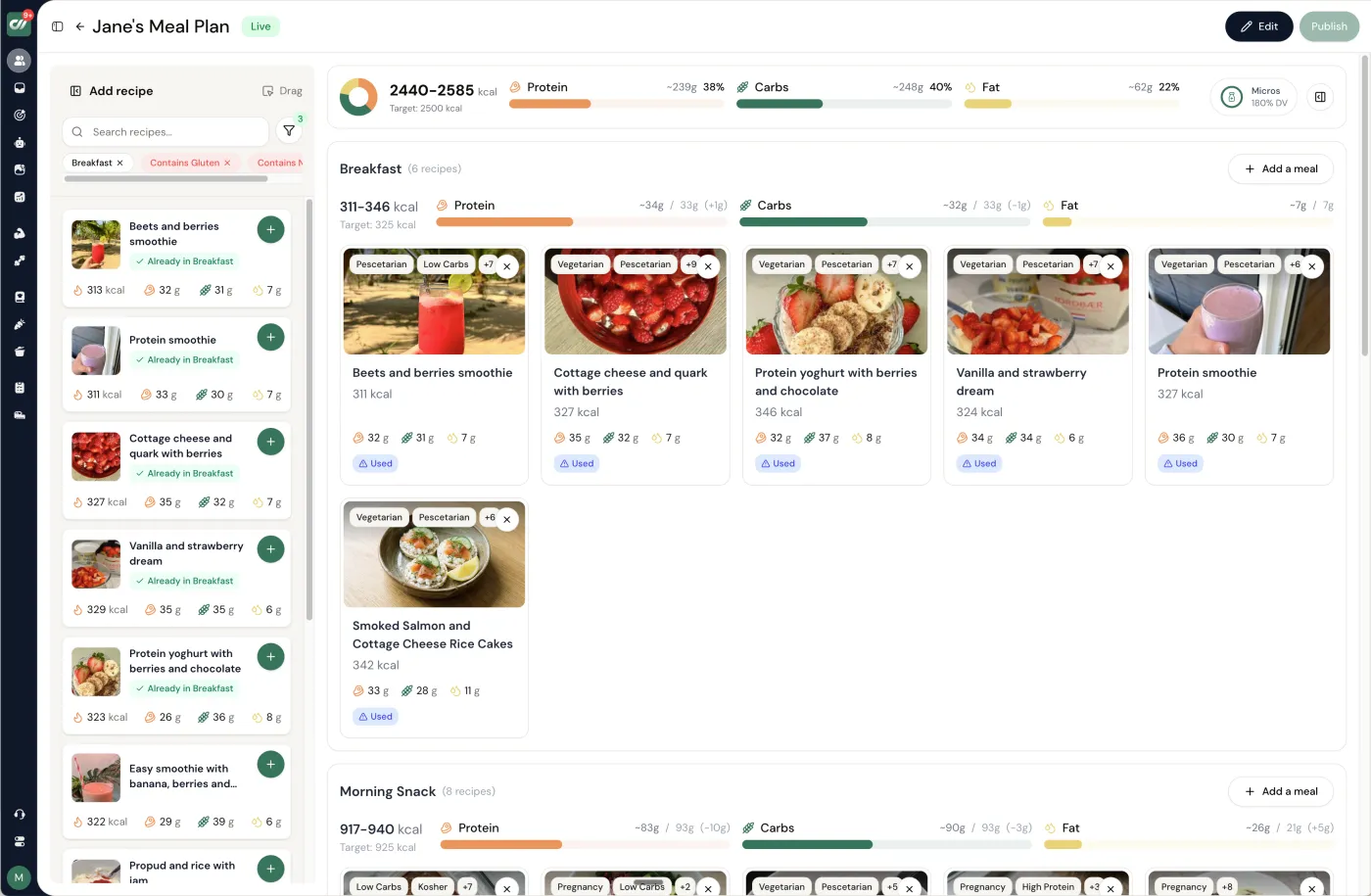
02 · best for multisport training analysis
TrainingPeaks
TrainingPeaks is the reference platform for triathlon coaches who live in the training-load numbers. Structured swim, bike and run workouts push to the athlete's watch, sessions sync back from Garmin, Wahoo, power meters and more, and the data feeds training-stress scoring and a fitness-and-fatigue view that many triathlon coaches build their entire method around. If your coaching decisions come from long-term load trends and post-session analysis, this is the category leader, and it is genuinely deep at that job.
The trade-off: it is built around the numbers, not the whole client business. Native meal planning, food logging, weekly check-in forms and per-client billing through your own processor are lighter than an all-in-one coaching platform, so coaches who need the relationship side too often run it alongside one.
03 · ai-driven multisport training engine
TriDot
TriDot puts an AI optimisation engine at the center of triathlon training. It ingests an athlete's data and adjusts the swim, bike and run prescription automatically, with race-specific analytics on top. It is athlete-facing first, sold as self-serve training subscriptions, and it also runs a TriDot for Coaches program where a coach applies that engine to their own athletes. If you would rather the load math be automated than hand-built, it is a strong multisport engine.
The trade-off: it is a training engine, not a coaching-business platform. The relationship layer - in-depth nutrition, weekly check-ins, payments through your own processor - sits outside its core, and the published prices are athlete subscriptions rather than a coach-business seat, so confirm how the coach program is priced before you build on it.
04 · coaching-business platform for endurance coaches
Training Tilt
Training Tilt sits on the business side with Coachway. It is a build-your-own coaching business toolkit - a website and landing pages, client payments and an online store, forms, a contact database, iOS and Android apps, plus training planning and a workout library. Endurance coaches choose it when they want their brand, their site and their billing under one roof rather than a training-analysis suite, and it is a fair fit for a triathlon coach who values owning the storefront.
The trade-off: the training-analysis depth is lighter than a TrainingPeaks, and the nutrition side is thinner than a nutrition-first coaching platform, so a coach whose method leans on deep load modelling or in-depth meal planning will feel those edges. It is the business layer, competent at planning, not a substitute for a dedicated analysis engine.
05 · endurance planning with a free athlete tier
Final Surge
Final Surge is a well-liked endurance platform, popular partly because individual athletes use a free account with full features while coaches layer paid plans on top. It handles run, bike and multisport planning, syncs from Garmin, Apple Watch, Strava, Polar, Stryd and more, and gives a clean calendar and a workout builder. For a triathlon coach who wants a familiar endurance calendar without the full weight of an analysis suite, it earns a shortlist spot.
The trade-off: it is an endurance planning tool more than a full coaching business. Integrated nutrition coaching, weekly check-ins, and payments through your own processor are not its center of gravity, so confirm how the client-business side fits your model before switching.
When a triathlon coach needs a business layer.
Almost every triathlon coach starts with a training-analysis platform for the swim, bike and run and improvises the rest - the plan in one tool, the invoice in another, the check-in in a chat thread, the fuelling advice in a document nobody reopens. It holds for the first handful of athletes, which is exactly why so many coaches never fix it. Then the admin compounds: chasing payments, retyping the same nutrition guidance, and hunting last week's check-in across three tools that never talk.
The moment to add a coaching-business platform is usually the same for everyone - when the admin of running your client list starts eating the time you should spend coaching it. A business layer earns its place when it collapses client management, nutrition, check-ins and billing into one record, so athlete number 40 does not multiply the tab-hopping. A free tool like our race time predictor pulls its weight here too, doubling as a lead magnet - a triathlete who books a goal race with your predictor is a warm conversation waiting to happen. Keep the analysis tool for the load math, and let the business layer carry everything around it.
Pick by your model, not the marketing.
- Your coaching decisions come from training-stress scores and fitness-fatigue trends across three sports. TrainingPeaks owns that analysis, and many coaches pair it with a business platform for delivery and billing.
- You want the multisport load math automated by an AI engine. TriDot, especially if your athletes are comfortable in a self-serve training platform.
- You want a branded site, an online store and plans in one business toolkit. Training Tilt, which owns the storefront side of a coaching business.
- You want a pace-and-power endurance calendar with a free option for athletes. Final Surge.
- You run the coaching business around triathletes and want nutrition, check-ins, payments and a client app in one place. Coachway covers that whole relationship, with completed runs and rides syncing in and billing through your own Stripe.
- You are both buyers at once. Run one analysis tool plus one business platform. That is the normal triathlon-coaching setup, not a compromise.
If the business side of that list is where your time goes, the fastest way to settle it is running one real athlete week for one real athlete.
No charge today - cancel anytime under Billing.Frequently asked.
What is the best triathlon coaching software?
For the coaching business around your triathletes, Coachway is the pick: it keeps in-depth nutrition, check-ins, client chat and payments around each athlete in one tab instead of six, at EUR 69 per month for up to 5 active clients plus EUR 9 per additional client with every feature included and coaches keeping their own Stripe. Be clear-eyed, though, that "triathlon coaching software" is really two categories. If your work is prescribing the swim, the bike and the run and living in the training-load numbers, a training-analysis platform leads: TrainingPeaks is the reference tool, TriDot adds an AI optimisation engine, and Final Surge is a lighter endurance calendar with a free athlete tier, and Training Tilt is the other business-first option alongside Coachway. Most triathlon coaches run one tool from each side, because these are two genuinely different jobs.
Does Coachway build swim, bike and run workouts or push them to Garmin?
No, and it is important to be clear about that. Coachway is a coaching-business platform, not a training-analysis tool. It does not build structured multisport workouts, it has no TSS, power or pace analytics and no fitness-fatigue chart, and it does not push workouts two-way to a Garmin device. What it does is manage the client relationship: nutrition coaching with meal plans and food logging, weekly check-ins, payments through your own Stripe, and a client app in six languages. For the structured swim, bike and run prescription and the load math, pair Coachway with a training-analysis platform like TrainingPeaks or TriDot and let each do the job it is best at.
Can Coachway import a triathlete's Garmin or Apple Watch activity?
Yes, within a defined scope. Coachway imports completed runs, rides and walks automatically from Garmin, Apple Health and any watch, plus daily steps, so a Saturday long ride lands in the client's record before you open Monday's check-in. It is activity import and it is read-only: it shows you what the athlete actually did, not a live device feed, not a two-way workout push, and not power or pace analytics. Swims are not part of the activity-import line, so treat the completed run and ride as the signal Coachway carries and keep the structured session builder on your analysis platform.
How is a coaching-business platform different from a training-analysis tool like TrainingPeaks?
They solve two different problems. A training-analysis platform is built around the numbers off the devices: training stress, fitness-and-fatigue curves, structured swim, bike and run workouts you push to a watch and analyse after the fact. A coaching-business platform is built around the relationship: managing every athlete in one place, coaching nutrition, carrying the weekly check-in, keeping athletes on one client app, and billing them. Many triathlon coaches are both buyers at once - an analysis tool for the prescription and a business platform for delivery and payments. Coachway sits firmly on the coaching-business side.
How much does triathlon coaching software cost?
The two categories price differently. Coaching-business platforms price per client: Coachway runs EUR 69 per month for up to 5 clients, then EUR 9 per additional client, with every feature included and a 14-day free trial that asks for a card. Training-analysis tools price by athlete count or subscription: TrainingPeaks Coach Edition starts at USD 21.99 per month plus about USD 9 for each Premium athlete you cover, TriDot's athlete plans run from USD 14.99 to 249 per month, and Training Tilt starts at USD 25 per month. Confirm current rates on each vendor's own page, and run the numbers at the athlete count you are aiming for, not the one you have today.
Is there a swimming coach app or swim coaching software for online coaches?
The swim-native tools are built for teams and the pool deck: SwimTopia and Commit Swimming handle squad management, meet entries and pace-clock sets, while MySwimPro is a consumer training app for individual swimmers. None of those is a 1:1 online-coaching business tool. For that side - managing each athlete, coaching nutrition, carrying the weekly check-in, taking payment through your own Stripe and keeping clients on one client app - Coachway does the same job it does for triathletes. Remember its activity import covers completed runs and rides, not swims, so pair it with a swim-native tool for the pool work.
Should a triathlete get a triathlon coach or app?
For most serious triathletes the honest answer to triathlon coach or app is both, because each solves a different problem. An app - TriDot, TrainingPeaks or Final Surge - tracks the swim, bike and run numbers and the training load automatically, which carries an athlete a long way on its own. A human coach adds what software cannot: reading a bad week, adjusting the taper, coaching fuelling and holding the athlete accountable. So the practical setup is an app for the daily data and a coach for the judgment around it. Coachway is the platform a coach runs that human side on - nutrition, check-ins and payments in one place.
Triathlon app vs coach vs training plan: what is the difference?
Triathlon app vs coach vs training plan comes down to how much each one adapts to you. A training plan is a fixed schedule - the same swim, bike and run sessions whether your week went well or badly. An app such as TrainingPeaks or TriDot adds live data and load tracking, adjusting the numbers as completed sessions sync back from your watch. A coach adds the human layer over the top: reading that data, changing the plan, coaching nutrition and keeping you accountable. Plenty of triathletes stack all three - a plan inside an app, overseen by a coach - and the coach runs the relationship on a platform like Coachway.
What does it take to deliver the best online triathlon coaching?
The best online triathlon coaching almost always runs on two tools rather than one, because the job genuinely splits in two. You need a training-analysis platform - TrainingPeaks or TriDot - for the structured swim, bike and run and the load math, and a coaching-business platform for the relationship: managing every athlete, coaching nutrition, carrying the weekly check-in and getting paid. Forcing a single tool to do both is where online triathlon coaching gets thin. Coachway runs the business half - nutrition, check-ins, completed runs and rides syncing in, and billing through your own Stripe - paired with whichever analysis tool handles your numbers.
What is the best triathlon coaching software?
It depends which of the two jobs you are buying: for endurance planning from device data, TrainingPeaks is the established pick with TriDot, Training Tilt and Final Surge as the alternatives compared here; for the client relationship around the training, the strength sessions, nutrition, check-ins and billing, Coachway. The comparison on this page scores the five on both jobs so a coach can see which pair fits.
Keep reading
all guidesSports coaching software: pick by the sport you coach (2026)
There is no single best sports coaching platform, because the unit you program in decides the tool: percentages of 1RM for strength, pace for running, power for cycling, macros for physique. Seven sports compared, and an honest line on where squad management is a different category entirely.
Read the guideBest running coaching software: 5 tools for coaches (2026)
What running coaches actually need: pace-based programming, mileage progression, and honest talk about watch data. TrainingPeaks, Final Surge, VDOT O2, Trainerize, and Coachway compared.
Read the guideHybrid coaching software: 5 tools compared (2026)
One client record across in-person sessions and online weeks, hybrid package billing, and the platforms that handle both sides without duct tape.
Read the guideBest Coaching Apps for Online Coaches (14 Picks, 2026)
The best coaching apps for online fitness and nutrition coaches in 2026, compared on features, branded client app, payments, and who each one fits.
Read the guideFree tools for this: Race Time Predictor · Beep Test Calculator · Running Pace Calculator
See how Coachway runs the business side of your triathlon coaching
Nutrition in depth, completed runs and rides syncing in through the phone's health platform, check-ins, and billing through your own Stripe - everything around one athlete in one tab, paired with whichever analysis tool handles your load math. Start the 14-day free trial and run a real athlete week: no charge today, cancel anytime under Billing.


