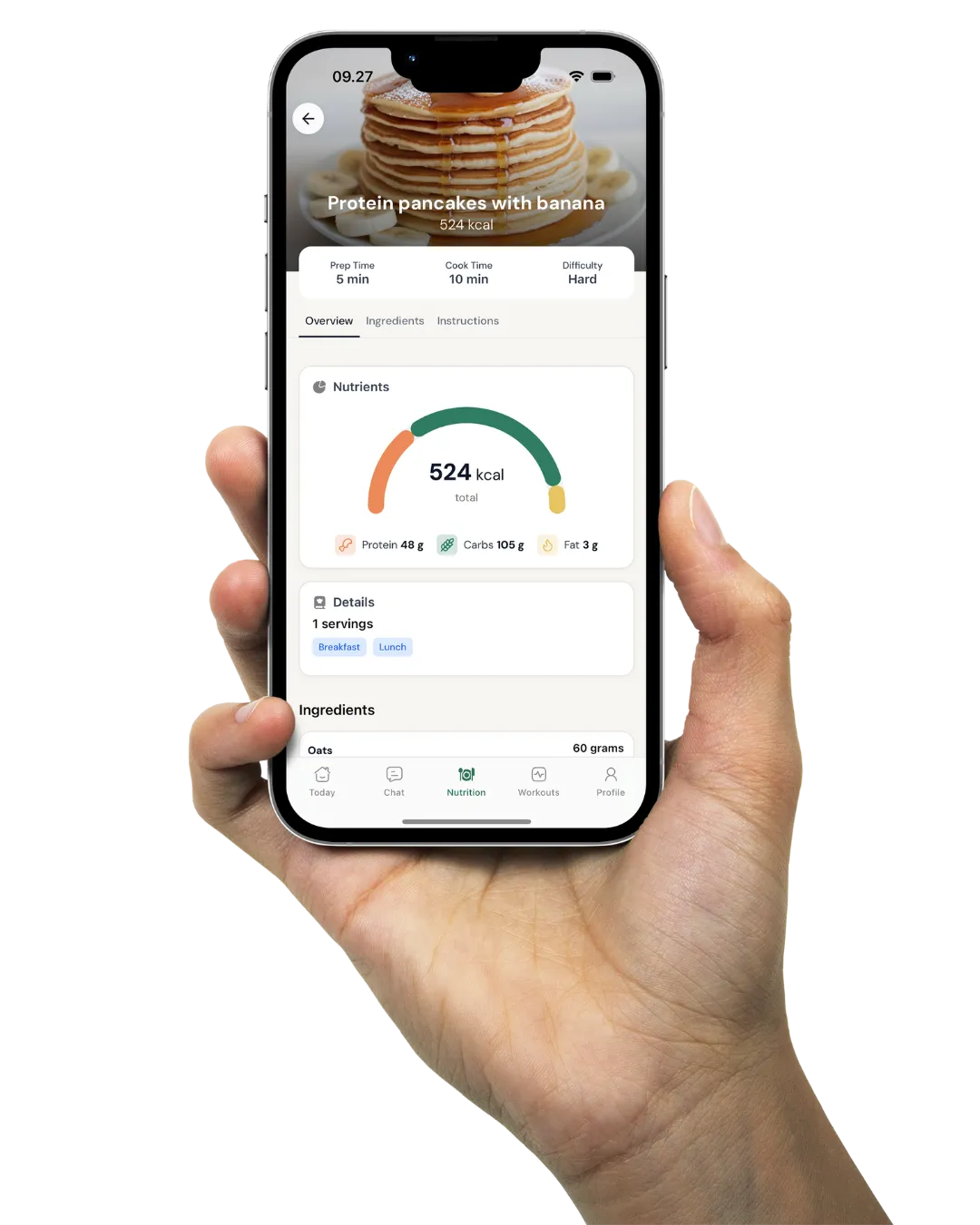
White-label fitness app: what it really costs, and who actually needs one.
A white-label fitness app is a coaching platform's client app published as a standalone app under your own name in the App Store and Google Play - your app icon, your store listing, usually your own Apple and Google developer accounts - while the platform runs the workouts, check-ins, meal plans, and chat underneath. It is the heavier of two levels: most coaches only need the branded in-app experience, where your logo and colours carry the screens inside the platform's app. This guide explains the real difference, what a standalone white-label app actually costs once you count the app-store overhead and update lag, and an honest framework for which coaches the full version is worth it for.
By Markus Evers · Updated September 2026
the short version
A white-label fitness app is a standalone client app published under your own App Store and Google Play listing, a step up in cost and upkeep from a branded in-app experience, where your logo and colours carry the screens inside the platform's app. Most coaches only need the branded level, included on Coachway from EUR 69 per month.
What is a white-label fitness app?
A white-label fitness app is a coaching platform's client app published as a standalone app under your own name in the App Store and Google Play, with your icon and your store listing, while the platform runs the workouts, check-ins, meal plans and chat underneath. "White label" is a marketing word, not a standard, and vendors stretch it across two very different levels - which is exactly why coaches over-buy. The lighter level is a branded in-app experience, where your logo and colours carry the screens inside the platform's app while the store listing stays the platform's; the heavier one is a true white-label app, where you also own the store listing and, in almost every case, your own Apple and Google developer accounts, store compliance, and a review cycle for every update. It is that heavier level, and the overhead nobody quotes for, that most coaches underestimate.
The two are not the same purchase, and the gap between them is where the real money sits. The branded in-app experience is the lighter option: it is what carries your brand in front of the client several times a week, and on some platforms it is included in the plan. If you are still getting the concept straight, the primer on what a branded coaching app is walks through it in plain language, and the full platform-by-platform view lives in the branded app for fitness coaches comparison.
Both levels beat the third option entirely, which is building your own app from scratch - a custom build realistically starts around EUR 20,000 plus yearly maintenance, and the wider build vs platform decision covers when that ever makes sense. This page is about the middle path: the standalone white-label app on an existing platform, what it costs, and who it is actually for.
How much does a white-label fitness app cost?
The headline "white-label tier" price is only the first line. A standalone app under your own listing adds three more costs that the platform's own app quietly absorbs for you - and the last one is a time cost, not a money one, which is why it never shows up in a quote. Here is the full stack to budget against.
- 01
The platform's white-label tier or setup fee
A standalone own-listing app almost always sits on a platform's top tier or behind a setup fee. Documented examples in 2026: FitBudd requires Super Pro (USD 149/mo) plus a one-time USD 75 setup, Kahunas gates it to Ultimate (USD 99/mo), My PT Hub adds EUR 145/mo on top of the plan, and Trainerize includes an own-listing app on Studio Plus (USD 275/mo per location). Everfit, Exercise.com, and Virtuagym price it by quote. This is usually the largest recurring line, and it is on top of your base subscription, not instead of it.
- 02
Your own developer accounts
A true white-label app is published under your business, so you hold the store accounts: the Apple Developer Program at USD 99 a year and Google Play at a one-time USD 25, plus, for an organisation Apple account, a D-U-N-S number for your business. These are yours to set up and renew, and they exist whether the platform or you does the actual submitting.
- 03
App-store review and compliance
Because the listing carries your name, every submission and every update runs through Apple and Google review under your account. That means owning the store page, screenshots, privacy labels, and any rejection back-and-forth. It is manageable, but it is real ongoing work that the platform's own listing simply absorbs for you.
- 04
Update lag on every new feature
When the platform ships a new feature, it lands in the platform's own app first; your standalone app has to be rebuilt with that feature and re-submitted for review before your clients see it. So an own-listing app can trail the shared app by a review cycle. It is the quiet cost nobody quotes for, and the reason the branded in-app experience keeps pace automatically while a full white-label build does not.
Put together, a standalone white-label app is often the single most expensive line in a coach's software stack once you count the tier, the developer accounts, and the hours around store review. That is not a reason to avoid it - it is a reason to be sure your business actually needs the store listing before you pay for it. The decision framework below is how to tell.
Which platforms offer a white-label fitness app, and on which tier?
This is the narrow question a white-label shopper actually needs answered: not all white label fitness apps mean the same product, so which platforms publish a genuine own-listing app, on which tier, and what it adds on top of the plan. Costs are stated only where the vendor documents them; quote-only vendors are marked as such rather than guessed at. For the full branded-vs-white-label breakdown across 10 platforms, including who includes in-app branding for free, see the branded app for fitness coaches comparison - the lighter option that most coaches land on.
| Platform | Standalone own-listing app? | Tier it comes with | What it adds on top |
|---|---|---|---|
| Coachway | Yes - separate paid option | Add-on to any plan | On top of EUR 69/mo up to 5 clients + EUR 9 per additional client; the branded in-app experience is already included at no extra cost. |
| FitBudd | Yes - built around it | Super Pro (USD 149/mo) | One-time USD 75 setup, plus your own Apple (USD 99/yr) and Google (USD 25) accounts and a D-U-N-S number. |
| Kahunas | Yes | Ultimate (USD 99/mo) | Own iOS and Android listings; lower tiers carry Kahunas branding. |
| Trainerize | Yes | Studio Plus (USD 275/mo per location) | The one-time USD 169 branded-app fee on Pro is in-app branding only, not an own-listing app. |
| My PT Hub | Yes | Add-on (EUR 145/mo) | On top of the subscription; the one-time EUR 95 custom branded app is the in-app-only route. |
| Everfit | Yes | Enterprise (quote) | In-app branding is already included from Pro without this; the standalone app needs a sales conversation. |
| Exercise.com | Yes - first-class product | Quote-only | Sold to gyms and studios; get the branded app, onboarding, and contract length in writing. |
| Virtuagym | Yes | Demo-gated | Tier and cost are not publicly itemised; confirm with sales. |
All figures as documented in 2026; pricing and tiers change often, so always confirm current rates on each vendor's own pricing page. PT Distinction includes custom-branded apps on its Pro and Master tiers but does not market an own-listing standalone app, so it sits in the in-app column of the fuller comparison rather than here.
What does a white-label fitness app cost, route by route?
The documented white-label prices from the branded app comparison, with the store accounts every route needs. All figures as documented in 2026; confirm current rates on each vendor's pricing page before you commit.
| Route | White-label tier or fee (documented 2026) | On top of | Verdict |
|---|---|---|---|
| Coachway | Branded in-app experience included on every plan; standalone white-label app is a separate paid option | EUR 69 per month for up to 5 clients plus EUR 9 per additional client | Start branded at no extra cost; add the own-listing app when the acquisition case appears |
| FitBudd | Super Pro tier, USD 149 per month | One-time USD 75 setup plus your Apple and Google developer accounts | Built around the own-listing app; the whole product assumes it |
| Kahunas | Ultimate tier, USD 99 per month | Lower tiers carry Kahunas branding | Own iOS and Android listings on the top tier only |
| Trainerize | Studio Plus, USD 275 per month per location | The one-time USD 169 fee on Pro is in-app branding only | The own-listing app sits on the studio tier, not the coach tiers |
| My PT Hub | Full white-label add-on, EUR 145 per month | On top of the EUR 25 to 215 subscription; in-app branding is a one-time EUR 95 | The clearest itemised add-on price in the group |
| Store accounts (every route) | Apple Developer USD 99 per year, Google Play USD 25 once | Plus the review and update work of owning a listing | Budget the hours, not just the fees |
Who actually needs a white-label fitness app?
Strip away the marketing and the question is simple: is your brand the reason a client downloads the app, or is the app just how you deliver coaching they already bought from you? That single distinction decides which level you need.
- You are running paid acquisition to your own brand at scale. If people find you by searching the App Store for your name, or you advertise "download my app", the own-listing version earns its cost - the store page is part of the funnel. This is the clearest case for going full white-label.
- Your app is a product you sell in its own right. A paid app, a challenge people buy access to, or a brand where the app itself is the offer - here the standalone listing is the product, not a nicety.
- You mostly onboard clients you already closed. If clients come from your DMs, calls, or referrals and you invite them in, they never touch a store search - the branded in-app experience carries your brand from the first login, and the standalone listing adds cost without adding reach.
- You are a small or solo coaching business. Under roughly this scale, the app-store overhead and the higher tier rarely pay back. Start with included in-app branding, prove the demand, and add the standalone app later if the acquisition case appears.
- You want your brand live this week, not after a review cycle. A branded in-app experience is uploading a logo and picking colours; a standalone app is developer accounts and store review before launch. If speed matters, start branded and upgrade deliberately.
- Branding is one factor among many. Zoom out to the full ranking in best coaching apps for online coaches and the criteria in how to choose an online coaching platform before you let the app icon decide the platform.
How does Coachway handle branded and white-label apps?
Coachway treats the branded client app as part of the core product, not a luxury tier. On every plan, your clients train, check in, follow their meal plan, and message you inside an app carrying your logo and brand colours on every screen, on iOS and Android, in six languages - English, Danish, Norwegian, Swedish, Finnish, and German. Setup is uploading a logo and picking colours, so a client can open your custom branded fitness app within the week, and new features inherit your branding automatically with no re-submission on your side. The coach-facing dashboard you run it from is in English. It is one price - EUR 69 a month with your first 5 clients included, then EUR 9 per additional client, every feature in, no tiers to climb - and payments run through your own Stripe.
A fully white-labelled standalone app, published under your own App Store and Google Play listing, exists as a separate paid option rather than part of the standard plan - honest about the fact that the own-listing route carries the developer accounts and store review described above. So the path is deliberately two-step: get your brand in front of clients daily for free with the included in-app experience, and add the standalone listing only when your acquisition case calls for it. The client app feature page shows the client side, the coach app is where you run the week from your own phone, and the check-ins and programming that sit around it live in the Power Panel. The 14-day free trial lets you see your own logo inside a real client app before you decide; it starts with a card held securely by Stripe, EUR 0 is charged today, and you cancel under Billing before it renews.
See the real product
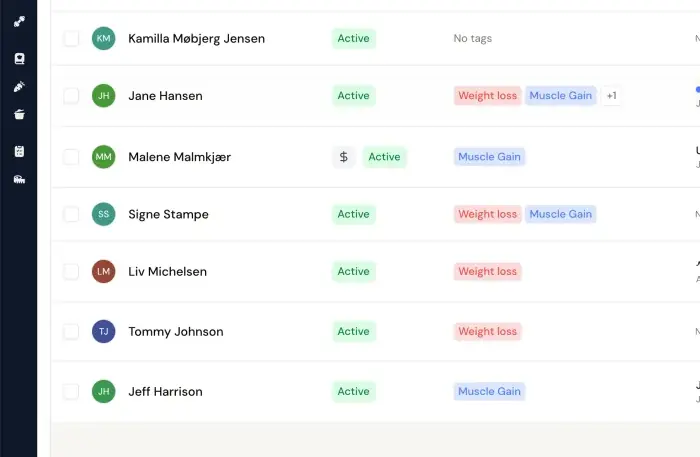
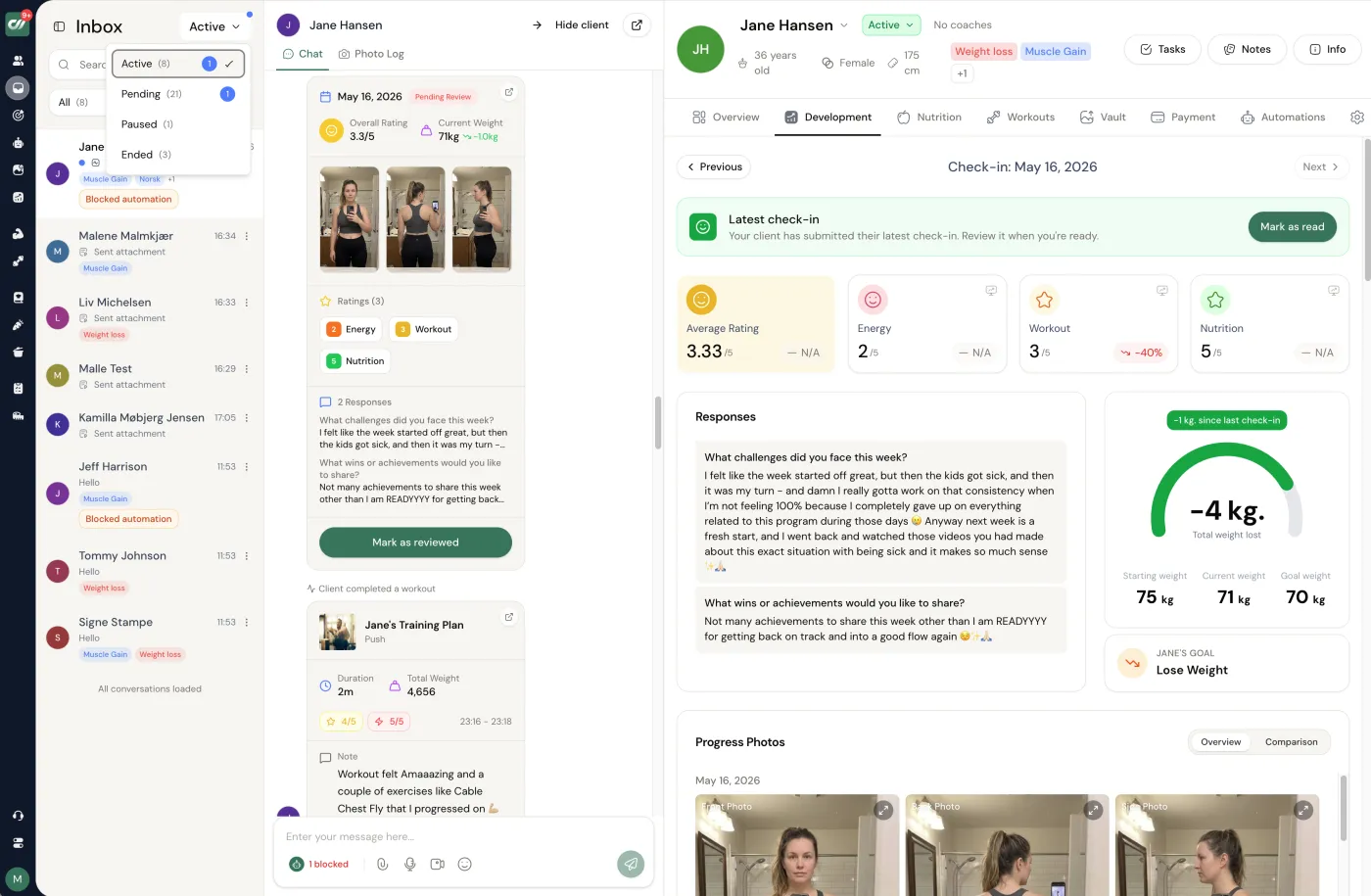
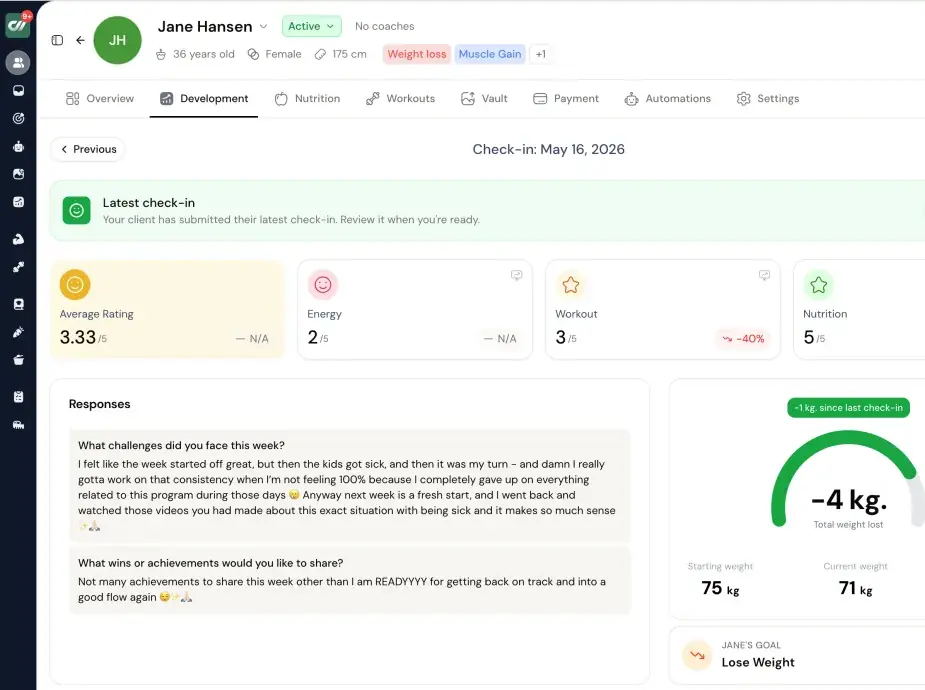
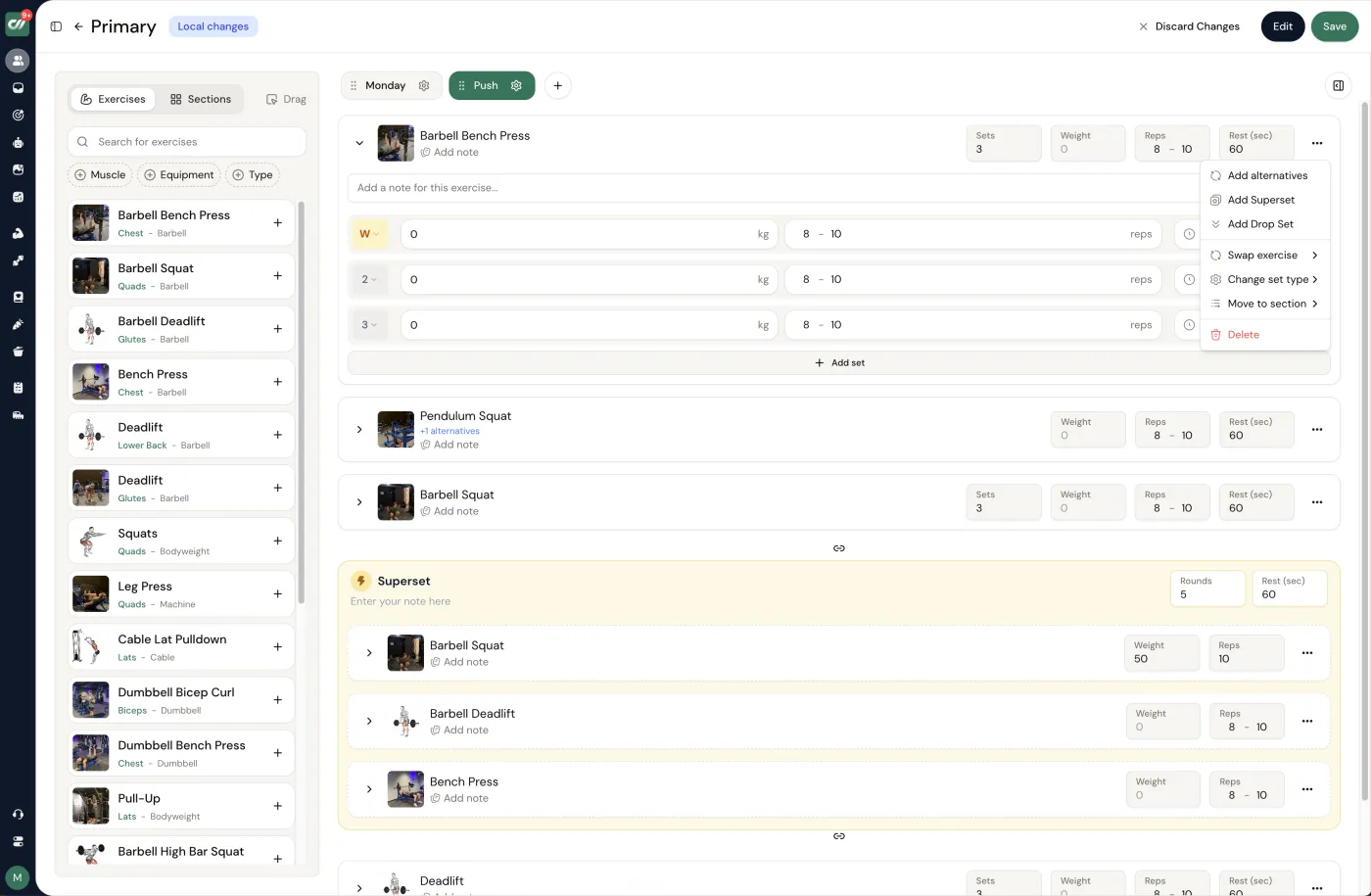
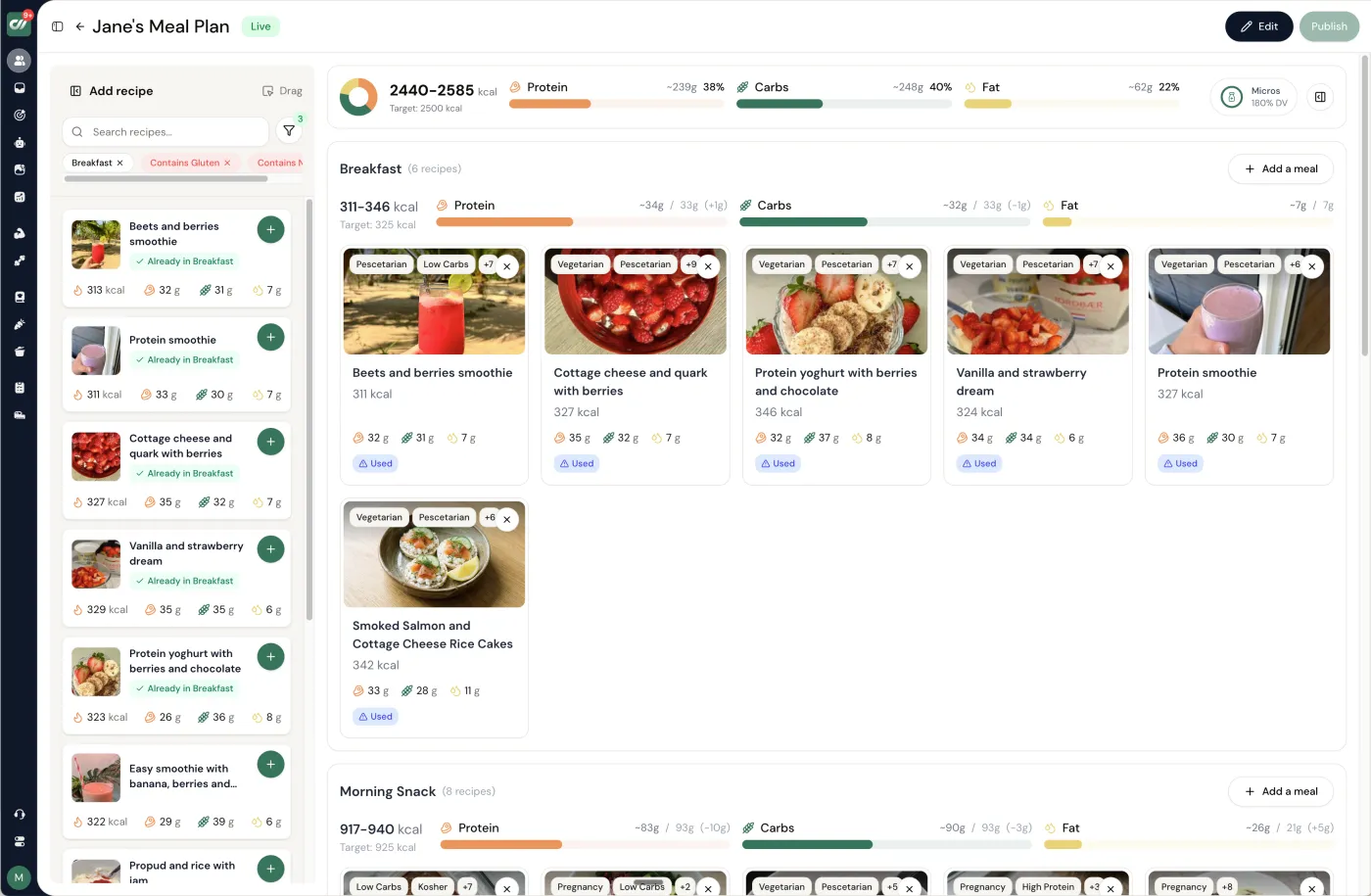
Clients - Every client in one table with status and goal tags - see where all of them stand at a glance.
Want to see your own logo and colours inside the client app before you weigh up a standalone build? Start the trial and set your branding up today, or see it live on a demo.
No charge today - cancel anytime under Billing.Frequently asked questions about white-label fitness apps.
What is a white label fitness app?
A white label fitness app is a coaching platform's client app published as a standalone app under the coach's own name in the App Store and Google Play, so clients download an app that reads as the coach's own product while the platform runs the workouts, check-ins, meal plans, and chat underneath. It is a step beyond a branded in-app experience, where your logo and colours carry across the screens inside the platform's app but the store listing stays the platform's. The white-label version means your own app icon, your own store listing, and usually your own Apple and Google developer accounts.
How much does a white label fitness app cost?
It depends heavily on the platform, and the standalone version is almost always gated to a top tier or a setup fee. Documented examples in 2026: FitBudd requires Super Pro (USD 149/mo) plus a one-time USD 75 setup, Kahunas gates it to Ultimate (USD 99/mo), My PT Hub charges EUR 145 a month on top of the plan, and Trainerize includes an own-listing app on Studio Plus (USD 275/mo per location). Everfit's standalone app, Exercise.com, and Virtuagym are priced by quote. On top of the platform cost you hold your own developer accounts - Apple at USD 99 a year and Google Play at a one-time USD 25. Always confirm current rates on each vendor's own pricing page, since tiers change often.
What is the difference between a branded app and a white label fitness app?
A branded in-app experience means your logo and brand colours carry across every screen your clients use inside the platform's app; the App Store listing and home-screen name stay the platform's. A white label fitness app goes one step further: your own app icon and your own App Store and Google Play listing, so clients download an app published under your name - which usually also means your own developer accounts and store compliance to manage. For most coaches the branded in-app experience is the level that matters day to day, and it is the lighter option covered in our branded app for fitness coaches guide.
Is a white label app worth it for a small coaching business?
For most small coaching businesses, no - the branded in-app experience covers what actually drives retention and pricing, because clients see your logo and colours every time they open the app, several times a week. A standalone white-label listing earns its added cost and overhead once your brand is the reason a client searches for and downloads the app in the first place - typically when you are running paid acquisition to your own brand at scale, or your app is a product you sell in its own right. Until then, the in-app branding does the same job for the client at a fraction of the cost and none of the app-store maintenance.
What is the app-store review overhead of a white label app?
Because the listing carries your name, every submission and every update to a white label app runs through Apple and Google review under your own developer accounts. You own the store page, screenshots, privacy labels, and any rejection back-and-forth, and a new platform feature has to be rebuilt into your standalone app and re-submitted before your clients get it - so your own-listing app can trail the shared app by a review cycle. A branded in-app experience avoids all of that: it rides the platform's own listing and updates, so new features reach your clients the moment the platform ships them.
Does Coachway offer a white label fitness app?
The branded in-app experience - your logo and brand colours throughout the client app on iOS and Android - is included on every Coachway plan at no extra cost, at EUR 69 a month for up to 5 clients, then EUR 9 per additional client, with every feature in that price. A fully white-labelled standalone app published under your own App Store and Google Play listing is a separate paid option rather than part of the standard plan. If owning your own store listing is essential, ask about the standalone white-label app on a demo; if you mainly want your brand in front of clients daily, the included in-app experience already does it.
Which training software can be white-labeled and built into my own app?
As documented in 2026: FitBudd (Super Pro), Kahunas (Ultimate), Trainerize (Studio Plus), My PT Hub (a monthly add-on) and Everfit (Enterprise) publish a standalone app under your own listing, and Exercise.com and Virtuagym sell it on a quote. Coachway offers the standalone app as a separate paid option and includes the branded in-app experience on every plan, which is the level most coaches actually need.
Custom branded fitness app vs white label coaching programs - what is the difference?
They are two different things that often get lumped together. A custom branded fitness app is the delivery software - the branded client app that carries your logo and colours while the platform runs the workouts, check-ins, meal plans and chat underneath, which is what this page is about. White label coaching programs are something else: ready-made training or nutrition programs some providers license for you to resell under your own name. Coachway is the platform and branded client app, not a program reseller - you build and own your own programming inside it and deliver it through your custom branded fitness app. So if a vendor bundles white label coaching programs with the app, treat the program content and the app as two separate decisions.
Keep reading
all guidesBranded fitness app for coaches: white-label guide (2026)
What a true white-label coaching app includes, what to check before you buy, and how a branded client app lifts retention and perceived value for online coaches.
Read the guideWhat Is a Branded Coaching App? Definition for Fitness Coaches
A branded coaching app is a coaching platform's client-facing app delivered under the coach's own name, logo and colours instead of the platform's. What the term means, how it differs from a plain client app, where it overlaps with white label, and what Coachway's client app includes on every plan.
Read the guideHow much does it cost to build a fitness app? (2026)
Fitness app development cost explained: MVP vs full custom build ranges, yearly maintenance, and why a coaching platform is cheaper and faster for most coaches.
Read the guideBuild your own coaching app, or use a platform?
An honest build-vs-buy guide for fitness coaches: the real cost and time of a custom app vs a branded app on a platform that is live in days.
Read the guideFree tools for this: Coaching Rate Calculator · Coaching Tool Stack Cost Calculator · Coaching Profit Calculator
See your brand inside the client app.
The branded in-app experience - your logo and colours on every screen your clients use - is included on every Coachway plan, no add-on fee, and a fully white-labelled standalone app is a paid option when you need it. Start the 14-day free trial with no charge today and cancel anytime under Billing, or see the branded app live on a 15-minute demo.