


Personal training studio software - the part that is not the booking calendar.
Personal training studio software is the system a solo trainer or small studio uses to run coaching, and the useful version does more than book in-person sessions. Booking and payments are the floor. The ceiling is delivery: programming, nutrition, check-ins and a branded client app that carry the relationship between sessions - and that let a studio take on remote clients it could never fit in the room. This guide covers what studio software should really cover, and how a coaching platform extends a studio's reach online.
By Markus Evers · Updated August 2026
the short version
Personal training studio software splits into two jobs. The first is the room: booking, a calendar, card-on-file payments and reminders for in-person sessions. The second is delivery: programming, nutrition, check-ins and a branded app that hold the client relationship between sessions. A pure scheduling tool only does the first, and it is the second that lets a studio add online clients without adding hours. If most of your revenue is a booked slot, you need strong scheduling. If you are adding remote or hybrid clients, you need a coaching platform - and a small studio is usually better served running both kinds of client through one delivery system rather than two.
What should personal training studio software actually cover?
It is easy to shop for studio software as if it were one product. In practice it is two, and they were built by different companies for different problems. The first job is running the room: taking a booking, holding a calendar, charging a card for the session, sending a reminder so the slot does not go empty. This is appointment software, and for a studio whose product is a booked hour it is genuinely the core of the business. If this is your model, session-based tools and the honest question of whether you even need scheduling software is where to start.
The second job is delivery: giving a client a plan to follow when they are not in front of you, checking that they did the work, adjusting when the numbers say to, and keeping them accountable through the weeks between sessions. This is coaching software, and it is a different shape entirely - built around the client over time rather than around a slot on a calendar. Most studios discover they need the second job the first time a client asks for a programme to run at home, or the first time they want to sell a lower-priced remote option to fill the quiet hours. The mistake is buying the room software and assuming it will stretch to cover delivery. It rarely does, because it was never the job it was designed for.
What does studio software need beyond in-person scheduling?
Scheduling is the floor, not the ceiling. Once you look past the booking calendar, a studio that wants to keep clients and add online delivery needs a handful of things a pure appointment tool does not carry. These are the pieces that turn a booked hour into an ongoing coaching relationship a client will pay to renew.
Programming a client can follow at home.
The single biggest gap in scheduling software is that it does not deliver training. A coaching platform gives you a workout builder and an exercise library so a client has a structured plan on the days they are not in the studio - which is most days. Coachway ships with 1,800+ exercises and a builder that lets you assign a full programme to a client's app, so the work continues between sessions instead of resetting to nothing the moment they leave the room.
Check-ins that replace the face-to-face read.
In the studio you read a client in person - energy, form, mood. Remotely you need that read to arrive as data. A drag-and-drop check-in builder collects weight, measurements, progress photos, training logs and simple ratings on a set cadence, with automatic reminders, so a remote client is as visible to you as one standing in the room. This is the mechanism that makes online accountability possible at all, and it is the piece scheduling tools simply do not have.
Nutrition and progress in the same place.
A studio that only trains movement leaves half the result on the table. Coaching software carries nutrition targets, food logging and a photo diary alongside the training, plus progress tracking that turns weeks of check-ins into a trend you can act on. When programming, nutrition and progress live in one client file, you make better calls faster - and you have something concrete to show a client who is quietly wondering whether to keep paying.
Recurring billing that is not per-visit.
Session software charges for the slot. Online delivery is usually sold as a monthly package, which needs subscriptions, payment plans, planned invoices and automatic reminders - not a card swipe per appointment. It also needs the money to be yours: with Coachway, payments settle in your own Stripe account and Coachway never holds your funds. Built-in payments are optional and carry a 2.4% per-transaction fee; run your own Stripe checkout instead and there is no Coachway fee on it. Klarna and SEPA are available as options.
A way to catch and convert enquiries.
A small studio lives on a steady trickle of new interest. An embeddable lead form and a simple pipeline - new, contacted, qualified, won - keep enquiries from dying in your DMs, and a one-click convert turns a won lead into a client with the branded app, an onboarding sequence and a subscription already set up. That is the difference between chasing people by memory and running a business that quietly compounds. If you are also weighing group formats to fill capacity, the same delivery layer is what makes small-group training workable online.
How does a coaching platform extend a studio's reach?
A physical studio has a hard ceiling: the number of people you can fit in the room during the hours you can staff it. Online delivery removes that ceiling without asking you to give up the in-person work you are good at. A client who moves away stays with you. A client who travels for work keeps training. Someone two towns over who would never make the drive becomes reachable. And the quiet daytime hours, when the studio sits empty, become time you can spend coaching remote clients instead of waiting for the evening rush. This is the practical case for adding online delivery to an in-person business: not replacing the studio, but extending it.
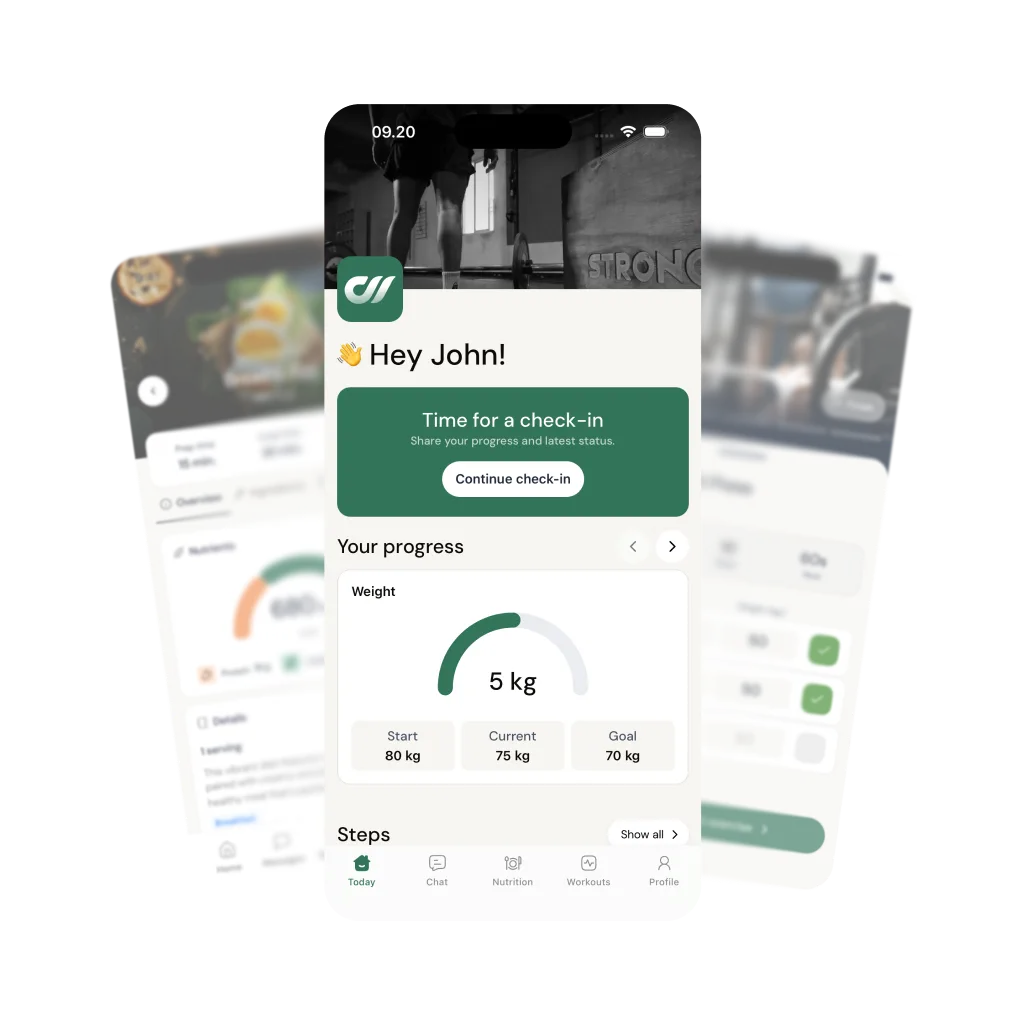
The mechanism that makes it feel personal rather than a downgrade is the branded client app. Instead of a client leaving the studio and going quiet until the next session, they carry your logo, their programme, their check-ins and their chat with you in their pocket. The gap between sessions - the part that used to be invisible - becomes the part you coach. Handled this way, online personal training is not a lesser product; for many clients the constant contact makes it a better one than the hour a week they used to buy. The studio becomes the flagship, and the platform is how everyone who cannot be there in person still trains with you.
Studio management software or a coaching platform?
These are two categories, not two brands, and the right pick depends on where your revenue comes from. Studio management tools are built around booking, memberships and point of sale - excellent when the product is a slot or a class, and heavier than a solo coach needs when it is not, which is why many trainers look at lighter alternatives to the big studio systems. Coaching platforms are built around the ongoing client relationship and online delivery. Here is the honest split.
| What you are choosing on | Studio management software | Coaching platform |
|---|---|---|
| Built around | The room - bookings, classes, memberships | The client relationship over time |
| Best fit | Class-based or heavily in-person studios | Solo trainers and small studios adding online |
| Delivery between sessions | Limited - booking is the product | Programming, nutrition, check-ins, branded app |
| Billing model | Per visit, membership, point of sale | Monthly packages, subscriptions, payment plans |
| Reaches remote clients | Not the design goal | Yes - the client app is the studio's extension |
Running in-person and online clients from one place.
Coachway is a coaching platform we build, aimed squarely at the solo trainer and small studio adding online delivery. It does not replace the way you book in-studio sessions; it carries the part clients pay to keep - the programming, nutrition, check-ins, progress and messaging - for every client, whether they train with you in the room or from another city. Each client gets a branded app carrying your logo and colours as standard, on iOS and Android, and each sees it in their own language across English, Danish, Norwegian, Swedish, Finnish and German; the coach dashboard you work from is in English. Payments settle in your own Stripe account, so the studio's money is never held by us. It is priced simply for a small business: EUR 69 a month with your first 5 clients included and EUR 9 per additional client after that, every feature in one price with no tiers, and it is built on knowledge from working with 150 online coaches over 6+ years. Start the 14-day free trial - EUR 0 today, a card is required and you can cancel anytime under Billing - or book a demo and see the client app first.
Frequently asked questions about personal training studio software.
What is personal training studio software?
Personal training studio software is the system a solo trainer or a small studio uses to run the business side of coaching, not just to book sessions. At its narrowest it is scheduling and payments for in-person appointments. The useful version is broader: client records, session history, billing and reminders, plus a way to deliver structured programming, nutrition and check-ins between the times a client is physically in front of you. The moment a studio adds even one remote or hybrid client, the scheduling calendar stops being enough on its own, because the work between sessions is where remote coaching actually happens. So the practical definition is the software that carries the whole client relationship - in the studio and out of it - rather than only the appointment slot.
Do I need studio software if I only train clients in person?
If every client is in the room for every session and pays per visit, a good scheduling and payments tool covers most of the job. Booking, a calendar, card-on-file billing and automatic reminders are the core, and a session-based studio can run cleanly on that alone. The gap opens the day a client wants a plan to follow at home, a check-in while travelling, or a lower-priced remote option so you can take on people who cannot reach the studio. That is delivery work, and pure booking software is not built for it. So the honest answer is that in-person-only studios need scheduling software, but most studios are one enquiry away from needing delivery too - which is why it is worth choosing a system that can grow into online without a migration.
What is the difference between studio management software and coaching software?
Studio management software is built around the room: appointment booking, class schedules, memberships, point of sale and front-desk billing. It is excellent when the product is a booked slot or a class. Coaching software is built around the client relationship over time: programming, nutrition, weekly check-ins, progress tracking and a branded app the client uses between sessions. A solo trainer or small studio adding online delivery needs the second job more than the first, because remote clients are not buying a time slot - they are buying structure and accountability that live in an app. Some studios run both categories side by side; others move the whole relationship into one coaching platform and keep a simple calendar for the in-person slots. The choice depends on how much of your revenue is a booked session versus an ongoing programme.
Can one platform handle both in-person and online clients?
Yes, and for a small studio adding remote clients it is usually the cleaner setup. A coaching platform gives every client - the one who trains with you on Tuesday and the one you have never met in person - the same branded app, the same programming, the same check-in rhythm and the same billing. Your in-person clients get a plan to follow on the days they are not in the studio, and your remote clients get the structure that replaces the room. In Coachway the coach dashboard is one place to run both, and each client sees the app in their own language. You still handle in-studio booking however you do now, but the coaching itself - the part clients pay to keep - lives in one system whether the person is local or on another continent.
How much does personal training studio software cost?
It depends on which job you are buying. Pure in-person scheduling and point-of-sale tools price by location, staff seats or booking volume, and prices vary widely, so check each vendor's own pricing page for a current figure. Coaching platforms that carry delivery usually price by the number of clients you coach. Coachway is EUR 69 a month with your first 5 clients included and EUR 9 for each additional client, every feature in that one price with no tiers or modules, and a 14-day free trial that charges EUR 0 today - a card is required to start and you can cancel anytime under Billing. If you run a mix of in-person and online, budget for one delivery platform priced by client, plus whatever light booking tool your in-studio sessions still need.
Which personal training studio software supports class scheduling and memberships?
The studio management category: tools built around the room, with appointment booking, class schedules, memberships, point of sale and front-desk check-in, which this page describes as the first of two purchases. The second is a coaching platform for what happens between visits (programmes, check-ins, nutrition, messaging), which Coachway covers and which extends a studio to online clients. The comparison on this page lays out both categories side by side so a studio can see whether it needs one tool or both.
Two neighbouring reads if you are weighing this up: the honest take on whether you need scheduling software at all, and a wider look at online personal training software once the studio starts coaching remotely.
Keep reading
all guidesMy PT Hub pricing in 2026: plans and real cost
My PT Hub keeps pricing simple with three plans: Starter at EUR 25/mo (capped at 3 clients), Premium at EUR 59/mo unlimited, and Ultimate at EUR 215/mo. The headline numbers are low, but branding and extra trainers are paid add-ons. Here is the full breakdown, the 30-day trial, and how Coachway compares.
Read the guideKahunas pricing in 2026: plans and real cost
Kahunas prices in three fixed USD tiers capped by client count: USD 35/mo for up to 25 clients, USD 69 for up to 50, and USD 99 for unlimited, with the fully branded white-label app gated to the top USD 99 tier. This guide lays out the full ladder, the 14-day trial, and how Coachway compares for European coaches.
Read the guideKahunas review (2026): an honest look
A doctor-honest review of Kahunas, the fitness-first coaching platform: its workout and nutrition toolkit, the three USD tiers (Essentials $35, Growth $69, Ultimate $99), the 14-day trial, and the branded app locked to the top tier. Covers what it is, who it suits, real strengths, honest limitations, a verdict, and where Coachway fits as an EU-focused alternative.
Read the guideFree tools for this: Coaching Tool Stack Cost Calculator · Coaching Profit Calculator · Client Capacity Calculator
See what Coachway can do for your coaching business
Coachway was built on knowledge from working with 150 online coaches over 6+ years, who all hit the same wall - slow platforms, clunky workflows, wasted hours. Start your 14-day free trial and see what we fixed - the whole platform, no charge today, cancel anytime under Billing.


