


How to set a calorie target for a client - the deficit is a decision, not a calculator output.
To set a calorie target for a client you start from their maintenance calories and then move that number toward the goal by a size you choose on purpose - a deficit for fat loss, maintenance to hold, a small surplus to gain. This guide is about that decision: how to pick the starting number and the deficit size from rate of loss, activity, adherence history and diet history, and how to adjust the target once real check-in data arrives.
By Markus Evers · Updated August 2026 · General coaching information, not medical or dietetic advice
the short version
Estimate the client's maintenance calories, then move that number toward the goal by a size you choose deliberately. For fat loss, a starting deficit of about 10 to 20 percent below maintenance, often 300 to 750 calories, drives roughly 0.5 to 1 percent of bodyweight per week. Set protein first and adjust from two to three weeks of real data.
What actually goes into a client's calorie target?
A calorie target is not one number a calculator hands you - it is a small stack of decisions. The first is the anchor: an estimate of the client's maintenance, their total daily energy expenditure, the intake at which bodyweight holds steady. The second is direction: down for fat loss, level to hold, up for a lean gain. The third - and this is where coaching happens - is size: how far below or above maintenance you set the number, which controls how fast the body composition changes and, just as importantly, how liveable the plan is.
The fourth input is the one the formula never sees: the client in front of you. Two people with the same maintenance estimate get different targets if one has a physical job and a decade of gym habits and the other sits at a desk, sleeps five hours and has crash-dieted twice this year. Getting the target right is mostly about matching the size of the move to that person, then correcting the maintenance guess from what the scale actually does. The rest of this guide walks each of those decisions in order.
How do you choose the starting number?
Begin with maintenance. You can estimate it with a formula and an activity multiplier that reflects the client's real step count and training - the method, the multipliers and a worked example live in the companion guide on calculating TDEE and setting macros, and a quick maintenance calorie calculator or TDEE calculator will sanity-check it in a few seconds. If the client already tracks and holds weight on a known intake, that real-world number beats any equation - use it.
From maintenance, set the direction. Fat loss means eating below it; holding means eating at it; a lean gain means eating a little above it. That much is simple. The hard part - the part that separates a target that works from one that fails in a month - is choosing how big the move is.
How big should the deficit be?
Set the deficit by the rate of loss you want, then check that the rate is sustainable for this person. A common, sensible target is losing about 0.5 to 1 percent of bodyweight per week - fast enough to keep a client motivated, slow enough to hold onto muscle and stay adherable. Because roughly 7,700 calories sit behind a kilogram of fat (about 3,500 per pound), a deficit near 500 calories a day works out to somewhere around half a kilo, or a bit over a pound, a week for many clients. In practical terms that usually means setting the target about 10 to 20 percent below maintenance, often a 300 to 750 calorie gap.
Pick inside that band by the client, not the average. The lighter and leaner someone is, the smaller the deficit they can afford before strength and energy suffer; the more they have to lose, the larger a deficit they tolerate comfortably. The honest rule is that the best deficit is the largest one the client can follow consistently while still training hard and sleeping enough - not the largest one the maths permits.
| This client | Deficit size | Rough weekly loss |
|---|---|---|
| A lot to lose, physical job, strong adherence history | Upper end, ~20% below maintenance | ~1% of bodyweight |
| Average client, desk job, tracks reliably | Middle, ~15% below maintenance | ~0.5 to 0.75% |
| Lean, stressed, under-slept, or new to tracking | Lower end, ~10% below maintenance | ~0.5% or less |
| History of crash-and-rebound dieting | Gentle, and hold longer before cutting again | Slow and steady on purpose |
What changes the target for this specific client?
Activity and the life around training
A construction worker who walks 14,000 steps a day and a remote worker who does 3,000 have very different maintenance numbers even at the same weight, because most of the difference between people is non-exercise activity, not the workouts. Set the target against the client's real average day, and remember that a big deficit often quietly lowers spontaneous movement - people fidget less and move less when energy is low - which is one reason an aggressive target underperforms a moderate one that keeps daily activity intact.
Adherence history is the strongest predictor
A target only exists on paper until the client hits it. If someone has never tracked before, start conservatively and let the first weeks be about building the logging habit, not maximising the deficit - a plan followed at 90 percent beats a stricter one followed at 60. If a client has a long track record of hitting numbers, you can trust them with a sharper deficit. Read the history honestly and set the size to what they will actually do, not to what an ideal client could.
Diet history and metabolic adaptation
Someone arriving off months of aggressive dieting is not starting from a fresh maintenance - their intake has likely drifted down and their body has adapted. Dropping them straight into another steep deficit rarely works. Often the right first move is to hold or even raise calories to rebuild a real maintenance before you cut again, which is the whole logic of reverse dieting and metabolic adaptation. A client's diet history changes the starting number as much as their bodyweight does.
Stress, sleep and training age
Poor sleep and high life stress blunt recovery and appetite control, so a client in a rough patch will follow a gentle deficit far better than an aggressive one. Training age matters too: a newer lifter can build muscle even in a modest deficit, which makes a slower, more liveable target genuinely productive rather than a compromise. Set protein first in every case - commonly around 1.6 to 2.2 grams per kilogram of bodyweight - because it protects lean mass in a deficit and drives satiety, and then let carbohydrate and fat fill the rest, as covered in the guide to macro coaching methods.
How do you set a maintenance or surplus target?
A maintenance target is the estimated intake that holds weight steady - useful during a diet break, a busy life phase, or the stretch after a fat-loss block when you want to lock in the result before deciding what is next. You confirm it the same way as any target: watch whether weight actually stays flat over two to three weeks, and nudge up or down if it drifts. Maintenance is not a resting state so much as a skill the client practises, and it is often the most valuable place a coach can park someone who has been dieting too long.
A surplus target, for building muscle, sits a small step above maintenance - a modest 5 to 15 percent, often 200 to 400 calories, is plenty for most clients. Muscle is built slowly, so a large surplus mostly buys fat you will have to diet off later. Keep protein high, keep the move conservative, and judge it not only by the scale going up but by the client staying reasonably lean. The counterpart to a deficit is covered in more depth in the guide to a calorie surplus, and a bulking calorie calculator turns that small step above maintenance into a concrete daily figure to start from.
How do you adjust the calorie target after you set it?
The first number is a hypothesis, not a verdict. Your maintenance estimate could be off by a few hundred calories in either direction, and the only way to find the truth is to set the target, then read the trend. Review it at every check-in, but change it only when two to three weeks of data - not a single weigh-in - ask you to. Daily weight bounces around with water, sodium, sleep and the menstrual cycle by more than a week of real fat loss, so acting on a single spike just chases noise. The adjustment is only as good as the log; if the client tracks with an AI photo counter, read what AI calorie counters get wrong before trusting the intake number.
Read the trend against the plan. If the client is losing at roughly the rate you intended and adhering well, do nothing - the target is working, and the discipline is to leave it alone. If the trend has genuinely stalled for two to three weeks with good adherence, drop the target in a small step or add a little activity rather than gutting calories. If they are dropping too fast, going flat in the gym or losing strength, raise the number. The rule is to change one variable at a time, in a small increment, and give it time to answer - adjust the target, not the whole plan. The step-by-step version, with the six-outcome decision table and a worked weekly-average example, is how to adjust a client's calories after two weeks of data. This is also where you catch adherence problems honestly: a stall with patchy logging is a habit issue, not a calorie one, and the fix is coaching, not a deeper cut. The wider rhythm of reading check-ins and deciding what to change lives in the guide to assessing client nutrition progress.
Where the target lives, and where you check whether it works.
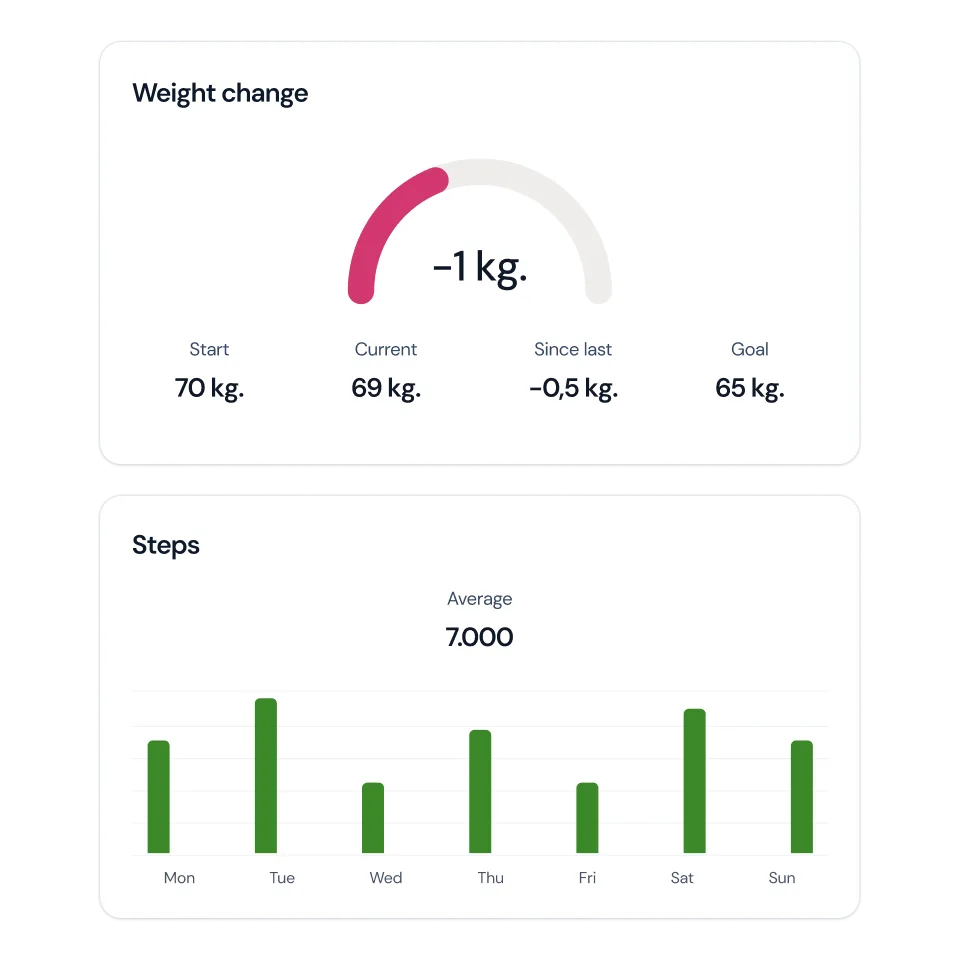
Setting the target is half the job; reading whether it worked is the other half, and the two go badly when they live in a calculator, a spreadsheet and a messaging app that never talk to each other. In Coachway you set a client's calorie and macro targets per person, per weekday, with date exceptions for phase work like a diet break or a heavier training block, and the client logs against them with macro rings that move as they eat. Then the weight trend, step chart and check-in answers sit next to those targets, so the decision to hold or adjust is made from the actual data instead of a guess. Every feature is included at EUR 69 a month with your first 5 clients, then EUR 9 per additional client, and it is built on knowledge from working with 150 online coaches over 6+ years. The 14-day free trial starts with a card held securely by Stripe and cancels under Billing before it renews, or you can book a demo and see the nutrition and progress screens first.
Frequently asked questions about setting a client's calorie target.
How do you set a calorie target for a client?
Start from an estimate of the client's maintenance calories - their total daily energy expenditure - then move that number in the direction of the goal by a size you choose on purpose. For fat loss, that means a deficit; for holding, maintenance; for a lean gain, a small surplus. The size is the real decision, and it comes from three things, not a calculator: the rate of change you want (a common range is 0.5 to 1 percent of bodyweight per week for fat loss), the client's activity and life around training, and their adherence and diet history. A reasonable starting deficit is roughly 10 to 20 percent below maintenance, often 300 to 750 calories, biased toward the smaller end for someone lean, busy or new to tracking. Then you treat the first number as a starting line and adjust it from two to three weeks of real data, not from the equation.
What is a good starting calorie deficit for a client?
For most clients, a starting deficit of about 10 to 20 percent below maintenance is sensible, which usually lands somewhere between 300 and 750 calories a day and drives a loss of roughly 0.5 to 1 percent of bodyweight per week. Pick within that band by matching the deficit to the person, not the average. A client with a lot to lose, a physical job and a solid history of following a plan can hold the larger end comfortably. A leaner client, a stressed or under-slept one, someone new to tracking, or anyone with a history of crash-and-rebound dieting should start at the smaller end, because a gentle deficit they actually adhere to beats an aggressive one they abandon in three weeks. The deficit that works is the largest one the client can follow consistently while training hard and sleeping enough - not the largest one a calculator will allow.
Should you use a calorie calculator to set a client's target?
Use it as a starting line, never as the answer. A calorie deficit calculator gives you a reasonable first estimate of maintenance and a rough deficit, and that is genuinely useful for the first two to three weeks when you have no real data yet. But the formula does not know your client's true activity, how honestly they log, how their metabolism has adapted to past diets, or how much stress and sleep are moving the number this month. Those are exactly the variables that decide whether the target works. So run the calculator, set the target a little conservatively, and then let the client's weight trend and adherence tell you what their real numbers are. The professional skill is not the arithmetic - it is choosing the deficit size for this person and correcting the estimate from results. The arithmetic itself is walked through in how to calculate a calorie deficit.
How often should you change a client's calorie target?
Review the target at every check-in, but only change it when the trend - not a single day or a single weigh-in - tells you to, which usually means giving it two to three weeks to produce a clear signal. Daily weight swings from water, sodium, sleep and the menstrual cycle are large enough to hide the real trend over a few days, so acting on them just chases noise. If the client is losing at the rate you planned and adhering well, hold the number and let it keep working. If the trend has genuinely stalled for two to three weeks with good adherence, drop calories in a small step (or add a little activity) rather than slashing them. If they are losing too fast, feeling flat or losing strength, nudge the target up. Change one variable at a time and give it time to answer.
How do you set a maintenance or surplus calorie target?
A maintenance target is simply the client's estimated total daily energy expenditure - the number that holds bodyweight steady - and you confirm it the same way as any target, by watching whether weight actually stays flat over two to three weeks and nudging up or down if it drifts. A surplus target, for building muscle, sits a small step above maintenance: a modest 5 to 15 percent, often 200 to 400 calories, is enough for most clients, because muscle is built slowly and a large surplus mostly adds fat you will only have to diet off later. Set protein first in every case (commonly around 1.6 to 2.2 grams per kilogram of bodyweight), keep the calorie move deliberate and conservative, and adjust from the scale trend and, in a surplus, from how lean the client is staying.
Setting the number is one link in a chain: the maintenance and macro maths that anchors it, the macro method that turns it into food, and the check-in read that tells you when to move it. Sanity-check the arithmetic with the calorie deficit calculator, then trust the trend over the formula.
Keep reading
all guidesRep Ranges: Strength, Hypertrophy, Endurance
Rep ranges by goal: roughly 1 to 6 for strength, 6 to 15 for hypertrophy, 15+ for endurance - plus the nuance that every range builds muscle when sets are taken close to failure with enough volume.
Read the guideRest Between Sets: How Long to Rest (by Goal)
How long to rest between sets depends on your goal: strength 2-5 minutes, hypertrophy roughly 1-3 minutes, muscular endurance under a minute - plus why longer rest can actually support muscle growth.
Read the guideTraining to Failure: What It Is and When It Helps
Training to failure means a set you cannot extend by another rep. The honest evidence: training close to failure (RIR 1-3) drives most of the muscle growth, while full failure adds fatigue for little extra benefit.
Read the guideFree tools for this: Calorie Deficit Calculator · Body Recomposition Calculator 2026 · Creatine Dosage Calculator
See what Coachway can do for your coaching business
Coachway was built on knowledge from working with 150 online coaches over 6+ years, who all hit the same wall - slow platforms, clunky workflows, wasted hours. Start your 14-day free trial and see what we fixed - the whole platform, no charge today, cancel anytime under Billing.


