


TikTok for fitness coaches - how to turn views into clients in 2026.
TikTok for fitness coaches is a discovery channel, not a closing one: it puts short videos in front of strangers who were never looking for you, and that is exactly why a brand-new account can still find the right client. The trap is treating a view as a sale. This is the honest playbook for the two parts most guides skip - the content that actually gets shown, and the DM-to-trial funnel that catches the interest before it goes cold in your inbox.
By Markus Evers · Updated September 2026
the short version
TikTok is the fastest way for a fitness coach with no audience to get found, because it shows videos to strangers based on what they watch, not who they follow. But it never closes a sale on its own. Post content that does one of three jobs - get discovered, build trust, or start a conversation - weighted heavily toward discovery, at a cadence you can actually hold: roughly one post a day, batch-filmed. Then build a short path off the platform. A bio link to a lead form, a real conversation, an offer with a start date. The part that breaks most coaches is not the content; it is manual DM chasing that collapses the week a video does well. Route every interested viewer into one pipeline instead of your inbox, and TikTok becomes a client channel rather than a vanity metric.
Does TikTok actually work for fitness coaches?
It works as a discovery engine, and on that one job nothing else comes close. Instagram and most other platforms mostly show your posts to people who already follow you; TikTok pushes each video out to strangers and lets the first hundred of them decide, by watching or scrolling, whether it deserves the next thousand. That is why an account you opened last week can out-reach one you have grown for two years - the platform is looking at the video, not your follower count. For a coach starting cold, with no email list and no audience, that is the single most valuable thing on the internet: a way to be found by the exact person who needs you, who has never heard your name.
What TikTok does not do is sell. A view is not a lead and a follower is not a client, and the coaches who quit TikTok almost never quit because the content failed - they quit because the handover failed. They got the reach, a stranger got interested, and there was nowhere for that interest to go except a comment or a DM that never became a conversation. So the honest way to think about TikTok for fitness coaches is as the wide, cheap top of a funnel whose bottom you control. The content earns the attention; a system you own turns it into a booked client. Get either half wrong and the channel looks like it does not work, when really only one half was ever built.
What should a fitness coach post on TikTok?
Stop thinking in topics and start thinking in jobs. Every video you post should be built to do one of three things - get you discovered, build trust, or start a conversation - and the mix should lean hard toward the first. Discovery content is what a stranger watches and shares; trust content is what turns that first-time viewer into someone who believes you know your craft; conversation content is the direct ask that turns a believer into a lead. Post only trust content and your existing followers love you while no new person ever finds you. Post only discovery content and you pull in strangers who never learn to trust you. You need all three, and every one of them has to be watchable in the first two seconds, because that is the entire window a scrolling stranger gives you.
| Content type | The job it does | How it reaches strangers | Effort |
|---|---|---|---|
| Myth-busting / quick tip | Get discovered | High - shareable and re-watchable | Low |
| Relatable struggle / hot take | Get discovered | High - drives comments and saves | Low |
| Client story / transformation | Build trust | Medium - lands best on warm viewers | Medium |
| Deeper explainer / method | Build trust | Medium - holds the ones who stay | Medium |
| Direct ask / keyword call-out | Start a conversation | Low - aimed at people who already watch | Low |
The same idea works across channels, so film once and place it everywhere: the short-form content that finds people here is the same content that carries your Instagram content, and the sane way to keep the pipeline full without living behind a camera is the batch-and-repurpose approach rather than a fresh idea every single day.
How often should you post on TikTok as a coach?
Often enough to learn, not so often the quality drops - for most coaches that means about one post a day, five to seven days a week, filmed in batches. The reason is not that the platform quietly punishes a quiet account. It is that short-form is a testing game: you cannot know which hook, topic or format will travel until you have posted enough of them, and posting daily simply gets you to that signal faster. Treat the first month as data collection, not performance, and read what actually happens rather than what you hoped would.
The only sustainable way to hold that rhythm as a working coach is batching. Film six to ten videos in one focused session, schedule them out, and a fully booked coaching week no longer means a silent account. If a daily post is genuinely unrealistic while you are still delivering to clients, three strong posts a week beats seven rushed ones - a cadence you can hold for six months matters far more than a two-week sprint you abandon in frustration. What does not work is posting in unpredictable bursts whenever you remember, because you never gather enough signal to get better, and the account never compounds.
How do you turn TikTok views into coaching clients?
You build a short path off the platform and refuse to run it by hand. TikTok gives you attention; the sale happens somewhere you own. The reliable route has four steps: the one link in your bio sends an interested viewer to a simple lead form, the form captures who they are and which video they came from, a real conversation follows in the DMs or on a call, and then a clear offer with a start date turns the yes into a client. Each step exists to stop a warm stranger going cold, which is the only thing that ever really happens to lost TikTok leads. That capture-and-follow-up path is the core of lead generation for personal trainers, whatever channel feeds it.
The step that breaks coaches is the third one, run manually. When one video does well and a dozen people message you in a day, chasing every thread from your own inbox collapses inside a week, and motivated people cool off while you are asleep or coaching. Replying faster is not the fix; capturing first is. Route every interested viewer into one place where the whole pipeline is visible - new, contacted, qualified, won - so nobody falls through a gap precisely when there are the most of them. That is exactly what Coachway's lead engine does: an embeddable lead form you drop behind your bio link captures the full source trail, a visible pipeline moves each person forward on purpose, and a one-click convert hands a new client the client app, the onboarding sequence and a subscription billed through your own Stripe. It is built on knowledge from working with 150 online coaches over 6+ years, and it costs EUR 69 a month including your first 5 clients, then EUR 9 per additional client, with every feature included. The 14-day free trial starts with a card and cancels under Billing before it renews - or book a demo and see the pipeline first.
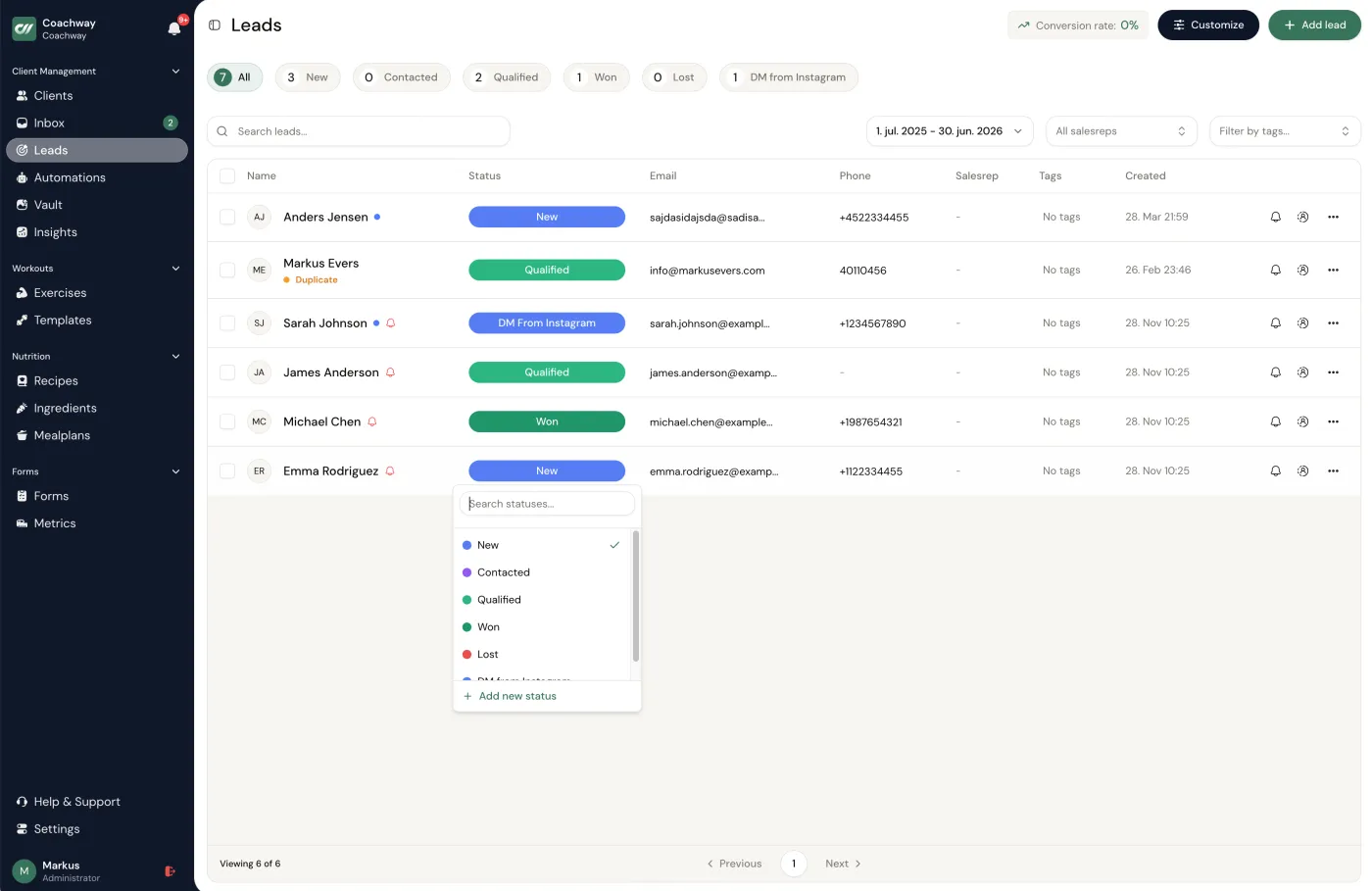
The conversation itself still has to be human - a machine can open a thread, but a person closes it, which is the whole rule behind sane DM automation. When a lead is warm enough, move them to a discovery call rather than trying to sell a stranger in writing.
You have no audience yet. What do you do this week?
Build the catch before you chase the reach. A viral video with nowhere for people to land is the most common and most painful TikTok mistake a coach makes. Four moves, in order:
1. Set up the destination first.
Before you post anything, put a lead form behind the one link your bio allows, and make sure it captures a name, a goal and where the person came from. This is the difference between a good video that builds an audience and a good video that builds a business. If the catch is not ready, the reach is wasted.
2. Batch your first ten videos.
Film ten short videos in one session, weighted toward discovery content - myth-busting, quick tips, the mistakes you see clients make. Do not chase production quality; chase a clear first two seconds and one useful point per video. Ten posts is enough to start reading which hooks travel and which fall flat.
3. Post daily and read the data, not your feelings.
Schedule the batch across the week and watch what actually happens. The video you were proud of may flop and the throwaway one may travel. That is the point of daily posting early on - it hands you real signal fast. Make more of whatever earned watch-time and shares, and quietly retire the formats that did not.
4. Reply to every comment, capture every lead.
Early on your comments are your best growth lever and your first leads. Answer them like a human, and when someone signals real interest, send them to the form, not into a DM thread you will lose track of. From the very first interested stranger, capture before you converse - it is a habit that scales and manual chasing is a habit that breaks.
Frequently asked questions about TikTok for fitness coaches.
Does TikTok actually work for fitness coaches?
Yes, but as a discovery channel, not a closing one. TikTok is the best place a coach has to be found by people who were not already looking for them, because it pushes short videos to strangers based on what they watch rather than who they follow - so a brand-new account with no audience can still land in front of the exact person who needs coaching. What it does not do is sell for you. A view is not a lead and a follower is not a client. TikTok works for fitness coaches when you treat it as the top of a funnel that ends somewhere you control - a lead form, a discovery call, a trial - and not as the whole business. Coaches who fail on TikTok almost always fail at the handover, not the content: they get the reach and then have nowhere for an interested stranger to go except a DM thread they cannot keep up with.
What should a fitness coach post on TikTok?
Post content that does one of three jobs: get discovered, build trust, or start a conversation. Discovery content is the myth-busting, quick-tip, before-and-after and relatable-struggle video that a stranger will watch and share - this is what the algorithm pushes and it is most of what you post. Trust content is the deeper explanation, the client story, the day-in-the-life that turns a first-time viewer into someone who believes you know your craft. Conversation content is the direct ask - a post that ends with a reason to comment a keyword or click the link in your bio. The mistake is posting only trust content, which your existing audience loves and no new person ever sees, or only discovery content, which pulls strangers who never learn to trust you. You need all three, weighted toward discovery, and you need every piece to be watchable in the first two seconds because that is all a scrolling stranger gives you.
How often should you post on TikTok as a coach?
Often enough to learn, not so often that the quality drops - for most coaches that is one post a day, five to seven days a week, in batches. The reason is not that the platform punishes low frequency; it is that short-form is a testing game. You do not know which hook, topic or format will travel until you have posted enough of them, and posting daily simply gets you to that data faster. The sustainable way to hit that cadence is batching: film six to ten videos in one focused session, then schedule them out, so a busy coaching week does not mean a silent account. If daily is genuinely unrealistic, three strong posts a week beats seven rushed ones - consistency you can hold for six months matters far more than a two-week sprint you abandon. What does not work is posting in bursts when you remember, because you never gather enough signal to improve.
How do you turn TikTok views into coaching clients?
You build a path off the platform and make it short. TikTok gives you attention; the sale happens somewhere you own. The reliable route is: a bio link that sends an interested viewer to a simple lead form, a form that captures who they are and where they came from, a real conversation - a DM or a discovery call - and a clear offer with a start date. The single biggest leak is trying to run all of that by hand out of your inbox. When forty people watch a video and eight message you, manual DM chasing collapses within a week, and warm people go cold while you are asleep. The fix is not to reply faster; it is to route every interested viewer into one place where you can see the whole pipeline - new, contacted, qualified, won - and move each person forward on purpose. Capture first, converse second, and never make a motivated stranger dig through your profile to find out how to work with you.
TikTok or Instagram for a fitness coach - which is better?
They do different jobs, so most coaches end up on both, but they start on TikTok. TikTok is the stronger discovery engine: it will show a small account to strangers faster than Instagram does, which is exactly what you need when you have no audience yet. Instagram is the stronger trust-and-conversion engine: the profile works harder as a landing page, the DM is where people are more comfortable buying, and story content nurtures an audience TikTok does not really let you hold. The efficient play is to make your video content once and post it to both, letting TikTok do the finding and Instagram do the closing, rather than treating them as two separate content jobs. If you only have the energy for one channel while you are starting out, choose the one whose format you can actually sustain - a channel you post to every week beats the theoretically better channel you abandon.
TikTok is one mouth of a wider funnel this guide only points at: the same short-form content feeds your Instagram content, and every channel ends at the same place - a booked conversation and an offer, which is the whole of getting online coaching clients.
Keep reading
all guidesFitness Content Calendar for Online Coaches 2026-2027
A month-by-month map of the online coaching year, September 2026 to August 2027: the seasonal client psychology, two or three concrete post angles, and one business move each month - from the autumn reset through Black Friday, the holiday hold and the New Year surge.
Read the guideBlack Friday for Personal Trainers: The Offer, Not the Discount
Black Friday was built for one-time products, and run carelessly it cheapens a coaching brand. Whether to run a sale at all - and how to run one that does not race to the bottom: the honest economics of discounting recurring coaching, an LTV formula you run on your own numbers, the EU price-reduction rule to check, and the bonus-led alternative to a discount.
Read the guideHow to Sell Workout Programs Online: A Coach's Guide (2026)
Selling a workout program means turning one proven training plan into a low-touch product a buyer follows on their own: package it for one specific person, deliver it through an app rather than a flat PDF, price it below your one-to-one coaching so it feeds that offer, and take payment on a checkout you control. The four steps from plan to sale, where to deliver it, and how much of each sale you actually keep under flat per-client pricing versus a revenue-share cut.
Read the guideFree tools for this: Referral Value Calculator · Ad Spend Breakeven Calculator · Email List Value Calculator for Coaches
See what Coachway can do for your coaching business
Coachway was built on knowledge from working with 150 online coaches over 6+ years, who all hit the same wall - slow platforms, clunky workflows, wasted hours. Start your 14-day free trial and see what we fixed - the whole platform, no charge today, cancel anytime under Billing.


