


How to sell workout programs online - the low-touch product tier.
A workout program you have already proven with clients is a product waiting to happen. To sell workout programs online you package that plan as something a buyer follows on their own, deliver it where a phone can open it, take payment through a checkout you control, and put it in front of one specific person. This is the honest, method-first version of that build - the product tiers that actually exist, the four steps from plan to sale, where to deliver it, and how much of the money you keep.
By Markus Evers · Updated September 2026
the short version
To sell workout programs online, take one training plan you already trust, package it for a single clearly defined buyer, deliver it somewhere a phone can open and follow it, and connect a checkout that pays into your own account. The order is package, deliver, price, sell. Keep version one lean, price the program clearly below your one-to-one coaching so it feeds that offer instead of replacing it, and market it inside the audience you already have. The build is the work; once the product exists, the same plan sells many times without a matching increase in your hours.
What does it actually mean to sell workout programs online?
Selling a workout program online - or selling a workout plan online, which is the same job under two names coaches search for - means turning your training expertise into something people buy and follow without booking a slot in your calendar. It is the low-touch end of a coaching business: the buyer pays, receives a structured plan, and works through it largely on their own. That is the crucial difference from one-to-one coaching, which is ongoing, personalised, and capped by your hours. A program is a product you build once and sell many times; coaching is a service you deliver continuously to a limited number of people. The two are not rivals - the program is usually the affordable step that introduces someone to how you work and leads a share of buyers toward the full coaching later.
In practice the term covers a few different products, and choosing the right one is half the job. A one-off template is the simplest: a single training block a buyer downloads or opens in an app and runs alone, priced low because it carries no support. A structured multi-week program sits a level up, with phases, progressions and exercise video, and earns more because it does more. A recurring program on a light subscription - a fresh block each month, or a program plus a small community - earns the most per buyer over time, because it is sold once and paid for repeatedly. A challenge is a time-boxed program with a fixed start date sold to many people at once, which adds urgency and a shared cohort to the same underlying plan.
Almost every coach reading this already owns the raw material. The best-selling first product is rarely something new; it is the block you have run with a dozen clients, the beginner progression you rebuild every January, the eight-week strength plan people keep asking you to write. You are packaging proven work, not inventing a product from scratch, and that is exactly why it can be both honest and quick to launch.
How do you sell a workout program online, step by step?
1. Package one program for one specific buyer.
Pick a single format and a single person it is for, and resist building five things at once. A "beginner kettlebell block for busy parents" sells better than a vague "training guide" because the buyer can see themselves in it before they read a word of the plan. Start from a program you have already run and trust, then cut it down rather than dressing it up: one goal, one experience level, one honest promise. The narrower the buyer, the easier every later step becomes, because your price, your marketing and your sales page all get to speak to one person instead of everyone.
2. Build it as a real deliverable, not a flat file.
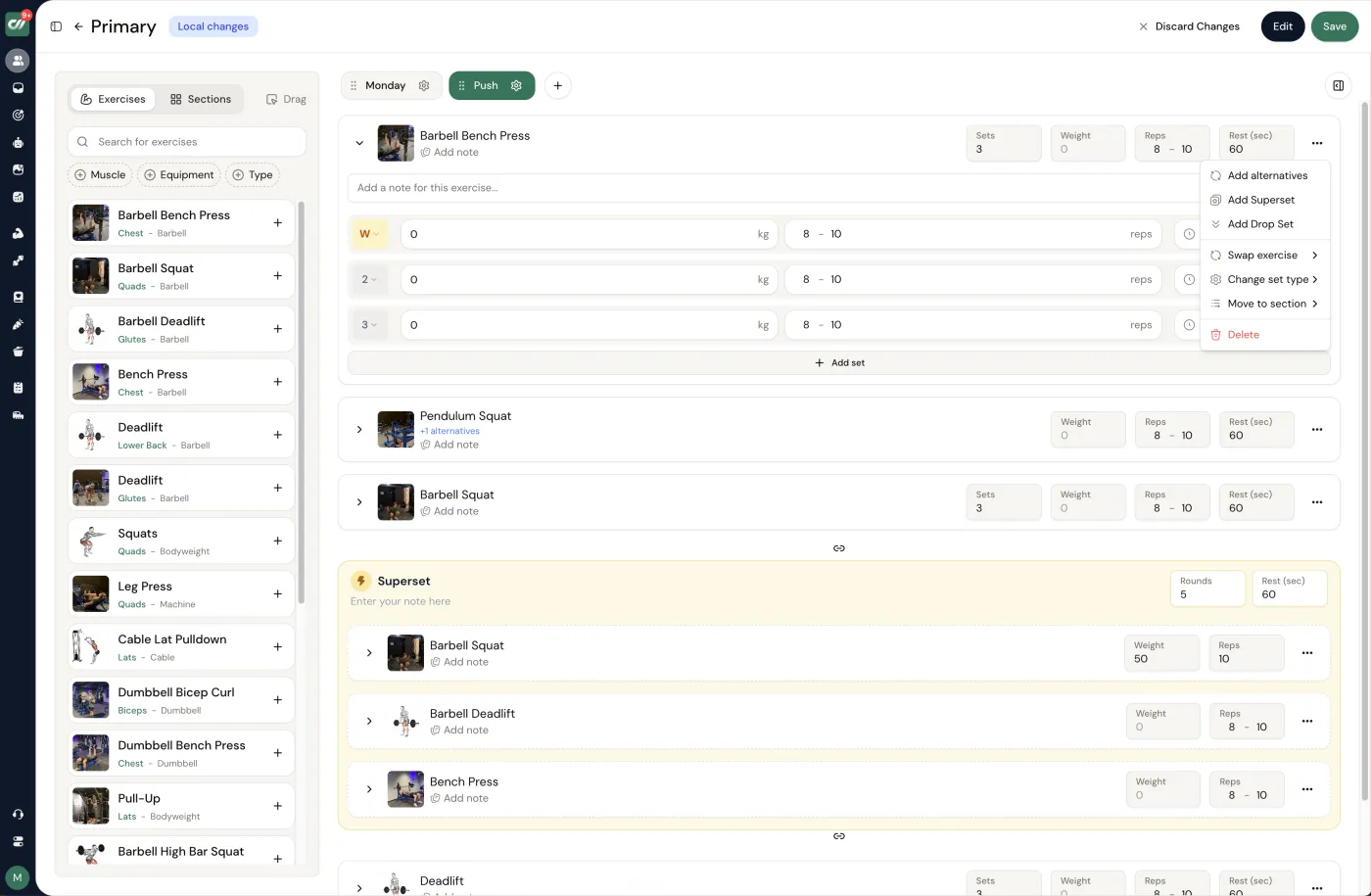
Turn the plan into something a buyer can actually follow on their phone: sessions, sets, reps, progressions and exercise video, in an order that makes sense on training day. A downloadable PDF or spreadsheet ships fastest for a first version, but it caps what you can charge and cannot be improved once it is sitting in someone's inbox. Building it in a proper workout builder lets you attach demos, swap exercises and update the program after launch without re-sending anything. Keep version one lean - you can deepen it once it is selling. The advice on writing a coaching program applies here, minus the individual tailoring.
3. Price it against your one-to-one offer.
Set a price that matches the depth: a template sits low, a multi-week program higher, a recurring subscription highest over time. Then decide where it sits relative to your full coaching, because that gap is the whole point. Kept clearly cheaper than one-to-one, the program becomes an on-ramp that feeds your coaching; priced too close to it, the program quietly competes with the offer that actually pays your bills. Think of the program as a rung on a value ladder: affordable enough to say yes to on a whim, structured enough to prove you are worth the step up.
4. Connect a checkout, then market it inside your funnel.
Wire up a payment method that drops the money into an account you control, so buying the program and receiving it are one smooth step rather than a manual handoff. The mechanics are covered in the guide to taking payments as an online coach. Then make the product findable: put it in your content, your bio, your email list and the natural follow-up to a discovery call that is not a fit for full coaching yet. A great program nobody can find sells nothing, so budget as much attention for distribution as you did for the build.
5. Plan the upkeep that keeps "low-touch" honest.
Low-touch is not no-touch. Buyers still ask questions, exercise links still break, and the occasional refund still lands. Budget a little time each week for support, updates and the unglamorous admin, because that maintenance is exactly what keeps the product good enough to keep selling and the reviews honest enough to help the next sale. This is also where a workout program can turn into recurring income: if the plan is working, a monthly follow-on block or a small community around it converts a one-time buyer into an ongoing one, which is the low-touch version of the passive-income products coaches build from their existing work.
A one-page template for packaging a workout plan as a product
Before you build anything, fill in these seven lines. They force the narrow, sellable version of the plan into words and double as the brief for your sales page. Copy the table into a note and answer each row in a single sentence.
| Line to fill in | What good looks like |
|---|---|
| Product name | Plain and specific, e.g. "8-Week Beginner Kettlebell Block" - not "Training Guide". |
| One buyer | The single person it is for, in one line, e.g. "busy parents new to lifting". |
| The promise | One honest outcome they can reach by finishing it. |
| Format & length | Template, multi-week program, or subscription - plus weeks and sessions per week. |
| What's inside | Sessions, sets and reps, exercise video demos, and how it progresses week to week. |
| Price & ladder gap | The number, and how clearly it sits below your one-to-one coaching. |
| Where it lives + checkout | The app or builder the buyer opens it in, and the account the payment lands in. |
Reusing an existing plan is the fast path. Start from a workout template you already run, cut it down to that one buyer, then rebuild it in a workout builder so it opens on a phone with video demos and progressions instead of as a flat file. That single move - proven plan, one buyer, real deliverable - is most of what separates a workout plan that sells online from one that stalls.
Where does the program live, and who takes the payment?
The two hard parts of selling a workout program are delivering it somewhere a buyer will actually follow it and getting paid without a platform standing between you and the money. When those live in different tools - a builder here, a checkout there, a spreadsheet tracking who paid - the product leaks time you were trying to save. In Coachway both run in one place. You build the program in a workout builder with more than 1,800 exercises, video demos and progressions, deliver it through the client app the buyer opens on iOS or Android, and take payment through your own Stripe account, which Coachway never holds. It is built on knowledge from working with 150 online coaches over 6+ years, and it costs EUR 69 a month including your first 5 clients, then EUR 9 per additional client - a flat software cost, not a cut of what your program earns. If you would rather see the builder and the client app before committing, book a demo. The 14-day free trial starts with a card and cancels under Billing before it renews.
How much of each sale do you actually keep?
This is where the platform you sell through matters more than most coaches expect, because the pricing model quietly decides how much of a growing product you get to keep. There are two structures. A flat, per-client software subscription charges the same whether your program sells ten copies or a thousand; it takes no share of the sale, so you keep the price minus your payment processor's own fee. A revenue-share platform takes a percentage of every transaction, which feels small on your first sale and turns into your largest line item once the product works. The more successful the program, the wider that gap grows, and it grows in the direction of the platform.
Coachway sits on the flat side. The subscription is priced per active client rather than as a cut of your revenue, and program payments settle in your own Stripe account, so the platform never sits between you and the buyer's money. The only percentage on the standard subscription is optional: route payments through Coachway's built-in system and a 2.4% fee applies per transaction; run your own Stripe checkout and there is no Coachway transaction fee at all. Klarna and SEPA are available as payment options if your buyers expect them. If you want to see the arithmetic at different client counts, the breakdown of per-client pricing versus revenue-share runs the numbers at 10, 30, 50 and 100 clients.
The honest takeaway is simple. Beyond a predictable flat software cost and your payment processor's ordinary fee, the money from a workout program you sell is yours, and it stays yours as the product scales. That is the practical case for treating program sales as their own tier rather than an afterthought: unlike your coaching hours, this line of income is not capped by your calendar, and unlike a percentage platform, it does not cost you more the better it does.
Frequently asked questions about selling workout programs online.
How do I sell workout programs online?
You turn one of your proven training plans into a product a buyer follows on their own, deliver it somewhere a phone can open it, take payment through a checkout you control, and put it in front of one clearly defined person. The sequence is package, deliver, price, sell. Start with a program you already run and trust, cut it down to a single format for a single buyer - a beginner kettlebell block for busy parents sells better than a vague training guide - then build it as a real deliverable with exercise videos and progressions rather than a flat PDF. Set a price that matches the depth and sits below your one-to-one coaching so it feeds that offer, connect a payment method that pays into your own account, and market it inside the content and audience you already have. The build is the hard part; once it exists, the same product sells many times.
What is the difference between selling a workout program and online coaching?
A sold workout program is low-touch: the buyer pays once (or on a light subscription) and follows the plan on their own, with little or no individual attention from you. Online coaching is high-touch: ongoing, personalised training and nutrition guidance with check-ins, messaging and adjustments built around one person. The program is a product you build once and sell many times; coaching is a service you deliver continuously to a capped number of clients. Most coaches run both, with the program as the affordable entry point on the ladder and one-to-one coaching as the premium tier the program leads people toward.
How much should I charge for a workout program online?
Price by depth and by where it sits on your ladder, not by what feels safe. A one-off template with no support sits low, a structured multi-week program with video and progressions sits higher, and a program delivered on a recurring subscription with light group support earns the most per buyer over time. The number that matters most is the gap between the program and your one-to-one price: keep the program clearly cheaper so it works as an on-ramp rather than a substitute for the coaching it should feed. There is no honest fixed figure, because earnings come down to how many people see it and how well it converts, so model it from your own audience size instead of someone else's screenshots.
Where do I deliver a workout program I sell online?
Deliver it somewhere a client opens on their phone and can actually follow, not as a static file they lose in their downloads. A coaching app or workout builder lets you attach exercise videos, sets, reps and progressions, swap exercises, and update the program after launch without re-sending anything. A downloadable PDF or spreadsheet is faster to ship for a first version, but it caps what you can charge and cannot be improved once it is in a buyer's inbox. The practical middle path is to build version one lean inside a builder that also handles the checkout, so buying and delivery are the same step.
How much of the money do I keep when I sell a workout program?
It depends on how the platform is priced. A flat, per-client software subscription takes no share of what a buyer pays you; you keep the sale minus your payment processor's fee. A revenue-share platform takes a percentage of every sale, so the more you sell the more it takes. On Coachway the subscription is per-client, not a cut of your revenue, and payments settle in your own Stripe account rather than the platform's. The only percentage on the standard subscription is an optional 2.4% fee if you route payments through Coachway's built-in system; running your own Stripe checkout carries no Coachway transaction fee. So beyond the flat software cost and the payment processor's own fee, the sale is yours.
A sold program is one rung on a bigger structure: it sits below your value ladder's coaching tier, it is the low-touch cousin of the wider passive-income products coaches build, and how much of it you keep comes down to per-client versus revenue-share pricing.
Keep reading
all guidesClient data privacy for online coaches: GDPR, consent, and storing progress photos safely (2026)
Online coaches hold sensitive health data and progress photos. A plain-language guide to consent, GDPR basics, secure storage, and what to do when a client asks for their data. General information, not legal advice.
Read the guideScope of practice for online coaches: when to refer out to a doctor, dietitian, or physio (2026)
Where a coach's job ends and a doctor, dietitian, or physio's begins. The boundaries of scope of practice, the red flags that mean refer out, and how to do it without losing the client. General information, not professional advice.
Read the guideHow to start and run a corporate wellness coaching business (2026)
Corporate wellness is the B2B side of coaching: companies pay you to coach their teams. How to package the offer, find and pitch decision-makers, price it, and deliver at scale.
Read the guideFree tools for this: No-Show Cost Calculator · Referral Value Calculator · Ad Spend Breakeven Calculator
Ready-made template: Workout Program Template
See what Coachway can do for your coaching business
Coachway was built on knowledge from working with 150 online coaches over 6+ years, who all hit the same wall - slow platforms, clunky workflows, wasted hours. Start your 14-day free trial and see what we fixed - the whole platform, no charge today, cancel anytime under Billing.


